
5 Steps to Validating Your Business Idea
A comprehensive guide with actionable guidelines to get you to launch.

Because I’ve had success in starting a business, one of the most common emails or messages I get is asking for my opinion on a business idea. The truth is, most of the time I don’t know. Sure, there are some ideas that just don’t make economic sense which can be struck off immediately, but almost always the answer is “I’m not sure, but I can find out if you want me to?”
I’m an idea’s man. I’m great at ideas. One of my goals for 2020, though, is to grow from being an ideas guy into an action guy — someone who my friends and colleagues refer to as “He’s the one who makes things happen”.
In the journey towards that goal, I decided to outline the actual process I go through to see whether the ideas which are constantly coming through my head are viable or not.
The intention is that by having a clear cut process, I can set apart some time in my week to make my way through the ever-growing list that I keep on Google Keep of potential ideas. By just sitting there, unattended, they take up a huge amount of bandwidth in my mind. I know if I can decide to either pursue or not, the mental baggage associated with what my brain see’s as missed opportunities can be dropped.
Step 1: Area of Interest
First, you need to figure out whether you are even qualified to be running a business in this industry or not.
You might think that this is short-sighted — Mark Zuckerberg definitely didn’t have any experience running a social media company before (the concept barely existed before the early versions of Facebook).
And you might also be right!
Hear me out though; by having the skills required, and even better — some experience — you’re making your life getting into the industry a whole lot easier. You’ll know what works and what doesn’t, likely have people you can contact for help, and know the ins-and-outs which will give you the competitive advantage over someone who has started blind.
This is not to say that it’s impossible to start completely new in an industry and forge yourself a successful business — some of the biggest companies in the world were started like this — it’s just that you can save yourself a lot of pain by operating in an industry that you know a bit about.
Some notes on this:
- Some industries are easier than others to break into without much knowledge: Blogging = easy. Specialized clothes manufacturing = not so easy.
- Some of the biggest and best companies in the world were founded off the back of no prior experience — its not impossible.
- The road to success without experience is much more difficult.
- Use your skills to guide you. If you’re a great writer and a bit of an introvert, starting a company that requires lots of sales pitching to prospects might not be for you, but one which requires great SEO could be.
Step 2: Market Size
Next, we need to figure out if there is anyone interested in what you’re creating.
This step in the process has evolved as search engines have become more popular. They are able to give a fairly accurate measure of interest in a certain topic because when someone wants to know about something, they search for it online.
There are a number of tools for getting search volume for certain keywords. The best free option is Google Ads. They have a ‘Planning’ section which helps you find things like:
- Estimated search volume,
- Cost-per-click,
- Number of clicks,
- Number of impressions
Here is an example: Let’s say I wanted to create a tool which builds business plans for entrepreneurs. My assumption is that anyone who would use a tool like this would be searching for either “Business plan generator” or “Business plan template” online*.
*This is obviously not very thorough, and just for example purposes. You’d want to develop a much more in-depth list of keywords and search terms.

From these forecasted results, you can get a gauge for the competition in the space (CPC) as well as the volume (Impressions) and conversion rate (CTR) for those specific keywords.
From these results, you can see it would be much better for me to frame my tool as a ‘Template’ rather than a ‘Generator’.
There’s also another part of Google Ads which helps you with your unit economics. Under the ‘Forecasts’ Tab within ‘Keyword Plan’, you will be able to put in a conversion rate value of conversion. This will help you gauge what sort of marketing spend you can expect for your product.
Let’s say we’re selling our business plan template for $15 (Equivalent of about R200, which is the currency my ad account runs on). We expect a conversion rate of 3% for every visitor who lands on our site. That means for every 100 people that land, 3 will buy. This is quite optimistic, but not unrealistic if your website is efficient at converting. These are the expected economics based on our keywords above:
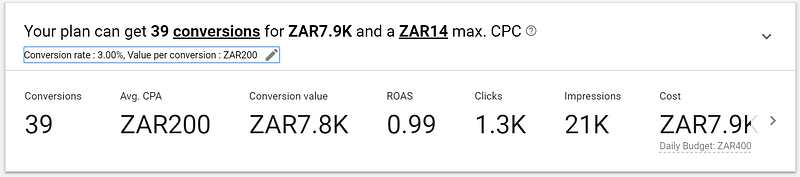
From this, we can see that the economics don’t work. Our return on ad spend (ROAS) is less than 1. That means we’re spending more than we’re making (as you can see, Cost = R7900, Conversion value = R7800), and that doesn’t even account for other expenses which we have to cater for.
Clearly, we need to target some different keywords or increase the price of our product.
There are lots of other tools which help you do this, almost all of them are paid. They’re mainly targeted at the SEO market, and so can get quite expensive. Here’s a list of options to consider:
- Ahrefs (probably the most popular option)
- SEMrush (My favorite option after using for 9 months or so)
- Mangools (Fairly basic, but the cheapest)
- Moz
Some Notes on This:
- Impressions are important, but CTR is too. There might be a lot of search volume for a certain term, but if the market isn’t converting on it, it’s likely your product won’t convert either.
- These are only estimates, there are ways to make Google Ads more efficient and less efficient too.
- Low CPC is great but beware of it being too low. This means there’s very little value placed on the keyword from competitors, which is normally a warning flag that what you’re doing is either revolutionary or won’t work. Normally the latter (unfortunately).
Step 3: Business Economics
This is sometimes a scary step for people who don’t see themselves as ‘numbers people’. The truth is, though, if you can’t handle the basic concepts behind what we’re about to go through, you shouldn’t be starting your own business.
The just of it is this:
You have to bring money into the business: Revenue.
You do this by selling a product: Cost of goods.
The difference between Revenue and Cost of goods = Gross Profit.
There are other indirect costs involved, too: Marketing, salaries, rent, etc.
You have to make sure you make enough Gross Profit to cover the other expenses involved in running your business.
What’s left after interest and tax deductions is your Net Profit. This can be re-invested in the business to help it grow.
Here’s a basic income statement to show you how it all goes together:
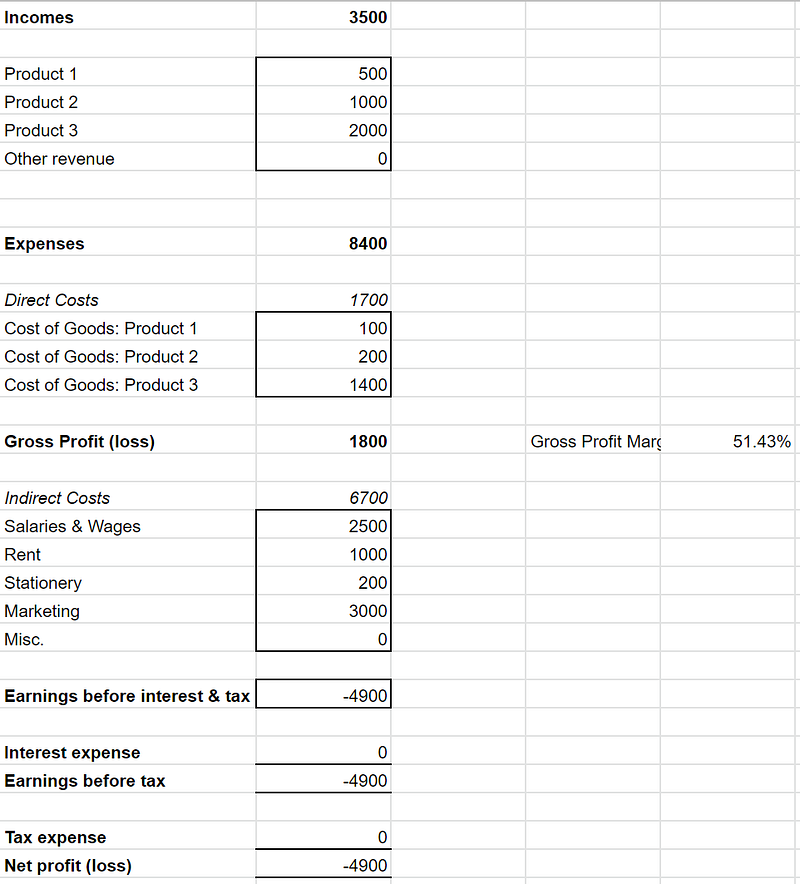
In your process of exploring your business idea, go through the economics of everything. Use Step 4, below, in conjunction with this tool to explore pricing and costing.
The way I go about it is this: Look at market-related prices and judge where on the value-scale your product is going to fit in. Is it a premium or budget product? Attach a provisional price to it.
Then, outline the costs of providing that product: both direct and indirect. Calculate your gross profit margin. Is it above 50%? If no, you’re likely either under-priced or your costs are too high. Iterate.
The 50% gross profit margin is just a figure I aim for. If you’re launching a lean business, like an online store using drop-shipping, your indirect costs are not going to be nearly as high as if you launch a brick-and-mortar where you have to pay salaries and wages. You’ll need a much higher GP margin to keep that business running. It’s all relevant.
Do this process for each product you plan to launch within your business and you’ll come to a price point that works.
Some notes on this:
- Keep your assumptions on the very conservative side. This applies to both sales numbers, as well as expenses. You will almost always sell less than you expect, and it will cost you more to do it.
- Iterate. If you find yourself getting stuck between market-related pricing and what you need to charge, you’ve probably run into a problem already. Alarm bells should be ringing.
- Start small. It’s tempting to cost for large order numbers — don’t. Let the economies of scale work in your favor once you’ve established your business and customer base. Rather increase your price and order smaller.
Step 4: Market Potential to Pay
Competitors
The first step in this process is to look at competitors. Do some research and find out what’s in the market, what they provide, and what they charge. SWOT analysis on each of these helps to identify gaps that you can fill, and how to price your product.
Identify their strengths, weaknesses, opportunities for growth, threats to success. Once you’ve done that for each of your competitors, you will have a more clear picture of where there is room for you to carve out your own niche in the industry.
Having a few competitors is good, it re-validates your assumption that your business idea is viable. Too many should be a warning flag that the market is saturated.
Pre-Sales
Here’s a sure way to establish market-pricing and demand: Sell your product before you have it.
For some businesses starting out, this is easier than others — because of the type of product. For example, An eBook = very easy to pre-sell. A complicated piece of clothing = not so easy.
For your eBook, you can create a quick mock-up of the title page, a table of contents with each section outlined and then a simple landing page. Then, drive traffic to the landing page with some paid ads. When people end up actually buying your product, you can either say to them “It’s not ready, would you like your money back”, or offer them a discount on any future purchases and thank them for their early support. Usually, a personalized email or phone call makes these customers more understanding. Once you’ve done this, though, it’s time to get cracking and get your product out the door.
Here’s a trick I used for a previous client which really helped him develop a valuable product for his audience. He was launching a how-to guide for business plans. I set up the pre-launch campaign for him and built the landing page with the aforementioned mockups. What made his campaign different though, is he reached out to every single one of the pre-purchase customers and asked for their input and help for features in the product. He effectively crowdsourced parts of his eBook. In so doing, he made sure he had created a valuable product that his target market wanted (and also an extremely loyal tribe of fans).
In our other example, a complicated pair of shorts made specifically for commuters, for example, it is much harder to sell them without the product in your hand. You need a prototype to be able to photograph and show off. Usually, if you have got that far down the line, you’re already committed and don’t need to be doing any pre-sell validation.
You can do this test across multiple landing pages, each with their own price point. You’ll know what your minimum threshold is because of your unit economics from the section above, so don’t bother going below that.
You’ll be surprised at what pricing works, and why you should never undervalue your product.
Key Takeaway: You have to make money. If you can’t beat your competitors on price, you need to show your customers why it’s worth more.
Step 5: Ability to Take to Market
This is the last step before you commit to your project, and you have to be honest with yourself. These questions will guide you to make the right call for both you, and the business you’re wanting to launch.
1: What do I want to achieve from starting this company?
Is it a side-hustle? Helping people? Diversifying your income? Growing a massive business that will make you millions?
Get clear on what you want early. This is going to drive your motivation.
2: How much bandwidth for a new business do I have right now?
What are your commitments? Family? Work? Health? Other projects?
Be realistic about how much time you can commit to this every week. What does the idea demand of you to make it a success? Is it something that can trickle along quietly, slowly growing momentum, or is it something you need to blast out quickly?
3: What is my timeline for achieving the goal mentioned in Q1?
Considering your time available to commit, is it a month? A year? 5 years? Does this suit the business model? What is the market like? Rapidly changing, or few disruptors?
4: What skills do I have that will make this business successful?
5: What skills don’t I have which this business needs?
How do you plan on tackling those hurdles? Do you have the money and/or time to overcome them?
6: What happens if I fail?
Do you grow any skills? What would you have learned? What are you left with? An email list? An asset? What is the cost of failure? What will that failure do to your life as a whole?
7: Is there a better way I could be spending the time I am going to commit to this project?
Think about every aspect of your life, and apply the 80/20 rule.
An endnote: Ideas should not be held sacred. The human brain is a powerful idea-generating machine. You can’t make anything out of an idea if you are fragile with them.
As in the image at the beginning of this piece; don’t protect them from the water. Throw them, splash them, dunk them. If they still come out burning — you’ve got a winner.