
NFTs, How-To, Funding, Community Building
Funding $2+ Million Projects via Generative NFTs — Launching Amazing Communities at Scale
Let me walk you through the proven process of raising millions in funding overnight. (Hint: Share with those who should know about generative NFTs.)
💡 I intend this article as a rapid-read, Q&A style, meant as an introduction to generative NFTs (as distinguished from normal, standalone NFTs). 💡
🙋Can a project really raise millions of dollars overnight via NFTs?
✅ Absolutely. Not only have thousands of NFT drops accomplished this, but I can personally attest to it, having been involved in numerous successful multi-million-dollar projects over the past year. My company did not adopt the slogan “We help mint millionaires!™” until this was literally true. And we’ve done it multiple times since. Although I’d qualify this with the note that these new “millionaires” all actually became the executives of successful well-funded projects. (We’ve actually long since updated that slogan to read simply “Web3 Tech & Strategy Experts”).
🙋What are “generative” NFTs?
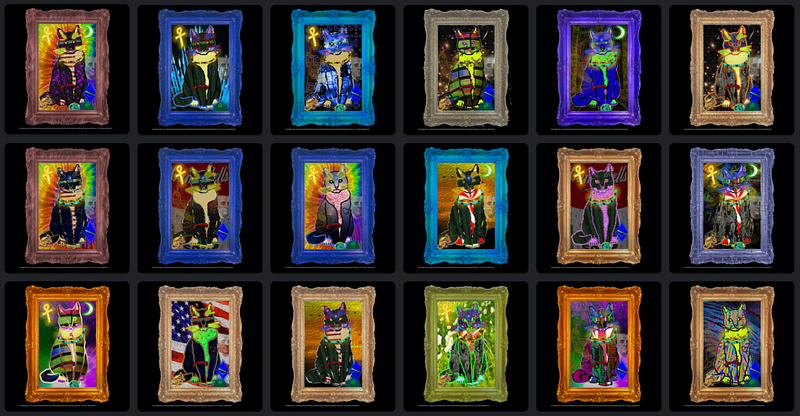
✅ A normal NFT (which many people have heard of) is just a digital asset, such as a JPG, that someone owns. Could be anything — a picture of your cat, for example. Generative NFTs, though, are different. Imagine that you’re drawing a cat, and that cat has a shirt, a necklace, a hat, and a background. Well, instead of an artist drawing one cat picture with these elements, she draws numerous examples of each of these parts—e.g., 10 fur colors, 10 shirts, 10 necklaces, 10 hats, and 10 backgrounds. And then a generative NFT coder (like Jim) takes those parts and writes a program to create thousands of unique combinations, saving each one as an individual, unique image. In this example, with just 50 elements, there would be 100,000 possible cat pictures! (In practice, an artist will typically create closer to 200 elements, at a minimum, and we usually create sets of 10,000.)
🙋And is it all cats?
✅ Oh, no! But, it’s typically animals or characters of some sort. The most famous generative NFT set is called the Bored Ape Yacht Club. Each ape NFT is currently worth about 100 ETH, which today (as ETH is valued very low!) is about $200,000 per ape! Have a look at the rankings on OpenSea for an indication of the kinds of animals and characters typically depicted. Most generative NFTs aren’t worth $200k each, of course! But, it’s fairly common for them to be many hundreds or thousands of dollars (or more, depending on the price of ETH at any given time). (Not all NFTs use ETH, but Ethereum is arguably the blockchain where the most NFTs “live.”)
🙋So you make up 10,000 character images, and then you sell all 10,000 online?
✅Yes, that’s the idea. (This is what my company helps NFT drop teams do. We program the generative art and accompanying data files, write the smart contract that facilitates all of the crypto sales and transfers, write the web application that facilitates purchasing using crypto currency, and guide teams through the tech and management aspects of the entire process.)
🙋And this raises how much capital?
✅About 800 ETH for a typical, average NFT drop (currently about $1 million, which is a gross figure and also keep in mind that ETH is currently in a major dip as of this writing; often it’s considerably more than $2 million). Of course, the gross sales for a drop also depend on the number of NFTs in the set (usually 10,000, but can vary) and the price each (typically about 0.07 to about 0.1, with higher values usually reflecting higher utility, which will be explained below).
🙋And then what? The NFT owners retire to the Bahamas?
✅Ha, no. I mean, there are actually few rules, technically. So, if that’s what you said you were going to do with the funds, and your buyers were somehow fine with that, then yes. But typically, generative NFT drops are meant as rapid launchpads for all sorts of real-life projects. And these could be anything — funding startups, game-building, funding nonprofit / charity organizations or initiatives, art projects, communities, music projects, or … the sky’s the limit. As long as you (1) use the funds for what you say you’re going to use the funds for, and (2) your buyers actually like what you’re going to do with the funds, then that’s what most buyers care most about when deciding whether to support you. Well, that and they generally like to have a nice attractive piece of unique, quality digital art to show for it as well — the nicer the better.
🙋But community is key, right? You put that in your headline after all.
✅Absolutely. While generative NFTs are an exciting, viable path to fast scaling and significant funding, I’ve found that the best projects are focused on building active, engaged, and positive communities. Really, this is what generative NFTs is all about at their core. If you can build a great community, then you’ve got a significant advantage in this space, and I would encourage you to look into generative NFTs for continued growth. [Special note: I realize that I’m posting this article about funding at a time when the crypto market is absolutely tanking, which seems ostensibly wrong. But, to me it underscores the absolute necessity for strong community-building as a part of the core utility of NFTs. It is these types of communities that will survive and thrive in the space. But, in the immediate moment, many prices and values are down significantly, which does have a trickle-down effect on the NFT space, though that’s another discussion.]
🙋Are generative NFT sets better than just one-off art?
✅They’re not better. They’re just different, and they generally have different applications and utility. If you want to create and sell one-of-a-kind digital art, then that’s amazing. A lot of NFT collectors are really into this. (They call this “1/1 digital art” — which means “one of one” or unique. More NFT terminology here.) But if you have a vision for a new community, larger project, or initiative that requires significant funding and can provide some benefit to those who buy, then generative NFTs are an excellent option.
🙋What do you mean by “provide some benefit to those who buy”?
✅Ahh, yes, I mean utility, which is a general term for various benefits, uses, and amenities available to NFT holders. I recommend reading this article on NFT roadmaps for a more thorough treatment of this topic.
🙋So, how do I find buyers for 10,000 NFTs?
✅Well, yeah, that’s the trick, isn’t it? With the financial potential offered by generative NFTs, everyone wants to hop onto the generative NFT train these days. But there are only so many people who will pony up, say, $200+ for a cat picture. As you may imagine, much of the success of a generative NFT project lies in marketing. This can happen in many ways, depending on various factors or specifics. If you’ve got leverage — meaning you’re a known brand or celebrity or influencer with a built-in audience, then it’s considerably easier than if not. But that said, anyone can enter the space and begin marketing. The better your art, the better your project, the better your growing community, the better your marketing … the better your success in getting off the ground. Marketing is a whole specialty in the NFT space. In any case, it’s always a critical part of the conversation when planning a generative drop.
🙋Why do most buyers buy in?
✅They buy in because they’re excited about the project. They could be fans of the team or brand or celebrity behind the project; they could love the artwork samples they’ve seen; they could love the roadmap / proposed utility of the NFTs; they could love the community they’ve found in your project’s social community; they could believe that the NFT will rise in value and thus are essentially investing; they could be “flippers” looking to quickly make some money by buying and then quickly selling for a profit; or, among many other reasons still, they could just love the whole game.
🙋What do you mean by “game”? Is there something more to all of this?
✅Yes, much more! You see, when we create the set of 10,000 NFT images from all of those separate parts, we don’t just do so purely at random. Instead, we have the computer select the parts based on what’s called a rarity table. If you’re not familiar with that, recall how I said that the cat could have 10 different shirts. Well, you’d think that means that each shirt has a 10% chance of coming up each time, right? But that’s no fun. So, what we do instead is assign a percentage to them. Some items might come up only 1% of the time, while others might come up, say, 15% of the time. This article explains rarity tables. When we run 10,000 this way, with each item having a set rarity, it creates all sorts of interesting things, with some NFTs containing mostly common elements and other NFTs containing rare items, and sometimes multiple rare items on the same image. When it’s all said and done, bots usually rank the NFTs from 1 to 10,000 according to their rarity, with the rarest ones selling for much more.
🙋But, I thought they all sell for the same amount?
✅Yes, when people first buy them, that’s correct. When people mint NFTs from a generative set, they do so not knowing what NFT they will get. It’s like purchasing a single collectible sports card — each with the same outer packaging (which is called the “prereveal image” by the way) and, only at some point later on, usually after the mint is complete, are all of the “wrappers” removed. This is called the “reveal” process — here’s an article about that — and it allows the NFTs to be seen, and thus this is the point at which buyers can finally see what specific NFT they got. Some will be common, some will be rare, and some will be super-rare.
🙋And so all of those are able to be sold again for more?
✅Yes, that’s where “secondary marketplaces” come into play. The largest one is called OpenSea → https://opensea.io/. On a marketplace web site, you can pull up a given collection and view the NFTs. So, all 10,000 cats (provided they all sold) would be shown here on a collection page. In the “prereveal” stage, all of the NFTs would look the same because, at that point, it’s like looking at 10,000 baseball card wrappers — all of them the same on the outside. Even at this “prereveal” stage, people can and do buy and sell NFTs in a set. But afterward, once all of the rares are identified, the rarest ones will become the highest-priced. Keep in mind, by the way that revenues for the NFT team are not solely from the primary sale. Any sales that happen on secondary markets can receive royalties. Typically, a generative NFT set will have royalties from 5 to 7.5%, though I’ve see it go as low as 2.5% and as high as 10%. This means that, for each sale from one NFT holder to another, the NFT owner wallet will receive that share. This is why, if a set becomes popular and valuable, the revenues can really skyrocket over time, often to more than the revenues of the initial minting.
🙋And what are the common ones worth?
✅The lowest price out of the 10,000 set is what’s called the floor price. This is the cheapest price at which anyone can purchase one of the NFTs in the set. Some people measure success by the floor price of a set. Certainly if the floor price is above the mint price, then every single person who minted has seen the value of their NFTs increase. Sometimes this can be dramatic. If an NFT mints for 0.08 ETH, for example, and the floor price goes to 0.24 ETH, then each person who minted has realized a 300% profit at that point (well, if they were to sell). But again, that’s just the floor price. Usually, there aren’t terribly many listed at the floor price. And those rares could be tens or hundreds of times more pricey than the floor ones. Not to mention the “super rare 1/1s.”
🙋“1/1s”? But, I thought these were 100% generated?
✅Well yes, usually almost all of them are generated. But, almost always, the teams will sneak 1/1 artwork into the set, meant as ultimate prizes. Here’s an article about how those work. Sometimes these are just single items, such as a shirt that the cat wears just once in 10,000. Other times, it’s completely separate art by the main artist — e.g., a special cat in the artist’s style that fits in with the set stylistically but is clearly not generated. These are usually considered the ultimate prizes of any collection and, if offered for sale, will fetch crazy-ridiculous prices.
🙋Cool! I’ve got an idea for a generative NFT drop. How many people does it take to do an NFT drop? How do I build a team?
✅ “It takes a village,” as they say. You need a talented artist, of course, and sometimes investors, marketers, advisors, project managers, a social media team, a tech partner, and perhaps even others. Here’s an article on that part.
🙋What if I’m a celeb or influencer, like the idea of NFTs, but don’t yet have a team or a plan?
✅ I would advise reading the article linked to just above for starters. But (shameless self-promotion here) shepherding people through the NFT space is exactly what my company, GenerativeNFTs.io, does. We can help you build out a team, manage the project from start to maturity, provide guidance on all tangential issues required, tackle the complete tech end of things, and utilize our experience to share information that can help your project become much more robust and rewarding. So one possible easy button is to just email me → [email protected] 😊


