
Frozen Words, Unspoken Hearts
Uncomfortably Numb Amid Walls and Derelict Fields
They talked on the phone every day, but not for long. Andrew didn’t have a telephone in his flat yet. He’d just moved in, so he called her from a booth on the street or in the underground. Besides, they were still just strangers who wanted to get to know each other. They didn’t have yet the means to sustain a few moments on the telephone without saying a word, on the basis of a shared past.
Their conversation relied only on the facts they had to tell each other, which were pretty soon through: he would ask her how she was, she would answer “Fine.”
He would insist, “What were you doing?”
She would answer, then Andrew would tell her where he was, on his way home or in front of the block of flats. He would also tell her he missed her, she would reply “So do I,” which sounded unnatural to her, as it had been prompted by his statement and was not a statement in its own right.
She mentioned that to him one day and he wondered, “Why does it sound to you unnatural?” Under the pressure of what his exclamation implied, that is, that maybe it felt unnatural because she didn’t actually mean it, she kept quiet, confused, uneasy, too embarrassed by his suspicion to be able to explain herself.
Very often the telephones didn’t work properly and she could only hear him faintly, which added to the strain of understanding his funny, kiddish way of pronouncing the words. The strain made her feel tense and talk very little, which prompted him to keep poking with questions about anything new she had to tell him. Sometimes there was an implicit complaint that she wouldn’t find anything to say, which made her start searching feverishly for some story to tell, but in vain. That is why such conversations usually left her with a somewhat bitter taste. They would look forward to these weekend dates, hoping that face-to-face they might be more natural and closer to each other than on the phone.
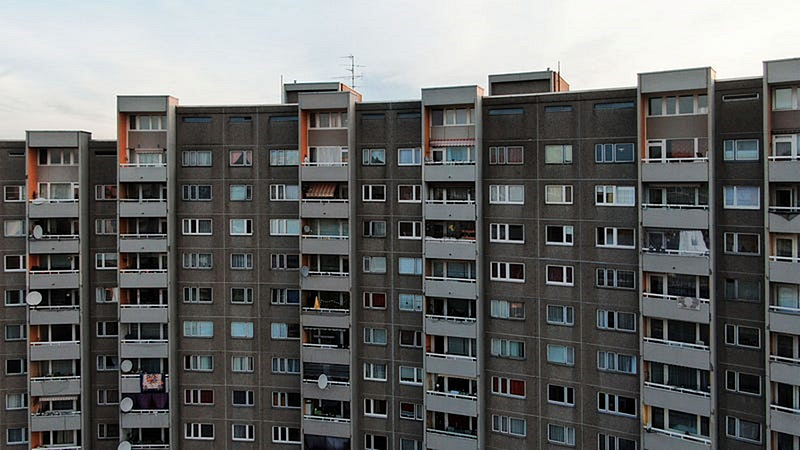
They would always go to his place. The way there had seemed to her long and complicated, but she remembered that his block of flats was on the edge of the town. From his windows, you could see no other windows or walls, only very far in the distance, another district, with a bare derelict field in between. When she was there for the first time, she looked at the field and Andrew had exclaimed with excitement, “I love it here! We’re in the last block of flats, on the last floor, in the last flat! It’s going to be so beautiful here in spring when these bushes are going to be green!”
He had then shown her the flat, which looked like a hangar, large and empty, as his parents hadn’t moved in yet. Andrew explained that the building had just been finished and had no heating yet, so he was living there alone, alone in the last block of flats on the last floor and in the last flat. It was only the living room that was more or less furnished, or so at least she remembered. His study room had an armchair, a desk, a miniature TV set, a magnetic tape recorder, and some ashtrays. In his bedroom, there was just a bed, with large cardboard boxes, brushes, newspapers, and rags littering the whole place. She had left her overcoat on a chair, and on stepping forward, she had heard her footsteps on the bare floor.
He kept asking her if she was cold, adding that he’d got used to it. His questions distracted her from feeling cold, even though there was an icy draught puffed in by the chilly early March. She’d smile and answer she was fine and keep on quiet, cringing to herself with the cold and the silence of that place. To fill this silence of the place and maybe hers too, Andrew had played music. Some guy called Waters.
The guy started then whispering about the flags of impossible pasts, which were now lying in chains and rags; about derelict sidings where poppies entwined and where cattle trucks were waiting for the next time. Then she could hear the faint voice of someone behind a wall, wailing, again and again, feeling cold, feeling lonelier and older all the time, but screaming on, hey you don’t give up without a fight! and he wailed won’t you help me carry my weight?
Then there was an ocean of sounds and nobody was saying anything, the sounds were just flowing amid asteroids gone mad with the void, amid giants that could barely carry their emptiness. And in this flow, the music picked up the song of each sphere, songs of loneliness, for though the endless space is full of shapes of all kinds, between them there flow rivers of loneliness. Now and then the shapes will collide, they scratch for an instant each other’s crust, and then they drift on, further and further apart, never to find each other again in this vast ocean of bodies and this infinite of probabilities.
In an empty flat on the edge of the field, she was receiving these codes coming from nowhere, like messages in empty bottles hurled desperately into the universe.
She suddenly heard Andrew’s repeated questions.
“What are you thinking about, Lili, please tell me, what are you thinking about?”
She gazed at him slightly intrigued by the sudden distance between herself and Andrew’s pleading as if they were on either bank of a river of solitude. She even seemed to hear how her tune and his were melting into that sad song on his tape.
She stared at him without answering while the music flowed on — and what could she possibly answer?, for she herself couldn’t understand what was going on. She too wished she could tear herself away from that frozenness and cuddle in his arms, but the music dripped on, endless, keeping her locked within its sounds.
Slowly, she could hear his words and see his eyes get closer and closer, although the music was still there in the background. She could see that Andrew seemed to be like her, a prisoner, she could hear him saying sad things and she wondered what they had to do with the two of them. She then saw him trying hard to smile and pursing his lips in resignation and then she wished her own smile could be full and true, only to make him smile truly too.
Usually, they would then change the subject to something more factual that was easier to deal with. He almost managed to put on a cheerful face, like a kid that is trying to come to terms with what he has if he can’t have more, which was making her even sadder. She wished again she could work wonders while he would watch her amazed as she was turning that box into a wardrobe and that newspaper into a carpet, filling his life with one wave of the hand and one word. Oh god, she would cry to herself, what was she supposed to do and say for this Andrew? What was the word and how was she supposed to wave her hand?
He walked through the flat, paraphrasing a familiar nursery song, his voice echoing against the walls, and the words, paraphrased or improvised by him, for all the gaiety of his joke, made her still sadder: “Nobody cares about me, nobody cares about me, nobody cares about me…” Then he came to her with a piece of cake and told her, “Here, if you won’t have it, I’ll sing again that nobody cares about me.” And then she would have the cake, even if she didn’t like it, only to stop him from singing again.
She would come to herself only back home, sometimes a few days later and it was only then that she would have been able to say something to him. Not being with him, she would try to write. She would do her best to scrutinize herself and articulate something, but the result sounded phony, besides the true meaning that she failed to capture.
She had once said, quoting her favourite writer, that writing helped her think. Everything would settle down and become more meaningful on paper. Except that the doors wouldn’t open now and she would go on peeping through the keyhole in an attempt to see something. The pen would put to paper only stereotypes that had no connection with the truth within her.
So what? The question would gush out from between her unconvincing and too-elaborate lines.