
From Mental Illness to Wellness
A personal account that I hope will help others.
I had a mental breakdown.
I didn’t know it at the time but with the benefit of hindsight, I can see it now.
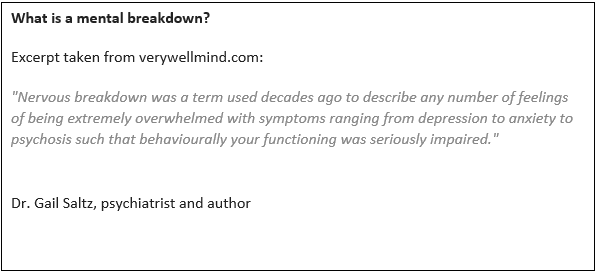
The term “mental (or nervous) breakdown” is bandied around and we, as a society, think that we know what it means. It’s only when we (or a loved one) personally experience it that true understanding dawns. I’m not a fan of those words but I have used them for clarity as it is a commonly recognised umbrella term. We have seen exaggerated scenes on television or films of someone suffering a mental breakdown, hugging their knees and rocking back and forth, or wildly throwing themselves against padded walls, restricted by a straitjacket. As with all illnesses, there are varying degrees. Yes, some people will be at the extreme end of the scale, but others (most people) will be somewhere in the middle. I was ignorant. My understanding of what a mental breakdown is (now) is different from what I would have thought six months ago. I had no idea of what I had suffered until I had emerged from it.
Lack of understanding from peers is part of the reason people struggle to talk about their mental health issues. It’s nobody’s fault, it’s just how it always was. It was the norm to keep it a secret. Nobody wanted to be considered mad/insane or thought of in any other negative light and this feeling is, I am sure, inherent in us all. Mental illness still has a stigma attached to it because of negative stereotypes that have not yet been shaken off, but it will happen one day. Things are better now than they ever have been thanks to the famous names and faces publicly talking about their mental health issues on social media. Mainstream discussion makes it easier for others to speak up. However, there is always room for improvement, and one day talking about mental health will be as common as comparing colds.
One day talking about mental health will be as common as comparing colds.
Remember…not everyone will understand what you are going through. Don’t resent them. Those who don’t understand probably just don’t know what to say. However, never underestimate the power of your support network. Even just being with family or friends and going for a walk, having a cup of tea, and chatting about mundane things like the weather can help. If you cannot go out, join an online group or forum. Connection is key.
A Brief History of My Mental Health Turbulence
2018
I paid little attention to what was going on upstairs. I had always had little niggles — thought I might like to be happier, have a little more oomph, I felt anxious in certain situations (mainly social) — but nothing that concerned me too much. Then in 2018, I had a manager who was powered by stress. He dealt with his stress by passing it on. He micro-managed where it wasn’t required and piled on pressure. He was extremely analytical (again, unnecessarily) which caused delays, accumulated queries, and pitted colleagues against each other. Add to this the difficulties of training a temporary member of staff and being short of other key members of staff and it was a thoroughly unpleasant situation to be in.
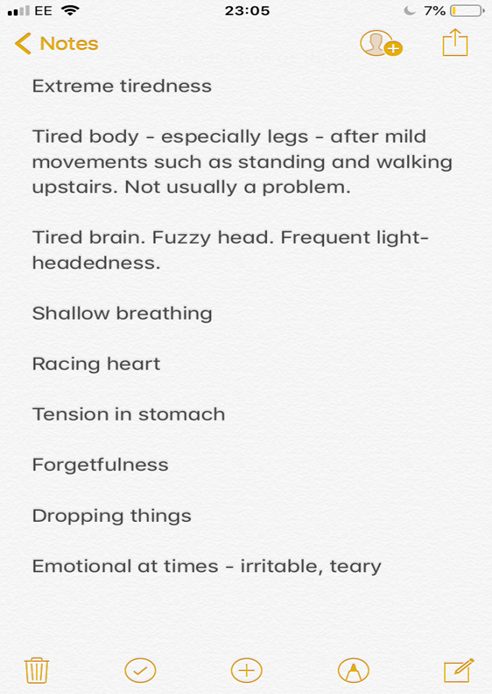
The pressure lasted months. I became exhausted. I remember describing my brain as a dried-out sponge. I felt like I was physically aware of my brain. It probably sounds like a bizarre thing to say but it was like there was a foreign object rattling around in my skull. I was exhausted climbing the stairs at home (there are only 14 and I was otherwise physically fit) and I had a constant tightness across my chest. I felt I was ready to crack up. One day I snapped at my manager and walked out of his office before he could see the tears welling up. He eased off after that, probably worried I would complain to HR. He had racked up several complaints in his first outing as manager years ago. This was his second chance. Then, it started all over again. For weeks I had been asking him to help with a query I had with a supplier invoice. I needed his input to be able to pass it for payment, but I was fobbed off because he never wanted to help. Then, when I was finishing up for a holiday, he chased me out to my car. He called on me repeatedly. I tried to ignore him. I had reached my limit. But he kept calling as he ran over to me. He said he wanted to resolve the issue before I left for my holiday. He implied I should go back into the office. l think he could see the thunder in my eyes, so he backed off and wished me a good holiday instead. He had had weeks to help, and it had never seemed so important to him as it did when I was leaving. The holiday (my friend’s hen weekend in Benidorm) was timely. A week off work was enough respite in this instance.
Somewhere in the midst of all that, I had visited a doctor (with a list of my symptoms — see photograph below) and was told that I had stress-related anxiety. I was referred to Moodjuice (an NHS website) and Calm — the meditation app — but used neither. Things improved naturally. Or, perhaps I just buried it again. The manager in question was made redundant and I had a new boss — one with a more laid-back management style who didn’t want any trouble or stress for anyone. As long as the work was done each day, she was happy. It was good to relax in my work environment for a change. There had been years of managerial changes, restructures, and general turbulence, and yet somehow, I always stuck it out. I’ve learned that sticking isn’t always good. But, as with all good lessons, they are learned the hard way.
May to September 2019
It had been quiet at work for weeks, possibly even months. I commented to my work friends that if it didn’t pick up, I would have to look for another job. Never for one moment did I suspect that the next day my manager would call a meeting. She told us that upper management wanted to trim the admin staff numbers from three to two. Before the words even left her mouth, I knew what she was going to say, and I knew that I wanted to go. Only the day before, I was saying I would go if things didn’t improve. I should (and would) be true to my word. We entered a consultancy period which was expected to last weeks. It was a stressful time as we knew that one of us would have to go. The team, as we knew it, would be broken up. We discussed it in the kitchen while the kettle boiled. The others didn’t want to leave. I did. I saw it as a positive outcome — I would be leaving through choice. It would mean my friends could stay and not have to worry about losing their jobs, and also that my manager wouldn’t have to make a difficult decision and deliver awful news to one of us. Win-win. But we still had weeks of waiting between my request being approved and my redundancy package being put together, and it brought out incredible stress and anxiety, much greater than anything I had felt before. It was such a negative place to be in — both in location (at work) and mentally. I thought my decision would make things easier, but it didn’t. I just wanted it all to be over. It couldn’t come quickly enough but when I got my freedom, I didn’t feel free.
I left my job of nearly 8 years on 14 June. My friends had organised gifts and a Japanese lunch. My card contained lovely sentiments and messages of support for the future. I felt nothing but warmth and gratitude towards these people and for the experience I had gained in my time with the company. I knew that the experience and my positive attitude would stand me in good stead for wherever I would end up next and I had confidence in myself. I felt buoyed by their farewells and was excited about the future — until it was actually time to leave and then I started to deflate. I said goodbye to my friends privately in reception and we all cried. I hadn’t expected it to be so hard. I had been so certain about my decision. I walked out of the main door and made my way to my car where I sat and cried again. It took me two hours to get home that day instead of the usual 40 minutes. The tears just wouldn’t stop. I cried most of the evening too. For the first time ever, I was unemployed.
I woke up the next morning with no real plan of what to do next. I could take part of the summer off with the kids. But that wouldn’t work because when I’d be looking to go back to work, we’d have a holiday (already paid for) to factor in. Ok then, I could take the whole of the summer off. Why not? When had I ever had the chance to do that? But I couldn’t relax. I was constantly on edge feeling that there was something I should be doing. I woke each morning with a churning stomach. I should be in the car on the way to work, I would think. But to go where? I had no job. Then, I would beat myself up because I had made that decision. I had no right to feel that way. I did it to myself. Then, I would feel awful for dousing myself with blame. It could have been a lot worse. If I hadn’t volunteered, it could have dragged on for a lot longer and been worse for everyone. Still, I couldn’t shake the feeling that I should be doing something big. Something important. Something for myself for a change. Why not? I had the time, didn’t I?
At that time, I didn’t want to ever work for another company again. I held no resentment towards my ex-manager, ex-colleagues, or the company, but I had been badly bruised several times over the years and I had had enough. It was time to do something for myself. Why not start a business? I could get paid to read and write — two things I love — by offering proofreading services, copyediting, and copywriting. What a great idea! I couldn’t sleep properly, I could barely eat, my stomach was churning so badly each day that I was shitting bile and I couldn’t get through the day without spontaneously crying several times but yes, by all means, it was a great time to make a major life-changing decision. What could go wrong?
Well, technically nothing did go wrong because I didn’t get it off the ground before I came to my senses. It was adding to my stress, not reducing it.
It’s not the best idea to make big decisions when you have been through psychological trauma.
My priority should have been to concentrate on my health, to look after myself properly so that I could enjoy the holidays with the kids, but I was in the perpetual stage of self-torture. Overall, I was off for around ten weeks, seven of these with the children. I had a lot of joy during this time, but it was undoubtedly marred by the black cloud hanging over me. However, I can’t help thinking, would it have been a lot worse if my craving to be alone had been fulfilled? Would I have been free to torture myself more if I hadn’t had the children in the house? What if I couldn’t go outside and enjoy some fresh air? What if I hadn’t had my mum and dad to go walking with? What if I couldn’t meet up with friends? What if I hadn’t gone away for a week to the beautiful island of Mull with my husband and the kids? Would I have festered even more? Things can always be worse. These simple things stopped me from disappearing completely because believe me, I felt I was fading more and more each day and if it had continued in that vein, there would have been none of Me left.
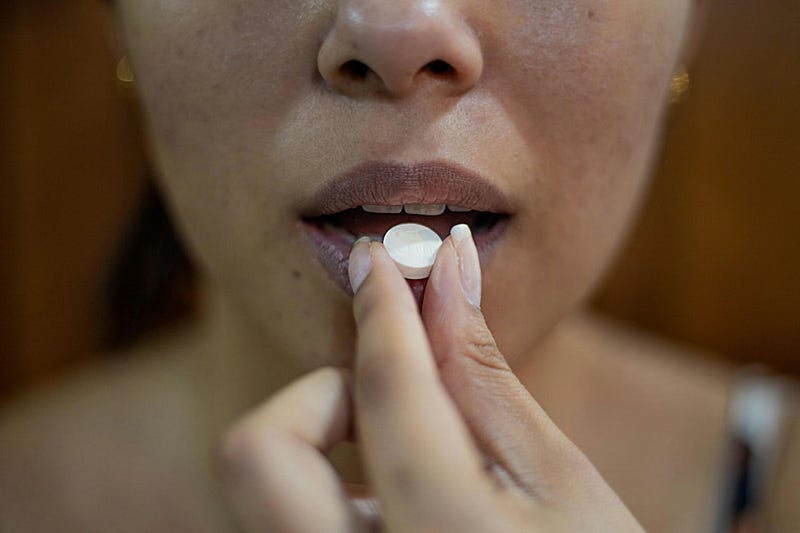
Again, I made a doctor’s appointment. Only this time, I cited stomach issues. It’s funny, I had symptoms that I knew were probably stress and anxiety-related, but it was the constant defecating that I thought I’d go and see about. I couldn’t bring myself to tell the receptionist that it was mental health-related when I made the appointment, so I opted for one of the physical symptoms. She told me that there was no need to see a doctor, a nurse practitioner could help. The nurse called my name. I sat down and I was armed with a piece of paper detailing my symptoms because I wasn’t sure I would be able to say it out loud without breaking down. I was right. I barely spoke three words before bursting into tears. The nurse practitioner knew immediately that she was not dealing with a mere stomach bug. She was very supportive, read over my list, let me cry it out, and then asked relevant questions to allow her to complete the diagnosis. She wrapped a cuff around my arm and the numbers showed my blood pressure was up. She prescribed Propanolol, saying that it would give me a break from the physical symptoms which would stop me worrying and perpetuating the problem. It would give me peace of mind and I would be able to see things more clearly. I was concerned I would be taking addictive drugs, but she assured me that it was a type of beta blocker, not an anti-depressant. I could stop taking them at any time. I had to wait 15 minutes for the prescription to be made up, so I walked around the town. Crying. The smell of hash wafted from someone’s window and I vaguely wondered if that would do the trick just as well. I collected the prescription and made the short drive home (five minutes) and took the first tablet as soon as I reached my kitchen. I felt slightly spaced out, but it seemed to be a one-off sensation. The medication got to work reducing the physical symptoms. I would have to consciously work on my mental health.
I had a follow-up appointment two weeks later. I cried a lot less, but it was still difficult. I told the nurse practitioner my stomach and appetite were still not right. She felt my stomach and listened in with a stethoscope (my stomach audibly gurgled each day) but did not seem concerned by what she heard. I did a pregnancy test to rule that possibility out then she gave me a repeat prescription for beta blockers. They did eventually make me feel better. I was improving every day: sleeping better, eating, and not using the toilet nearly so much. But it took time. Months of stress had gone into making me feel so bad. I knew I would need to give myself time to heal. The medication was taking care of the physical symptoms, but the mental issues were down to me. I had to start being kinder to my mind.
It’s like a switch flipped on. As much as routine can be boring, I needed it. I craved normality and for the first time in months, I realised I needed to get back to work. I had to find a job, resulting in stability and income. Still taking each day as it came, I started to apply for jobs.

I was invited to four interviews. Interview number one was terrible. For my first interview in years, I prepared as well as I could, given the fact that my brain was so fried that retaining information (about a company that I wasn’t sure I wanted to work for anyway) was near impossible. I was also away on holiday until the day before so had to try to prepare while I was away from home with my family. Not the easiest task. I think the interviewer made up her mind, probably before I gave a bad simulation of a phone conversation with a customer, that she didn’t want an administrator working in a call centre. From the outset, she told me that administrators prefer the routine of fixed hours and lunch breaks. She was right. I’m glad I didn’t get that job.
Interview number two — I was up all through the night vomiting. I don’t know if it was a bug, nerves I didn’t know that I had, or more gifts from my stress/anxiety/depression cocktail. However, the interview wasn’t until 4 pm. It gave me enough time to have a nap, put on layers of makeup, and go and give it my best shot. The interview was very laid back and I seemed to strike a rapport with the two interviewers. I had a good feeling about it. I didn’t get the job, but they did offer me a job three months later and I was in a position to decline.
Interview number three was an absolute shocker. I was interviewed by an elderly man and woman for a receptionist job. The man looked bored (before I even spoke) and did lots of shifting in his seat and sighing. I often gave short answers because I worried people wouldn’t be interested in what I had to say. As a result, my conversational skills suffered. However, on this occasion, I was glad of this habit because I dread to think how the man would have behaved had I said more. The office looked dated, the IT equipment was antiquated (I would also be expected to be a technician), and it seemed to be an old-fashioned way of working i.e. a boss who can’t send an e-mail on his own. I was asked if I had experience of using Facebook, as if it was some new cutting-edge software and not a social media site/app that has been around since 2004. I was in my thirties so of course I knew how to use Facebook. It was another job I was grateful not to get.
Interview number four — by this time, I was dreading another interview. Especially as I didn’t get the job I wanted (number two) and was fresh from a bad interview — a lucky escape. I had reams of notes that I had prepared for previous interviews so I read and attempted to memorise as much as I could. I applied for the role via an agency and the agent told me that he expected the interview to be informal, just a chat about my CV. I was still physically and mentally exhausted but relaxed. I had given up having any expectations. I knew I needed to get a job, but I knew I had to stop torturing myself or it would be a lot harder. I listened to a hypnotic track about confidence before getting ready then I dressed for success and left, listening and singing along to ABBA on the way there. My mood was level when I arrived, and I didn’t give off any nerves. Cool as a cucumber. I surprised myself. I confidently answered when questioned about items on my CV and was just myself. I didn’t put on an act to impress anyone. I think that’s why I got the job.
From the moment I started, it felt good to have a routine again. It was like I had a purpose rather than just sleepwalking into the days. I had a healthy mix of nerves and excitement at being the new girl, meeting new people, and learning new things. However, I knew I still had underlying confidence issues and in reality, it took me a few months to settle in properly. But I took each day as it came and continued to take steps to feel better.
For months, I couldn’t think of that period of my life without crying. I’m sorry for what that woman (a previous version of me) went through. I’m sorry but no longer sad because I can see that it had to happen. It was a pivotal moment.
You have to ride the rough to appreciate the smooth.
What helps to keep your mind healthy?
Routine
Maybe that’s a regular job, a university timetable, or as a stay-at-home parent you work around the school day. Whatever you commit to doing regularly, that’s your routine. It’s a steady structure that you can work around.
Novelty
Routine is important but so is novelty. What can you do that’s new and interesting? Pick a hobby, or as many hobbies as you like. Fun is underrated as an adult. We need to do different things to keep our neurons firing. Read, write, learn a language, play an instrument, sing, dance, bake, sew, draw, whatever. Pick something you enjoy and express yourself.
Patience
Be patient with yourself. Remember that recovery takes time. In my case, months of stress compounded to break me down. The reality is it took months for me to recover.
For months, I couldn’t think of that period of my life without crying. I’m sorry for what that woman (a previous version of me) went through. I’m sorry but no longer sad because I can see that it had to happen. It was a pivotal moment.
You will learn coping strategies and will bounce back faster next time.
Fresh air
Just go outside. Whether you are walking, sunbathing, or pulling weeds, fresh air is like a magic wand. Instant calm.
Exercise
Walk, run, do yoga, lift weights, dance…
Just move.
Physical movement can change your state. Get those endorphins pumping! Choose something you enjoy doing and your body will tell your mind you’re feeling better.
5 years later
I have never sunk to those depths again. I still feel stressed at times, it’s only natural in modern life, but I know myself better now. I know which coping strategies work for me and I can bounce back much quicker these days.
I hope my story will help anyone reading this who may be feeling low, or overwhelmed. I plan on writing more stories around this subject and will go into more detail about coping strategies. If anyone has anything to add, I’d be happy to hear it.
Life is hard. Let’s all help each other out!
Thanks For Reading
If you like my words, please give a clap or a few dozen.
Want to write for Peace, Love & Crappiness? Find out more here.


