
“Friends” at 25 (Part I): The One with the Analysis
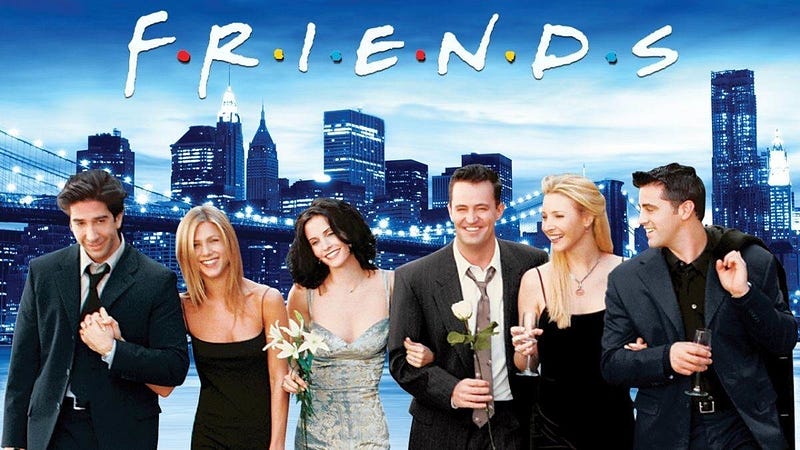
Author’s Note: This is the first part of a five-part series on the legacy of Friends as it reaches its silver anniversary. Click here for Part II, in which I delve into what the show meant to me personally. Click here for Part III, where I take a deep dive into the classic Thanksgiving episodes. Click here for Part IV, where I rank the 25 best episodes of the show’s run. Click here for Part V, where I rank the best acting performances on the series. For my recap of the reunion special that aired in 2021, click here.
25 Years After its Premiere, the Legacy of Friends is Still Hotly Debated
Next Sunday marks the silver anniversary of Friends, which aired its pilot episode as part of NBC’s legendary Thursday night lineup on September 22, 1994. The wildly popular sitcom ran for 10 highly rated and culturally impactful seasons and exited with a series finale that remains one of the most watched entertainment broadcasts in television history.
Despite its popularity, Friends was divisive among television viewers even when it was on the air. There were many who found the cynical absurdism of Seinfeld and the high brow wit of Frasier to be infinitely superior. And certainly there were large swaths of people who rejected the white-washed, laugh track-assisted, heteronormativity of all those shows and their ilk (although admittedly I had no exposure to such people growing up in a mostly white suburb in the pre-Internet era).
Recently, I haven noticed the emergence of a new subgroup that I find a bit troubling. These are the people who loved Friends when it aired and still love Friends now but now show their love in an ironic, self-deprecating way because they believe their fandom is shameful. This likely stems from the avalanche of Friends critiques that was unleashed in the wake of the entire series becoming available on Netflix on January 1, 2015 (and thus becoming infinitely more accessible for careful rewatching). Articles reanalyzing and disparaging Friends seemed to come out weekly, which paradoxically only underscored the cultural relevance of a series that had already been off the air for more than a decade.
Below, I look at two indisputable facts about Friends followed by a host of disparaging claims about Friends that at worst are grossly inaccurate and at best fail to take into consideration what the state of the television industry was a quarter century ago.
Two Indisputable Facts about Friends
Indisputable Fact #1: Friends was — and remains — one of the most popular television series of all time.
In its premiere season, Friends was the 8th most watched show on primetime television. In its 2nd season, it jumped into the Top 5 where it remained for the entire remaining 9 years of its run. No primetime comedy series has ever been that consistently popular for such a long run. Not a single one. Classics like M*A*S*H, All in the Family, Seinfeld, and Cheers took some time to find their legions of fans while out-of-the-box smashes like The Cosby Show, The Golden Girls, and Roseanne dealt with dwindling numbers in their final seasons.
It peaked as the #1 most watched show during the 2001–2002 season (its 8th). That season, which premiered just 2 weeks after the September 11th terrorist attacks, was an unexpected comeback critically and commercially for the series as it rose 24% in the ratings over the prior season and won the show its first and only Emmy for Outstanding Comedy Series. Although Season 8 was a high point, every season averaged at least 20 million viewers (unheard of by today’s viewership standards). Friends also claims not one but two of the top 10 most watched episodes of a comedy series in television history — with over 52 million people watching the second season lead out from Super Bowl XXX (“The One After the Superbowl”) and the series finale (“The Last One”).
And Friends remains huge. It has been a top-rated series in syndication for the past two decades and Netflix reported that in 2018 it was their second most watched show overall with over 32.6 billion minutes being streamed. No matter what way you analyze it, there is no denying that Friends is one of the most popular television shows of all time.
Indisputable Fact #2: Friends had a massive impact on popular culture.
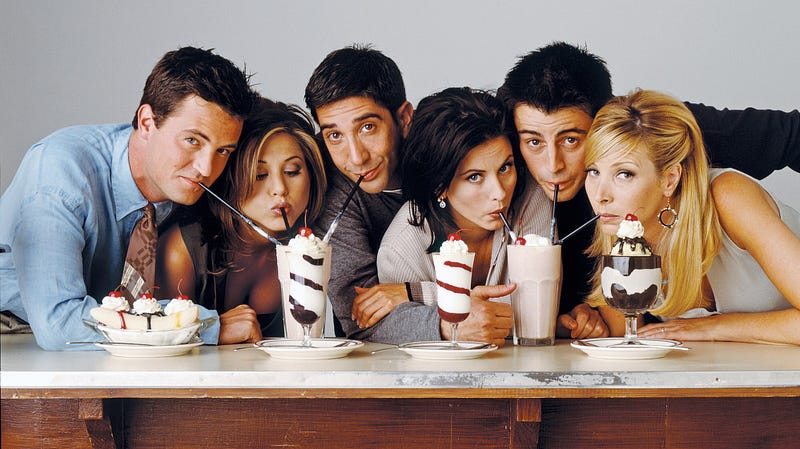
There’s also no denying that Friends had a massive influence on popular culture. The show burst onto the scene with six largely unknown actors and catapulted all of them into household names. They all went on to star in movies, follow-up series, or have big endorsement deals. The most famous and successful of them, Jennifer Aniston, continues to reside on the A-list.
The show produced a vast array of knockoff sitcoms about directionless and lusty twenty-somethings that were unavoidable on television in the late 1990s. It hastened the coffee house craze of the 1990s and to many it is still synonymous with it. It made millions off of merchandising with apparel, books, and posters. And seemingly everyone in 1995 wanted the haircut known as “The Rachel.”
Countless aspects of the show are permanently etched in pop culture. Talk about Ross and Rachel, “Smelly Cat,” and “We were on a break!” and the majority of people will be at least vaguely aware of it. The cliffhangers that capped each season finale were a constant discussion topic over the summer leading to big ratings for the season premieres. And I know many people that still get visibly upset when you remind them about Rachel and Joey’s brief romantic subplot.
Seemingly everyone in Hollywood wanted to be involved in Friends. The astonishing list of A-list guest stars the show worked in over its 10 years is mind boggling. The show featured guest appearances by 9 Oscar winning actors: George Clooney, Charlton Heston, Helen Hunt, Gary Oldman, Sean Penn, Julia Roberts, Susan Sarandon, Robin Williams, and Reese Witherspoon. Other notable guest stars included Jason Alexander, Christina Applegate, Hank Azaria, Alec Baldwin, Billy Crystal, Danny DeVito, Elliot Gould, Greg Kinnear, Brad Pitt, Tom Selleck, Kathleen Turner, and Jean-Claude Van Damme.
Nowhere is the show’s cultural impact more on display than at the Warner Bros. Studio Tour in Burbank, CA. The beloved tourist attraction showcases the highlights of the 96 years the studio is in business. The studio produced countless big screen masterpieces (e.g., enduring Best Picture winners like Casablanca and Ben-Hur) and blockbuster franchises (e.g., Batman, Harry Potter, the DC Comics extended cinematic universe), yet the tour culminates in the chance to sit on the original set of the Friends coffee house (the Central Perk) and re-enact a classic scene. And once you leave you get the chance to buy food and drink at the replica cafe and shop in the store, which includes a massive selection of Friends merchandise. Think about that: In 2019, a 1990s sitcom is still the main attraction for a nearly century-old, top-tier film studio.
Yet despite its popularity and impact (or perhaps because of it), people love to hate on Friends.
My Rebuttals to the Most Common Disparaging Claims Against Friends
Disparaging Claim #1: Friends had majorly messed up sexual and gender dynamics that make it “cringe-worthy” to watch in the present day.
Most of the commentaries disparaging Friends focused on the fact that the humor has aged poorly and most that make this argument cite outdated sexual and gender dynamics. These commentators cite the occasional gay panic humor, the fragile masculinity of the show’s men, and the portrayal of sexual and gender minorities. Sure, there is some humor that felt crass when it first aired and would definitely not sit well with the Twitterverse if aired today (like the fat jokes about Monica), but nevertheless these arguments have never convinced me that Friends was misogynistic, homophobic, or transphobic. Here’s why.
Exhibit A: The Women are Strong and Equal. Rachel, Monica, and Phoebe are fully equal members of the ensemble, which is in sharp contrast to many of the show’s contemporaries (e.g., Seinfeld, Frasier). The female characters are fully autonomous in their careers, powerful agents in their romantic relationships, treated as full equals by the male characters, and approach marriage and motherhood with an admirable mix of caution and commitment.
Exhibit B: The Men’s Fragile Masculinity is the Subject of Derision not Celebration. Ross and Chandler are extremely insecure in their masculinity (most egregiously displayed when Ross refuses to hire a male nanny for Emma and any time someone thinks Chandler is gay). Sure they get uncomfortably teased by the other characters for being soft or effeminate, but what is overlooked in this argument is that their fragile masculinity is the butt of the joke. It quickly becomes clear that Chandler’s use of humor is a defense mechanism against his intense fear of expressing vulnerability, Ross’s attempts to prove his manliness are off-putting, and Joey’s bed-hopping is soul-crushing. They are huge liabilities that each character needs to overcome to have any shot at a happy ending. In fact, becoming emotionally mature men is the arc of all the male characters.
Exhibit C: The show not only portrayed sexual and gender minorities, but also portrayed them positively. Ross’s ex-wife Carol’s decision to leave him for another woman at first felt like a provocative plot twist, but when viewers were introduced to the same-sex couple what they did not see was an offensive caricature or the butt of a joke, but rather a healthy, stable relationship between two strong women committed to marriage and motherhood. They even got married in a particularly memorable and controversial episode that aired at a time when there were no regular gay or lesbian characters on a primetime network comedy (this was 2 full years before Ellen DeGeneres came out of the closet).
Undoubtedly more problematic was the portrayal of Chandler’s cross-dressing father. The fact that his father ran off with the pool boy and started an all-male burlesque show was frequently used to explain why Chandler was so damaged and insecure. Although that may sounds horrific to a 2019 reader, there are several factors that should be considered. First, everyone on the show came from a dysfunctional family (Monica and Ross’s parents were hypercritical and played favorites, Joey’s parents were engaging in extramarital affairs, Rachel’s parents went through an exceedingly nasty divorce, and Phoebe was raised by a single mother who died by suicide). It was hardly presented as the case that Chandler’s family of origin was dysfunctional because of his father’s sexual and gender identity, it was just an aspect of it. And that becomes increasingly clear when we meet his mother, the boundary-averse romance novelist (played by Morgan Fairchild), and eventually his father (played by film legend Kathleen Turner). Much outrage has been piled on the decision to cast a cisgender actress as his father, but it is important to note that transgender rights and transgender representation in media are a long overdue but nevertheless recent phenomenon. The very fact that the show had a (presumably) transgender character that was eventually humanized and accepted could be viewed as a positive step toward inclusivity.
Disparaging Claim #2: The lack of racial diversity on Friends was unrealistic and offensive.
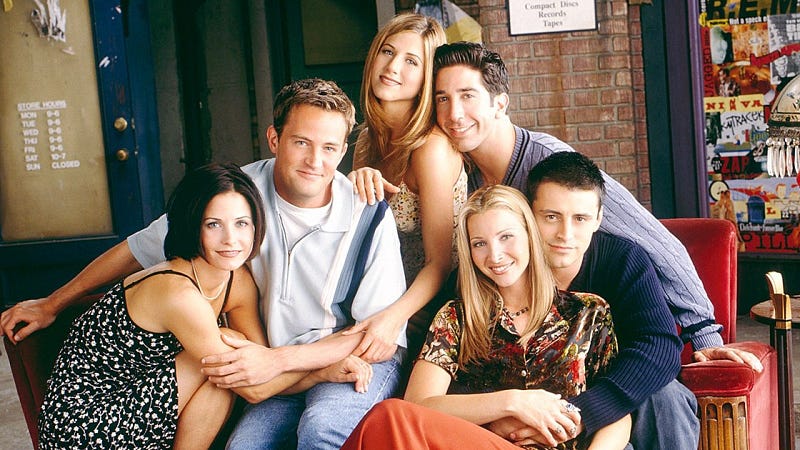
Other than Ross’s romances with a couple of women of color (most notably Aisha Tyler in the final two seasons), Friends was undoubtedly whitewashed. The homogeneity of the show was especially ridiculous when you consider that its setting was urban New York City in the 1990s. In many ways this is a valid criticism, but it overlooks an important contextual factor — network television as a whole was enormously segregated during this time period. Mixed-race ensembles barely existed with shows being either predominantly black (e.g., A Different World, Martin, Living Single) or all white. And of course, the all-white ones got more than their fair share of the acclaim. In fact, during the 10 years that Friends was on the air, a total of 13 series were nominated for the Primetime Emmy for Outstanding Comedy Series —Friends, Frasier, The Larry Sanders Show, Mad About You, Seinfeld, 3rd Rock From the Sun, Ally McBeal, Everybody Loves Raymond, Sex and the City, Will & Grace, Malcolm in the Middle, Curb Your Enthusiasm, and Arrested Development. Of these 13 series, only 2 had cast members of color and neither were in a lead role. These exceptions to the all-white ensembles were Penny Johnson Jerald, who routinely stole scenes as Larry Sanders’s assistant, and Lisa Nicole Carson and Lucy Liu, who were Ally McBeal’s confidante and nemesis, respectively. (One could argue that Shelley Morrison and JB Smoove became regulars at some point on Will & Grace and Curb Your Enthusiasm, respectively, but they definitely weren’t part of the core, original ensembles of those series).
Although this is technically a valid criticism, it reflected the state of television at the time and singling Friends out as a particularly egregious offender is illogical.
Disparaging Claim #3: Friends was anti-intellectual.
The most ridiculous take I have seen on Friends was that it contributed to the downfall of Western Civilization by mocking intellectual pursuits and science. Yet somehow, this take nevertheless went viral. Ross was ultimately not mocked because he believed in science but because he was socially awkward and annoying. The geekiness was just an easy target. Again, looking at the 13 series nominated for Outstanding Comedy Series during the 10 years Friends aired, 4 featured main characters with highbrow professions requiring graduate degrees (Ross the academic on Friends, Frasier and Niles the psychiatrists on Frasier, Will the lawyer on Will & Grace, and the entire ensemble of Ally McBeal). In each these shows, the highbrow professions were mercilessly mocked. And, echoing what was said above about how any representation could be viewed as good representation, Ross was one of the only PhD academics on a comedy series until The Big Bang Theory rolled around.
Disparaging Claim #4: Friends was just frothy fun and had no substance.
Comedy series in the 1970s and 1980s tended to have serious undercurrents (e.g., the horrors of warfare on M*A*S*H, culture wars on All in the Family, ageism on The Golden Girls) or at the very least pause from the laughs frequently for very special episodes covering dramatic material (e.g., The Cosby Show, Roseanne, Murphy Brown). These were shows about something. Then the self-proclaimed “show about nothing” Seinfeld came along and provided a new and refreshing model. But to me, Friends was not a Seinfeld knockoff. It had far more emotional depth and was far more interested in human development and nuanced social relationships. I think it exists somewhere in between the extremes of being about something very serious and being about nothing. I could try to articulate my thoughts on this in my own words, but why bother when it has already been said perfectly?
“No sitcom has ever been as deliberately self-effacing as Friends. The title, the theme song, the episode names (“The One Where…”) were self-explanatory at best, insipid at worst. They were friends; they were there for each other. Move along, nothing more to see. But it wasn’t just the sharp writing or the comic rapport that made Friends great. Its Gen-X characters were the children of divorce, suicide and cross-dressing, trying to grow up without any clear models of how to do it. They built ersatz families and had kids by adoption, surrogacy, out of wedlock or with their gay ex-wives. The show never pretended to be about anything weightier than “We were on a break.” But the well-hidden secret of this show was that it called itself Friends, and was really about family.” — James Poniewozik, Time Magazine
Disparaging Claim #5: Friends was a good television show — but only for the first few seasons.
I find this a particularly confusing argument, because to me one of the things that is most astounding about the show is how it forged such a unique trajectory in terms of quality. Typically shows go one of two paths — they start strong and eventually decline or they take a while to find their footing and then soar. The best seasons of Friends are its 4th and 8th, its worst are its 3rd and 7th, with its 1st and 10th seasons lying in between. After a strong 1st and 2nd season, it took a big hit quality-wise in its 3rd season, leading many to think it was heading to an early flameout. But then things got hugely rejuvenated in Season 4 when Phoebe became a surrogate, the guys and girls switched apartments, and Monica and Chandler began their secret affair. After a terrific 5th and 6th season, the show hits its low point with Season 7, which lacked interesting plot points, was overstuffed with guest stars, and featured the lowest point of Matthew Perry’s drug addiction. But then out of nowhere it bounced back in its 8th season with its Emmy-winning arc about Rachel’s unexpected pregnancy. The final two seasons declined a bit, but still had a number of masterful episodes that were on par with the best the show had ever done. The fact that Friends was so resilient following quality downturns is one of the things that makes it so singular in television history and such a joy to rewatch from start to finish.
Disparaging Claim #6: Friends was just not a good television show.
If you can strip away the baggage of its popularity and cultural impact, ignore its retrospective lack of “woke”-ness, and overlook the outdated technical aspects inherent in the multi-camera comedy, what you are left with is consistently hilarious character-driven comedy featuring clever writing and superb acting. Episodes like “The One with the Embryos,” “The One Where Everybody Finds Out,” and “The One with the Prom Video” are consistently and rightfully ranked among the best half hours of television comedy in history. The performances of the whole ensemble, particularly the Emmy-winning ones by Jennifer Aniston and Lisa Kudrow, are only more impressive upon repeated viewings. And even when it went off the rails with some truly bad episodes (don’t even get me started on episodes like “The One with Russ,” “The One with the Mugging,” or “The One Where Joey Speaks French”) it would get back on track with a gem in no time.
Friends was not the most consistent or refined comedy of all time and, like all comedies, the appeal of its humor and characters is subjective. (And contrary to popular belief, not finding a show’s style of humor or characters particularly appealing does not make it inherently or objectively poor in quality.) But there’s a reason why so many millions of people continue to love the show and why it was feted by the Emmys, Screen Actors Guild, and Golden Globes. And that reason is that it was a great television series. And if you agree with that statement, I assure you there is nothing to be ashamed about.
Follow the author of this story on Medium and Twitter.
Check out other articles about classic TV comedies by this author:


