
My Final Night with Will & Grace
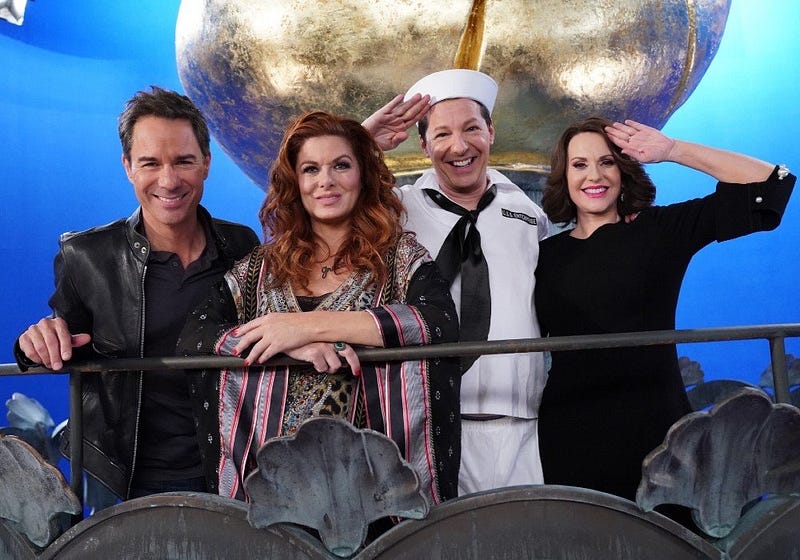
After two separate runs totaling 11 seasons and 246 episodes over the course of 20 years, the groundbreaking NBC comedy Will & Grace aired its finale on Thursday night. Although the revival started to run out of steam midway, the show rallied for a lovely finale that righted almost all the wrongs of the original 2006 send-off and underscored the show’s undeniable legacy.
Author’s Note: This is the third article in the author’s series about Will & Grace. Click here for Part One, which analyzes the revival trend and recounts my night at an episode taping. Click here for Part Two, which recounts the cast’s appearance at PaleyFest to celebrate the success of the revival. Click here for Part Four, which reviews and ranks all of the holiday episodes.
21 years, 7 months, and 3 days later
On September 21, 1998 NBC premiered a sitcom that in many ways was a carbon copy of its 1990s “Must See TV” formula. The success of Seinfeld, Friends, and Mad About You led to a proliferation of sitcoms about sexy young people dealing with dating in a big city. The city was almost always New York and the ensemble was almost always exclusively white. The same was true of Will & Grace, but one thing set this one apart— two of the four lead characters were gay.
Interestingly, the series premiered just four months after Ellen DeGeneres’s eponymous sitcom aired its series finale. It was canceled due to dwindling interest and increased controversy following her decision to have her character come out as a lesbian. The question of whether mainstream America would embrace a sitcom with gay leads was still a big question mark.
The American public embraced Will & Grace in a big way. It ran for eight seasons and at one point was among the top ten most watched shows in America. It was nominated for an astounding 83 Emmys and won 18, including Outstanding Comedy Series for its second season and wins for all four members of its ensemble. (Its ensemble joined those of All in the Family and The Golden Girls as the only ones to earn Emmy gold for all of its regular cast members.) It was an undeniable cultural phenomenon, with dozens of A-list celebrities and bona fide legends like Cher, Elton John, Madonna, Matt Damon, Britney Spears, Michael Douglas, Jennifer Lopez, Janet Jackson, Lily Tomlin, Gene Wilder, Glenn Close, and Debbie Reynolds making appearances. It was also a reference point for a country struggling greatly with divides over the acceptance of LGBTQ people. When he was Vice President, Joe Biden famously said, “I think Will & Grace did more to educate the American public more than almost anything anybody has done so far. People fear that which is different. Now they’re beginning to understand.”
But the show was far from perfect, as a sitcom and a social statement. Its initial run was wildly uneven in terms of quality, with flashes of almost unimaginable brilliance intermixed with downturns into broad slapstick, nonsensical plotlines, and pandering celebrity cameos. It also received a great deal of criticism for its often stereotypical portrayals of gay men and its general ignoring racial and ethnic minorities and people who identified as transgender and bisexual. Despite the mixed bag that the show presented, I was a faithful watcher and avid fan for eight years. This is why I was so crushingly disappointed in May of 2006 when the show churned out a one-hour finale that I count among the worst series-enders in television history. In addition to being largely unfunny, the finale featured a massive falling out between Will and Grace and Karen and Jack facing desperation after Karen loses her fortune. Who cares if it was realistic or bold, it was most certainly not what I wanted to see after investing so much time and emotional energy into the show.
Click here to read more about the show’s original run and the impetus for the revival.
The Revival’s Rocky Road
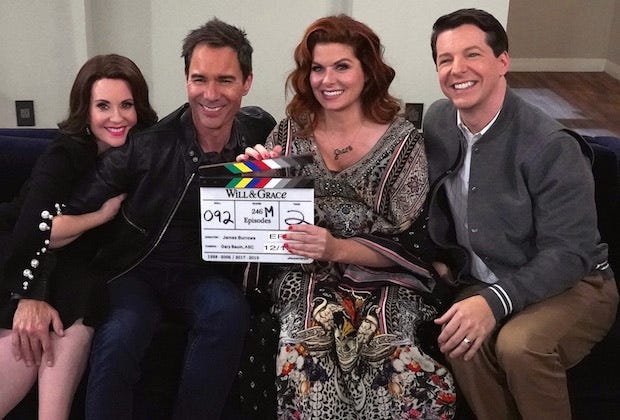
When a hilarious anti-Trump video reunited the cast in their original roles and went viral in September 2016, people were all of the sudden talking about the show again. Since it had wrapped a decade earlier, significant progress in the cultural depictions of LGBT people had been made, multi-camera sitcoms had fallen out of fashion, and the very of-the-moment pop culture references that comprised so much of the humor of the show had faded into obscurity. Underscoring the show’s decreased relevance was the fact that unlike its contemporaries it was not widely available on streaming platforms.
As a result, the fact that the series returned at all was a surprise. The fact that it did so with so much buzz and quality was a genuine shock. The first revival season of Will & Grace (the show’s 9th overall) was among the very best seasons the show ever produced. Most of its 16 episodes were inspired comedy that delved into the development of the characters and made clever social commentary. It produced at least two classic episodes that were on par with the show’s best. One was “Rosario’s Quinceanara,” the episode dedicated to Karen’s maid Rosario, a recurring character from the show’s original run who could not be included on the revival due to her portrayer’s ill health. The other was “The Beefcake and the Cake Beef,” which hilariously skewered the debate over whether shunning Trump-supporters constituted as hypocritical censorship.
The second season of the revival (the show’s tenth overall) was a step down but it certainly had its moments. The two that stand out the most are “Grace’s Secret,” which featured Grace revealing her childhood sexual abuse to her conservative father, and “Bad Blood,” which featured Grace’s father refusing a potentially life-saving blood transfusion from Will due to his association with gay men and AIDS. Both episodes balanced big laughs, character-driven drama, and timely social commentary with aplomb. But things went downhill from there.
It is hard to pinpoint the exact moment when the revival of Will & Grace went from triumphant return to thudding disappointment. It occurred at some point in the second of the three revival seasons after they introduced David Schwimmer’s grating love interest for Grace and before Will and Grace spent an episode trying to exploit the sudden death of Will’s boss. (Turns out he wasn’t dead, just unconscious — hilarious!). But things were clearly in rough shape by the time we arrived at the third and final season of the revival (the eleventh overall). By this point, numerous attempts at injecting life into the series had failed. Will’s relationship with a gorgeous newsman yielded little (even though he was played by the impossibly gorgeous and charming Matt Bomer). The same was true for Grace’s embracing of her uninhibited single lifestyle. Karen’s dabble in bisexuality was just uncomfortable (despite featuring great work from The Handmaids Tale Emmy winner Samira Wiley). And Jack fell in love with a cloying caricature and hitched his wagon to him, bringing his whole value as a character down in the process. Oh, and Will and Grace’s widowed parents marrying each other was absurd, contrived, and utterly pointless (even though the brilliant Blythe Danner and Robert Klein did their best to make the plotline work).
To get the final season energized, the writers had Grace return from her impulsive trip abroad in the prior season finale to discover that she was pregnant with no clue who the father is. This coincided with Will deciding to have a baby with his boyfriend via surrogacy. His boyfriend decides he’s not ready and breaks up with Will, but Will decides he can still raise a baby with love and support from Grace, especially if they are embarking on the journey together. It is actually a beautiful and promising setup for a final season. It allows the characters to move forward without undermining (or outright detonating) the special relationship that kept the show afloat for so long. Unfortunately, the writers just couldn’t seem to mine great comedy out of it. Although she’s more that competent at line delivery, pop music star Demi Lovato’s appearances as Will’s surrogate never amount to much. Grace’s ongoing romantic foibles lead to two of the revival’s (and the series’) worst episodes with one involving Grace’s epic bowel movements and the other involving her damning an endangered species of porpoise to extinction by helping it sexually pleasure itself. (Yes, that’s true and if you don’t believe me check out the episodes “What a Dump” and “Accidentally on Porpoise” — but don’t say you weren’t warned.) Jack and Karen don’t get treated much better by the writers. Jack has very little to do now that he’s married and Karen’s entire plot arc is about a minor league baseball team that she is conned into taking over by her ex-husband Stanley and his brother named … Danley (even the fact that he’s portrayed by the gifted Patton Oswalt can’t save things).
The season is also clearly impacted by the behind-the-scenes tension between Debra Messing and Megan Mullally. As a result of the feud, Mullally doesn’t appear in two episodes. This marks the only episodes in the show’s long run not to feature the character of Karen and they underscore how essential her character is to the show working. Also as a result of this, the season does almost nothing with the dynamic of Grace and Karen, who were an important relationship for much of the show’s run and the lack of closure in that dynamic is disappointing.
This is not to say that the final season is an outright disaster. There are high points. The first three episodes are a riot before the injection of energy provided by Grace’s pregnancy wears off. And the final two episodes may fall short of being classics, but they wrap the series up infinitely better than the original finale in 2006. And in the middle of the season there are two gems. One is “Bi-Plane,” the final season’s only true classic, which features a hilarious plot line involving a threesome with a celebrity on an airplane and an incisive, clever one about how out of touch Will and Grace are with the experiences of sexual minority youth. The other is “We Love Lucy,” the homage to the classic sitcom that features inspired recreations of some of its most classic moments and plays like a love letter to the art of sitcom-making itself. The show may run out of steam as it approaches the finish line, but unlike the original run, it doesn’t totally botch the landing.
The Series Finale Redux

Series finales are hard to get right given the intense scrutiny from the fans that have stuck with the shows and the relationships they depict for so long. Crafting one is not an enviable task (click here to read more about the art of making a good series finale.) Nevertheless, I typically embrace series finales with enthusiasm because I love seeing how shows choose to wrap things up. However, after the excruciatingly painful capper to the original run did literally everything wrong, it was hard for me to approach the second series finale of Will & Grace with anything but apprehension.
Thankfully, the episode “It’s Time” (which aired last Thursday) entirely sidestepped everything that made the original series finale such a crushing disappointment and turned out to be one of their best episodes of the final season. It isn’t going to join the annals of great series finales, but it works and actually works well. Each of the four characters gets something special. Will and Grace pack up their apartment and Grace gets ready to give birth. Jack finally gets to go on stage in a Broadway play when the four people before him in line become incapacitated. And Karen decides she’s meant to be with Stanley (who is still unseen 246 episodes after he is first mentioned). They also say goodbye to the city of New York, with a key scene atop the Statue of Liberty.
There are hilarious running gags that are unique to this episode, with the constant jokes about the painting of the sad gay man that has been displayed in Will’s apartment largely undiscussed for the show’s entire run and Jack’s ridiculous pondering about the various jobs he has had (some of which he worries he may still have). We even get two great cameos, one from Minnie Driver who makes one final appearance as Karen’s filthy ex-step daughter Lorraine and one from Matt Bomer, who shows up to remind Will that a gay man can get his Prince Charming as well. It’s a very important moment given how badly the initial series botched the landing.
The show runners interestingly opted for a normal length episode rather than a super-sized send-off and it mostly works. Parts of it feel a bit rushed or underdeveloped and it leans a bit too heavy on the typical sitcom series finale tropes, but overall it’s a gem. Never is it better or more powerful than in the moment near the end when Grace laments the fact that once they have kids they will no longer be just Will and Grace after so many decades and Will responds, “Maybe we have been Will and Grace long enough.” It is a jam-packed exchange that can be read on numerous levels and injects heartbreak, hope, and nuance into a finale that mostly aims for broad humor and milestones.
Did the Revival Enhance or Tarnish the Legacy of Will & Grace?
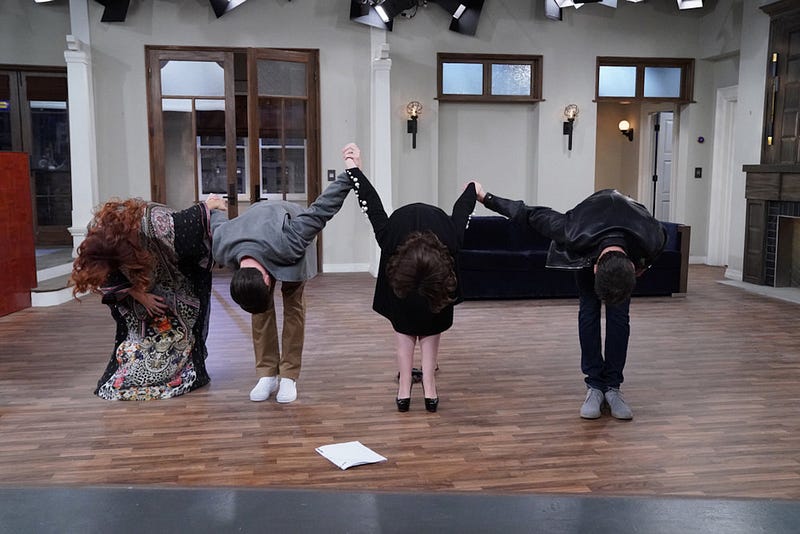
So now that the show’s second run of three seasons and 52 episodes has come to its end, it’s a fitting time to reflect on whether the decision to revive the series enhanced or tarnished the show’s legacy. From a commercial perspective, the revival was largely a win. Even though ratings sagged quickly, the new episodes clearly reinvigorated interest in the property (the show now has a high profile streaming home on Hulu) and revived the quartet’s Hollywood profiles (see major award nominations for Debra Messing and Megan Mullally).
And even though it was clearly a rocky road in terms of quality, I think that it was mostly a creative win as well. The cast and crew proved that a show that was very much of its time and in an out-of-date format could be brought back with craftsmanship, passion, and purpose (for one and a half seasons, at least). And, more importantly, they got a chance to right several of the wrongs of the initial series. Grace’s speech in “Who’s Sorry Now?” in which she comes to the realization that she has been cruel for holding a grudge against Will for coming out and breaking her heart when he was just trying to live his truth, is a much-needed twist in the traditional gay narrative. The same goes for the fact that the gay man has his love story intact at the end of the show’s run, but the straight woman is confidently single. “Rosario’s Quinceanara” brought justice to a character that was a punching bag for most of the series. “Bad Blood” was the first time the show really mentioned AIDS. “Bi-Plane” directly addressed the fact that the series’ first run was dismissive and cruel about bisexuality and admitted that Will and Grace are old and out of touch.
But no wrong from the series’ original run was more in need of being righted than the abysmal 2006 finale. And thankfully, the second series finale righted that wrong. We got to see a new timeline in which the quartet embark on exciting new lives while staying together. We have been gifted with a finale that largely eschews heteronormative tropes and largely pays due respect to the two decades of investment that fans have put into the characters.
I’m sure I will revisit Will & Grace someday. (Maybe sooner rather than later depending on how long the stay-at-home orders last.) But for the first time since I started watching it as a 14-year-old, I finally feel at peace with the show and ready to put it away for a while. And that more than anything makes me glad for the existence of the revival.
Follow the author of this article on Medium and Twitter.
Check out other articles by this author about classic TV comedies:


