
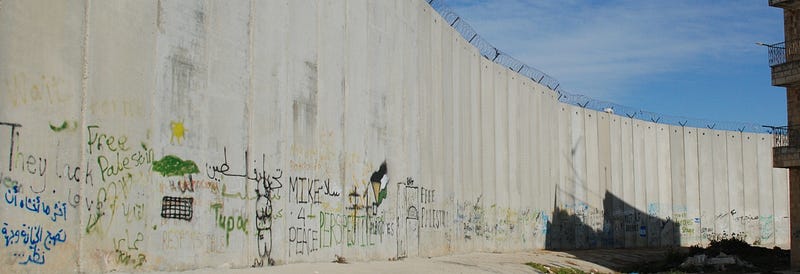
OPINION | PALESTINE | LANGUAGE
‘Free Palestine!’ What It Means To Me
Slogans and the power of language in shaping the psychology of liberation. How language elevates, or degrades, the struggle for freedom and justice.
(Not a Medium Member? Read full article here.)
To draw attention to the genocide in Gaza, a group of well-intentioned Palestine activists dropped a banner at the NBA all-star game on Feb. 17, 2024. Their choice of message left me exasperated. Out of all possible slogans, couldn’t they find anything better than ‘Let Gaza Live’? As a Palestinian activist who has been resisting oppression for decades, I have come to respect Edward Said’s lessons on “the power of words, and their capacity to liberate, or to oppress,” as I express in my book Fugitive Dreams.
“Learning how word choice was used to dominate, I grew to reject Israeli terminology, like calling a stolenment a “settlement”.”
— Ramsey Hanhan, Fugitive Dreams
People learn by repetition. Here, I ask what are we programming ourselves to believe when we reiterate each of three commonly-used slogans in the Palestine movement.
‘Let Gaza Live’
“Like “Black Lives Matter”, I find it sad and shameful that we actually have to affirm something as basic as the right of a human being to life. (At least in the one case, “Black Lives” are the subject — they “matter”. The defeatist “Let Gaza Live” puts “Gaza” as an object, acknowledging and accepting the power of the Occupier, whom the slogan addresses, over the lives of its people.)”
— Ramsey Hanhan, Fugitive Dreams
Let Gaza Live not only sets the bar too low, it is dehumanizing towards the very people of Palestine whom the activists purport to be helping. The objectification of Gazans removes their agency. The people of Gaza today are heroically enduring and resisting one of the most horrific campaigns against Life itself. They surely deserve our recognition. These three words belittle the accomplishments of the medics, hospital workers, aid workers, and journalists, among many others, who risk their lives to keep others alive and record the daily atrocities.
“As we learned in the School of the Intifada, a person who stands up for their rights is no victim.”
— Ramsey Hanhan, Fugitive Dreams
‘Let Gaza Live’ gives in to bullying, while simultaneously absolving ourselves of any responsibility. “This is all on the people in power. It’s their decision, …”
This defeatist slogan was never part of the Palestinian resistance lexicon. It was introduced abroad, around 2009, culminating decades of what I call “reverse mission creep” in the objectives of the Palestine activist movement. By prolonging the occupation, and building ‘facts-on-the-ground’ in the form of stolenments, then a Wall, Israel has gradually squeezed our aspirations and blocked our horizons, to the point where “not killing” the Palestinians in Gaza has become the main objective.
‘From the River to the Sea, Palestine Will Be Free’
Much ado has been stirred about this couplet. The simple rhyme makes it a favorite at protests in the USA and other English-speaking countries. I will not address the laughable claims that ‘River to the Sea’ clause implies a desire for genocide. Other writers have eloquently refuted that (see articles by Johnny Silvercloud, Rebecca Ruth Gould, Caitlin Johnstone, Daoud Kuttab, or Hatem Bazian).
My problem is with the second half of the slogan!
‘Freedom’ here is an object, a worthy goal cast perpetually in the future by the simple phrase, ‘Will Be’. Freedom is a fantasy, one that motivates us, but not entirely. There is no urgency in that phrase. We can feel comfortable having done something to help that freedom along, but are resigned to not expecting results in our lifetimes.
The slogan’s passive tense is another major weakness. It tells us what the goal is, but not who will get us there. The subject is hidden, the unknown benefactor, a future Salah-el-Din who will ride to Jerusalem on a (hopefully color-neutral) horse.
‘Free Palestine’
‘Free’ here is both an adjective and a verb, a goal and a process, a promise and a commitment — a call to action. ‘Free Palestine’ is now, perpetually in the present, a reality we live every moment of our lives, whether we were born Palestinian or not.
“But we know too well that our freedom is incomplete without the freedom of the Palestinians.”
— Nelson Mandela
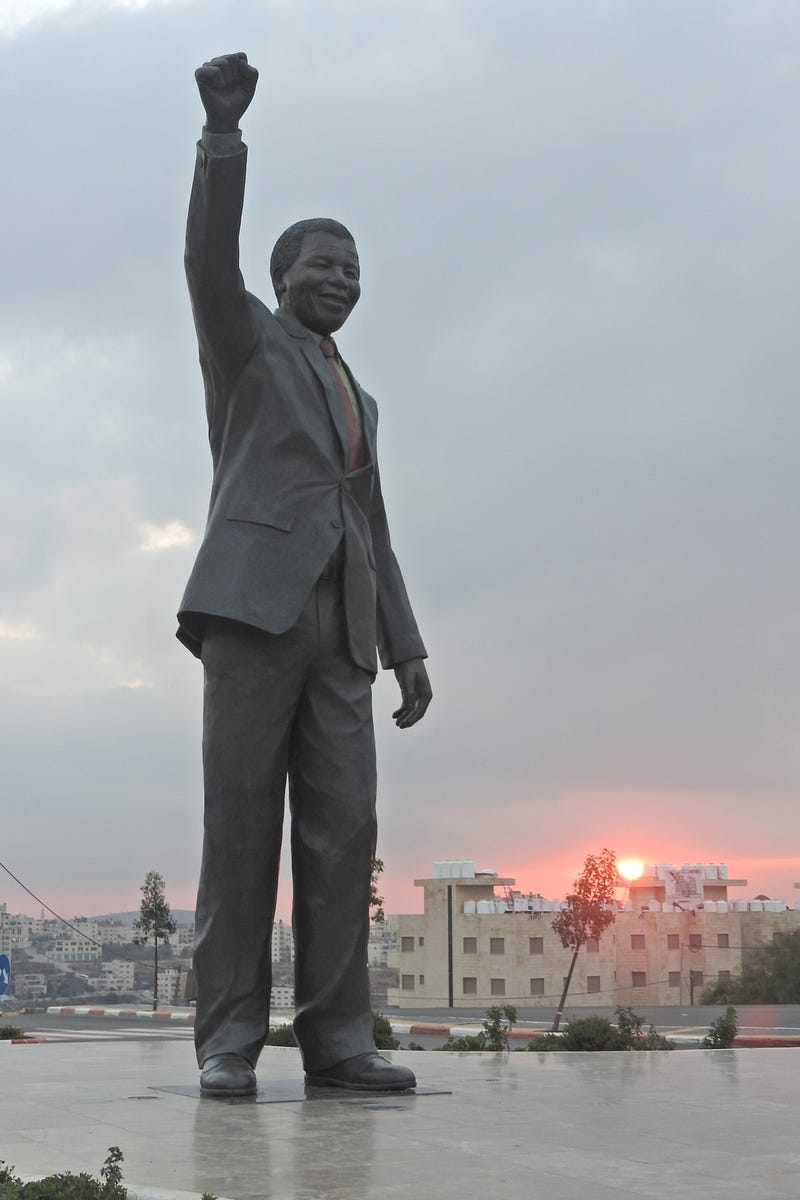
As with ‘Free South Africa,’ ‘Free Palestine’ keeps the responsibility squarely centered on us. The slogan talks to you, talks to me, to everyone. There is no passing the buck. In the spirit of Bob Marley,
I and I must liberate Palestine.
Freedom is not simply controlling the space between two lines on the map. Freedom is a continual rebirth — freedom from want, freedom from oppression, freedom from debt, freedom from the past, freedom from our beliefs, freedom to love.
As every decolonized country knows, the quest for freedom doesn’t stop with independence.
‘Free Palestine’ = ‘Free Israel’
‘Free Palestine’ is a commitment to freedom not only for Palestinians, but also for Israelis, who for 75 years have been trapped in their self-made prison of paranoia and rigid warrior roles. For Israelis, ‘Free Palestine’ means freedom from victimhood and freedom from fear. It is also freedom from supremacy, and the chance to relate authentically to their neighbors as equals, not conquerors.
Exterminate ‘Exterminate’
On the topic of language, it pains me to see many tweets a day by Palestine activists, some Palestinian, that recycle the same dehumanizing language used by Israeli politicians. Palestinians are not vermin to say “Israel is exterminating Gazans.” Israel is mass-murdering Gazans by the thousands. Palestinians are human beings, and the verbs used need to reflect that.
In one photo I received from a friend, a protester held a sign reading, ‘Dogs are treated better than Palestinians.’ What exactly is the message here? Whose agenda does this comparison serve?
Please think about the words you use. We must guard not to reinforce the very fascist paradigm we are challenging. Especially at this time of genocide, it is imperative for all supporters of Palestine to emphasize the humanity of Palestinians.
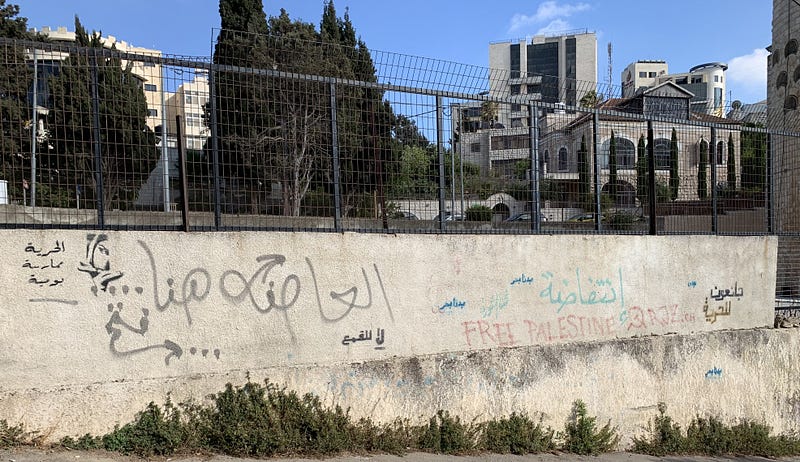
Let us not descend to the despair I read scrawled on a wall in Ramallah in 2019, ‘We Want a Sea.’
We forget that a truly free Palestine has no checkpoints, and no Walls. Qalandia is back to being the village from which the old milkman has hailed, on his donkey. Jerusalem is open to all. So are the roads. There are no settlers, only citizens, equal under the law. — Ramsey Hanhan, Fugitive Dreams
With love, Ramsey Hanhan Author, Fugitive Dreams