
History of Philosophy
Francis Bacon — Blinded With Science
The pros and cons of being an obsessive innovator
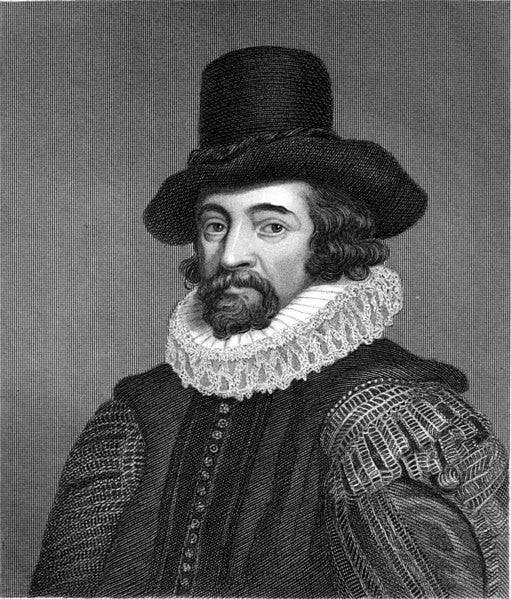
In the early 1600s, British scholar Francis Bacon (1561–1626), inspired by William of Ockham, brought to the forefront the empirical method of science. Bacon’s goal was to achieve a total reconstruction of sciences, arts, and all human knowledge, raised on the proper foundations. Bacon was a significant creator of the image of science and scientists that persists to this day.
Bacon wanted to replace what he saw as the vain obfuscation of Aristotelian Scholasticism and its contemplative reorganization of long-known eternal truths. Such a conception was largely based on Thomas Aquinas’ interpretation of Aristotle, especially the notion that all objects had in their essence a final cause. Scholasticism focused on a more thorough understanding of these final causes. Bacon’s alternative was to see science as a discovery of the unknown — science as learning rather than systematizing. He urged his countrymen to sweep away the rubble of medieval tradition and head toward a “new continent” of knowledge, science being the ship that will guide us there. He saw the emergence of natural philosophy, freed from theology and adopting its own intellectual methodology, as the great hope for humanity.
It may appear to us today that Bacon’s program is secular, but it is in fact thoroughly grounded in religious belief. He believed natural philosophy would recover the knowledge humanity had had in the Garden of Eden but had lost because of the Fall. In the Garden, Adam and Eve had dominion over all of the earth. Because of their disobedience, God removed Adam and Eve’s dominion over nature and set nature at odds with the children of Adam and Eve who were now required to toil by the sweat of their brows to survive. But by God’s grace and providence, humanity was being granted an opportunity to recover this dominion. “The true ends of knowledge,” Bacon wrote, are “a restitution and reinvesting of man to the sovereignty and power which he had in his first state of creation.” (New Organum III, 222) The new natural philosophy was not just a matter of increasing human knowledge and power; it was the means of righting an ancient mistake and partially restoring humanity’s rightful relationship with nature. This was not mere lip service by Bacon to keep from running afoul of religious authorities. There is no reason to doubt that Bacon, like nearly all of the intellectuals of his era, sincerely believed the biblical narrative of the creation and fall. Natural philosophy was in no way a threat to the established doctrines of Christianity.
Bacon understood that the way we approach things affects how we perceive them. Knowledge is power, he said. We see what our knowledge tells us we see. Therefore, it is important that we have true knowledge, not false knowledge. Yes, we can have false knowledge if we think we know something is true but it isn’t. (We will see later that all we have are beliefs.) False knowledge comes from what Bacon calls the corruption of our minds by idols.
“Idol” was originally a religious term that morphed into a general term for things foolishly worshiped — like pop singers on reality TV. In his book Novum Organum (1620), meaning “New Instrument,” Bacon observed that people don’t think clearly because they are distracted by four types of Idols of the Mind:
1. The Idols of the Tribe. The tribe here refers to humanity, and these idols inhere within human nature itself. Our human tendency is to want the universe to make sense as we think it should make sense (like the Scholastics did). Our human desires affect how we see things, especially how we assume there is more order in the universe than is really there. We all tend to make the facts fit our preferred conclusions. To overcome this idol of wishful thinking, we need a disciplined approach of observation and reasoning about what is. We see what we think we should see, so if we assume that the universe should conform to our expectations, we are distracted by this idol. It is a human tendency we need to overcome, Bacon says, if we are to think clearly.
2. The Idols of the Cave. Bacon uses the metaphor derived from Plato’s Allegory. Bacon says that each of us dwells in our own unique little “cave” of beliefs that we think are true. These beliefs, formed by our dispositions, education, experiences, and the authorities we admire, limit our vision of what is. Our philosophy, thus, follows our personal history more than it follows reality. A pessimist sees the cup as half empty; the optimist sees the same cup as half full. Bacon says we need to guard against our natural idiosyncratic prejudices:
And generally let every student of nature take this as a rule, — that whatever his mind seizes and dwells upon with peculiar satisfaction is to be held in suspicion, and that so much the more care is to be taken in dealing with such questions to keep the understanding even and clear. (Novum Organum, I.XLII)
3. The Idols of the Marketplace. Today we hear “marketplace” and think of economic activity. Bacon is using the term in the 1600s sense of the market square as the hub of civic life. What you found in the market were people gathering to buy; sell; and talk, talk, talk. The cacophony of voices in the marketplace was Bacon’s analogy for the problems of language that interfere with our pursuit of truth. The idols of language are related to the first two idols. We have names for things that do not exist, like “luck,” but the name’s existence can deceive us into believing in their existence and using their names to explain events incorrectly. More problematic is our use of abstract terms that are full of vagueness and ambiguity. We complain about a “heavy” cell phone even though it weighs less than a “light” backpack. And “heavy” is one of those words that have many different meanings. You can say you have a heavy heart because of your heavy course load, so you listen to heavy metal music, none of which can be measured objectively. The point that Bacon is making is that we need to be careful not to let words distract us from seeing the world clearly.
4. The Idols of the Theater. Bacon’s time was the time of Shakespeare. No, Bacon didn’t write Shakespeare’s plays, but Bacon uses the metaphor: “All the received systems are but so many stage-plays, representing worlds of their own creation after an unreal and scenic fashion.” (Novum Organum, I.XLIV) In other words, there are various dogmatic systems of philosophy, such as those of Plato and Aristotle. These systems created large internally coherent systems of connected concepts that built a story to describe the universe. But like a world created in a fictional plot, these intellectual worlds have no connection to the real world. We need to hold in suspicion any intellectual system that claims to explain the universe, no matter its origin. Bacon adds that he means not only entire systems but also many of the axioms of science that by tradition, credulity, and negligence have come to be received. The answer is to reject dogmatism and ideology and learn by observing facts in the world.
Bacon, like many before him, assumed the universe had a unified rational order. To learn how that order works, we need to collect facts about the world, properly catalogue those facts, and look for the forms within those data. By “forms,” Bacon was thinking in terms of Aristotle’s sense of forms or essence. Bacon rejects Aristotle’s theory of final causes but thinks of the material world largely in terms of formal and material causes. We learn about the forms of nature by collecting particular facts and inductively reasoning to discern where forms are present and where they are absent. For example, Bacon says we can learn about the form of heat by observing where heat is present and where it is absent and when heat increases and decreases where it is present; then we correlate those data with other data to find relationships among phenomena. His method leads him to conclude that the form of heat is an expanding notion that travels through bodies, which is an accurate assessment as far as it goes.
Bacon’s primary contribution to science was to establish the foundations of a philosophy of science. Bacon placed faith in our ability to gain knowledge through disciplined observation and recording of our sense experiences. Similar to Descartes, Bacon had unrestrained optimism about what science with the proper method could accomplish. He thought that science properly conducted would, in only a short period of time, discover all that could be discovered. He therefore, proposed that society create committees of scientists working to discover the forms of nature. The areas of science would be divided into specialties. He classified 128 particular specialties, from the study of astronomical bodies to the study of machines. For each specialty, he called for two groups of scientists. One group would engage in research, conducting experiments and collecting empirical data. Another group would analyze the data by using induction to identify positive and negative relationships in the data, deriving the forms in nature. Across all specialties, another group of scientists would take the findings of the specialties and use induction to identify positive and negative relationships among the areas of science. Bacon confidently predicted that such a method would lead to “the power and dominion of the human race itself over the universe.” (Novum Organum, I.CXXIX) Such was Bacon’s optimism that, although he never finished it, he wrote a book, New Atlantis, in which he imagined the future world as a utopia transformed by science and technology.
Bacon’s positive contributions to science were blunted by some serious blind spots in his thinking. He was so enamored with his new empirical method that he rejected as obsolete and unnecessary all theories. He therefore rejected the theories of Kopernik and Kepler on planetary motion, and anything that he saw as reasoning from principles. That type of reasoning he dismissed as medieval Scholasticism. So, though Bacon established the empiricist movement in philosophy and pioneered the idea of systematic science, his failure to appreciate the value of legitimate theorizing in science, prevented him from developing a full scientific method.