avatarKevin Buddaeus

Free AI web copilot to create summaries, insights and extended knowledge, download it at here

1146

Abstract

9d13">As the thing in itself cannot be known, we are left with patterns of rationality as the only relevant reality (idealism). These patterns of intelligibility structure reality, and like living things they can develop towards more rational states. The name for this kind of extended mind in German is <b>Geist</b>, meaning a combination of mind and spirit.</p><p id="8020">The development of Geist is driven by two processes: <b>differentiation / articulation</b>, and <b>integration</b>. Together, they comprise the <b>systematization</b> of the world itself. This autonomous system gradually evolves as it synthesizes opposing ideas through the dialectical process. In this way, rationality (and thereby reality) realizes itself, ultimately becoming self-aware in the form of the World Spirit (or God).</p><p id="ce4a">One of the consequences is that God, as the self-organizing principle of reality, is again seen as rational, and we can again access the divine through rational reflection. Hegel is effectively translating religion into philosophy.</p><p id="fbc4">While popular in his time, Hegel’s ideas faced critiques on numerous front

Options

s:</p><ul><li>Schopenhauer (and later Nietzsche) considered the intelligibility patterns to be driven by will (Will to Live, Will to Power), making them fundamentally irrational and arbitrary.</li><li>Kierkegaard criticized Hegel’s philosophy for being a purely intellectual system lacking in the participatory knowledge needed to cultivate wisdom. From the Kierkegaardian perspective, our attempts to realize the divine have been severed from personal transformation (they do not compel us to take the “leap of faith”).</li><li>Marx saw religion as an opium distracting us from the reality of how socioeconomic forces shape history through conflict. The participation that Hegel inherently lacked, Marx provided through a call to political and economic revolution.</li></ul><p id="dc4e"><a href="https://readmedium.com/summary-of-awakening-from-the-meaning-crisis-by-john-vervaeke-chapter-23-romanticism-0ded8b29cb29">Previous chapter: Romanticism</a></p><p id="24a8"><a href="https://readmedium.com/summary-of-awakening-from-the-meaning-crisis-by-john-vervaeke-chapter-25-the-clash-a8ea65710b2d">Next chapter: The Clash</a></p></article></body>

Poetry | History | Religion

Four Riders

Poetry — About the end times
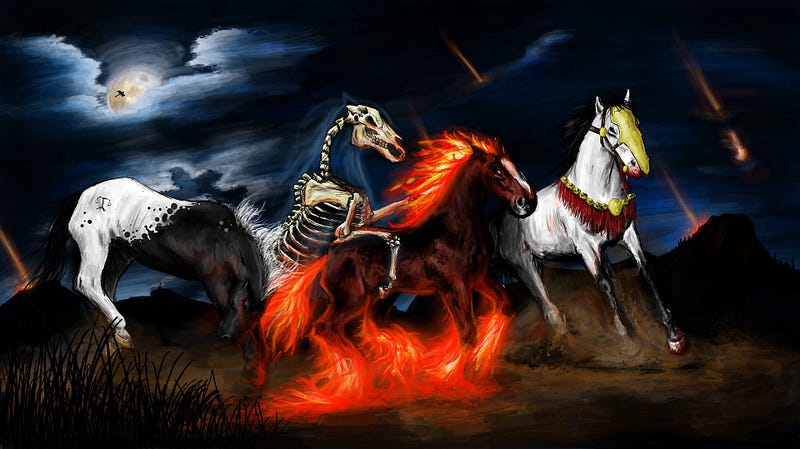
Image by Jeroným Pelikovský from Pixabay

Four horses unlike any animal you know Will come as the last sign of prophecy Carrying four horsemen, to bring the final blow Against a crumbling empire, the end of humanity

A white steed, pure and supreme Carries its master, the white rider above He is the antichrist, an impostor undreamed A bow in his hand, on his head a false crown.

He will ride to conquer, nothing shall stand in his way For he is the prophet of doom and decay

A red steed, fierce and inflamed On its back sits the manifestation of war He will shed blood, carrying a sword in his hand Until only ashes remain, all armies will fall

He will ride to destroy, extinguishing man’s breath For he is the prophet of destruction and death

A black steed, its eyes dark as the night On it sits famine, holding a scale He will bring starvation, countless shall die All will slowly turn weak and pale

He will ride to taint harvests with his bad fate All shall hunger, no food shall remain

Lastly, a pale steed, only bones of it left Carrying Thanatos, death itself taking form He is followed by Hades, the world of the dead Reaping their souls, till there’s no one left to mourn

He will ride to take with him the souls of the fallen For the final judgment is their calling

In the end of times, our debts will be due And these four shall ride to collect and pursue

Kevin is an editor and writer for the ILLUMINATION publication. Follow him on Twitter and LinkedIn.

Poetry
Religion
Fiction
Life
History
Recommended from ReadMedium