
Food, Food, and More Food
An Italian Christmas
One of my favorite authors on Medium — and not just because we, coincidentally, share a last name — wrote a great article regarding weight loss. In it, she points out that :
“According to the British Dietetic Association, the average person will consume 6,000 kcals on Christmas day.”
The whole article can be found here.
While some might challenge that figure, saying it’s too high, I think I might have gone over that 6,000 kcals at this year’s Christmas lunch at my In-Law’s (Marie Claire and Sergio) house in Northern Italy. Sergio is from Torino but moved to the southern part of Lake Como (Lombardia), with his wife Marie Claire several years ago. Marie Claire is from the Italian part of Switzerland.
I think most Americans would be surprised — and wouldn’t guess — that most of the food we ate was Italian. To be fair, each region and sometimes each city in Italy has its own cuisine. Torino is in Piemonte — at the foot of the Alps. I give a detailed view of Torino here:
The short story is that it was heavily influenced by the French and the food is not heavily pasta/tomato-based like it is in the South of Italy. Northern Italy in general, and Piemonte in particular, is wealthier than the South — and this is reflected in the food — more high-end seafood (salmon, lobster) and meat of all types.
Christmas is a big deal here and typically spent with family. Italians have a saying “Natale con i tuoi, Pasqua con chi vuoi.” Translated — Christmas with your family, Easter with who you want.” So, while Christmas (Natale) is for family, it might be a little forced at times. Kind of like Thanksgiving for many Americans! But in general, families are very close here. Sure, there can be drama at times, but it all gets worked out — and even if it doesn’t, it’s still family.
On to the food…
We were 12, including 2 kids. But two adults and three other children didn’t come as one of the parents had been at a party a couple of days before with someone who later tested positive for COVID-19. That left us with a lot more food than needed — but not necessarily more food than would have been prepared anyway.
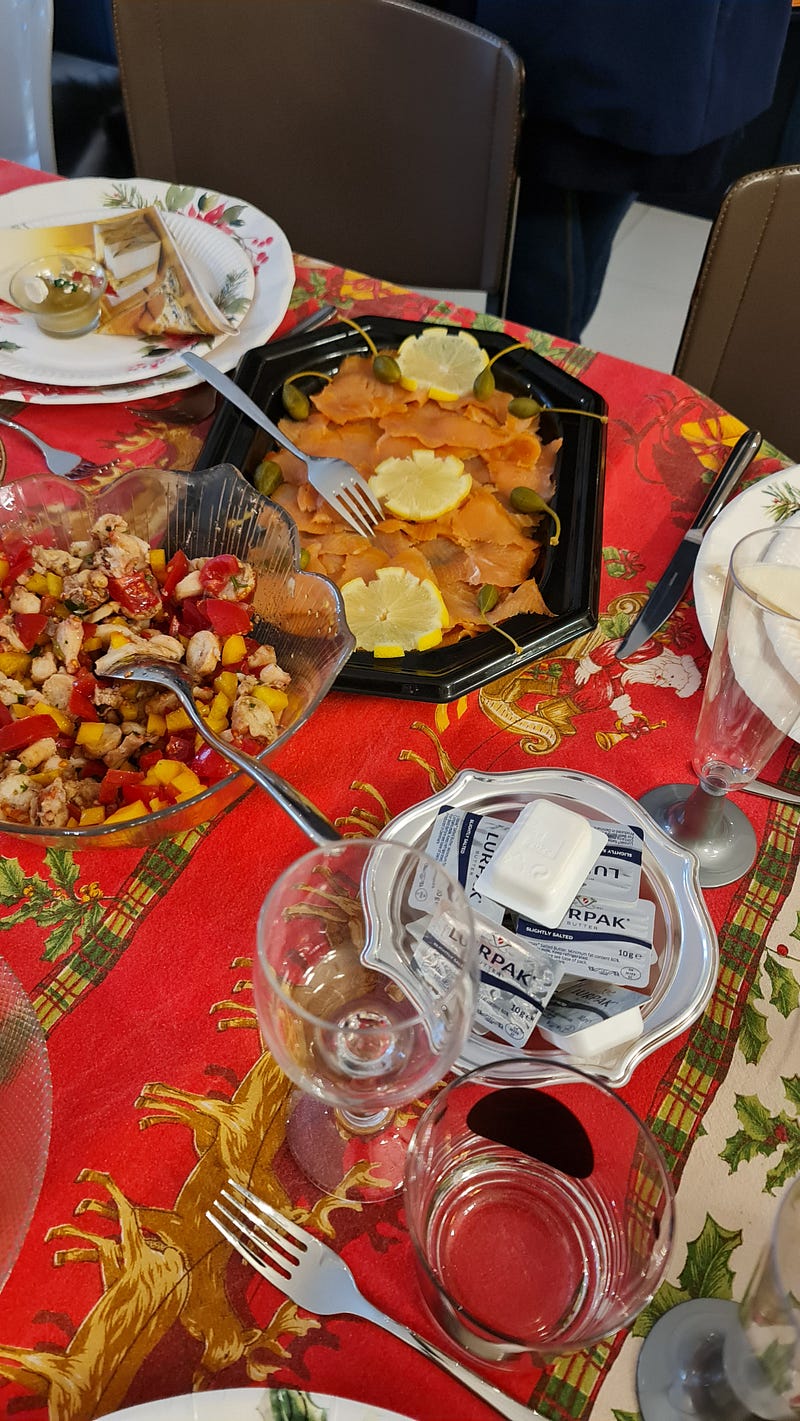
The Italian meal has three main parts plus side dishes and dessert. When we arrived at my In-Law’s house, the table was already set with the appetizers (antipasti). I used to think it was called antipasto (the singular form) because Italian food was, basically, pasta and the started dish was not pasta — so, anti-pasta (which, for some reason that made sense to me changed the last letter from an “a” to an “o”…). Now I know that “anti” is a Latin form of “ante” (before) and “pasto” means meal. So, antipasto means before the meal — appetizer. The plural form is antipasti. Anyway, here they are!
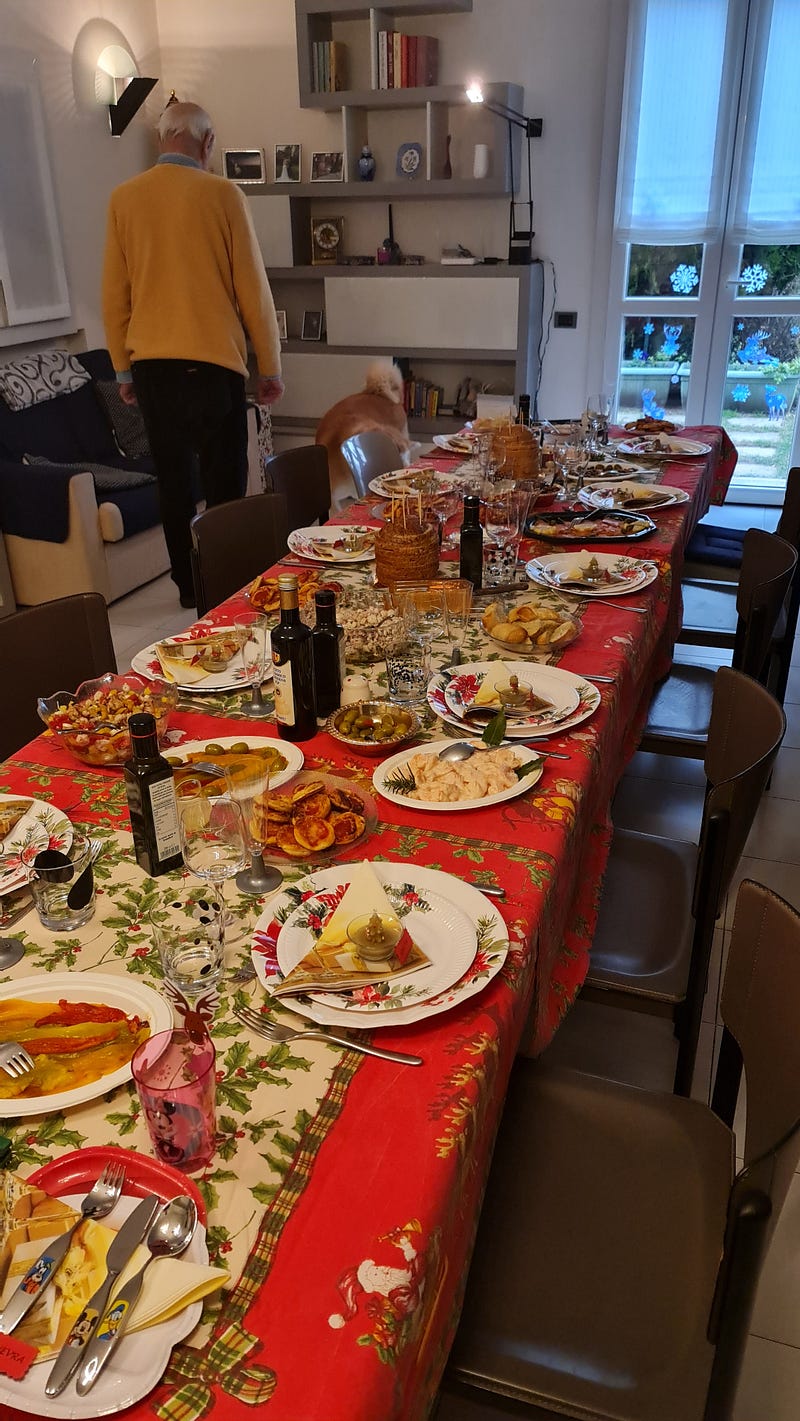
Up close, we have:
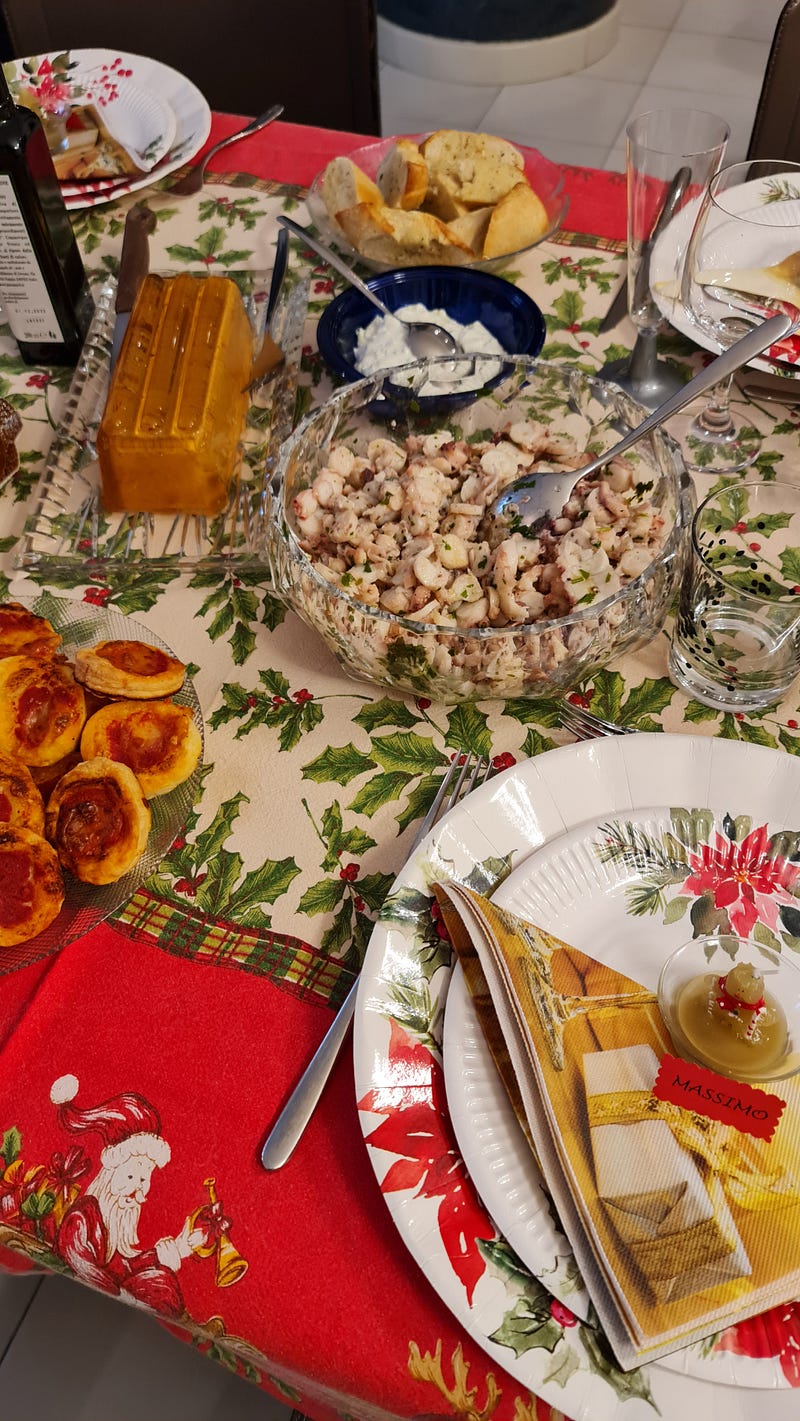
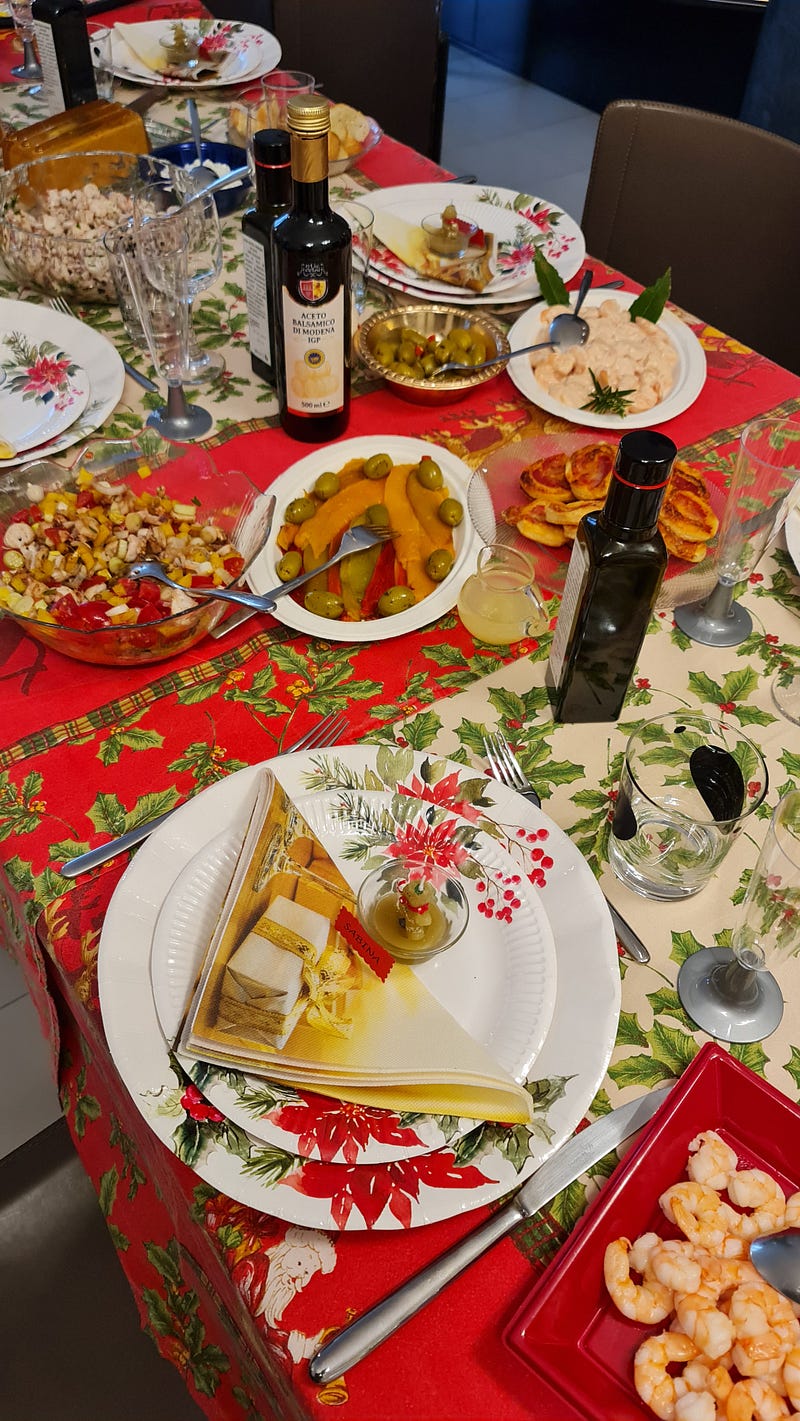
To drink we had a choice of red wine or prosecco — or both!
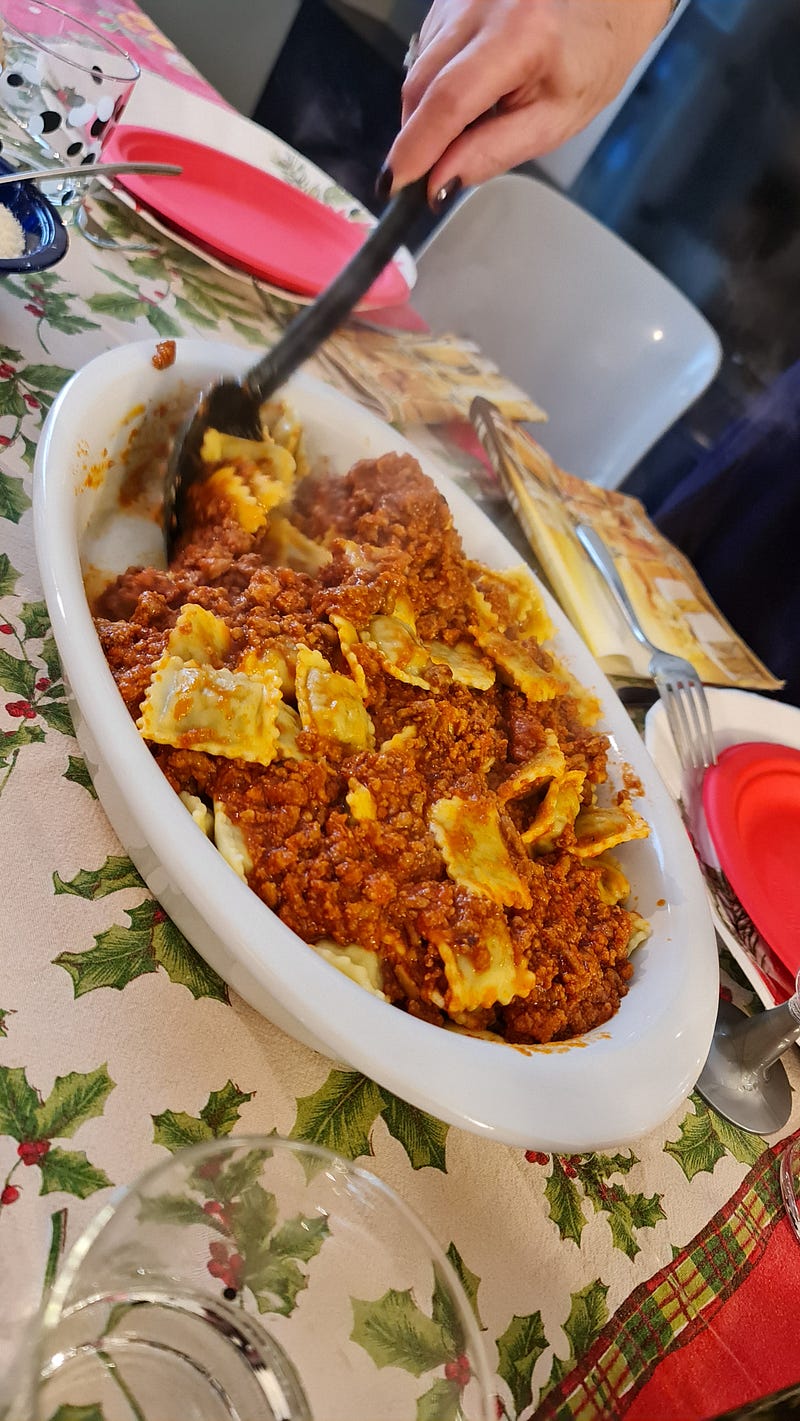
Next came what is called the il primo piatto — the first plate. This will, traditionally, be the starch — pasta, rice, etc. Here we have a Piemontese specialty — agnolotti al ragù. Agnolotti are small ravioli with meat inside. I stood in line for an hour to pick up our order at the little shop near us — apparently the best in the area. These were tasty! The ragù was a mix of ground beef and pork. Again, there was wine, and, of course, bottled water.
An interesting thing related to table manners is that in Italy, you don’t do all the switching of hands with your knife and fork. The knife goes in your dominant hand, the fork in the other. You don’t put them down until you are done! If you stop eating to take a drink and put down your utensils, you don’t put one hand on your lap — that’s poor manners.
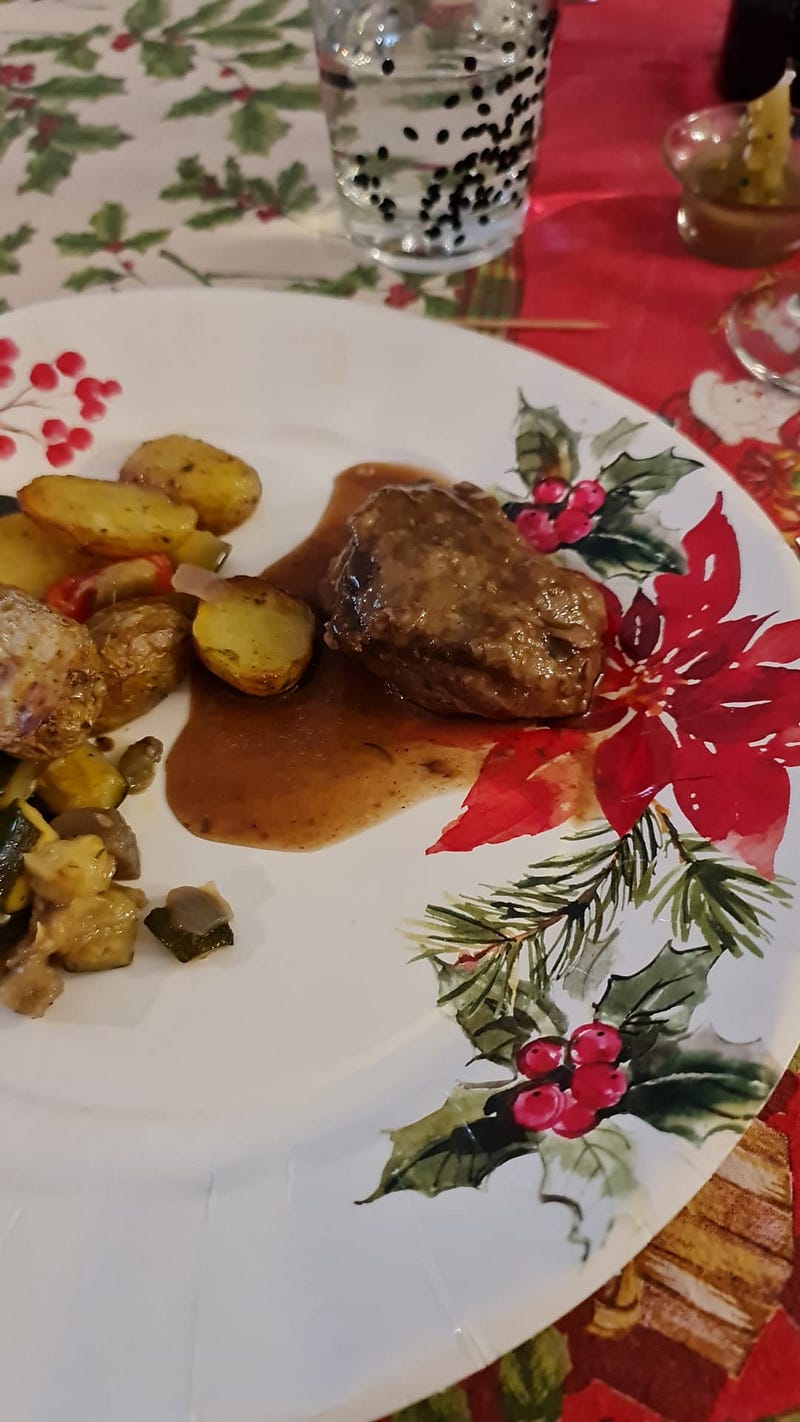
After eating too much agnolotti al ragù, il secondo piatto (second plate) arrived. The second plate is the protein course. This was a first for me — guancia di vitello (brazed calf cheek). If you’ve ever had traditional spaghetti carbonara, you’ve had pork cheek. This guancia di vitello was the most tender meat I’ve ever eaten. There was no need for a knife — or teeth, for that matter. To drink, more wine and/or water.
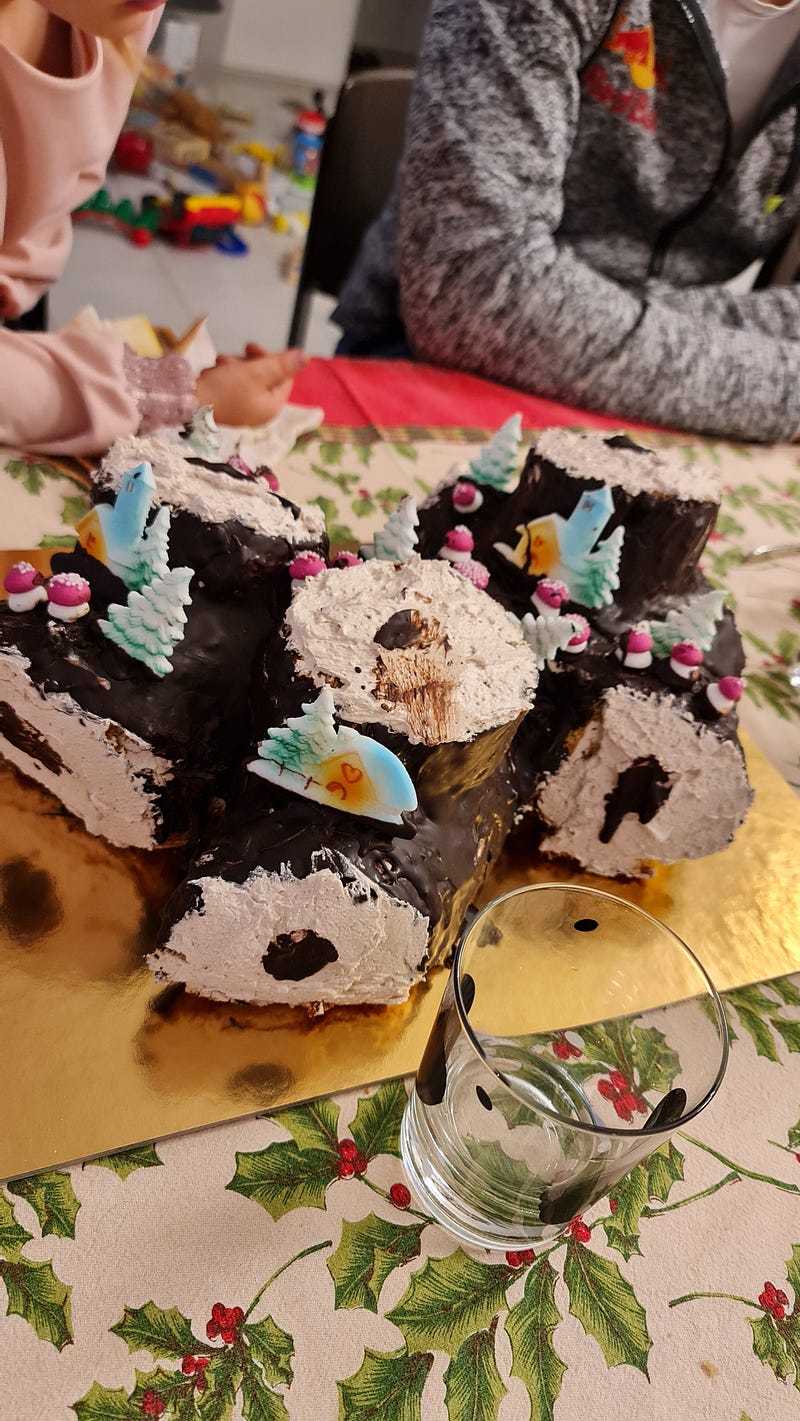
Next, and finally, was il dolce (the dessert). This is a Christmas tradition called il tronchetto di natale (the Christmas log). After this came the coffee and an array of after-dinner drinks: grappa, rum, limoncello, and amari.
I meant to time the affair but forgot. I think we started eating around 1:00 PM and finished around 4:00 PM.
As I mentioned above, this was a Northern Italian Christmas lunch. If anyone has tales of Christmas meals from other parts of the peninsula, add to the comments!
Thank you for reading this article — hopefully, it contained something you found useful.
If you aren’t a member of Medium but are thinking of joining, please join through my page! If you do sign up to Medium through my page, some of your membership fee goes to me (but you still pay the normal membership price).
With a paid membership to Medium, you will get to read more of my work plus you get unlimited access to thousands of Medium writers. And it’s only about $5.00 a month!


