
#30DaysOfSciKuChallenge
Fly Pushing
Day 6 Prompt: Model organism Inspired Sciku
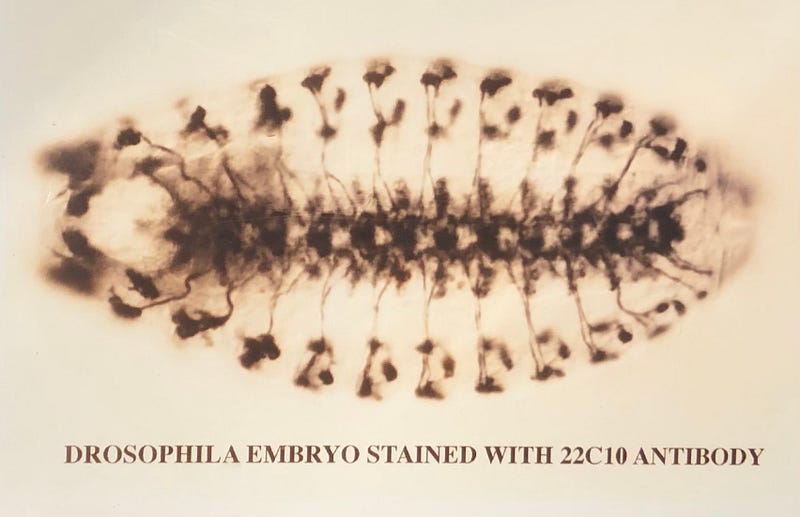
small yet mighty Morgan identified a gene in the fly six Nobel prizes named
It has been just over 100 years since Thomas Hunt Morgan’s lab — a dingy closet-like space at Columbia University from 1911 to 1928 first started to use glass milk bottles to conduct experiments using fruit flies or Drosophila melanogaster. “The Fly Room,” as it is often called — has come to be known as the birthplace of groundbreaking research in the field of genetics and neuroscience. Since then, discoveries in fruit flies have contributed significantly to our understanding of neuroscience and have formed the basis for six Nobel prizes awarded to date.
Fruit flies share 60% of the same DNA as humans, have easy logistics, and a short lifecycle — that, among other things, offers a cheap, fast pipeline to reach a good understanding of complex biological questions with meaningful implications for medical applications, thus making them an ideal model organism for research. In the words of William Blake in The Fly ( 1794):
Am not I A fly like thee? Or art not thou A man like me?
Pioneers of a new frontier in science, the researchers in Morgan's lab were themselves an interesting bunch — they often made rules “on the fly” and championed an era of democratic atmosphere open to new ideas and unconventional thinking — much of what has become a standard in laboratory research today. A recent Fly Room documentary provides a fascinating view of the initial atmosphere and describes the stories of men and women behind the science.
If you find a chance, visit a Fly room — I highly recommend it. The fly research community is one with overly enthusiastic, curious, fun, quirky, yet socially engaged individuals. If you have ever spent any time in a research lab — chances are you know someone with a connection to the fly room— this is a fun exercise — try it — ask around and see if you can locate a “fly person” — we are easy to find fly-ing around the world looking for good food!
Also, in an authentic 2020 style — “fly persons” are considered the “essential workers” of Science :
**This is Day 6 of the #sciku challenge — science-inspired haiku ( so #sciku?) prompts to get you inspired — Our dear readers — why not spend some time each day creating and having a little fun — if you do — publish it anywhere on medium, just tag it with — #30DaysOfScikuChallenge.
**If Haikus/SciKus are not your thing, feel free to exercise your artistic creativity and write another form of a science-inspired story — I can’t wait to read what you come up with.
Tagging Anthi Psomiadou Louis Dennis Terry Mansfield and anyone else who feels inspired to follow and/or play along with this fun #30DaysOfScikuChallenge and today’s prompt: Model Organisms
What to read next? How about Laura Griffith Machado, PsyD


