
Flow: A State of Total Immersion That Opens Us Up to Happiness
I no longer try to pass the time, but rather get carried away and forget its existence.

The day I found out, it was as sharp as a slap in the face.
I had to feel totally misaligned for a while until finally the obvious hit me. I was constantly trying to pass the time. I was no longer carried away by any activity, passion or deep interest; nothing was able to cut me off from the notion of time anymore. All I did had only one purpose: passing the time, until the next meal or the next moment to fall asleep. I was bored. Deeply, profoundly bored.
I was no longer able to immerse myself in a book, nor dive deep into some work, merging with things through passion and true interest.
All I did was superficial.
This is a sign of deep misalignment. When nothing truly sparks your interest anymore. When your life feels empty and boring. Not boring in the contemplative way, but boring in the deserted way.
What does it mean to be in alignment?
In plain English, here is the definition of “alignment”:
Alignment /əˈlaɪn.mənt/ n. an arrangement in which two or more things are positioned in a straight line or parallel to each other
Here, we find an idea of parallelism, of a straight connection between things. Being aligned suggests some kind of matching between your everyday-self and your higher-self. Your higher-self, also known as your deep-self, is the person that you truly are. A sort of continuous basis embodied and developed since your very first day on Earth. Your everyday-self is the person that you are daily, prone to the vicissitudes of life, relationships, and so on.
It is not uncommon for these two “selves” to slowly but surely take different paths as the years pass. At the very beginning of our lives, they are aligned, but they soon start drifting away, until we gain awareness and get things back under control. This is what happened to me.
There are many signs showing alignment, but the thing is, you don’t need a map. When you are aligned, you just know. Same things when you are not. It just feels right or wrong.
I suddenly regained this sense of alignment on a recent trip. I was spending 10 days in Guadeloupe when it stroke me. I was not trying to pass the time anymore. On the contrary, I was feeling in accordance with time and space. I was back in the game.
The concept of congruence
After a lot of research and reading, I realized that it was all about congruence. This is the path to “flow”, which we will discuss next. Let’s start again with the basics. Here is the English definition of the word “congruence”:
Congruence /ˈkɒŋ.ɡru.əns/ n. the quality of being similar to or in agreement with something
In a less literal sense, here’s how Gandhi illustrates it:
“Happiness comes when what you think, say, and do are in harmony.” — Gandhi
Being congruent is showing a coherent alignment between what we feel, what we do, the ideas that we have, and what we say. It is the fact of tuning our thoughts, words, and actions within themselves, and with our higher-self.
Spoiler alert: this is not easy.
Congruence requires three main criteria:
- A frequent and fearless questioning of the different aspects of one’s life
- Honesty and transparency towards oneself
- A good dose of self-awareness
Honesty toward yourself is often the key to many self-improvement steps. But being honest toward yourself is also scary, because who knows what you could find out, and what changes you could have to make? However, it’s up to you. To live freely, or to live with blinders on?
When these three criteria are honored, congruence leads to a more authentic life, assertiveness, and happiness.
Why happiness? Because congruence is the path to self-knowledge, which lends itself to the “flow.” Here we are.
Welcome to the “Flow”
“The best moments in our lives are not the passive, receptive, relaxing times . . . The best moments usually occur if a person’s body or mind is stretched to its limits in a voluntary effort to accomplish something difficult and worthwhile” — Mihaly Csikszentmihalyi
Mihaly Csikszentmihalyi is a Hungarian-American psychologist. Born in 1934, it is to him that we owe the psychological concept of “Flow,” a highly focused mental state conducive to productivity.
According to him, the only way to reach happiness is to change one’s state of consciousness to enter the “Flow,” a concept describing those moments when one is completely absorbed in a challenging but doable task.
Everybody has experienced this state, which many recognize as a feeling of being “in the zone.” To find it out, Csikszentmihalyi interviewed artists, athletes, and musicians, because he wanted to know how they felt and what they did when they experienced optimal performance levels.
“Enjoyment appears at the boundary between boredom and anxiety, when the challenges are just balanced with the person’s capacity to act.” — Mihaly Csikszentmihalyi
This state of “Flow” is the result of a subtle balance between several criteria, such as illustrated in this diagram:
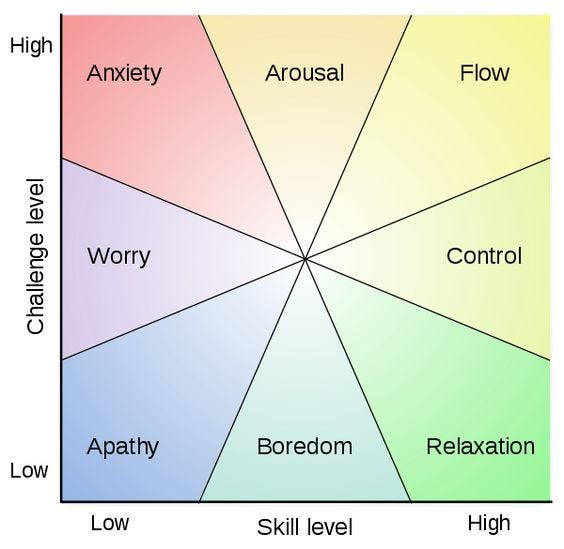
“Flow” is the meeting point between the right amount of challenge and someone’s skills, for one not to feel too much stressed nor bored.
According to Csikszentmihalyi, “Flow” can be recognized through eight characteristics:
- Complete concentration on the task;
- Clarity of goals, reward in mind and immediate feedback;
- Transformation of time;
- An intrinsically rewarding experience;
- Effortlessness and ease;
- A right balance between challenge and skills;
- Actions and awareness are merged, losing self-conscious rumination;
- A feeling of control over the task.
The state of “Flow” embodies our passions. It is one of the real doors to happiness, as well as the one to a deep awareness of the present moment.
Find what leads you to the “Flow.” Try out as many things as possible, and just find out. But at the same time, don’t prevent yourself from getting carried away. Surrender to it. Don’t always try to control everything. Merge in the activity. Disconnect from reality. Stop holding on to it. Those mistakes are the ones that got me.
When we can merge in the “Flow,” we no longer try to pass the time. Instead, we surrender in getting carried away by it, while at the same time forgetting its existence.
“Most enjoyable activities are not natural; they demand an effort that initially one is reluctant to make. But once the interaction starts to provide feedback to the person’s skills, it usually begins to be intrinsically rewarding.” — Mihaly Csikszentmihalyi
Unlock Your Best Life, get my free 5-day course via email → https://bit.ly/388XW0t
Other stories you may like: