Finding a Crossroads of Faiths In Cordoba
How different faiths contribute to creating a fantastic culture
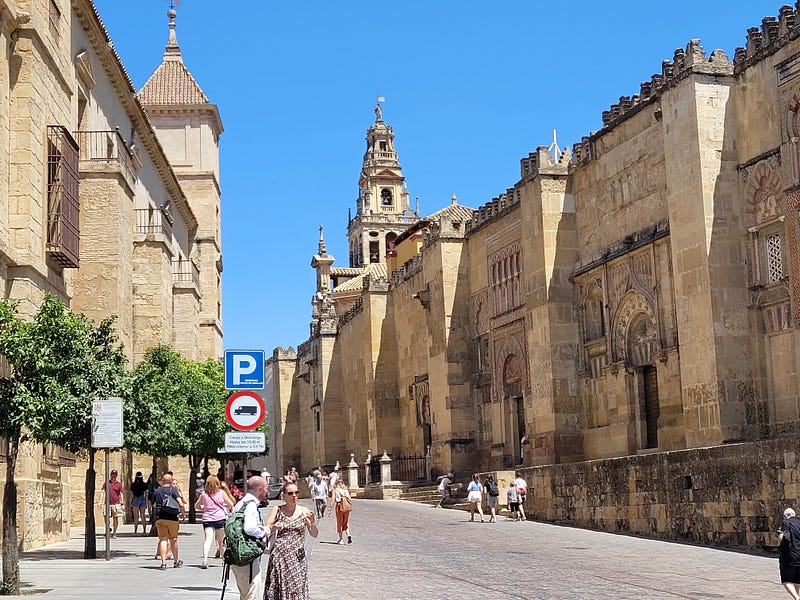
In the Summer of 2022, I took some of my students to Spain. Our tour took us to Madrid, Cordoba, Seville, and Toledo. I’ve written about my experiences in Toledo previously. The ancient city has a beautiful cathedral and thousands of years of history.
Cordoba is another tremendous Spanish city that has a rich history. The town also boasts a cathedral, which differs from Toledo’s. The cathedral was also a mosque at one point, and the mixture of the two cultural traditions is everywhere. We took a guided tour of this massive building and gained a new perspective on the history and culture of Spain.
Cordoba started as a Roman settlement and then grew under the Visigoths. A church was built on the site that may have been home to an ancient Roman temple. Following the Ummayyad conquests, the Christians and Muslims agreed to share and co-exist in the city. The church was demolished, and a grand mosque was built in its place. In return, the Christians were allowed to rebuild other churches destroyed during the conquest.
The Great Mosque was built between 785 and 787 CE. The building employed features of Syrian, Roman, and Visogothic building styles. This points to a multi-ethnic workforce and shows how the groups attempted to work together.
One of the most striking features of the building is the alternating colored arches and columns. The bricks alternate between red and grey. This is due to the materials being red-clay bricks and concrete. This alternating stone allowed the stone to expand and shrink as the weather changed without compromising the structure of the building. It is an excellent example of practicality and aesthetically pleasing craftsmanship.
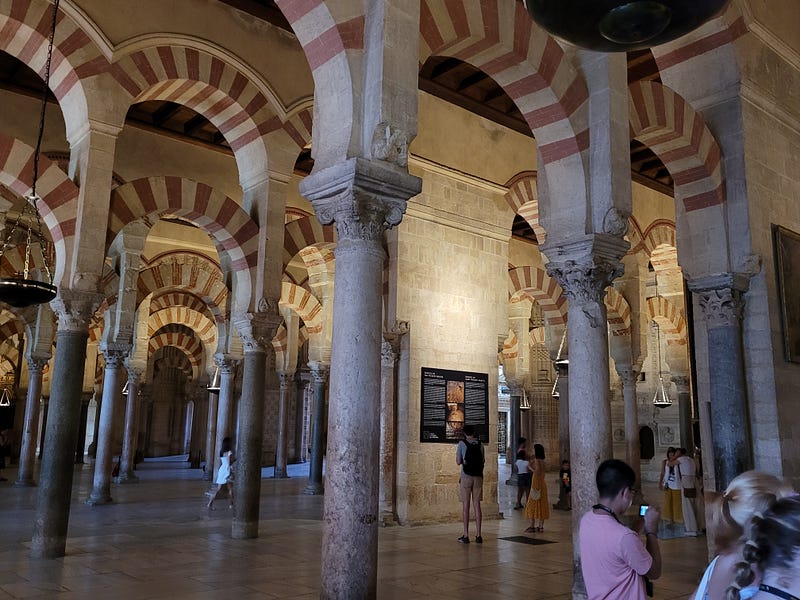
Walking through the cavernous hypostyle hallways of the building, it was easy to see the combination of each religion’s influence. Some areas can serve as mosques with open spaces for prayer rugs, while just around the corner can be an altar dedicated to a Christian saint.
The mosque went through several renovations and expansions over the centuries. During the 13th century, Spain experienced a period known as the Reconquista. During this time, Christian kingdoms began to conquer Muslim-held territories. In 1236, Ferdinand III of Castile captured Cordoba. That same year, the Great Mosque was converted to a cathedral and dedicated to the Virgin Mary (Santa Maria).
The Christian leaders made a few alterations to the mosque besides installing some small chapels. The workers in charge of maintaining the cathedral were Muslim workers who worked for the previous regime and worked on the cathedral twice a year as a tax.
One significant change to the cathedral was the construction of the bell tower. In 1589, an earthquake caused damage to the minaret, which had served as a bell tower. It was decided to repair and rebuild the tower as a more contemporary structure. Much of the tower’s lower levels are from the original minaret, making the bell tower a combination of both cultural traditions.
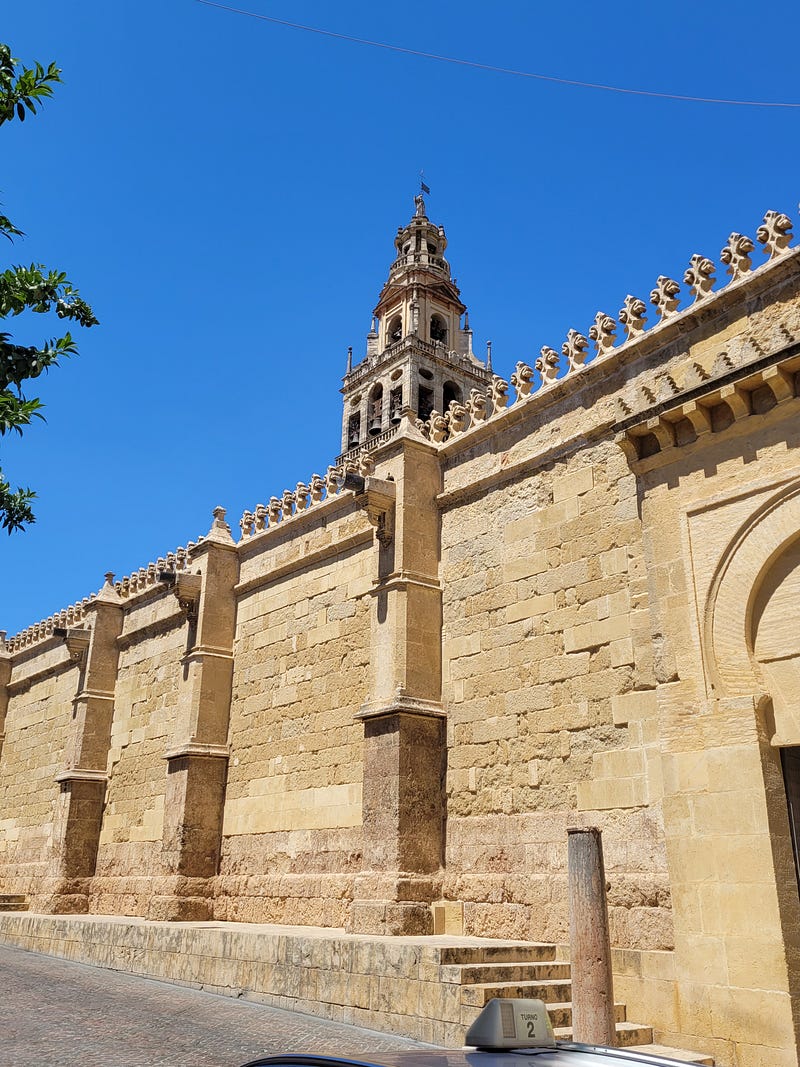
It is a testament to the Cordoba that one can see the blending of these two cultures. For a brief period of time, people of different faiths could get along relatively well during a period of religious tension.
As the years went on, the building became known as the Mosque-Cathedral and was also referred to as the Mezquita to recognize its former status as a mosque. In 1984, it was declared a UNESCO World Heritage Site.
When I left Cordoba that day, I gained a new appreciation for the ability of people to co-exist. Spain has a fascinating history regarding the Christian, Jewish, and Muslim faiths. We can see it in the food, language, and architecture. And in Cordoba, you can see it in the city’s most important center of worship.
Cordoba is one of many places where you can see the interaction of various religions. Check out Rhonda Carrier’s exploration of the holy sites of Jerusalem.
You can also read about Jillian Amatt - Artistic Voyages adventure visiting a mosque during lockdown.
I like to write about various topics, including history, books, travel, and wrestling.
You can Buy Me a Coffee here.
My new novel, What the Dew Might Bring, is available here.