
Find Your Killer Morning Writing Routine to Get to the Next Level
It doesn’t have to be hard to get up and write stuff

The world is a big place, and there are probably a few weirdos out there that naturally leap out of bed every day, then hammer out 1000 words before breakfast as easily as they grow skin. These lucky individuals have no idea what it’s like for the rest of us as we slid out from under the sheets and force ourselves to walk the few steps to the washroom with sleep encrusted eyes.
For most, the killer morning routine had to be built from scratch. It didn’t come naturally. I’m never content doing things the hardest way possible, so I looked for a way to streamline it. I hacked my way to a better morning like an adventuring archaeologist looking for the lost city of gold in the Forest of Ubangme.
I found that I need to make things as easy as possible, lowering the barrier to entry for my killer morning. After I wake up, almost anything that requires willpower or decision making is going to fall flat. To smooth the way, I make all of the decisions the night before. That way, when I stumble out of bed before the sun is up, I just go straight into my morning flow.
Let me show you how easy it is to get to that killer morning routine!
Now, don’t get alarmed
The first thing I did was set an alarm. No, not to get out of bed. This one reminds me to set up all the dominoes the night before so my morning goes off without a hitch. It’s easy to get distracted and vegetate on the couch until suddenly realizing it’s too late to do anything. I have done this countless times.
I pick a calm ringtone that I never use for anything else, and set it for 9:30 PM with the snooze turned on. When this alarm goes off, I know it’s time to get my morning prep done. I start by writing down the morning checklist. Even if it’s the same items every day, they seem to help me.
My routine is pretty simple. It’s all based around a 4 or 5 item to-do list in my journal. I’ve tried more complicated things, but I just keep going back to simple old pen and paper. Why? Because it’s easy and quick. Anything hard, complicated or time consuming ends up not getting used. Keep it simple, silly human!
Here’s my checklist:
- yoga 15 minutes
- meditation 15 minutes
- write 1 hour
- coffee (toast) break 15 minutes
- write or edit 1 hour
- **** important daily tasks **** (whatever is going on)
Right now I’m laid off from regular work, or otherwise the morning would look a lot different. I’ve adjusted it to reflect extra time for writing.
Notice that email, news articles on the phone, Disgracebook updates, and other distractions are not on this checklist. I’m asking myself to forget all of that until after I get the writing done.
But wait! The night-before prep time isn’t over yet. This next part is the most important piece of the puzzle.
Want writing to be easier? Set yourself up
Pick your topic the night before. That way you aren’t going to sit in front of an empty screen with an empty brain, coming up dry. And don’t stop with just an idea. Outline it in rough bullet points or a few sentences. Just write down a few ideas about your topic. If you want to work on an article, get some main talking points ready.
For a novel, write down your next chapter and plot ideas. Where are you in the story? Get your rough chapter outline on paper before bed.
For nonfiction book writing, the same thing applies. What’s next in the book? Outline it in bullet points or header sentences.
If you need help brainstorming, you could try mind mapping your idea the night before, which is how I do it:
Don’t skip this step of choosing your writing topic. If you preload your wetware with ideas and then sleep on it, the old brain factory gets to chew on it all night. In the morning, the subconscious is ready to get down to business. He probably looked around in the basement, the attic and under the stairs of your cranium. He dragged out a bunch of storage boxes and dusted off thoughts you forgot you ever had. It’s amazing what a little warning and prep time can do for your writing abilities.
Set up your workspace the night before too. Your laptop, desktop computer or paper writing tools should all be laid out and waiting for you when you crawl out of bed. Put your topic notes beside your laptop. Sometimes I use headphones, so I make sure I have them handy instead of having to search the entire house in the dark.
If you own a lucky rock, put that there too. I did.
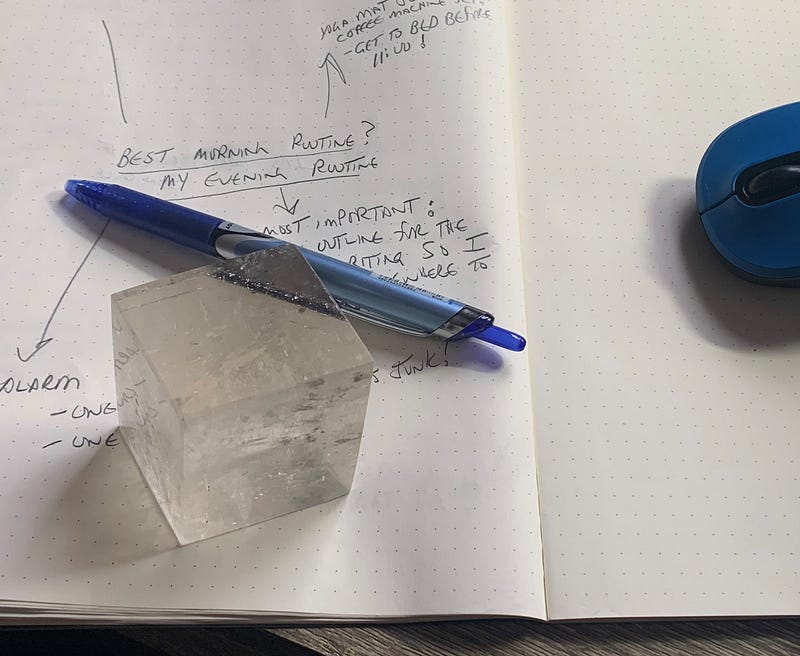
What other tools will you need for the morning? I do yoga first thing, so I spread my yoga mat out the night before and put my meditation cushion beside it. I also prep the coffee maker so all I need to do is push the on button when I walk toward the office.
Don’t forget to set the morning alarm
If you don’t get up, all your preparations are for nothing. So set an alarm, and make it annoying.
An extra step to take if you have a significant other in bed with you is to let them know you will be getting up, and ask them to help. If they wake up too, they can gently pace their feet on your body and shove you toward the edge of the bed with loving determination, until you fall off and hit the floor.
Let the morning begin!
If I have a plan, I’m 83% more likely to get up
The night before prep is a gamechanger for me. Just having the plan means I’m probably going to see a point in rising a little early. If there’s no plan, then why not just sleep longer in my warm bed? Everything can wait if there’s no sense of urgency.
During this uncertain time when I keep getting laid off due to Covid 19, It’s hard to maintain a schedule for writing. I need to be able to make my own way through the day, and this routine lets me do that a lot better. I don’t want to just float along waiting for someone to save me.
Eventually, when I have a regular scheduled job to go to again, this will be even more important. It’s hard to find an extra half hour in the morning to write before the commute. I need everything to be ready and set up for success. I don’t want to waste time thinking of ideas instead of getting down to the business of wordsmithing.
I urge you to give this a try
Plan your morning the night before. Eliminate all the obstacles you can. Preload your subconscious mind with prompts and ideas. Put your lucky rock in a prime location. Then get up and kill that morning!
I love feedback! Talk to me. What is your morning routine? Or do you write in the evening? What makes you more productive?
If you need some humor in your life, look no farther. Here’s an alien hot sauce recipe made using only organic vegans:


