Film Review — Priscilla
Cailee Spaeny is a revelation in the titular role of Sofia Coppola’s compassionate biopic
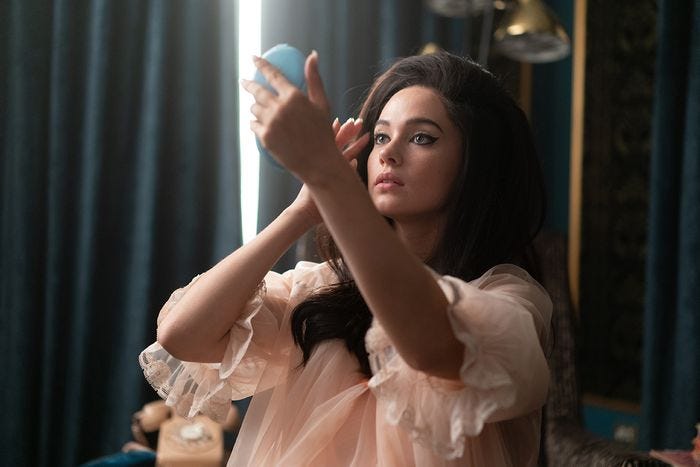
Interest in the King of Rock and Roll was reignited in 2021 with Baz Luhrmann’s energetic, flamboyant Elvis. Sofia Coppola pulls the opposite trick with Priscilla; a low-key, intimate, subtle, yet potent examination of young love degenerating into pseudo-gothic marital entrapment.
It’s a story seemingly tailor-made for Coppola, whose back catalogue is studded with similar tales of lonely characters trapped in gilded cages. Her signature style of melancholy romantic longing blended with a mature, non-judgemental compassion for her characters shines through every frame of her take on Elvis and Me by Priscilla Presley and Sandra Harmon. Not a director to draw attention to herself via overly complicated camera movements, she nonetheless makes immensely shrewd shot choices, immersing the audience in Priscilla’s perspective and experience.
The isolation Priscilla (Cailee Spaeny) feels is inherent from the very start before she even meets Elvis (Jacob Elordi). As the stepdaughter of Captain Joseph Paul Beaulieu, stationed at a US military base in Germany (her real father died shortly after she was born, and her mother Ann remarried), Priscilla is friendless and alone, missing her native Texas. Here, at the tender age of fourteen, she is introduced to Elvis during his military service. In contrast, he is twenty-four, and already an international music sensation.
Here, the film simultaneously invites empathy for all concerned whilst inherently acknowledging, without any smug sense of moral superiority, the strangeness of the situation. It makes clear that sexual interaction did not take place until later years, but at the same time, the film doesn’t shy away from the fact that Priscilla was still a minor when she went to live in Graceland. With Elvis often away shooting films, she’s left with the strict control of his father and other members of the family, who denied her anything resembling a normal teenage life.
For instance, she is forbidden from inviting any of her school friends back to Graceland. Nor is she allowed to simply play in the garden with her dog, because she can be seen by crowds of Elvis admirers at the gates. She lights up the moment Elvis is home, yet when he isn’t present, there’s something of Daphne Du Maurier’s famously nameless protagonist in Rebecca about Priscilla, as she sits alone in opulent surroundings, with carpets and clothing embossed with Elvis’s initials. She’s there to “keep the home fires burning”, as Elvis puts it, not permitted to have a career, but to be his girl on his terms.
Although desperately in love, Priscilla finds herself increasingly unhappy. Gossip columns speak of Elvis’s rumoured romantic dalliances elsewhere, and the fact that Elvis refuses her sexual advances doesn’t help her feelings of insecurity. Nor does this come off as honourable pre-marital abstinence, as Elvis insists. Rather, his fetishisation of her “sacred” innocence and virginity feels creepy and hypocritical, considering he admits having sexual encounters with other women his age, which in his own words, made it OK. It all paints his obsession with Priscilla in a rather disturbing light, even though he does eventually marry her and consummate the relationship.
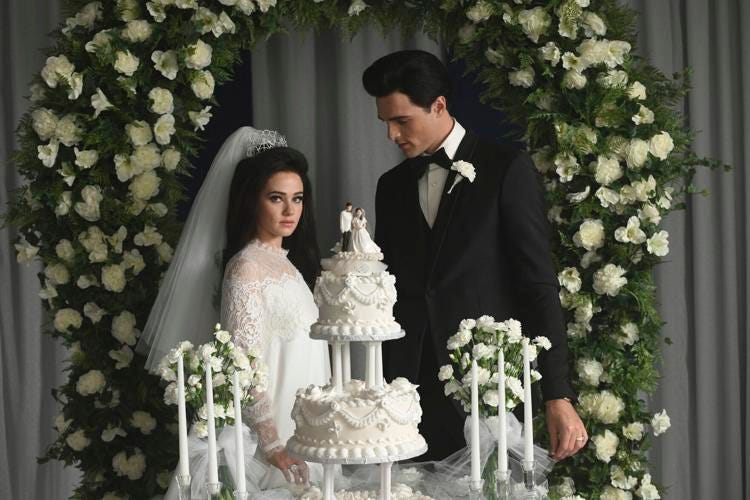
Still, although Elvis is portrayed as a darker, more dangerous character here, prone to sudden bursts of violent anger, this element of the film isn’t overdone. Nor does it invite loathing for the character, casting him as an abusive groomer and her as an outright victim, as a lesser film would. Rather, it paints a deliberately incomplete picture of the legendary singer, with Elvis rightly at the periphery of the film rather than the centre. Coppola trusts her audience already knows the bigger Elvis story, especially his pill-popping problems, and the Faustian dealings with Colonel Tom Parker; a man generally considered to be the villain in the Elvis Presley story. Here, he isn’t seen onscreen, but the Colonel’s presence is felt, as he initially urges Elvis to keep Priscilla under lock and key, and out of the press.
Instead of dwelling on such matters, the film stays with Priscilla’s experience. Her relationship with Elvis is sometimes one of swooning, heartfelt, lovesick ecstasy, especially in earlier scenes. But she longs for him to be home, longs to go and see him in Hollywood, then regrets doing so, seeing his magnetic effect on other young women, and how he indulges them. One scene, in which Elvis reads a passage from the Bible to a group of flirty rapt admirers in front of Priscilla, is particularly skin-crawling as an indicator of the cult-like sway he held. In such moments, Priscilla remains lonely in a crowd. Coppola often keeps the camera on her face, as Elvis and his entourage laugh and joke offscreen. Subtle facial movements indicate just how shut out she feels, whilst maintaining her outwardly smiling and glamourous demeanour, all of it obsessively overseen by Elvis.
This is as good a point as any to state that Cailee Spaeny is superb in the titular role. She particularly excels depicting Priscilla’s discomfort as she is visually transformed. A shopping scene where she models dresses in front of Elvis and his gang reminded me of a key scene in Vertigo (1958), when James Stewart obsessively supervises the makeover of Kim Novak. Although the scene is less intense than the one in Hitchcock’s masterpiece, as with that film, Priscilla has interesting observations to make about men transforming women into doll-like trophies, rather than taking an interest in who they really are. Yet in Priscilla’s case, she isn’t sure who she is, as she was only fourteen when she met Elvis. Her own identity is subsumed by the shadow of her husband’s ideas of what she should be, and concealed by her undeniable love for him. Only later does Priscilla start to ask these difficult questions.
Even when she goes to the hospital to give birth to her daughter, Lisa Marie, Priscilla first applies eyelashes and makeup, maintaining the image that has been fed to her through a 1950s culture of women’s magazines providing tips on pleasing your man. Both she and Elvis are shaped by said cultural forces. It was a different time, and all that; one where a man telling a teenage girl’s father that she is “mature for her age” wouldn’t necessarily raise quite the same alarm bells as it would now. As such, Coppola excels at dipping into these knotty grey areas, whilst cleverly portraying the gradual emergence of a young woman’s self-discovery and emancipation. This transformation is subtly hinted at in the evolution of Priscilla’s wardrobe (for example, the way she eventually starts wearing clothes Elvis earlier said he disliked).
In closing, it’s worth noting another bold choice made by Sofia Coppola: Her almost total omission of any Elvis Presley music. Aside from a brief instrumental piano riff of Love Me Tender, the decision to give Priscilla its own musical identity mirrors that of the film’s protagonist’s quest for identity. In that respect, deliberately anachronistic contributions from The Ramones, Dan Deacon, Sons of Raphael, and others, as well as more period-appropriate tunes, provide a fine musical commentary throughout.
The Dillon Empire beyond Medium