Film Review — Elvis
Austin Butler stuns as the King in Baz Luhrmann’s flamboyantly entertaining biopic.
Baz Luhrmann films are often divisive, provoking a Marmite-style love/hate divide. I am firmly in the former category. Romeo + Juliet is astounding. Strictly Ballroom and Moulin Rouge! are among my all-time favourites. His much-derided take on The Great Gatsby is also massively underrated, in a Baz-Luhrmann-remix sort of way. I even enjoyed the everything-and-the-kitchen-sink Australia.
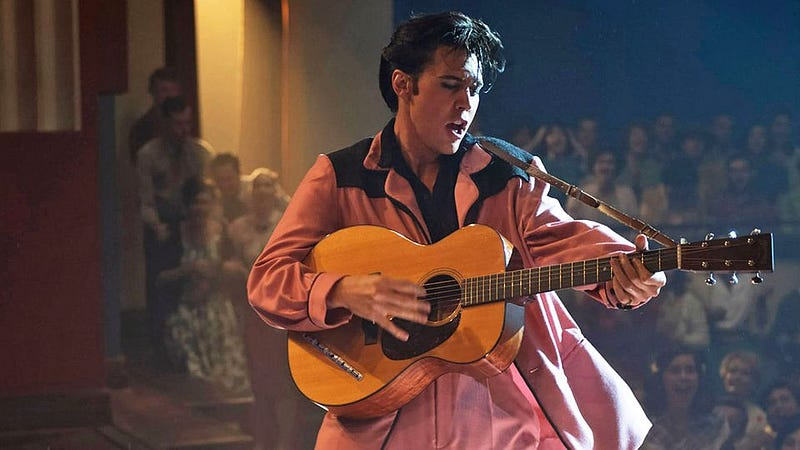
Elvis is a Luhrmann film through and through, employing rapid-fire editing, dream sequences, animation, swooping camera moves, and deliberately anachronistic music, whilst rattling along at a cracking pace with his singular flamboyance and style. Those who enjoy his schtick will doubtless find much to entertain here, especially those who are also fans of Elvis Presley (brilliantly portrayed here by Austin Butler). The film thunders through Presley’s entire life, but is told through the eyes of his manager, the notorious Colonel Tom Parker (Tom Hanks). In flashback, Parker speaks of how history painted him as the villain in the Elvis story and seeks to refute that claim. But Luhrmann makes him the villain nonetheless; especially highlighting Parker’s merciless financial exploitation of his star to fund his gambling debts, and how he kept Elvis tied to Las Vegas, never letting him tour outside America.
However, before we get to all that, Luhrmann touches on other key points in Elvis’s life and career. These include his early days, his relationship with his family (especially his mother), lightning-in-a-bottle singular popularity, how his dance moves got him in hot water with segregationists and moral guardians, his time in the army, the marriage to Priscilla (Olivia DeJonge), the Hollywood films, and his later musical comeback, culminating in the aforementioned Vegas years. These events are covered with pop video speed, and I daresay the film indulges in a bit of historic licence (I don’t know enough about Elvis’s history to comment). However, judging by what I’ve heard from Elvis fans, it sounds like Luhrmann gets the important stuff right.
From my perspective as a cineaste, this is a colourful, vibrant, absorbing piece of work; a kaleidoscopic ride that nonetheless has depth, getting under the skin of its subject in a number of important ways. Firstly, I was pleased to see Luhrmann make abundantly clear how Elvis’s musical style came directly from African American gospel and R&B, with him both supporting and exploiting their music. Black singers such as BB King (Kelvin Harrison Jr) were a vital influence, as were the gospel choirs and big tent revival meetings he attended as a child. In one telling moment, when Elvis confides in BB King that he’s worried he’ll be jailed for moving the way he does, King tells Elvis a white boy like him is too much of a money-spinner to put in jail, whereas they might arrest him for crossing the street. The point is understated but clear.
Secondly, the film does a good job of portraying Elvis’s descent into drugs hell, with all the pill-popping you’d expect, but with a specific focus on Parker’s manipulations, exploitation of fears, and financial blackmail in keeping Elvis tied to the US. It is particularly distressing seeing Elvis’s ineffectual former convict father (Richard Roxburgh) doing nothing to protect his son from Parker’s parasitic actions. Speaking of Parker, Tom Hanks is something of a latex-enhanced pantomime caricature, but his performance is undeniably entertaining.
Thirdly, as a film, Elvis is clear-headed about the price of fame, wisely depicting how, despite all his success, Elvis felt unfulfilled, especially since he wanted at one point to be a serious actor. All of this wouldn’t work without a convincing lead, and Austin Butler is simply sublime. His Elvis is essentially decent and humane, but vulnerable, naïve, fearful, and often deeply scarred by tragedy — both personal (the untimely death of his mother) and political (the Martin Luther King and Kennedy assassinations). He is also in thrall to his audience, addicted to adulation, seemingly possessed of near-supernatural purpose; an icon whose culture-defining music and performance sent shockwaves throughout the entertainment industry that continue to be felt to this day.
On that point, fourthly and most emphatically, this is a film that explores Presley’s destructive relationship with his live audience. These scenes are among the most electrifying in the film, with Presley causing girls to scream and lustfully worship him in a way he initially doesn’t comprehend, but that becomes addictive. He is as hooked on his audience as much as they are on him, but the audience becomes insatiable. There’s a predatory, dangerous undercurrent to these scenes, as his fans all but devour him.
It goes without saying that the music is superb, with several Elvis hits included, along with all the modern remixes, fusions, and new tracks one expects from Luhrmann (including contributions from Doja Cat, Eminem, CeeLo Green, Swae Lee, Diplo, Måneskin, and various others). There are flaws. Despite a 159-minute running time, the film sometimes feels rushed. I also wish we’d seen more from Priscilla, but DeJonge does very well in what is a largely thankless role. Such nits aside, for my money, Elvis is an opulent, entertaining, satisfying piece of work, featuring Luhrmann on top form, and a standout performance from Austin Butler.
This article was originally published at Simon Dillon Books. For more about me and my writing on Medium, please click here. For a list of my published novels and other works, please click here.