Film Review — No Time to Die
My spoiler-free verdict on the latest, long-delayed James Bond film.
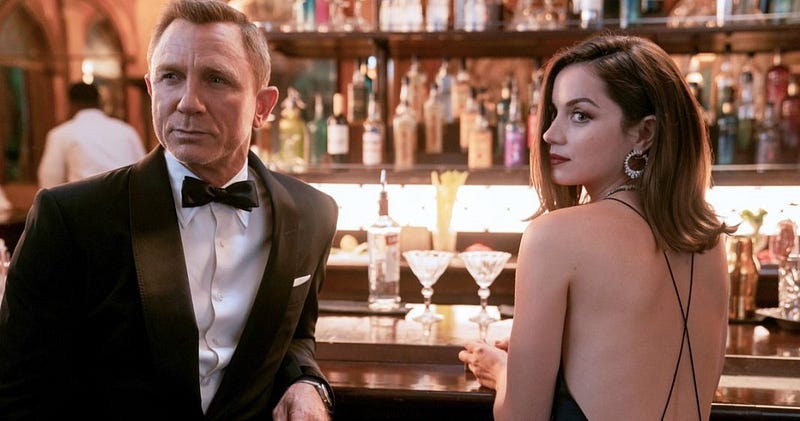
This review will be entirely spoiler-free, with no discussion of plot specifics. I should add that I recommend seeing No Time to Die as quickly as possible, as I suspect the internet will soon be swamped with thoughtless memes, social media posts, and the like, ruining the surprises of this film. To be clear: That isn’t necessarily an endorsement of every single shock turn this film contains (and there are several). It is simply a statement of my belief that it is better to come to this film with no prior narrative knowledge.
What I will say is that the much-delayed No Time to Die is a fitting end to the Daniel Craig James Bond era. When Craig inherited the role with Casino Royale, there was a real sense of the rule book being torn up. James Bond felt dangerous again. It had a jeopardy and physicality that had long since been absent. As the Craig era evolved, honoured conventions were broken, but they were broken for the right reason: to replace them with something better. This is an important screenwriting principle, and was put to great use particularly in Casino Royale and Skyfall. No Time to Die isn’t in the same league for a variety of reasons, and one of them is I’m torn on whether it breaks a convention too far. I’ll have to revisit the film before I have a definitive answer.
Performance-wise, Daniel Craig is superb. His Bond has always been a far deeper incarnation of Ian Fleming’s spy, delving into the darker aspects of what was on the page. Craig’s Bond has never been a flippant caricature but a damaged, often vulnerable character, who actually shows his feelings. That isn’t to say he wasn’t every bit the bruising, brutal, cold-blooded, vodka-martini drinking killer with whom we are familiar. Here he even gets a post-kill quip worthy of Roger Moore. At any rate, although it will doubtless prove divisive, this film is a fine swansong for Craig.
Returning Bond alumni Ralph Fiennes, Rory Kinnear, Naomie Harris, Jeffrey Wright, Ben Whishaw, and Christoph Waltz all contribute fine support, as M, Tanner, Moneypenny, Felix Leiter, Q, and Blofeld respectively. Joining them is Lashana Lynch; excellent as Nomi, another 00 operative. We also get Ana de Armas as Paloma. I wanted to see more of her hugely entertaining character, though I understand why this film’s narrative demands meant that wasn’t possible.
Of course, we also get the return of Lea Seydoux as Madeleine Swann. Her ongoing relationship with Bond, inherited from the previous film Spectre, marks another first for the franchise. In the villain stakes, we get Rami Malek’s character Lyutsifer Safin (quite close to “Lucifer Satan”), and the usual rogue’s gallery of henchmen and treacherous assistants. Some have criticised Malek as not being a particularly memorable villain, but I thought he delivered the required sinister menace.
Beasts of No Nation director Cary Joji Fukanaga isn’t a visual stylist on a par with Sam Mendes, who helmed the previous two Bonds. Nonetheless, he makes good use of locations — including Jamaica, Italy, and Norway — and delivers some solid action set pieces. Some of these involve enjoyably outlandish gadgets, despite Q telling Bond in earlier Craig films that they don’t really go in for the exploding pen sort of thing anymore.
There are also some startling horror-ish moments, recalling everything from Halloween to The Silence of the Lambs. These heighten the usual over-the-top hokum, with nods to several previous Bonds including Dr No, Licence to Kill, and On Her Majesty’s Secret Service. Music from the latter is also quoted in key moments, with Hans Zimmer on scoring duties, and Billie Eilish performing the title song. All those elements work well enough, though I still miss John Barry.
I must admit I’d love to know what Danny Boyle and screenwriter John Hodge would have made of No Time to Die. They had been set to make the film, before pulling out over apparent creative differences. I’m very curious to learn the specifics. As it stands, we’ve no way of knowing, at this point, how much of their involvement carried over into the final version of the screenplay, penned by Bond regulars Neal Purvis and Robert Wade, with input from Fukanaga.
Also, there has been much ill-informed foolishness in the media about Phoebe Waller-Bridge giving the script a polish. No, she hasn’t made James Bond “woke”. Nor is a woman writing Bond an unprecedented occurrence. It happened on the very first Bond film Dr No, with Johanna Harwood and Berkely Mather (as I mention in this piece). Harwood also polished several other earlier Bonds, often uncredited. Media claims of a “woke” agenda are condescending nonsense, and sexist knee-jerk reactions to such claims are equally irksome, considering that for decades, the Bond franchise has gradually made the female roles more nuanced and interesting, without compromising Bond’s character or pretending the series is an advertisement for radical feminism. It is impossible to tell who wrote what in the final script in any case, so I’d say Waller-Bridge did a very professional job.
On that note, I will say that No Time to Die is still percolating in my consciousness. It will certainly divide fans, and at the moment, I’m sitting on the fence concerning one particular aspect of the film. Another viewing or two should settle the matter in my mind. In the meantime, as I mentioned at the start of this review, see it as soon as possible, before some nitwit on social media spoils it for you.
This article was originally published at Simon Dillon Books. For more information about Simon Dillon on Medium, click here.