Feature
Has James Bond Finally Met His Match?
Why ‘No Time to Die’ can’t afford to be anything less than a box office smash, plus a glide through the history of 007 films.
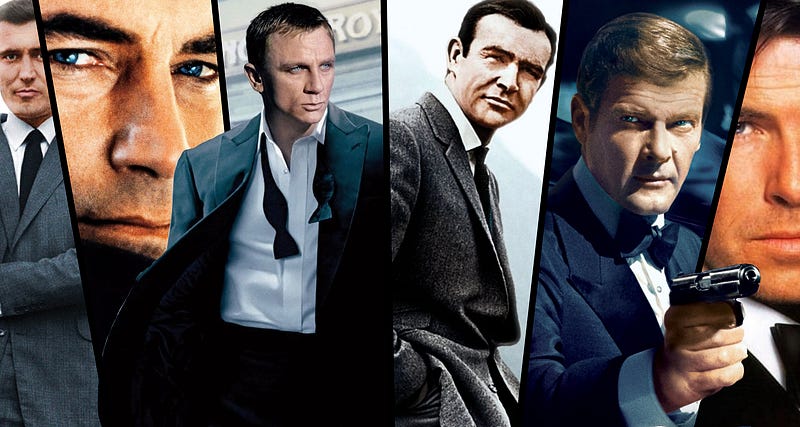

There’s nothing quite like James Bond in cinema history. For close to seven decades, the adventures of debonair British secret agent James Bond 007, who likes his vodka martini shaken but not stirred, have captured the imaginations of audiences eager for a fix of spy thriller escapism. Portrayed by several actors in several different eras, the character hasn’t changed much, despite the world and society changing a great deal. There have been 24 Bond films, grossing around $7BN globally (unadjusted for inflation). The Bond formula seems timeless and as popular as ever, yet that popularity is about to be put to the ultimate test.
With the upcoming release of No Time to Die (2021), the much delayed 25th official Bond film, all eyes are on Cary Fukunaga’s film to see if it delivers, both in terms of creative quality and box office success. The latter is a particularly crucial test, given the recent COVID-19 accelerated tug of war between online streaming and cinema viewing. When Amazon purchased MGM, there were concerns amongst old-school fans (including yours truly) that Bond would be watered down into lowest common denominator “content”; no longer a treat every few years on the silver screen, but strip-mined for interminable TV series spin-offs — cutting open the golden goose, so to speak. Perhaps we’d get a Moneypenny thriller, a Q adventure, or M’s backstory series? Given how the rest of Hollywood seems hellbent on copying Marvel Studios and putting everything inside a “universe”, I’m alarmed this could happen to James Bond.
Thankfully, for now at least, Eon Productions have put the kibosh on talk of such nonsense. With the rights still in the hands of Barbara Broccoli and Michael G Wilson, both insist that Bond will remain on the big screen only , without any of this simultaneous platform release experimentation that potentially threatens the future of cinema epics like Denis Villeneuve’s Dune (2021). But how much can we trust in such resolve?
Per the tagline for A View to a Kill (1985), has James Bond finally met his match?

Origins
The James Bond novels were written by author Ian Fleming, starting with the publication of Casino Royale in 1953. Fleming conceived Bond as pure escapism, but his background in naval intelligence informed many of the Cold War thrills contained therein. Bond was an instant hit with book readers, who devoured Fleming’s fast-paced, sex and violence-packed adventures. A film adaptation was inevitable.
Enter producer Albert R. “Cubby” Broccoli, Harry Saltzman, and Eon Productions. They developed Dr No (1962) after forming a partnership, but initially found Hollywood resistant because studio bosses found the project “too British” and “too blatantly sexual.” But, eventually, United Artists greenlit the movie. Saltzman and Broccoli signed Terence Young to direct, in view of his previous work with Broccoli’s production company Warwick Films. Rather amusingly, Young had directed an earlier movie entitled No Time to Die (1958), about an American sergeant seconded to the British during World War II.
Richard Maibaum adapted Fleming’s novel into a screenplay, tweaking some elements and adding a few new ones, but generally keeping the essence of the original narrative. As the series progressed, the films stuck less and less to their literary source material, but initially the movies bore a decent resemblance to Fleming’s work. Maibaum went on to write or co-write most of the Bond films, up until Licence to Kill (1989). It’s also important to credit Johanna Harwood and Berkely Mather for their contributions to polishing the final draft of Dr No, as they ensured the film retained the British nature of the protagonist.
Broccoli, Saltzman, and Young oversaw the establishment of many key elements that would come to define the 007 series. These included Ken Adam’s phenomenal production design and, of course, the all-important casting of Sean Connery in the lead. Connery ultimately starred in six official Bond productions — excluding Never Say Never Again (1983), which was an unofficial remake of Thunderball (1965) due to an ongoing legal dispute with the novel’s co-writer Kevin McClory that took decades to resolve.
The supporting cast in Dr No included Bernard Lee as Bond’s boss M; the best M for my money. His grumpy personality is superbly established as someone grudgingly tolerant of Bond’s antics because he’s clearly excellent at his job. Equally excellent is Lois Maxwell’s secretary Moneypenny, with whom Bond constantly flirts with in her office. Again, their banter became a regular feature throughout the series. Bond’s CIA pal Felix Leiter, another series regular, also appeared for the first time in Dr No, played here by Jack Lord. Other key cast members included Ursula Andress as the all-important leading ‘Bond Girl’, even though her lines were later dubbed over by vocal actress Nikki van der Zyl after concerns about Andress’s heavy Swiss-German accent. Last but not least, Joseph Wiseman was cast as the eponymous villain, Dr No.
Establishing the Formula
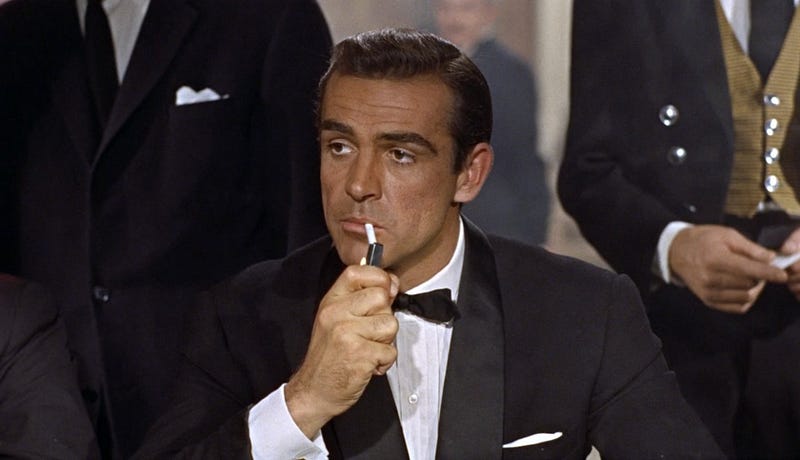
Needless to say, Dr No was a smash hit. From the moment Bond first appears, playing Chemin De Fer in a casino club opposite the glamorous Sylvia Trench (Eunice Gayson), announcing himself with panache as “Bond, James Bond”, Connery immediately exudes the danger, charm, charisma, and sex appeal that has made Bond iconic. For my money, Connery is still the greatest Bond; which is hardly a controversial or unpopular opinion, although there are strong cases to be made for some of the subsequent leads.
Bond’s thrilling investigations are tense, gripping, and sometimes shocking — from near-death by a deadly spider in bed, to Bond’s merciless gunning down of the treacherous Professor Dent (Anthony Dawson). On top of this, Wiseman makes a wonderfully sinister villain, setting a high benchmark for Bond adversaries by posing a genuine threat. Bond is tested to the absolute limit, often rising to the challenge without his signature gadgets but more lo-fi innovations (like a strand of hair stuck to a door to alert him if anyone has entered his hotel room, or his ingenious escape from a prison cell).
With the success of Dr No, sequels were inevitable. From Russia with Love (1963) and Goldfinger (1964) soon followed, and audiences returned in droves. There was nothing else quite like Bond in the 1960s, and the popularity of the franchise soared. Both sequels helped establish the formula, with the now customary pre-credits sequence immediately throwing the viewer into the heart of the action. In the case of From Russia with Love, Bond is stalked and garrotted by assassin Red Grant (Robert Shaw), only it turns out to be a man in a Bond mask used as a live target by ruthless secret organisation SPECTRE. In the case of Goldfinger, the pre-credits sequence involves an iconic moment where Bond emerges from underwater, stripping off his diving gear to reveal a perfectly pressed white tuxedo. A spot of explosive infiltration later and he’s in the arms of a duplicitous woman, only to end up in a brutal fight with another villain, who winds up dead in an unfortunate bath/electricity interface. “Shocking,” Bond deadpans, “… positively shocking.”
Directors Terence Young and Guy Hamilton, respectively, offered slightly different visions of what a Bond film could be, whilst consolidating and establishing the parameters of the 007 formula. In Young’s case, with From Russia with Love, the emphasis was on Cold War espionage, with SPECTRE playing East and West against one another to obtain a valuable decoder. The film also introduces evil, mysterious Ernst Stavro Blofeld; the iconic, cat-stroking SPECTRE mastermind whose face is cleverly not revealed for another four films. Young also made great use of outdoor locations, specifically a pre-tourist trap Istanbul, as well as Venice in the finale.
Bond is assisted by Istanbul head of station Ali Kerim Bay (Pedro Armendariz), establishing another Bond tradition. Typically Bond’s head of station colleagues wind up dead, as is the case here, but Bay’s working relationship with Bond is closer than most. Leading lady-wise, Daniela Blanchi plays Tatiana Romanova, who like Bond is manipulated by SPECTRE in their deadly games. On villain duties, in addition to the lethal Grant, we get Machiavellian Chessmaster Kronsteen (Vladek Sheybal) and SMERSH defector Rosa Klebb (Lotte Lenya), whose poison-tipped shoe daggers prove a deadly challenge during a last act dust-up with Bond. (“She’s had her kicks.”)
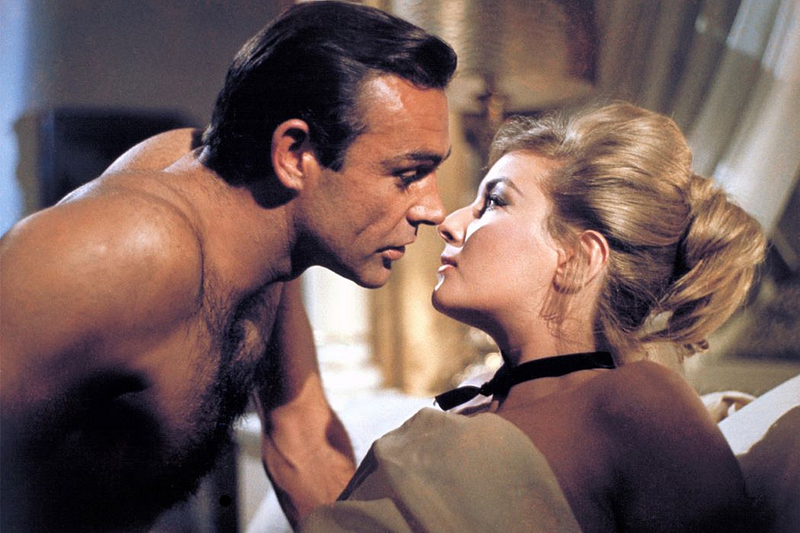
Speaking of fights, the stand-out action scene in From Russia with Love is a phenomenally choreographed confrontation between Grant and Bond inside a moving train. With a bigger budget than Dr No, Young also had scope to include some vehicular carnage, including a helicopter attack and boat chase. But despite this, the emphasis is more on atmosphere and Cold War intrigue than grandiose stunts.
By contrast, Goldfinger’s Fort Knox heist plot is far more outlandish. It features a hugely memorable villain and henchman, in the form of Auric Goldfinger (Gert Frobe) and his deadly servant Oddjob (Harold Sakata) — whose razor-edged hat is inexplicably capable of severing a statue head. Bond almost suffers castration by laser in one of the series most beloved ‘he’ll-never-get-out-of-this-surely’ moments.
BOND: You expect me to talk?
GOLDFINGER: No, Mr Bond. I expect you to die.
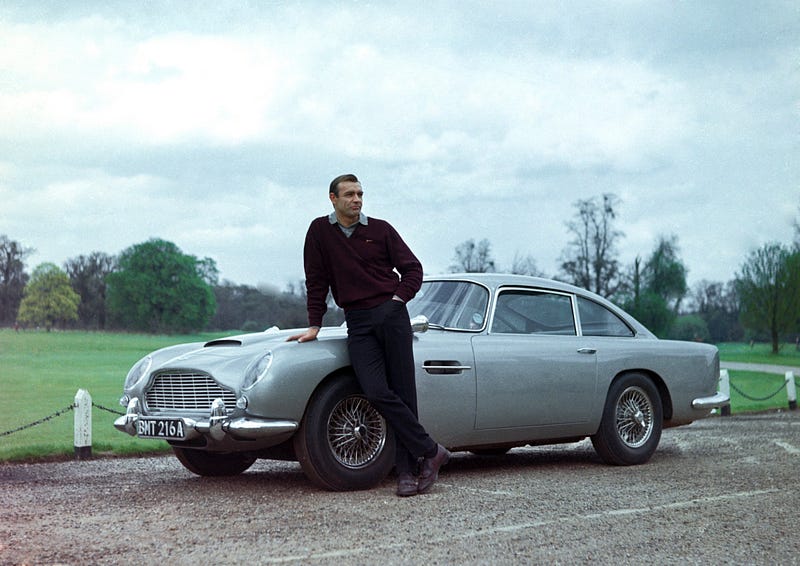
There are action scenes and gadgets galore, most memorably Bond’s iconic Aston Martin — complete with machine guns, oil slicks, tyre-slashers, smoke screens, and so forth. “Ejector seat? You’re joking!” Bond exclaims. “I never joke about my work, 007” Q replies. Speaking of Q, Desmond Llewelyn makes his second appearance here, after giving Bond a “nasty little Christmas present” briefcase in From Russia with Love fitted with daggers, bombs, and so on. However, Goldfinger was the film that introduced the idea of Bond’s relationship with MI6’s quartermaster being less than cordial. Their banter went on to become one of the funniest aspects of the franchise.
Legendary composer John Barry is another vital player firmly established by the first three Bond films. On Dr No, he was uncredited, though his arrangement and orchestration of Monty Norman’s James Bond theme are transformative to the point that, quite honestly, it might as well have been written by him. Barry gets full musical credit on From Russia with Love and Goldfinger, including his collaboration with Lionel Bart/Matt Munro’s title song from the former, and Shirley Bassey’s title song from the latter. Bond songs went on to become another vital part of the formula, often but not always clumsily shoehorning the title into the lyrics.
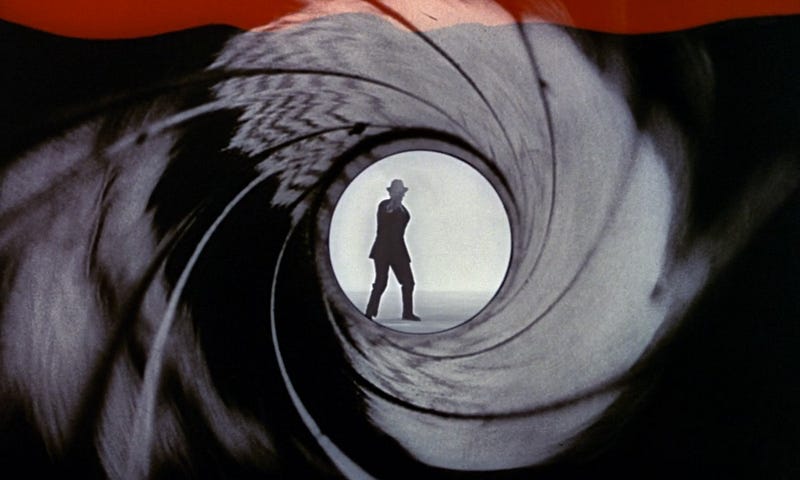
Another key contributor to the early Bond films was title designer Maurice Binder. He created the iconic gun barrel logo that opens almost every Bond film, and most of the title sequences that accompany the theme song (which normally involve a lot of shadowy naked women with text sometimes projected onto their bodies). Occasionally, clips of the films themselves appear during the titles. Roger Moore’s Bond also cropped up a few times in these sequences during his tenure. Binder was responsible for the titles in most of the first 16 Bond pictures, from Dr No to Licence to Kill, though Robert Brownjohn created the titles for From Russia with Love and Goldfinger.
Between them, From Russia with Love and Goldfinger are arguably the greatest Bond films on points, given their trendsetting work in establishing the parameters of the franchise. However, one other point they share, along with virtually every Bond film, is a portrayal of women that can be considered problematic — to say the least. Goldfinger in particular comes in for criticism on this front, considering the outcome of the plot essentially depends on Bond’s ability to seduce and “convert” Goldfinger’s lesbian pilot Pussy Galore (Honor Blackman). One particularly notorious scene sees Bond all but force himself on Pussy. It’s an element inherited from the novel, and the film tries to play the scene for laughs, but it remains an uncomfortable moment.
Accepting that the Bond franchise is a fantasy, a product of its time, and hardly an advertisement for feminism, is an argument that only goes so far. However, I would make the case that despite the aforementioned scene, the Bond Girls of the Connery era — at least, those that make it to the closing credits for the final clinch — are actually more progressive than their Roger Moore counterparts. Most of their characters at least play an important role in the plot and aren’t just window dressing.
Bond Gets Bigger… and Wider!
The next Bond film, Thunderball, was the first one shot in scope. With a bigger budget, Terence Young returned behind the camera one last time for this thrilling tale of SPECTRE attempting to hold the world to ransom by stealing a couple of nuclear warheads. Bond joins forces with Felix Leiter (Rik Van Nutter), following a lead in the Bahamas to the villainous Emilio Largo (Adolfo Celi, dubbed by Robert Rietty) and his mistress Domino (Claudine Auger, dubbed by Nikki van der Zyl — the second time she’d dubbed a Bond Girl). The title song is performed by Tom Jones, and John Barry contributed another atmospheric score. Thunderball was a box office smash and became the highest-grossing Bond film to date.
Next up, Lewis Gilbert’s You Only Live Twice (1967) proved an even more spectacular picture. Again, it featured SPECTRE attempting to manipulate east and west by abducting their spacecraft to a secret volcano base in Japan. The film is fast-moving and frenetic, featuring crazy action scenes, gadgets, splendid location work, a superb title song by Nancy Sinatra, and a lush John Barry score that I personally rate as one of his absolute best, second only to On Her Majesty’s Secret Service (1969).
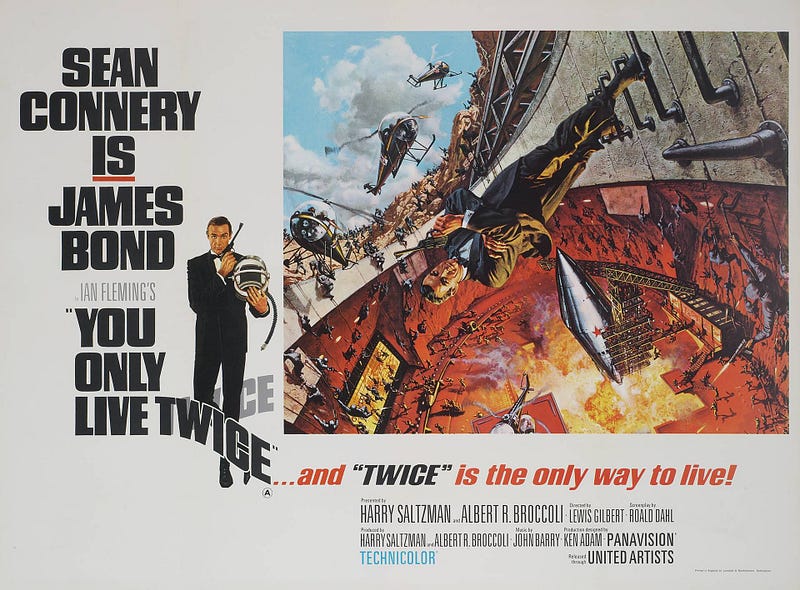
The supporting cast includes Charles Gray, who’d go on to play Blofeld himself in Diamonds are Forever (1971), and Tetsuro Tamba as Tiger Tanaka, head of the Japanese secret service. The Bond Girls include Kissy Suzuki (Mie Hama, again dubbed by Nikki van der Zyl), and Aki (Akiko Wakabayashi) — a rather splendid character who saves Bond on multiple occasions, and whose (admittedly memorable) demise always rather upset me. You Only Live Twice is also the film that finally reveals the face of Blofeld (in the form of Donald Pleasence).
Both Thunderball and You Only Live Twice encouraged big screen audiences to feel the width of the new scope format, whether in the undersea battle of the former, or in the ninja commando assault on best-ever-baddies-base of the latter (Ken Adam’s production design at its most outstanding). Again and again Bond narrowly escapes death in his adventures, whether by sharks (Connery’s alarmed reaction is genuine, in a notorious Thunderball shot that went awry), piranhas (“bad” Bond Girl Karin Dor’s grisly demise indicates their lethal viciousness), car attack, helicopter attack, or at the hand of umpteen other assassins.
Reflecting on the first five Connery films, although they were contemporary thrillers in their time, they’re now… if not exactly period pieces, then akin to period pieces in a hermetically sealed parallel universe. Said universe is filled with the stylish iconography of 1960s spy chic, and almost constitutes a genre of its own. Connery absolutely owned the role of Bond, but was tired of the role, and allegedly became more demanding and difficult to work with. In view of this, Broccoli and Saltzman decided it was time to recast the part…
“This Never Happened to the Other Fella”
Australian George Lazenby was cast as Bond for On Her Majesty’s Secret Service. His somewhat wooden performance proving the only weak link in what some consider the greatest Bond film of all time. Had it starred Connery I would probably have shared that opinion, since everything else about the movie is outstanding.
Sticking closely to Fleming’s original text, the story doesn’t feel the need to throw in a car chase every 10 minutes but builds momentum gradually. Bond encounters the enigmatic Countess Tracy di Vicenzo (Diana Rigg), whose father Draco (Gabriele Ferzetti) runs a criminal empire. Draco has connections that help Bond locate Blofeld (Telly Savalas) at a mountain top medical research facility in Switzerland. M then sends Bond in undercover as London College of Arms historian Sir Hilary Bray. Sure enough, the research facility proves to be a SPECTRE front, and Bond uncovers a sinister brainwashing plot masterminded by Blofeld and his henchwoman Irma Bunt (Ilse Steppat).
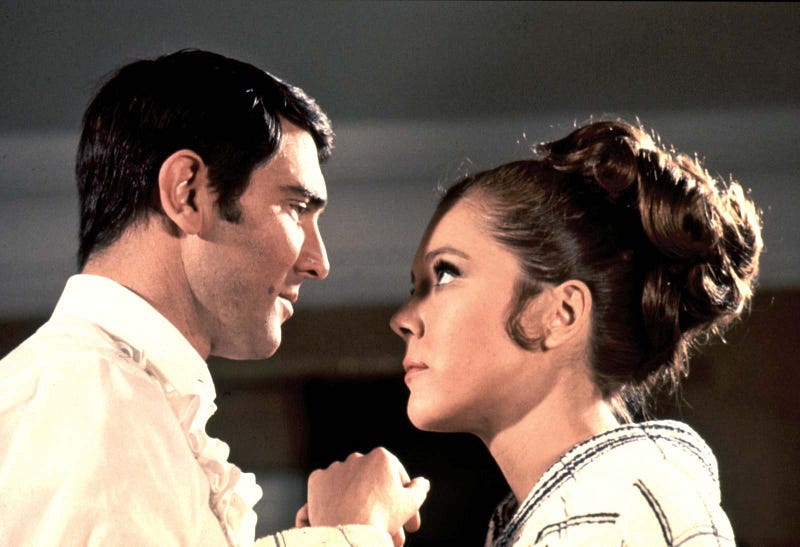
With this set-up in place, only then do the action scenes really kick in, and they prove some of the best in the series. The ski chases, set to John Barry’s greatest ever Bond score, are unforgettably thrilling, as is the avalanche sequence, and the final aerial assault on the mountain top facility. Yet the beating heart of On Her Majesty’s Secret Service lies in Bond falling in love with Tracy, to the point he even quits MI6 and marries her. Diana Rigg is superb in this role, and her character is one of the most memorable Bond Girls. Their romance is only enhanced by Louis Armstrong’s wonderful, melancholy, ironic song “We Have All the Time in the World” — a track used not during the opening titles, but during a very un-Bond romantic montage that unconventionally forms the climax of act one, instead of a big action sequence.
The unforgettably cruel finale was initially going to be saved for the start of the next film, but Broccoli and Saltzman wisely opted to keep Fleming’s shocking last scene of the villains escaping and Bond weeping over his murdered bride. It’s an extraordinary downer for a Bond movie, and this deviation from the formula proved as controversial with audiences as the casting of Lazenby. Yet over the years, the film’s reputation has only grown, and now fans consider it one of the best in the series.
On Her Majesty’s Secret Service was directed by Peter Hunt, who had served as editor and second unit director on previous Bond pictures. It is interesting to watch the credits of those earlier films, as certain names gradually rise through the ranks. John Glen is another name whose name gradually comes to prominence, with him ultimately directing all the Bond films of the 1980s.
‘Diamonds are Forever’ & The Roger Moore Era
Following the poor reaction to On Her Majesty’s Secret Service, Connery was persuaded to return for one more film: Diamonds are Forever. Intended as a reassuring balm to audiences that normal service had been resumed, the film isn’t remembered as one of Bond’s finest outings. However, the silly diamond smuggling/space laser plot is not without its pleasures.
Goldfinger director Guy Hamilton makes the film noticeably more violent in places, particularly during a stand-out fight in a lift in Amsterdam. Jill St John is an enjoyable feisty Bond Girl, and there are a handful of tense moments, such as when Bond is nearly immolated in a crematorium. Elsewhere John Barry delivers another terrific score, and even if Blofeld’s murderous henchmen Mr Wint (Bruce Glover) and Mr Kidd (Putter Smith) are portrayed with unpleasantly homophobic relish, they are also memorably and entertainingly nasty.
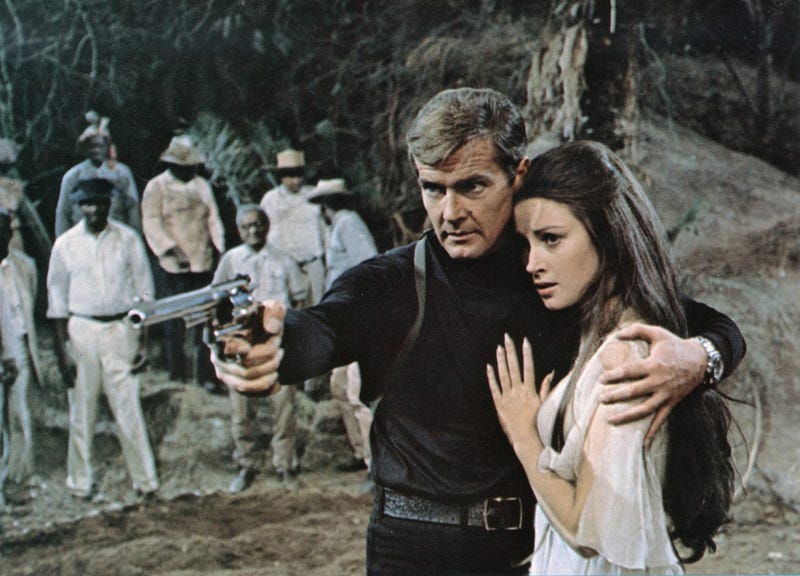
With Connery and Lazenby now in the rear-view mirror, a new Bond was cast in the form of Roger Moore. Moore went on to star in seven Bond films, all of which proved immensely popular with audiences. His take on 007 was less violent and more comedic, befitting the increasingly outlandish plots of his tenure. Today, the Moore era is often criticised as being too ridiculous, too spoofish, and frequently more sexist — even by Bond standards. However, again, although it doesn’t match the standard set by Connery, I’d argue the Moore era has some notable high points.
One of these is Moore’s debut, Live and Let Die (1973). It’s a ridiculous, politically incorrect, but hugely enjoyable romp, with Bond assigned to investigate drug trafficking and voodoo in Harlem and the Caribbean, alongside Felix Leiter (David Hedison). The villain, Mr Big (Yaphet Kotto) has the virginal Solitaire (Jane Seymour) read Tarot cards for him — an ability that will apparently cease once she has slept with a man. Of course, Bond seduces her, which leads to problems.
Featuring a slightly scarier tone than usual, a superb title song from Paul McCartney and Wings, and some spectacularly silly stunts, Live and Let Die is outrageously entertaining. The crocodile farm scene, complete with a ‘Trespassers Will Be Eaten’ warning sign, is memorably daft, as is an amusing double-decker bus/bridge interface, and a motorboat chase involving hillbilly Sheriff J.W Pepper (Clifton James) — a rather irritating character who returned in The Man with the Golden Gun (1974).
Despite the charismatic presence of Christopher Lee as the eponymous assassin, The Man with the Golden Gun isn’t the best of the Moore pictures by a long shot, despite the odd nifty stunt, some fine use of far east locations, and innovative use of the sunken RMS Queen Elizabeth. Many of the laughs come off as cruel (Bond pushing a boy from a boat, for instance), and a moment where 007 twists Maud Adams’s arm is unnecessarily brutal, not to mention out of place given Moore’s more comic approach to the character. Moore later said he hated both scenes. The Man with the Golden Gun also wastes Britt Ekland and, alongside Jane Seymour, both characters represent a low point for female characters in James Bond. It is also notable as the last Bond film Saltzman produced.
The Spy Who Loved Me (1977) is better, and many consider it the best of the Moore bunch. I actually don’t, as it’s still a bit too spoofy for my taste, but the submarine abduction shenanigans of Karl Stromberg (Curt Jurgens) at least involve plenty of action, with an outstanding pre-titles ski jump parachute stunt, and a gadget-laden Lotus that can turn into a submarine. It also has a better-than-usual (for the Moore era) leading lady in the form of Soviet spy Anya Amasova (Barbara Bach), an entertainingly silly henchman in Jaws (Richard Kiel), and the first appearance of KGB head General Gogol (Walter Gotell), who’d become a regular fixture in Bond films for the next decade. Carly Simon performs a memorable title song, and Lewis Gilbert helms with a steady hand. The film was another box office smash.
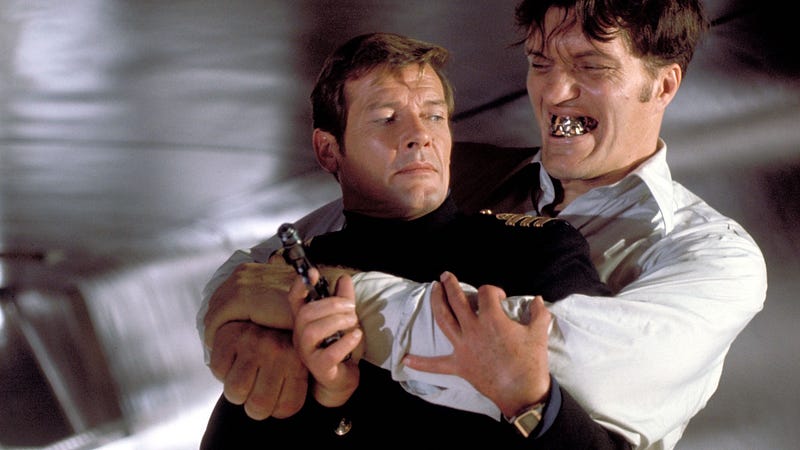
Gilbert returned for Moonraker (1979), which in many ways is a space-set remake of The Spy Who Loved Me, with a similarly motivated villain in the form of eugenics-obsessed Hugo Drax (Michael Lonsdale). It even features the return of Jaws, though more as comic relief than a genuine threat this time, as he fails to kill a single person. Moreover, he ultimately helps Bond after realising he and his new girlfriend are unlikely to measure up to Drax’s diabolical ideas of racial purity.
With a vastly inflated budget, more juvenile double-entendre leading lady names (in this case Holly Goodhead, played by Lois Chiles), Star Wars (1977) inspired space battle set pieces, a surplus of spoof — with silly winks to everything from The Magnificent Seven (1960) to Close Encounters of the Third Kind (1977), Moonraker represents a creative low point for the Bond franchise, though not the very lowest. That it’s still occasionally entertaining is testimony to the strength of the Bond formula, and we at least get another gloriously epic John Barry score.
Enter John Glen
Things came down to earth somewhat in For Your Eyes Only (1981), with John Glen taking over as director for this and four further Bond pictures. At the time, the film was intended as a return to grassroots after the excesses of Moonraker, and it succeeds, to a point. There are still jokes — mainly banter between Q and Bond — but the plot is a more plausible Cold War-based affair, with Bond trying to stop villainous brokers selling the Russians secret British submarine co-ordinating technology procured from a sunken intelligence vessel. The supporting cast features Julian Glover and Topol, with viewers initially playing a guessing game as to which will turn out to be the bad guy.
A few leftover scenes from the Live and Let Die novel are shoehorned in (as they also are in Licence to Kill), and the film features an uncharacteristically brutal moment for Moore where Bond kicks an assassin off a cliff in his car. In addition, the rope-climbing finale (featuring a great location in the form of Meteora in Greece) is genuinely tense, and Carole Bouquet is appealing as vengeance-seeking lead Bond Girl Melina. It’s certainly no Casino Royale (2006), with sillier than necessary stunts, an even sillier Margaret Thatcher gag, and the notorious “you put your clothes on, and I’ll buy you an ice cream” moment, but on the whole For Your Eyes Only is a superior entry in the Roger Moore canon. Fun fact: This is the only Bond film to feature the singer in the title sequence (Sheena Easton).
Octopussy (1983) is another rather silly affair, opening with a lunatic stunt involving a light aircraft, a missile, and a hangar that pretty much sets the tone. However, there is some fun to be had in this tale of jewellery smuggling and a rogue Soviet general bored of détente. In the villain stakes, we have Louis Jourdan and Steven Berkoff as an exiled Afghan prince and the aforementioned Soviet general, respectively. Robert Brown takes over as M, following the death of Bernard Lee (hence his absence from For Your Eyes Only). Maud Adams plays the mysterious Octopussy of the title; her second role as a Bond Girl, having met an untimely demise in The Man with the Golden Gun. This time she is served rather better!
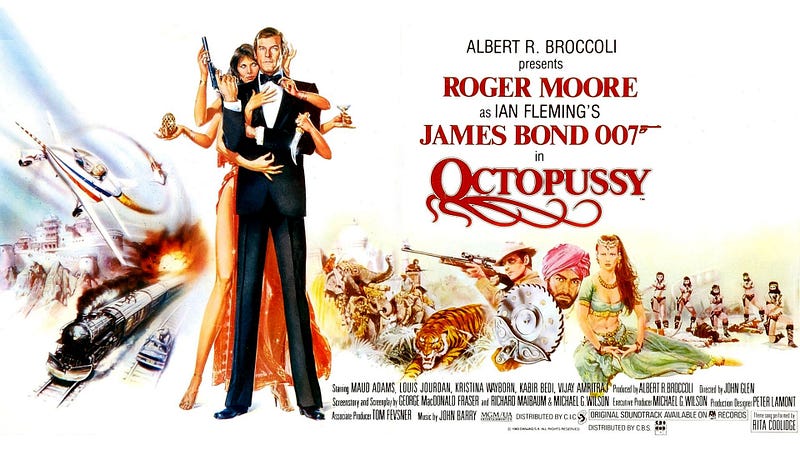
The film makes good use of locations, mostly in Germany and India. John Barry contributes another fine score, and there’s a genuinely edge-of-the-seat sequence where Bond is desperate to find a hidden nuclear weapon in a circus. I’d argue this is the tensest countdown-to-detonation sequence in any Bond film.
As an aside, I find it interesting that throughout John Glen’s tenure as director, Bond seems to care just that little bit more when his assistants inevitably bite the bullet. The aforementioned moment in For Your Eyes Only with Bond kicking a killer off a cliff is provoked by the death of Bond’s Italian contact Luigi Ferrara (John Moreno). Here once poor old Vijay (Vijay Amritraj) meets his maker, Bond appears genuinely sad (“No more problems”). He seems equally dismayed by the demise of Sir Godfrey Tibbett (Patrick Macnee) in A View to a Kill (1985), and enraged by the killing of Saunders (Thomas Wheatley) in The Living Daylights (1987). But I’m getting ahead of myself.
Roger Moore’s final outing as Bond, A View to a Kill, is little more than Goldfinger with microchips, plot-wise. Also, at 58, Moore really is a bit too old to be credible in the role now. However, there are major plus points in the colourful villains, including psychotic racehorse enthusiast and microchip entrepreneur Max Zorin (Christopher Walken), his girlfriend Mayday (Grace Jones), and former Nazi scientist Dr Carl Mortner (Willoughby Gray). Tanya Roberts isn’t the most memorable of Bond Girls, but the statuesque Jones more than makes up for this. Speaking of which, it is interesting to see how Bond goes from bedding four women in this movie, to become essentially monogamous in The Living Daylights. One wonders if the AIDS crisis had a part to play in the self-consciously trousers-up approach of the Timothy Dalton era.
Although not remembered as one of the better Bonds, I really like A View to a Kill. For one thing, it features some fun action scenes — most notably the Eiffel Tower chase and the cliffhanging finale on the Golden Gate bridge. On top of that, we get another terrific John Barry score and an absolutely dynamite title song from Duran Duran. All things considered, not a great Bond film, but definitely a bit of a guilty pleasure.
Timothy Dalton: Ahead of His Time
When Timothy Dalton was cast as Bond, the producers made a determined effort to bring the character back down to earth. Dalton emphasised the more serious aspects of 007, delivering a tremendous performance in both his films, though not everyone liked the tougher tone he brought to the series. He’s since been dismissed or overlooked by many, but I think his films are greatly underrated, if not without flaws.
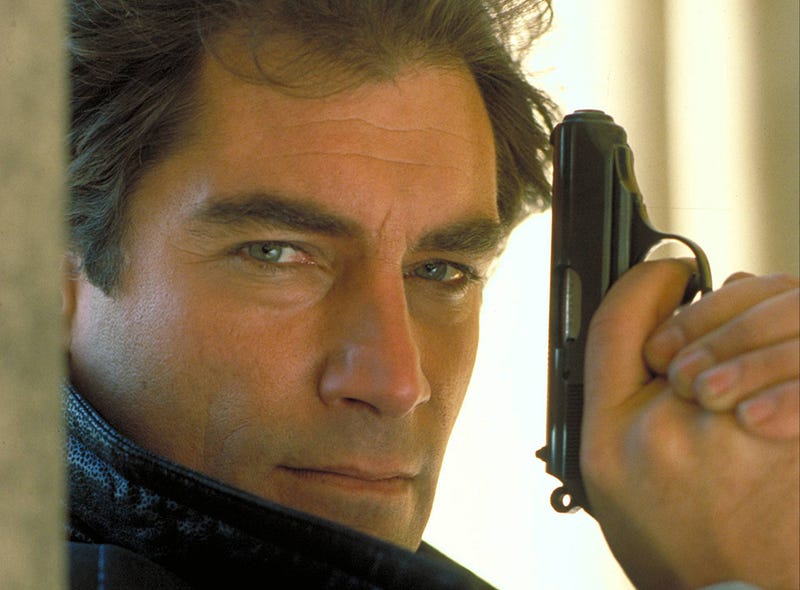
The Living Daylights was, at the time, a highly contemporary tale, featuring torn-from-the-headlines Cold War intrigue, and (rather awkwardly in retrospect) Bond assisting the Mujahideen in Afghanistan. The plot involves a double-dealing defecting Russian general (played with smarmy aplomb by Jeroen Krabbe), with the opening section (or at least, the bit after the opening credits) essentially covering an Ian Fleming short story involving a mysterious female assassin.
Said assassin is Kara Milovy (Maryam d’Abo), whose role here seems more reminiscent of female leads in Hitchcock spy movies like North by Northwest (1959) — even her hairstyle reminds me of Eva Marie Saint. Bond’s burgeoning romance with her is more heartfelt than usual, and as he discovers she’s been set up, their relationship recalls the aforementioned Hitchcockian romances rather than the usual more coldly recreational post-mission trysts. In fact, The Living Daylights features high on my list of personal favourites for many reasons, not least the splendid use of locations (notably Gibraltar and Vienna), as well as some terrific action scenes (a kitchen fight surprisingly tough for a PG-rating, plus a new gadget-laden Aston Martin, and a great climactic fight dangling out of the back of a Hercules plane). This was also the last Bond film to feature a score by John Barry, with A-ha performing the title song, and The Pretenders also contributing to the music.
I have some minor criticisms. The villains aren’t as memorable as they could be, though Joe Don Baker does well enough in his limited scenes as nasty arms dealer Brad Whitaker. The plot is perhaps a little too convoluted for its own good, and during the later Afghanistan scenes, one gets the feeling Bond is explaining the plot to the audience, not to Kara or Afghan resistance leader Kamran Shah (Art Malik). On top of that, there is still a niggling sense that the film has one uneasy foot in the Roger Moore past, with some of the sillier gags involving cello cases and shower demolition. However, things were about to get a hell of a lot tougher in Licence to Kill.
In retrospect, I feel a bit sorry for Dalton, Broccoli, et al, in terms of what they were up against in the summer of 1989. With Batman (1989), Indiana Jones and the Last Crusade (1989), and Lethal Weapon 2 (1989) gobbling the lion’s share of silly season ticket sales, Licence to Kill was left with comparatively slim pickings. That it also represented a major break from the Bond formula possibly didn’t help sell it beyond the Bond faithful. In addition, for the first and only time, a Bond picture wound up with a 15 certificate in the UK, to the dismay of younger viewers.
Licence to Kill is a more brutally violent proposition than previous Bonds (hence the 15 rating), with Bond on the run from MI6 and out for revenge for the mutilation of long-time CIA pal Felix Leiter (David Hedison) and the murder of his bride. The target of Bond’s fury is south-of-the-border drug dealer Franz Sanchez (an excellent Robert Davi). Bond infiltrates Sanchez’s organisation, and systematically unleashes bloody mayhem.
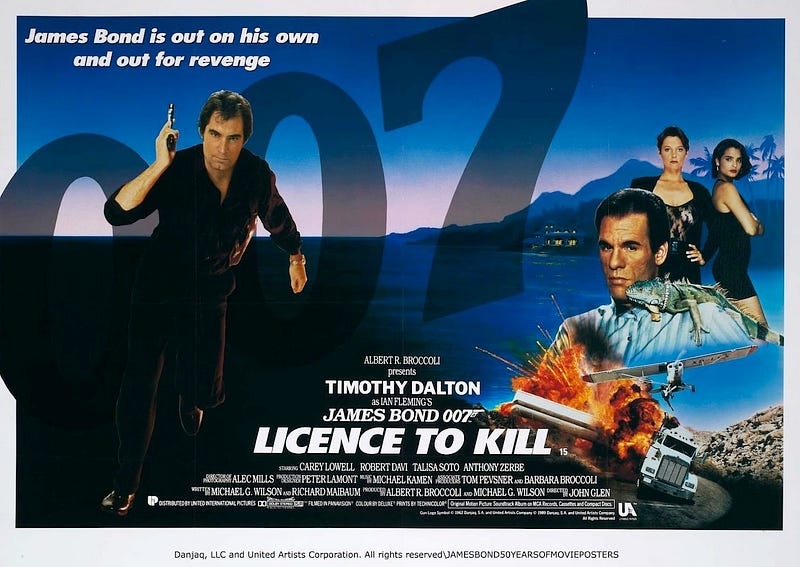
And it really does get bloody! Leiter’s mauling by sharks is a particularly nasty sequence, as is a moment involving a pressure chamber and an exploding head. Sanchez is also violent to his mistress Lupe (Talisa Soto), administering a brutal whipping whilst his henchman cut out her lover’s heart. From the word go, it’s clear this Bond film isn’t aiming at a family audience.
Yet in spite of this harder edge, Licence to Kill has an entertaining lighter side, especially in the way Q joins 007 in the field for once. There are some incredible vehicular stunts — a pre-credits moment involving a helicopter winch, and a later tanker truck chase for instance — and Bond’s leading lady is DEA informant Pam Bouvier (Carey Lowell); a character who represents a significant step forward compared with the more sexist Roger Moore era. When it comes to Sanchez, he is a surprisingly well-written character with a strict code of honour. His showdown with Bond features a real sense of vendetta from both parties, though by this point in the story, the plot has thickened to reveal bigger narrative concerns beyond Bond’s personal quest for vengeance. On a more trivial note, look out for an early role for Benecio Del Toro, as one of Sanchez’s henchmen.
All things considered, Licence to Kill is a Bond film that was too far ahead of its time, but perhaps wouldn’t have felt out of place in the tougher Daniel Craig era. Sadly, Dalton wasn’t to play Bond again, as a lengthy legal battle put the series on ice until it kicked off again in 1995, with Pierce Brosnan in the lead.
Pierce Brosnan: A Bland Retrograde Step
Poor Pierce Brosnan. He always gave it his all, and wasn’t a bad casting choice… but his Bond films were run-of-the-mill, at best, and represent an all-time low for the franchise at worst. Brosnan had almost got the part a decade earlier, for The Living Daylights. However, his contractual obligations to the TV series Remington Steele put paid to that idea.
When he finally accepted the role in Goldeneye (1995), much had changed in the world. The Cold War had ended, so the film chose to address that directly. It also chose to at least acknowledge the less politically correct aspects of the Bond character, by casting a female M (Judi Dench) and having her tell Bond he’s a “sexist, misogynist dinosaur”.
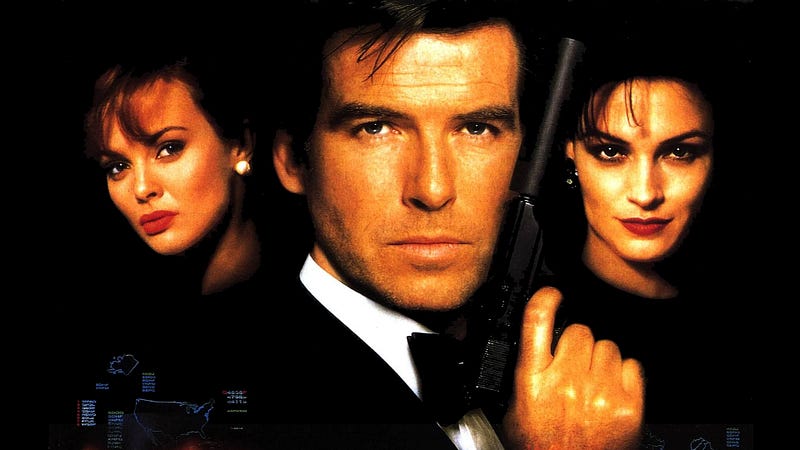
It’s a rather fun moment in what is, in relative terms, the most interesting Bond film of Brosnan’s era. An opening bungee dive stunt next to a dam sets the tone well, and there are sillier stunts to follow — like jumping into the cockpit of a plummeting plane and pulling it out of a nosedive, for instance. That’s all before we get to the opening credits, with a title song written by U2 and performed by Tina Turner.
Despite Dench’s accurate assessment of Bond’s character, he’s still very much in ‘Roger Moore mode’ when it comes to other women on screen. It isn’t long before he’s seducing Serena Gordon’s MI6 psychiatrist, and his attitude to “bad” Bond Girl Xenia Onatopp (Famke Janssen) is similar. (“No more foreplay.”) Of course, we also get the “good” Bond Girl, Natalya Simonova (Izabella Scorupco), a Russian computer programmer caught up in the shenanigans of the not-so-mysterious Janus (the identity of the villain is sorely predictable). Sean Bean also features as 006, as does Samantha Bond, playing Moneypenny (replacing Caroline Bliss, who had, in turn, replaced Lois Maxwell during the Timothy Dalton era).
Director Martin Campbell proved a safe pair of hands in terms of bringing Bond after his six-year hiatus, and would go on to reboot Bond a second time, far more memorably, in the superb Casino Royale. Here, however, one can’t escape the feeling of a slightly blander tone. Despite a plethora of action sequences — including one particularly destructive tank chase through St Petersburg which Bond survives without a hair out of place — Goldeneye lacks the sense of danger that Dalton brought back to the role. The film, along with all the Bond pictures of the Brosnan era, somehow feel as if they’ve been shot for television. There’s no essential information at the sides of the widescreen frame, seemingly anticipating a pan-and-scan video release. They always lack the cinematic vibrancy of the earlier (and later) films.
It’s also worth noting that Goldeneye was the last Bond film to feature Albert R. Broccoli in the credits (as “consultant producer”). He passed the producing reins to his daughter, Barbara Broccoli, along with Michael G. Wilson, her half-brother — who had co-written several of the Moore/Dalton era Bond pictures. Albert R. Broccoli then sadly died in 1996.
Tomorrow Never Dies (1997) proved a rather uninspiring follow-up, with Bond attempting to prevent Jonathan Pryce’s media mogul from starting World War III in order to obtain Chinese broadcasting rights. Some have retrospectively reassessed the film as prescient, noting that Pryce is decidedly Rupert Murdoch-esque, and that the plot may have been intended as satire. I’m unconvinced by that, and find it illogical even by the nonsensical world domination standards of 007 villains.
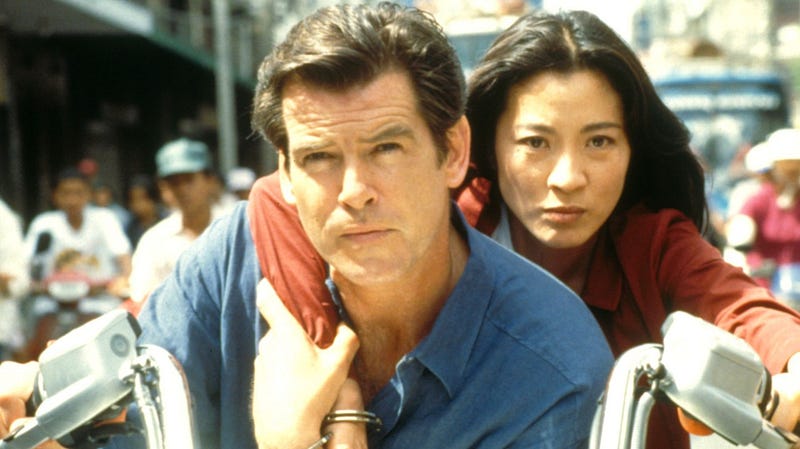
Tomorrow Never Dies’ pleasures are minor. For instance, the presence of Geoffrey Palmer alongside Judi Dench in a a nod to the popular BBC sitcom As Time Goes By they co-starred in. Hong Kong action legend Michelle Yeoh is also fun to watch — but, beyond that, Roger Spottiswoode’s direction again seems to have the small-screen foremost in mind, with the action scenes making little lasting impact. Screenwriter Bruce Feirstein (who also collaborated with Jeffrey Caine on Goldeneye) finds the odd amusing gag (“The Empire will Strike Back”), but all things considered, this is far from premium Bond.
The World is Not Enough (1999) didn’t have much artistic merit either, even with a talented director like Michael Apted at the helm — although I must emphasise the Brosnan films were big hits at the global box office. This film also marked the debut of screenwriters Neil Purvis and Robert Wade, who’d go on to work wonders with some of the screenplays in the coming Daniel Craig era. Here, however, the plot — some nonsense about triggering a nuclear meltdown in the seas around Istanbul to inflate petrol prices — is entirely unremarkable.
Robert Carlyle (Trainspotting) is utterly wasted on villain duties, though Sophie Marceau brings the story to life a little with her duplicitous character Elektra King. In contrast, Denise Richards’s woefully miscast and poorly written character, Christmas Jones, ended up being the butt of many jokes, including those made by Bond himself. (“I thought Christmas only comes once a year”, “I always wanted to have Christmas in Turkey”, and so forth.) The best thing I can say about The World is Not Enough is that it features an eerily prescient and poignant swansong scene for the excellent Desmond Llewelyn, who died shortly afterwards.
For me, Die Another Day (2002) represents the lowest point to which the Bond franchise has ever sunk. With stunts and gadgets that beggar belief even by Bond standards (invisible cars, surfboarding amidst unconvincing CGI tidal waves), this sorry mess of a film makes one nostalgic for Moonraker. Not even the presence of the wonderful Halle Berry and Rosamund Pike can save it. Madonna’s cameo (“I don’t like cockfights”) is as misjudged as her title song, too. As for director Lee Tamahori, his action-adventure credentials had been put to much better cinematic use elsewhere — like The Edge (1997).
Daniel Craig: A Superb Reboot
A visibly shaken Bond asks for a vodka martini at the bar. When the bartender asks if he wants it shaken or stirred, he replies “do I look like I give a damn?” This scene sums up not only Daniel Craig’s iconoclastic approach to James Bond, but also Barbara Broccoli and Michael G Wilson’s determination to deliver audiences a radical reboot.
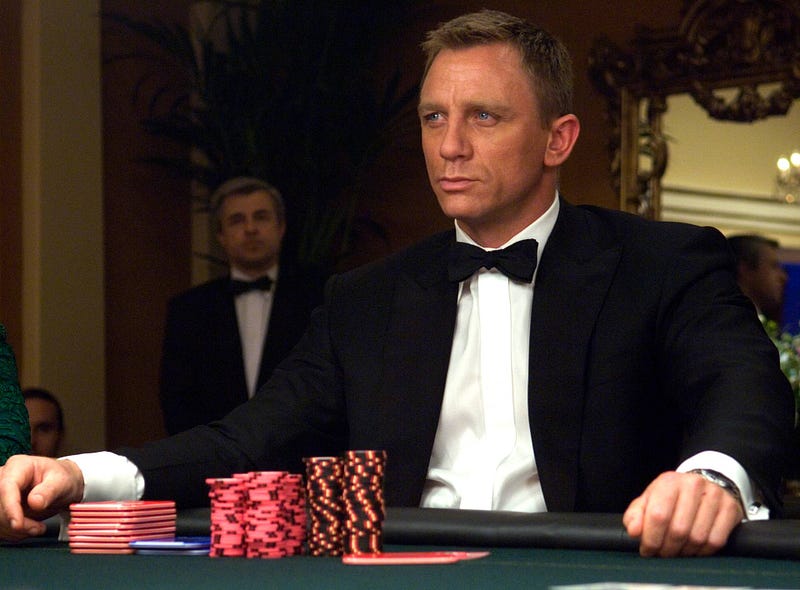
In collaboration with screenwriters Paul Haggis, Neil Purvis, and Robert Wade, as well as director Martin Campbell, with Casino Royale they worked together to produce the best Bond film this side of On Her Majesty’s Secret Service. Yet it’s Craig who really sells it. His casting was initially treated with scepticism with “blonde Bond” jokes, and there were notable online campaigns against him taking on this iconic role. Craig had the last laugh and is easily the best Bond since Connery.
Physically imposing, arrogant, tough, brutally efficient, yet prone to serious errors of judgement, Craig’s Bond in Casino Royale is a diamond in the rough. He’s yet to become the more seasoned Bond we know, and even M has concerns about his recent promotion to double-0 status (which he achieves in a superbly stylised, monochrome prologue). Although he still looks rather dapper in a dinner jacket, as Vesper Lynd (Eva Green) observes.
Plot-wise, the film follows Ian Fleming’s novel fairly accurately, once we reach the end of Act I’s bruising action sequences. These include some first-rate fight scenes, and a foot chase through a building site that returns a sense of true jeopardy to the franchise. However, Casino Royale’s centrepiece is the high-stakes poker game itself, wherein Bond is bankrolled by MI6 to take down terrorist banker Le Chiffre (a superb Mads Mikkelsen). The twists, turns, blind-sidings, and bluffs are expertly assembled, with the game interspersed by brutal attempts on Bond’s life (a poisoning sequence is particularly pulse-quickening). Later, we get a notoriously brutal but darkly comic torture sequence that had to be trimmed by the BBFC to avoid a tougher 15 certificate.
Casino Royale felt no need to be a box-ticking exercise or slavish to established formulas. There’s no Moneypenny, no Q, and Bond isn’t even recreationally promiscuous (after seducing Caterina Murino, he doesn’t bother to sleep with her now he has the information he needed). Instead, the emotional anchor of the film — Bond and Vesper falling in love — comes to the fore in a surprising and powerful way that’s faithful to the source material. The refusal to follow formula even extended to the signature Bond theme, which doesn’t even appear until the end credits! Speaking of which, David Arnold’s impersonation-John Barry score and Chris Cornell’s propulsive title song “You Know My Name” provides the icing on a delicious cake.
Sadly, Craig’s second outing as Bond, Quantum of Solace (2008), was hamstrung by a writer’s strike. Forced to work from the first-draft of a screenplay, director Marc Foster struggled to bring coherence to the narrative, despite another fine performance from his lead. Quantum of Solace is an unusual Bond film in that it’s s the only one to be a direct sequel, literally picking up moments after the last scene of Casino Royale. However, despite the odd fine action sequence — an early rooftop chase for instance — the movie ultimately collapses under the weight of its own incoherence.
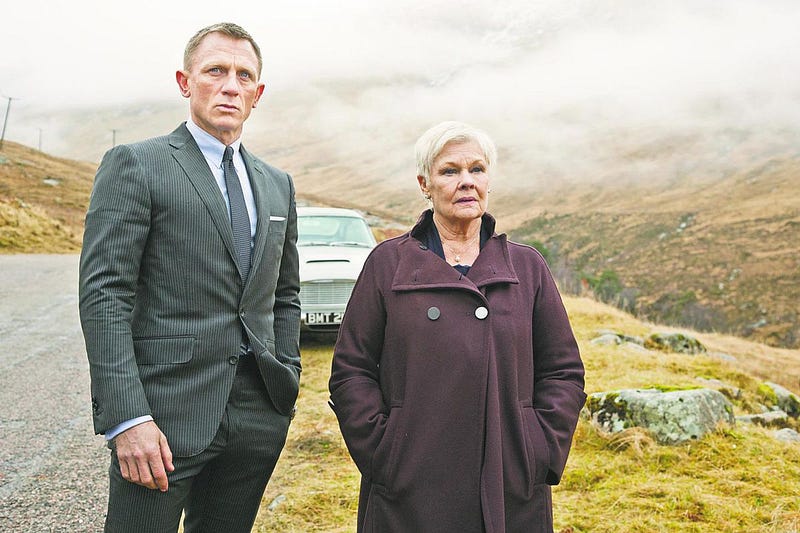
Skyfall (2012) was a far different story, in every sense of the word; different in being vastly superior to Quantum of Solace, and different in narrative terms. Some consider it the best Bond film ever made. I don’t quite go along with that, but it’s certainly an exceptional entry into the long-running spy series. With Sam Mendes at the helm and Roger Deakins as cinematographer, I’ll certainly concede that it’s the best-looking Bond film ever made, featuring an extraordinary visual journey that begins in bright, steely high-tech and climaxes in a dark, lo-fi, fiery Gothic flourish.
The plot involves stolen information that could compromise MI6 agents across the globe. Said information lies in the hands of the villainous Silva (Javier Bardem), whom Bond tracks down via Macau and Shanghai. Soon the Wikileaks narrative gets Oedipal overtones revolving around M (Judi Dench, superb in her final appearance), leading to some riveting London-set action, and an extraordinary finale in Scotland. Here, Dench and Craig join Albert Finney’s gamekeeper to fight off the baddies with decidedly old-school weaponry, whilst under siege at Bond’s abandoned family estate. Finney’s role was supposed to be played by Sean Connery, but he sadly wouldn’t come out of retirement for the franchise’s 50th anniversary.
Skyfall also features a younger Q (Ben Whishaw), who proves an amusing addition, alongside Ralph Fiennes’s M-in-waiting. We also get Bill Tanner (Rory Kinnear); the MI6 Chief of Staff who doesn’t really feature in any memorable way until this film and Spectre (2015). Berenice Marlohe and Naomie Harris provide fine support in their traditional bad/good Bond Girl roles, although Harris’s character proves far more significant, considering she turns out to be Moneypenny in a cute final twist. Finally, Adele contributes a fine title song (I’d wanted her to sing a Bond track ever since I first heard “Set Fire to the Rain”).
In contrast to Skyfall, Spectre (2015) proved a comparatively formulaic affair, though still a hugely entertaining one. The opening sequence in Mexico is tremendous, with Sam Mendes back on directing duties and showing off his penchant for long takes. He follows Bond through the streets during the ‘Day of the Dead’ festival, inside a building, into a bedroom with an inevitable female companion, then outside for a rooftop assassination. A melee of exploding buildings, foot chases, and helicopters looping the loop ensues, making this one of the most memorable beginnings to any Bond.
That Spectre is the most expensive Bond film ever made (and also incidentally contains the single largest real explosion ever put on film) shows in every glamorous frame, with dazzling use of locations including the aforementioned Mexico City, London, Rome, Austrian mountains, and Tangier. The tremendous action sequences feature minimal CGI and lots of real stunt work. Highlights include a car chase through the streets of Rome, an elaborate plane/car chase on snowy Austrian mountain roads, and a fantastic train fight that recalls From Russia with Love.
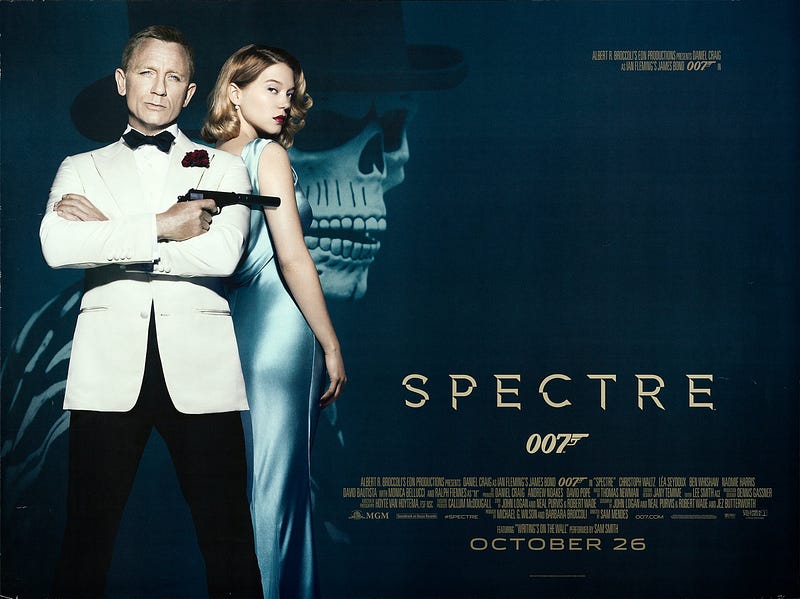
Craig cements his reputation as Best-Bond-since-Connery. Monica Bellucci’s role amounts to little more than a cameo, but Lea Seydoux ranks amongst the best Bond Girls. Dave Bautista‘s Mr Hinx is a suitably imposing henchman, whilst Christoph Waltz is tremendous as uber-villain Franz Oberhauser, even if his true identity as Blofeld is easy to guess. Skyfall alumni Ralph Fiennes, Ben Whishaw, Naomie Harris, and Rory Kinnear all reprise their roles to memorable effect.
Yes, we’re back to full-blown theatrics here. Between the most sinister villainous meeting this side of an Illuminati AGM, and Obenhauser/Blofeld monologuing his master plan instead of simply putting a bullet in Bond’s skull, this is a far cry from the grittier treatment of Casino Royale. Post Snowden relevance manifests itself in a subplot involving the potential mothballing of the double-0 section. M spars with young upstart C (Andrew Scott), who seems determined to replace M and his antiquated agents with Orwellian surveillance. Yet despite these flirtations with serious issues, the film is not above knowingly passe set pieces involving ticking time bombs.
In short, Spectre is a lot of fun, even if it does leave the window wide open Blofeld’s return. Nor is anyone remotely convinced that Bond will really retire from MI6 to romantic bliss with Seydoux. The trailers for No Time to Die make that much clear.
Conclusion: Why ‘No Time to Die’ Can’t Afford to Fail
All of which brings me back to my original question regarding Bond’s future. Despite Barbara Broccoli and Michael G. Wilson’s insistence that Bond will remain off-limits to the content spin-off brigade, I have my doubts. If No Time to Die underperforms, there’ll be increasing pressure placed on Eon Productions to kowtow to the new order under Amazon.
I believe Bond should remain an old-school special treat, once every two or three years in cinemas. There’s no need whatsoever for a “Bond Universe”, and I, for one, hope viewers are tempted back to the big screen in droves to watch No Time to Die. If they don’t, even though he’s bested multiple megalomaniacal villains, we could lose Bond in an increasingly vacuous whirlpool of streaming content. Here’s hoping he remains on the big screen where he belongs. After all, nobody does it better…
Author’s note: I hope you enjoyed this article. For more about me and my writing, click here. To upgrade to full Medium membership, click here. (I have a financial incentive for new referrals.)
Header image designed by Dan Owen.


