
Feel Like a Rare Bird In Small-Town USA?
We gotchu! The black nod on white sidewalks lets you know you’re not alone
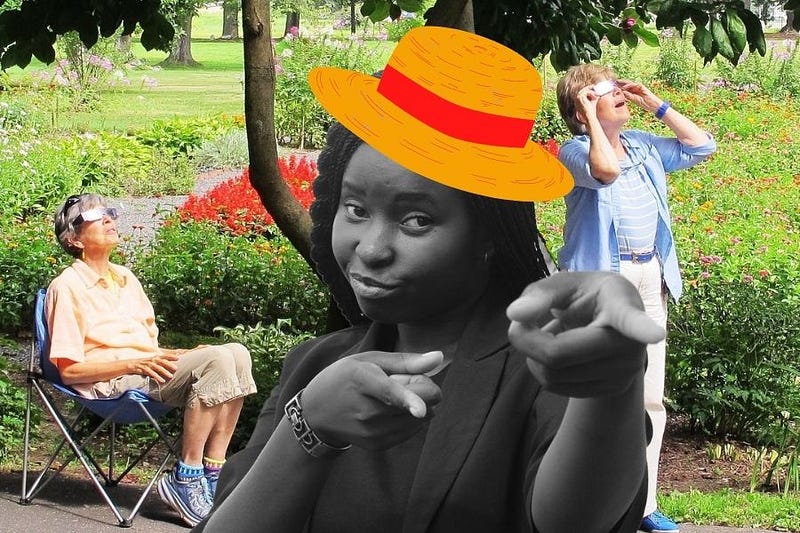
When I was in middle school and high school my little sister and I played a game whenever we drove through our small northeastern town. The game was called “count the black people.” We made sure not to consider ourselves in the tally. That was cheating.
If you’re from the Northeast USA like me, you’re used to a rather high level of coldness, and you know I’m not just talking about winter.
Just the other day, coming back from living nearly 6 years in warm-hearted Peru where everyone smiles at strangers, and talks with a tender familiarity, I got a mini culture shock.
I walked into a store that reminds me of Jerry Garcia’s closet. It was the right store to search for some genie pants. I love me some genie pants. I turned to the attendant and said, “Excuse me, I have a question…” “No!” he barked like a nor’easter gale.
In some places, it’s customary to nod and acknowledge fellow humans. For example, in Peru, everyone greets elderly folks on the street.
My college African dance class professor told us that in Ghana if you don’t greet someone as you pass by, people consider you very rude.
In my one-block town center, I have noticed something. The black nod. When I’m walking the skinny sidewalks, laden with flower pots and mural-covered newspaper dispensers, if I pass a black person, we often greet each other, or nod, or make eye contact. In essence, we acknowledge one another.
Is this a small-town black person thing or is it a practice transported from a kinder climate? I have heard that people in the South are friendly. They say us northerners are cold. You would be too if your backyard looked like the Blair Witch Project.
How do you explain the occurrence of the black nod? I have noticed that the black nod usually takes place between grown folk, meaning people over 30.
I think there is also a reverse critical mass idea that explains the black nod. If there are too many black people, the nod is meaningless. The nod means, “I see you. We are in dangerous territory. We are outnumbered. I got you.”
After college, I taught English in Taiwan for 2 and a half years. Most other teachers were white. I made friends with a black teacher, let’s call him Archie.
One day at the bar, he walked up to me and whispered, “We’re the only ones here. We have to stick together.” We both laughed.
That’s the undertone of the black nod. “We gotta stick together.”
People might start blowing up the comments section saying, “How can you declare a smile, a greeting, or a nod as black?” It’s simple. Just like Phife Dawg from A Tribe Called Quest said,
“…It’s like a white girl named Shareema — you never see her.”
It’s the same with the black nod. Some black people have particular cultural ways. But don’t treat this like bird-watching. If you see a black nod, it’s not an instinctual behavior, so let’s not get essentialist.
I have tossed someone the nod and been unrequited. There’s nothing worse than trying to connect with someone who leaves you hanging. It happens.
Oh, oops. I forgot to say the other reason, that we in the mental health field might call the “strengths-based reason” for the black nod. We love seeing other black people! Don’t you?
Right before grad school, I performed at a fashion show and cultural event (I once tried to make a business selling repurposed recycled clothes, but that’s another story).
A lovely black woman came up to me, and said, “My white husband thinks I’m crazy (her word) for coming up to you like this, but there are so few black women around here and I saw you and I was so excited! Can we exchange numbers?”
My heart soared. I was like, whatever your mental health, I want part of this because I love being around black women!
I admit, I did a similar thing in Peru, but with a dash more stealth. One evening in the town of Barranco, I saw a lovely black woman sitting on the bench reading. I felt like a creep, but I went to sit down next to her and asked if she liked the book. A boring but effective conversation starter.
I confessed, “I saw you sitting here, a black person, and I was like, ‘I have to talk to her!’” Luckily, she laughed and we began a friendship until she returned to Georgia a year later.
But, we all aren’t like that. Perhaps the reluctant nodders might be thinking, “Why are you nodding at me? Is it that strange that two black people are walking down the same street at the same time?” Where I live, the answer is “ haaail yes.”
Thanks for reading!
~MJ