
Father of modern Brisbane
The folly of mid-century modern new world cities
Clem Jones seemed like a decent man. A dedicated republican and Labor party stalwart, he died aged 89 on 15th December 2007. The press are widely crediting him with ‘building Brisbane’, which is now the fastest-growing city in Australia and a ‘Third Metropolis’ finally forcing the traditional cultural capitols of Sydney and Melbourne to sit up and take notice.
Queensland Premier Anna Bligh says Jones was “the father of modern Brisbane … his lifelong civic contribution and love of the city of Brisbane was unsurpassed … Clem will long be remembered for his vision and commitment to transforming Brisbane from a conservative country town to a vibrant and cosmopolitan city.” Local boy and new Australian Prime Minister Kevin Rudd — another sign of Brisbane’s currently rising star — said “Clem was a longstanding personal friend of mine, a great source of support and encouragement and friendship.”
He may well have been the key catalyst in transforming Brisbane in the latter part of the twentieth century. The city is increasingly unrecognisable to those who knew it in the 1970s and 1980s. Wealthy from numerous sources, a strong hi-technology-oriented industrial base, with an increasingly well-respected university and research sector, the best new art gallery and library in Australia and currently the country’s most innovative architecture scene, a sub-tropical climate and reasonably handy for the stunning Queensland coastline, increasingly good restaurants and fabulous local produce, a tree-covered hilly topography on which the extremely liveable suburbs sit, and with the distinctly Asian aspect that most Australian cities should have.
There is still a residual sense of the earlier Brisbane in the culture, of course, as these things take generations to shift. The city had to come a long way too, from the frankly unbelievable Joh Bjelke-Petersen years. But the character is now orientated towards an educated, cultured, outward-looking, and sophisticated city — a world away from the ‘Brisvegas’ that the out-of-touch in Sydney and Melbourne occasionally still tag the city with, albeit with an increasingly insecure note in their voice.
Jones, as Lord Mayor for 14 years from 1961, pulled the city’s socks up and set the scene for all of this. But along the way, Clem Jones was also the man who pulled the trams out of Brisbane in 1969.
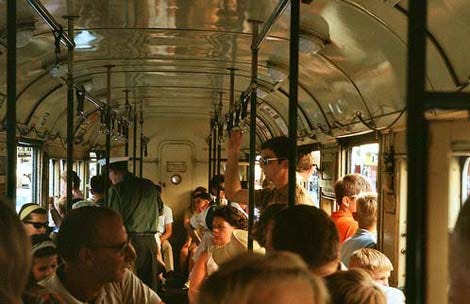
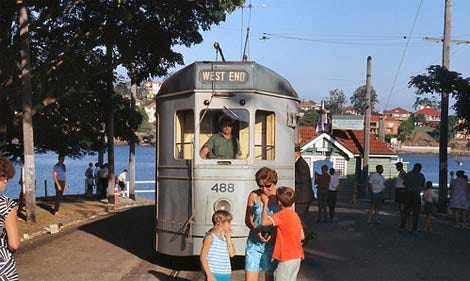
By all accounts, no-one was particularly happy that last day of the trams, except a few of the traffic engineers. As a replacement, Jones and his administration embarked on the vast road-building schemes that now define the modern Australian city, and all to no avail. Of course, now we know that road-building generates traffic, via decades of data on induced demand. (More on all this in a later.) We might forgive those moves in the 1950s and 1960s, but not now. Brisbane remains horribly clogged with car traffic, no matter what. Just as Sydney is.
And that, perhaps more than anything, holds both cities back from fully realising their modern vision. Jan Gehl’s recently announced plan for Sydney’s centre is not without its flaws — listen to his lecture from September to see where it comes from — but a pretty close version of it needs to be implemented in Sydney, and Brisbane should do likewise, though recognising the need to spread the ambit of the plan over the sprawling city’s outer suburbs.
As with most cities, the trams were a part of the urban infrastructure that resonated long after their demise. The great Brisbane writer David Malouf suggests that the city is still marked up with the ghosts of the tramlines:
“The city is conceived of in the minds of its citizens in terms of radial opposites that allow them to establish limits, and these are the old tram termini: Ascot/Balmoral, Clayfield/Salisbury, Toowong/The Grange, West End/New Farm Park, to mention only a few; and this sense of radial opposites has persisted, though the actual tramlines have long since been replaced with ‘invisible’ (as it were) bus routes. The old tramline system is now the invisible principle that holds the city together and gives it a shape in people’s minds.” [David Malouf, ‘A First Place: The Mapping of the World’, Southerly, vol.45, no.1, 1985. Found in The Third Metropolis by William Hatherell]
That’s such a beautiful evocation of the city’s form that it seems churlish to wonder how many people today, a generation later, would sense those radial opposites. Malouf’s imagery is so strong that it would defy simple quantitative measurement, and by repeating it here I’m hopefully reinforcing the image one more time.
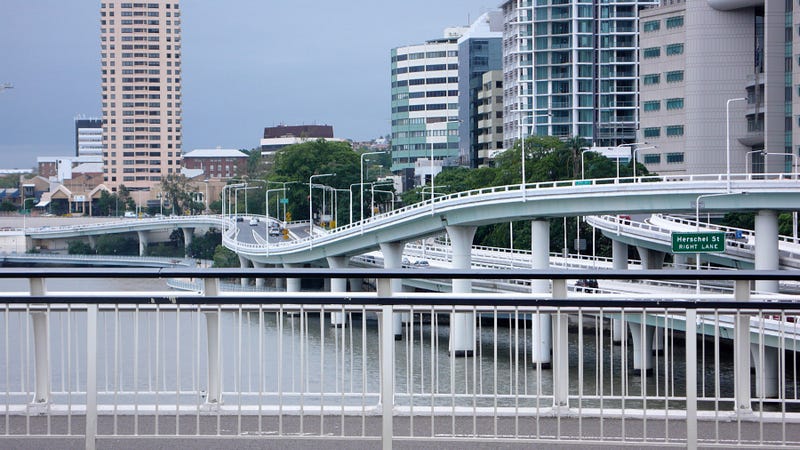
However, today’s Brisbane has very visible swollen arteries — principally Coronation Drive into Riverside Expressway, and the ICB (Inner-City Bypass) — rather than invisible principles, and they appear to do little to hold it together.
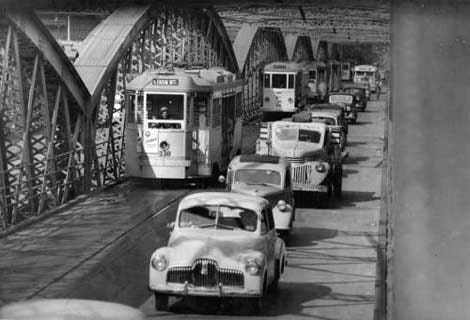
Jones did what he thought was necessary — albeit advised by American planners, apparently—do I detect the dead hand of Wilbur Smith Associates here, as with so many other places? (Ed. Years later I confirmed that, yes, it was Wilbur Smith & Associates, as described in this piece.) Certainly, someone had to lift Brisbane into the post-war period. Before Jones, many of Brisbane’s roads “even those just a kilometre from the GPO”, reports The Australian, breathlessly — were “uncurbed and unsurfaced dirt”. Those dirt roads were far from tenable at that point and Jones’s administration sorted all of that.
But in doing so, it fully orientated the city towards the car. There’s an in-built prejudice against public transport around this. Jones was quoted as saying that his ideal was for the working man to be driving his own car, not catching a tram. This is where Australia looked to American values rather Mittel European or Asian, and for the worse. There are clearly spatial similarities between Australian and American cities, but I’m yet to perceive the swing back towards public transport seen across the US west coast, from the Bay Area up to Portland and Seattle (never mind New York City, which might be a special case). It’s not a party political issue either; Jones was solid Labor, though his sentiment was close to Margaret Thatcher’s infamous alleged statement: “Any man who rides a bus to work after the age of 30 can count himself a failure in life.”
Here we see, if true, not only Thatcher’s near-psychotic levels of misanthropy but also, crucially, her lack of long-term strategic vision. The question now is, at what point will we be saying “any man who doesn’t ride a bus won’t be getting to work”.
(Ed. A few years later the great Enrique Peñalosa would say, “A developed country is not a place where the poor have cars. It’s where the rich use public transportation”, beautifully putting Thatcher and Jones in their place.)
Jones was far less destructive than Thatcher but either way, an entire car-centric infrastructure will now have to be taken apart, bit by bit, and reconstructed with mass transit and service-led mobility systems in the ascendancy. As with Sydney, that realisation is not widespread yet, and the culture is so ingrained as to actually prevent people from thinking there could be another way. The dramatic flourish in Gehl’s plan for Sydney, pulling down the Cahill Expressway across Circular Quay, is described by the Sydney Morning Herald’s urban affairs editor as overly “drastic and impossible”.
Frankly, that’s the unconsciously defeatist talk of someone who’s spent too long in their city’s skin, and can’t think the unthinkable. Equally, in Brisbane, it seems people can’t think of another solution to near-fatal levels of individual car traffic than building more roads. If they listened to Gehl’s talk, they’d hear that building more roads only leads to more traffic, a pattern we’ve seen many times over. Almost every day in the local rag, the Courier Mail, you’ll read of a simple unfortunate accident causing hours of chaos throughout a system organically interconnected through necessity rather than strategy. They even have a ‘Stop the carnage’ campaign, due to the increasing number of road deaths on Queensland’s roads. These are all symptoms of the same spiralling metastasis you see when systems run at overload. Yet the solution offered up — despite the carnage, even — is usually tunnels, bypasses, bridges, while rail and bus services suffer from the bad management often seen when implicitly deprioritised.
Some of those elevated road systems can be amongst the most thrilling aspects of modern cities, particularly Brisbane’s Riverside Expressway (section pictured top), which is virtually a big-dipper casually sweeping out over the river. It’s going to take far more imaginative campaigns than we’ve seen thus far — it’s a hegemonic battle, ultimately — alongside serious build around mass transit systems and related infrastructure, hard and soft, and a way of reconciling, adapting, retrofitting and reworking such road systems.
A recent BusinessWeek article seems to assume that citizens have got the message:
“The size of a city determines its need for a metro system. Cities of a few million people — or those anticipating huge population growth — really can’t do without a mass transit system. But cities of one or two million inhabitants can choose between a subway and a surface tramway, which costs far less but also runs more slowly.”
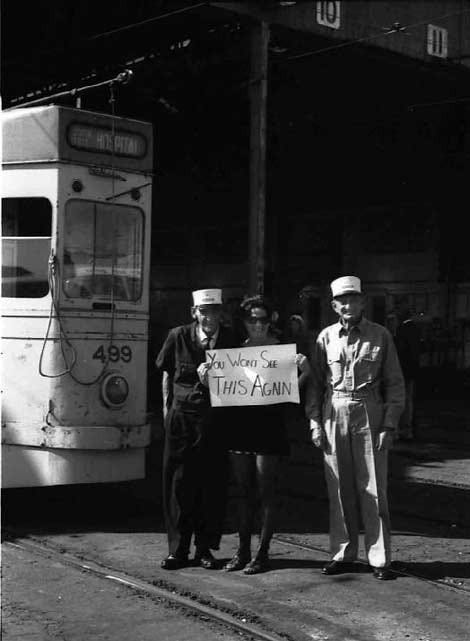
But I’m not sure it’s that well understood — simply a case of choosing between subway or tramway. Of course, there are now plans to for the trams to return to the 1.8m strong Brisbane (the person holding that ‘You won’t see this again’ sign in 1969 was wrong), along with bus systems weaving underground and around the centre. Bike lanes are emerging, albeit threaded through some of the busiest and most dangerous roads in the country. These are usually seen in addition to road-schemes, rather than as progressive replacement.
So it’s a start, but hearing the currents in everyday conversation in this city, people have yet to understand the scale of change required to the city, that quite shocking sense of dismantling the entire infrastructure, and collectively re-imagining a different way of being in the city.
It’s too simplistic to blame Jones or his administration — as a New World city boss of the 1950s and 1960s, almost anyone would have seen cars as a first-order object to organise around. Only the already dense cities of the Old World were fortunate enough to have the right form for mass transit, though even then Paris, New York, London, Boston, Barcelona et al did their best to slice their fabric apart with roadways, turning their backs on rivers or harbours, only to have to now re-build. Yet even with a shift towards private ownership of cars, there was no fundamentally worthwhile reason, strategic or economic, to pull the trams and light rail systems out of cities, and certainly no need to go as far as Jones or Thatcher suggested.
Brisbane is beautiful, and potentially more beautiful again. And Clem Jones seemed like a good man. He helped shape what’s emerging as a great city, and now is not the time to speak ill of his generally valuable work. Yet it’s symptomatic of the lack of understanding of the ills of the modern Australian city that few people are pointing out the flaws in building Brisbane around the car.


