
British Network Television
‘Father Brown’: S03.E13. “The Paradise of Thieves”
Father Brown, Mrs McCarthy, Lady Felicia, and Sid get caught up in a bank robbery that goes sideways fast
The Paradise of Thieves, first televised in the British Isles on Wednesday, 21 January 2015, draws the episode title from G. K. Chesterton’s 1914 published short story collection The Wisdom of Father Brown. The episode features a screenplay written by Rob Kinsman.
Kinsman, for people not familiar with his work, has written for such British television series as Land Girls, Holby City, Shakespeare & Hathaway: Private Investigators, and Doctors. As opening teasers go, not that other episodes don’t deliver more captivating beginnings, The Paradise of Thieves has what it takes to hold our interest.
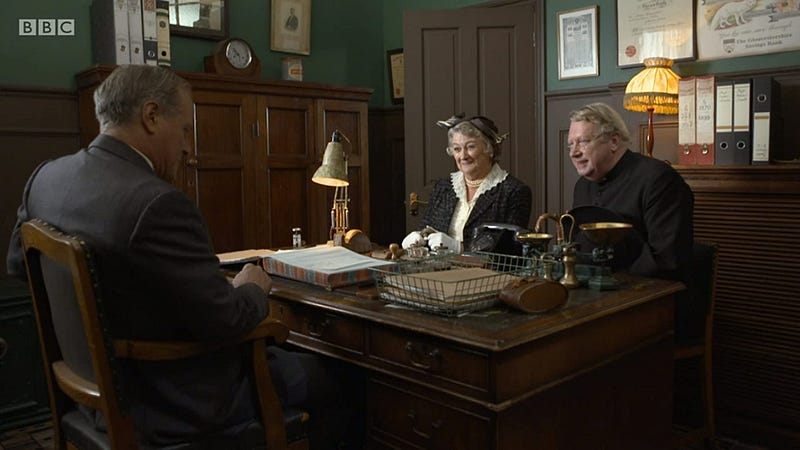
With the roof at St Mary’s Catholic Church needing repairs, noting the cost being significant, the Gloucestershire Savings Bank seemingly establishing a new charitable fund is a G-d send to Father Brown (Mark Williams) and his church. Bridgette McCarthy (Sorcha Cusack), the parish secretary, presses bank manager Samuel Harrogate (William Gaminara) for a concrete figure. There are hopeful expressions from both Father Brown and Mrs McCarthy.
This is one of those times, with repairing the church roof not coming cheap, Father Brown needs his parish secretary to be at the top of her game. Mrs McCarthy doesn’t disappoint. Kembleford’s Catholic church, as Mrs McCarthy sees it, is short by £247. The figure quoted by Mrs McCarthy, remembering the series is set in 1953, would be equivalent in purchasing power to about £6,941.88 in 2020.
Obviously, with the inflation rate being at 3.05 per cent in 1953, this figure has fluctuated over the decades. The current inflation rate, not final, stands at 1.5 per cent. Whilst much of this information doesn’t pertain directly to the episode itself, recognising how financial issues have frequently plagued small churches, it should be noted how the cost of maintaining such buildings has increased over the years.
With Father Brown and Mrs McCarthy meeting with the bank manager, out in the customer area, we find Lady Felicia Montague (Nancy Carroll) and Sidney “Sid” Carter (Alex Price) with several other customers. Lady Felicia, being served by chief bank clerk Martin Wheeler (Michael Jibson), wants to make a deposit. It is at this very moment two masked armed robbers enter the building.
We immediately know, because of Lady Felicia’s brief interaction with the bank clerk, Mr Wheeler is likely important to the episode’s narrative. Rarely do series creators Tahsin Guner and Rachel Flowerday allow background characters as much as a single line in episodes. Another employee, junior bank clerk Thomas Brandon (James Burrows), is also prominent in the episode narrative.
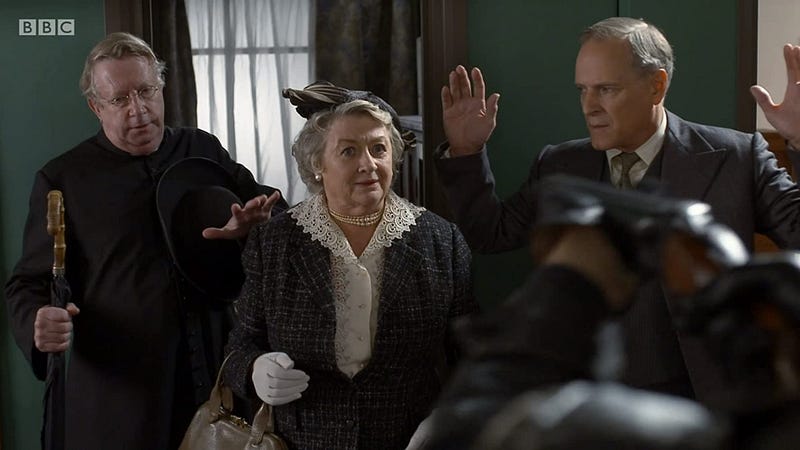
Mrs McCarthy, fearless in her confrontation with the bank robbers, is a tad naive if she thinks either of the robbers will back down. The robbers, not yet identified, aren’t impressed with Mrs McCarthy’s show of bravery. Is Mrs McCarthy really defining herself as a defenceless woman?
The parish secretary, as we have seen with previous episodes, possesses a significantly nasty metaphorical bark. Despite this point, observing the bank robber’s behaviour, there is nothing to suggest this person wouldn’t shoot a defenceless woman.
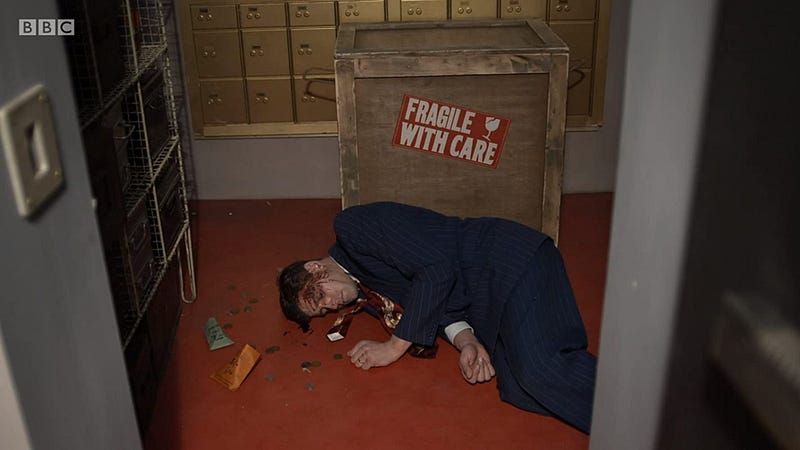
Discovering a dead body in the bank volt, William “Billy” Flanders (James Charles O’Neill), is just as much a surprise to the bank manager as it is to the robbers. Not wanting to hang around, especially with their being a dead body involved, the robbers decide there is too much heat involved with this particular robbery. Mr Flanders, as we soon discover from the bank manager, is his son-in-law.
A tiny puddle of water, initially appearing unimportant, doesn’t escape Father Brown’s attention. There is nothing included in Father Brown episodes, even by itself, which isn’t relevant to the episode story.
Outside the bank, noting Father Brown’s Bucephalus (his bicycle) propped up outside the bank, Inspector Sullivan (Tom Chambers) and Sergeant Daniel Goodfellow (John Burton) exchange knowing glances.
Since the police inspector’s introduction to the series in 2014’s The Ghost in the Machine, even more than the then newly promoted Chief Inspector Valentine (Hugo Speer), Inspector Sullivan has explicitly and repeatedly told the Catholic priest to steer clear of his investigations. Inspector Sullivan isn’t the only character that doesn’t want Father Brown poking his nose into affairs that don’t concern him. Mrs McCarthy has also been known to express a similar opinion.
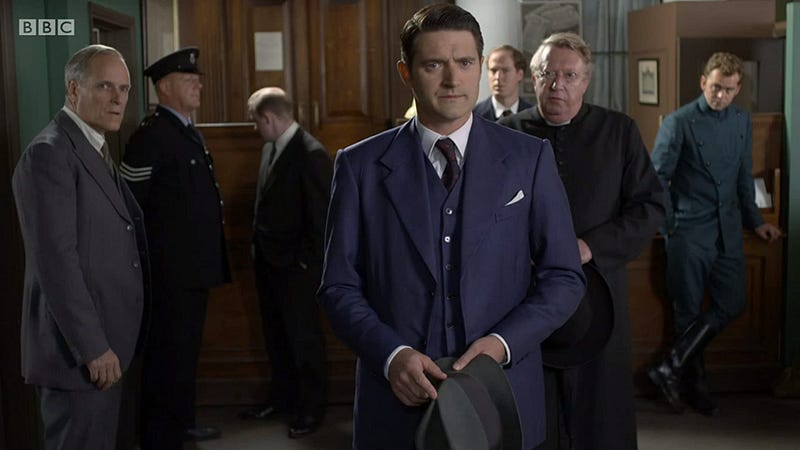
Inspector Sullivan, after speaking with the bank manger, has no interest in listening to Father Brown and his observations. Time and again, as we have seen in numerous episodes, the police inspector has disregarded Father Brown as a valuable resource. A good detective, regardless of his personal feelings, utilises all resources available to them.
The police inspector doesn’t seem interested in why the robbers would want Father Brown to accompany Mr Harrogate to the volt. The only person interested in this curious happenstance in Father Brown himself.
Whilst Mr Wheeler gives off a working class vibe, observing Mr Brandon’s mannerisms, there is a certain undeniable arrogance to the second bank clerk which suggests he feels his position is beneath him. Mr Brandon feels, if anyone should replace Mr Harrogate as bank manager, it should be him.
Julia Flanders (Kirsty Besterman), the bank manager’s daughter, shows up shortly after the police arrive on the scene. Mr Harrogate tells his daughter the tragic news. Sergeant Goodfellow, not able to prevent Mrs Flanders from heading to the volt, is ineffective. Characters seem to have little to no respect for the police sergeant’s authority. This has been demonstrated by Mrs McCarthy, in various episodes, several times.
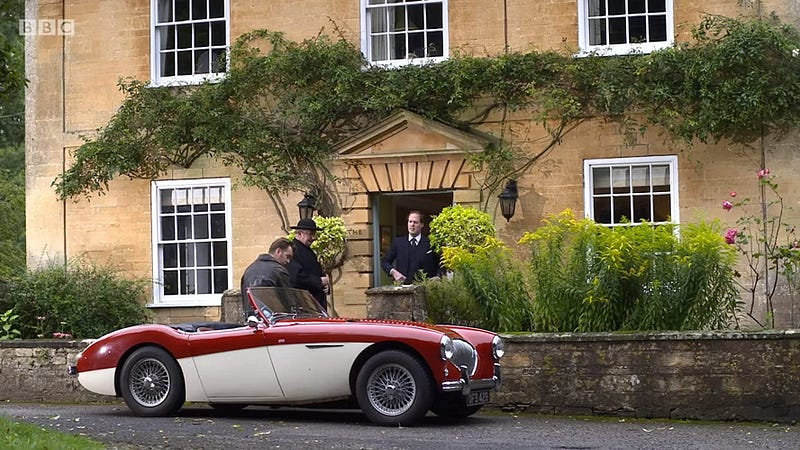
The Paradise of Thieves, like previous episodes, contains many twists and turns which point us in the wrong direction. Mrs Flanders, no matter how odd, doesn’t rise to the level of murdering her own husband. Mr Brandon, even though he was blackmailing Mr Harrogate, is seemingly incapable of murder. Speaking of the blackmail, whilst it plays a minor role in the episode, ties into the primary narrative rather nicely.
Mr Harrogate, during the First World War, was apparently known amongst his British Army regiment fellows as a lady’s man. He had had a sexual relationship with a woman that had resulted in an unwanted pregnancy. Mr Wheeler, as it turns out, is Mr Harrogate’s illegitimate son and he isn’t pleased with how the bank manger treated Mr Flanders better than his own blood.
Mr Flanders, having married Mr Harrogate’s daughter, was merely a son-in-law. Mr Wheeler, despite his illegitimacy, is a blood relative. Mr Flanders money making business plans, from his night club to his racehorse, never panned out the way he intended. All money that went into these ventures had disappeared down the drain. This was the catalyst for Mr Wheeler’s jealousy.
The justifiable jealousy we see from Mr Wheeler, when Mr Harrogate wasn’t willing to help him financially, is readily apparent. The bank manager did for Mr Flanders what he wouldn’t do for his own son.
Father Brown, as he always does, details the crime perfectly. Volts and safes, as Harry Houdini demonstrated many times with his sensational escape acts, are designed to keep people from breaking in. If there is on thing these items aren’t designed for, as Father Brown correctly observes, it is keeping people from breaking out.
As far as Mr Harrogate was concerned, with him having returned home for the evening, he had signed for the real shipment. Mr Wheeler, hidden inside a crate, had himself locked inside the volt. After Mr Harrogate left the bank, not needing a key to get out of the volt, Mr Wheeler signed for the real shipment. All it took was signing Mr Harrogate’s name for the delivery men to believe they were dealing with the right person.
Mr Flanders, having shown up at the bank expecting to find his father-in-law, is murdered by Mr Wheeler. Mr Wheeler, needing away to prevent the locking mechanism from falling into place before the door was closed, used an ice cube. This explains the small puddle of water Father Brown saw shortly after Mr Flanders’ body was discovered.
Mr Harrogate planned the robbery to hide the fact that a significant amount of money was missing from the volt. This explains why the bank robber insisted that Father Brown accompany Mr Harrogate to the volt. Mr Harrogate needed someone of impeccable honesty to support his claim the bank had been robbed. Inspector Sullivan, despite not wanting the Catholic priest involved in police matters, is hardly likely to question Father Brown’s word.
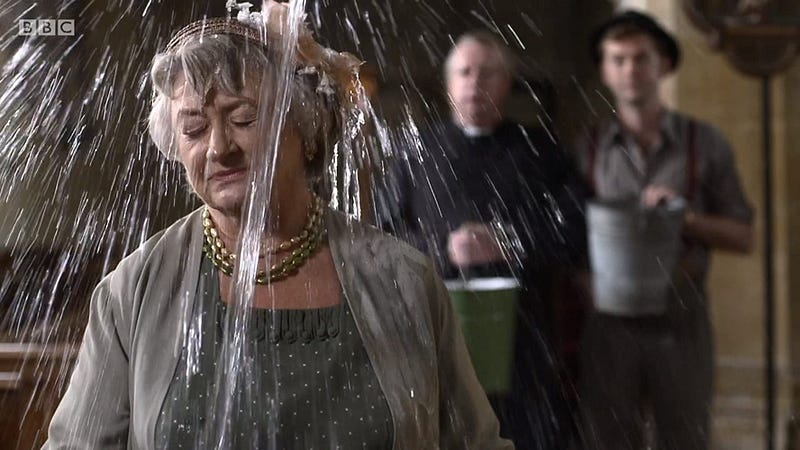
The episode closes with the roof at St Mary’s Catholic Church, even though Sid tried and failed to fix the leaks on the cheap, leaking all over Mrs McCarthy and her hat. Lady Felicia, seeing the parish secretary drenched with rainwater, finds the entire sceptical most amusing. The same is true of Father Brown and Sid. It doesn’t look like St Mary’s Catholic Church will be getting the £247 it needs any time soon.