
British Network Television
‘Father Brown’: S03.E10. “The Judgement of Man”
The local art gallery has the priceless painting ‘The Judgement of Man’
This episode opens with a scene set during the Second World War. The Nazis are seen entering a household and stealing a priceless religious oil painting on canvas. Jewish families, during the early days of the Second World War, were forced to hide their artwork from the Nazis.
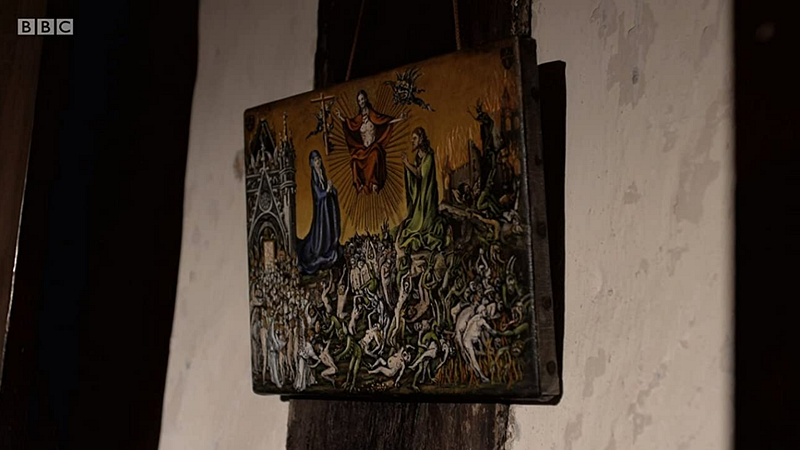
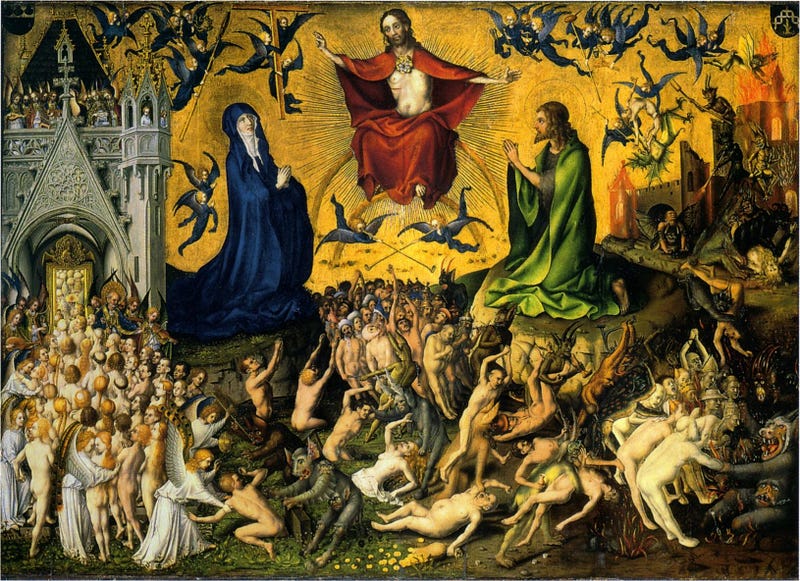
The painting, referenced in this Father Brown episode as The Judgement of Man, is supposedly Stefan Lochner’s Last Judgement. Painted c. 1435, with works such as this possessing more than one title Lochner’s oil painting is also known as The Day of the Lord. This painting, in real life, can be found hanging at Cologne’s Wallraf-Richartz Museum. There are numerous figures missing from the painting depicted in the Father Brown episode.
The episode references the horrors of the war. Later, as the war progressed, Jewish families were forced to hide themselves. History shows a significant number of Jewish families perished in concentration camps. This is a piece of history, unimaginably horrific, some people have refused to acknowledge occurred.
The Judgement of Man, even though it is a Hercule Flambeau (John Light) instalment, is one of the darkest Father Brown episodes ever televised.
The next time we see the painting, The Judgement of Man, Father Brown (Mark Williams) and museum curator Binkie Cadwaller (James Dreyfus) are admiring it. The priest’s comment regarding The Judgement of Man, noting the size, is the same one many people make when first seeing Leonardo da Vinci’s Mona Lisa. Father Brown is surprised it is so small.
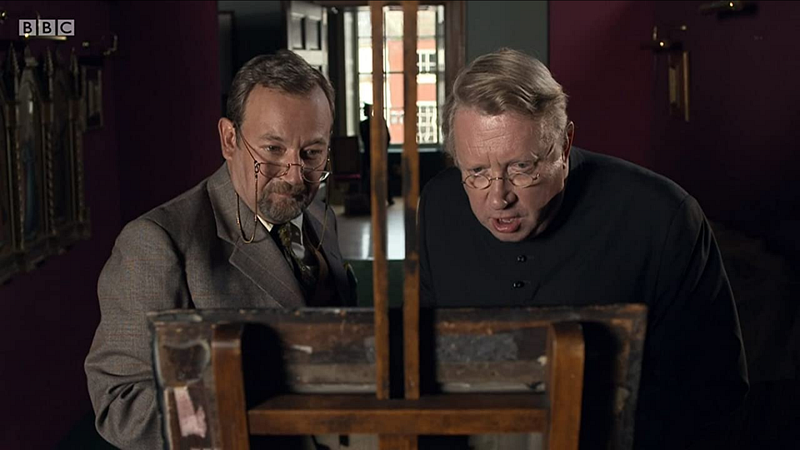
The painting, as Father Brown correctly observes, is a timely reminder for the need of redemption. The presence of the year 1452 in the painting piques Father Brown’s curiosity. Writers responsible for penning Father Brown scripts, especially Paul Matthew Thompson, never include toss-away lines to fluff out scenes with meaningless dialogue. There is always a reason, even if it isn’t immediately apparent, for including the smallest of details.
The sound of something slamming to the floor draws their attention away from the painting. One of the movers responsible for bringing the artwork into the building accidentally dropped a piece. Mr Cadwaller, angered by this apparent clumsiness, suggests to Father Brown that he is surrounded by philistines. With a reference to the Vatican, addressing Father Brown’s curiosity, Mr Cadwaller tells the priest that the piece was hidden away within the Apostolic Archives.
Soon thereafter, with Inspector Sullivan (Tom Chambers) making his presence felt, the police inspector isn’t surprised to find Father Brown with Mr Cadwaller at the museum. Father Brown, explaining his presence, tells the police inspector that he managed to persuade Mr Cadwaller to allow him a preview of the artwork before the exhibit had been opened to the public. Mr Cadwaller reminds Father Brown to not tell Lady Felicia Montague (Nancy Carroll) that he saw the artwork before her because he would never hear the end of her annoyance.
Inspector Sullivan, even though he allocates a single police constable to keep an eye on things, doesn’t seem to think museum security is reasonable use of police time and resources. The police inspector, visibly irritated by Father Brown being there, agrees with the priest when he suggests to Mr Cadwaller that he should leave.
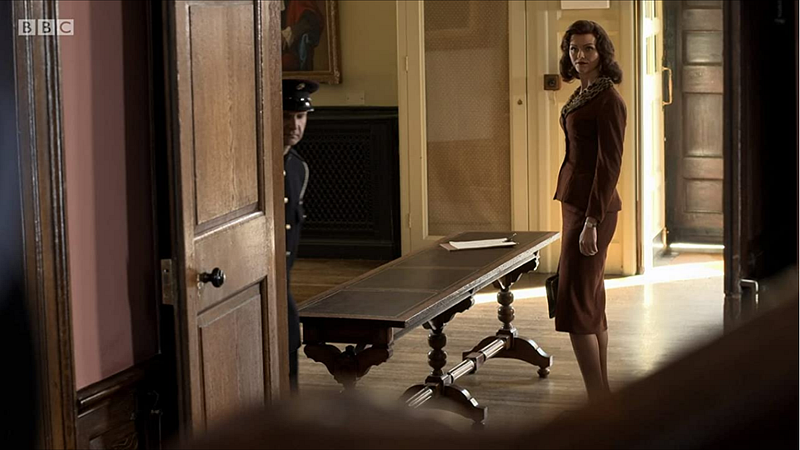
It is here that Rebecca Himelbaum (Anna-Louise Plowman), a journalist, arrives at the museum to cover the coming art event. Inspector Sullivan is clearly taken with the journalist’s appearance.
Father Brown’s request for a lift back to Kembleford goes unanswered as Inspector Sullivan drives away. If the police inspector hadn’t been more interested in returning to the police station, noting Father Brown’s gaze, he would have noticed something strange on the opposite side of the road.
Following Father Brown’s gaze, with a facial expression suggesting more than a modicum of curiosity, we observe a familiar French gentleman entering a property. The cigarette butt left outside seems to confirm Father Brown’s suspicions. It is Monsieur Hercule Flambeau (John Light).
The episode briefly takes us to the interview Miss Himelbaum is conducting with the museum curator. Miss Himelbaum, referencing Leipzig, asks Mr Cadwaller whether he had been to the German city. Leipzig, located in Saxony, is much bigger today than it was during the Second World War. Mr Cadwaller’s reaction, even though he states he isn’t terribly familiar with Leipzig, clearly indicates he’s hiding something. There is a coldness in Miss Himelbaum’s eyes which tells us she knows the museum curator is lying.
Meanwhile, at the presbytery, Bridgette McCarthy (Sorcha Cusack) questions whether Father Brown actually saw Monsieur Flambeau. This is when Sidney “Sid” Carter (Alex Price), visibly annoyed, enters the presbytery kitchen in a huff. Someone has apparently stolen the spark plugs to lady Felicia’s vehicle. Who could possibly want to do that?
With the Rolls-Royce out of action, noting her ladyship turning up on the 3:15 p.m. train, Sid must call the train station so that Lady Felicia is informed of the situation. Whilst it is a curious situation, if Father Brown hadn’t been preoccupied with other matters, it is likely he might have connected a few dots. Father Brown believes Monsieur Flambeau wants to steal the painting. He’s not wrong.
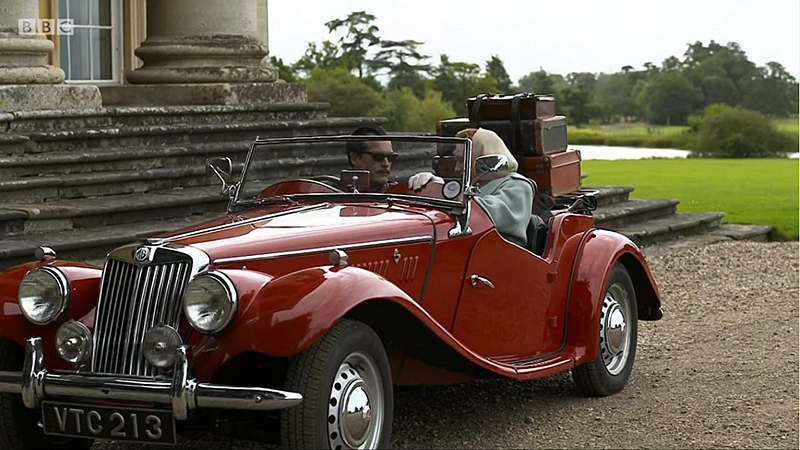
The episode takes us to a maroon MG being driven past a nearby church. Our first glimpse of Lady Felicia sees her occupying the passenger seat. In the driver’s seat, with there being no doubts, it is clearly Monsieur Flambeau. It becomes evident Monsieur Flambeau had the spark plugs removed from the Rolls-Royce because he didn’t want Sid showing up at the train station.
Monsieur Flambeau presents himself to Lady Felicia as an American artist visiting England so that he can paint some landscapes. Lady Felicia, similarly to the way Inspector Sullivan looked at Miss Himelbaum earlier in the episode, is obviously taken with this American artist.
Little does she realise the person occupying the driver’s seat is Monsieur Flambeau. Monsieur Flambeau, referencing religious art as being his forte, embodies a certain amount of truth in is American persona. Having been invited to the museum exhibit, even though there is no reference to the event time, Monsieur Flambeau suggests he collect Lady Felicia from her residence at 2:30 p.m.
Father Brown, at the Kembleford Police Station, tries to convince Inspector Sullivan that Monsieur Flambeau is in town and it is likely he is there to steal The Judgement of Man. Inspector Sullivan believes Father Brown’s concern is merely a half-baked hunch. Suspicious as to why Father Brown is sharing information with him, noting Inspector Sullivan’s tone, the priest states that the Catholic Church owns the painting and that he has a vested interest in seeing the painting not stolen.
The police inspector recalls how close he was to catching Monsieur Flambeau the previous time they crossed paths. Father Brown and the police inspector remember the incident very differently.
Sergeant Daniel Goodfellow (John Burton) brings to the police inspector’s attention recently received information. Before Sergeant Goodfellow can elaborate on what he has, recognising Father Brown is still in the room, Inspector Sullivan indicates the priest that he leave.
Silly, before closing the door to Inspector Sullivan’s office, Sergeant Goodfellow mentions the name Mirren McConnell (Martin Docherty). He has been released on parole from Winson Green. The prison, more correctly named HM Prison Birmingham, is located in the Winson Green area of the West Midland’s city.
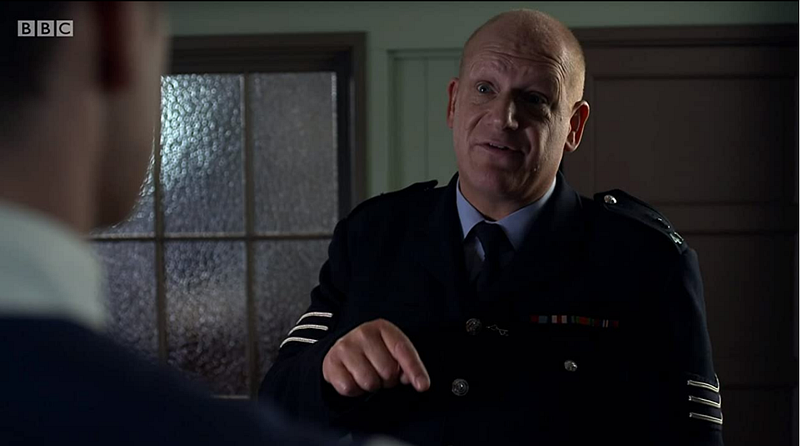
Loitering outside the office, unbeknownst to either Inspector Sullivan and Sergeant Goodfellow, Father Brown and Sid learn hear everything that is said during a seemingly private conversation. Sergeant Goodfellow points out to Inspector Sullivan that Mr McConnell’s past form pertains to art theft. Father Brown, when discovered by the police inspector, suggests that they work together.
Inspector Sullivan, never having previously expressed an interest in working with Father Brown on anything, tells the priest he will be having his name removed from the museum guest list. Sid, exasperated by Inspector Sullivan’s attitude, reminds the police inspector that the priest came to him with information. Inspector Sullivan, not bantering words, suggests he will have both Father Brown and Sid arrested for obstruction if he sees them anywhere near the museum exhibit.
Father Brown, wanting to know about Mr McConnell’s history, is told by Sid that the recently released criminal has form with explosives and other crimes. Mr McConnell, according to Sid, has a scare on his face.
There is a brief scene, with Mr Cadwaller at the museum, where the curator looks extremely pleased with himself. All the artwork exhibited, in addition to The Judgement of Man, is likely to have a history the museum curator would rather kept secret.
After Mr Cadwaller leaves the museum for the evening, noting he will return bright and early the following morning, we see a man matching Mr McConnell’s description walking round the establishment. The police constable is more interested reading his newspaper than he is with observing the comings and goings of museum personnel.
Interestingly, not that it relates to the episode narrative, the newspaper shows a reference to Meyrick Good and the first Grand National broadcast. A headline reads “Come on Ted! You’ll win!” The newspaper seems to have a bias towards a certain horse, rider, and owner.
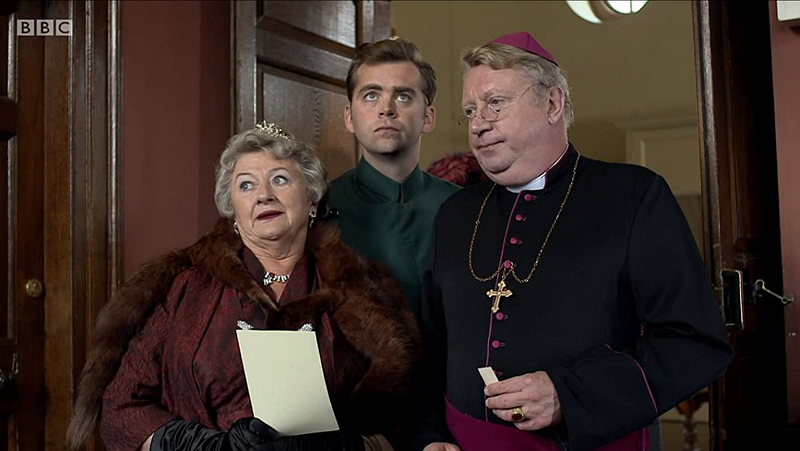
The following day, recognising Father Brown and Mrs McCarthy queuing to get into the museum exhibit, there is something seriously suspicious about their attire. Father Brown, dressed as a bishop, presents himself as Bishop Talbot. The real Bishop Talbot (Malcolm Storry) is indisposed at a synod in London.
As for Mrs McCarthy, noting how she is wearing Lady Filicia’s tiara, is introduced by the ‘bishop” as the Dowager Duchess of Worcester. Mrs McCarthy plays into her new persona like she’s a ham-actor. Sid accompanies them as their chauffeur.
Meanwhile, also at the exhibition, we find Lady Felicia introducing her new American friend to the museum curator. Lady Felicia, still unaware she is with Monsieur Flambeau, and the American make a striking couple. Monsieur Flambeau, as quick observations of the building and the security are noted. There are police officers posted throughout the museum.
Claude Chabrol (David Gant), disguised as a waiter, offers the three of them Champagne. Mr Chabrol is someone that works with Monsieur Flambeau on certain tricky jobs. Lady Felicia, not one to turn down a glass of the bubbly, partakes in a glass of Champagne with her companions.
The museum curator, in a brief conversation with Inspector Sullivan, tells the police inspector that his openings have always been fondly remembered. Inspector Sullivan’s facial expression suggests that there is a clear double entendre in Mr Cadwaller’s words.
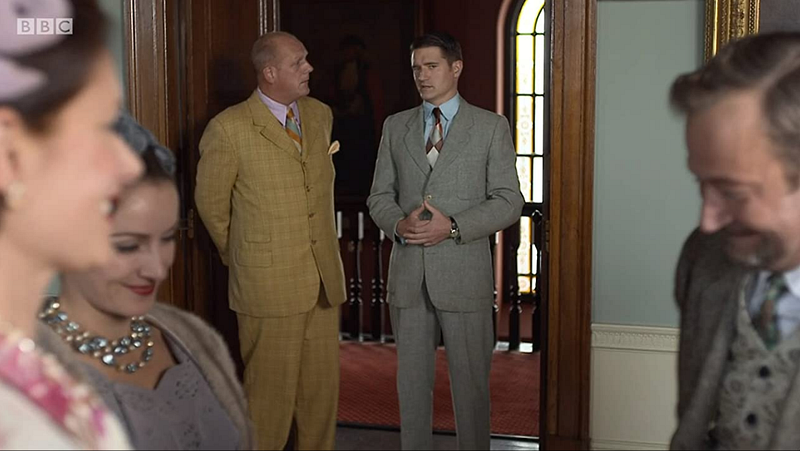
In addition to Inspector Sullivan being at the exhibition, wearing a suit that stands out like a sore thumb, we also find Sergeant Goodfellow. There is no way, even though the police inspector directs his sergeant to blend in, Sergeant Goodfellow couldn’t not stick out. Where did Sergeant Goodfellow get that suit?
Elsewhere, near The Judgement of Man, we find Miss Himelbaum wanting to touch it. Father Brown, still dressed as a bishop, approaches Miss Himelbaum. The number tattooed to Miss Himelbaum’s arm doesn’t escape Father Brown’s attention. People familiar with Second World War history will know, at concentration camps, detainees were tattooed with an identification number. The presence of such a number on Miss Himelbaum’s arm is an accurate historical nod to happenings across Europe during the war.
Father Brown ask of the article she’s writing about Mr Cadwaller. Miss Himelbaum’s words, with more than a hint of finality, are most enlightening. She suggests her article will be a fitting obituary for a colourful career. This comment, as the meaning isn’t immediately apparent, leaves Father Brown somewhat perplexed.
Mrs McCarthy continues to play her part as the Dowager Duchess of Worcester like she’s the lead actress in an Agatha Christie adaptation. This dedication to her persona, noting Sid’s reaction, doesn’t go unnoticed. The same is true for Father Brown.
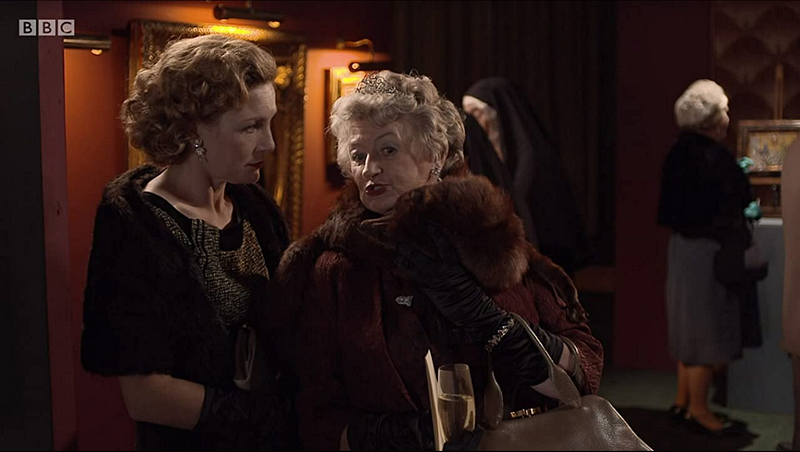
Mrs McCarthy, oddly not recognising the mayor, suggests to Father Brown that he could be a likely suspect. Lady Felicia, excited to see Father Brown, wants to introduce him to her new American friend. There is no sign of him anywhere. With unfinished business, noting a certain figure to his back to the priest, Father Brown looks for Monsieur Flambeau. It doesn’t take long for Lady Felicia to notice Mrs McCarthy is wearing her jewellery.
Elsewhere, deliberately colliding with the museum curator with a tray of Champagne glasses, Mr Chabrol picks Mr Cadwaller’s pocket for the keys to his office. Mr McConnell swiftly taking the keys from Mr Chabrol is observed by Sid. Naturally, mainly because of his overly developed curiosity, Sid continues to observe Mr McConnell as he enters another part of the museum.
Mr McConnell slides a small case under a table in the main exhibition hall. Sid, seeing it happen, examines the case and discovers a time bomb. Inspector Sullivan, recognising Sid’s uniform pulls him from beneath the table. The police inspector doesn’t immediately see the threat as he is preoccupied with Sid. Sid draws the police inspector’s attention to the bomb.
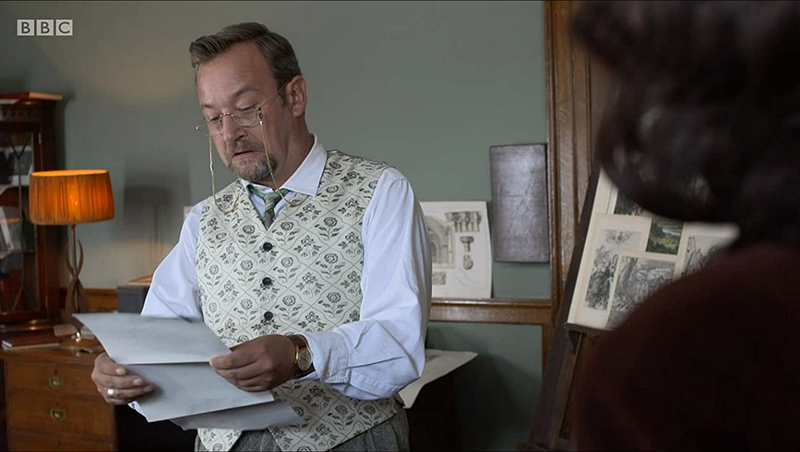
Meanwhile, in his office, Mr Cadwaller is confronted by Miss Himelbaum. It is her intent to get him to read her article before seeing it published. The article, a partial list of artwork stolen by the Nazis, details Mr Cadwaller’s criminal activities during the war.
Monsieur Flambeau takes advantage of the confusion and attempts to steal The Judgement of Man. Father Brown, having recognised the bomb as a classic misdirection, shows up when Monsieur Flambeau lifts the painting from the stand. Monsieur Flambeau removes the painting from the frame and makes his way to the front entrance.
On the stairway, followed by Father Brown, Monsieur Flambeau crosses paths with Miss Himelbaum. It becomes clear, even to the casual observer, Monsieur Flambeau and Miss Himelbaum have a deeply meaningful personal history. This interaction doesn’t go unnoticed by Father Brown.
Father Brown, returning to the main exhibition hall, finds Inspector Sullivan attempting to defuse the bomb. Looking like the bomb is going to blow, running from the room, the police inspector places Father Brown’s safety above his own. The bomb is a dud merely designed to distract everyone’s attention. Red, white, and blue streamers fly from the small case. The French National Anthem can be heard. Inspector Sullivan realises the painting is gone.
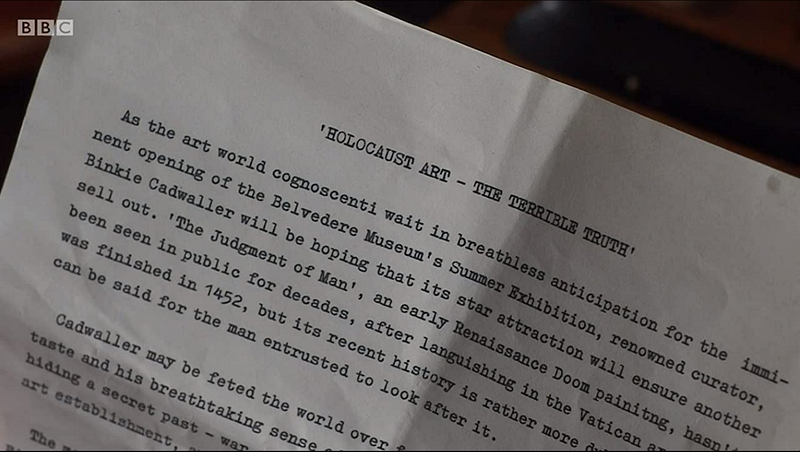
Mr McConnell distracts everyone’s attention long enough to allow Monsieur Flambeau to escape from the museum. Monsieur Flambeau, pushing Mrs McCarthy out of his way, escorts Lady Felicia from the museum to safety. Sergeant Goodfellow quickly apprehends Mr McConnell. Father Brown, now in Mr Cadwaller’s office, locates the article Miss Himelbaum about the museum curator. The contextual meaning is not lost on Father Brown.
Detained at the police station, noting possibly no way out, Mr McConnell is questioned by Inspector Sullivan in connection with his involvement with Monsieur Flambeau and the robbery. Father Brown, after the police inspector concludes his conversation with Mr McConnell, tries to speak with Inspector Sullivan. Inspector Sullivan, when Father Brown notes the museum curator has vanished, suggests Mr Cadwaller could have been in on the robbery. Mr Cadwaller apparently has form.
Back at the presbytery, seated with Sid and Mrs McCarthy, Father Brown wants to know about this American that Lady Felicia likes so much. Mrs McCarthy, remembering French cologne, realises the American is likely Monsieur Flambeau.
Meanwhile, at Montague Hall, we find Lady Felicia and Monsieur Flambeau together. Lady Felicia remembers that her American friend had offered to prick her up at 2:30 p.m. He knew the time of the event before she invited him. The American reveals his true self. Whilst Lady Felicia refers to him as a common thief, noting the way he carries himself, there is nothing common about Monsieur Flambeau.
Monsieur Flambeau sums Lady Felicia up extremely quickly. She can’t say he’s not right. Lady Felicia, filling her life with mundane distractions, is trapped in a loveless marriage.
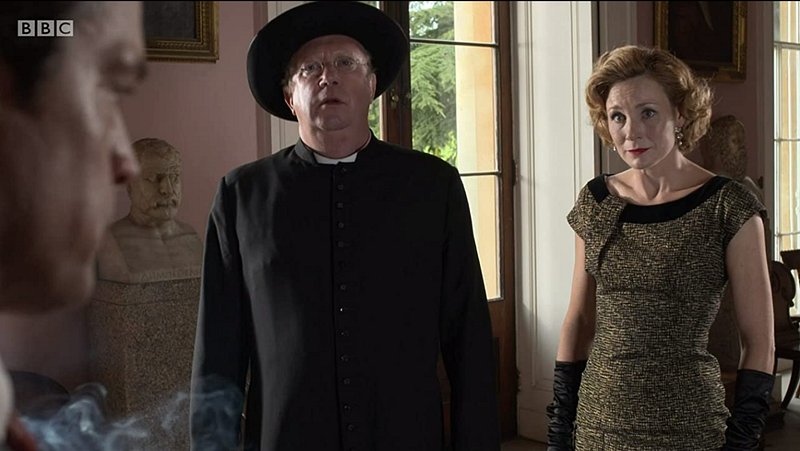
Father Brown, now not dressed as a bishop, arrives. The priest, in conversation with Monsieur Flambeau, wants to know what his connection is to Miss Himelbaum. Monsieur Flambeau refers to a wartime liaison that abruptly ended. Miss Himelbaum, in a flashback, is seen with Monsieur Flambeau when her family members are taken by the Nazis. This, before encountering her at the museum, was the last time Monsieur Flambeau saw Miss Himelbaum. This is also where Monsieur Flambeau first encountered Mr Cadwaller. Lady Felicia doesn’t believe her friend could stoop as low as to collaborate with the Nazis. Where could the painting be?
Father Brown, understanding Miss Himelbaum’s perspective, believes she will seek revenge on Mr Cadwaller for his part in her family’s death. Monsieur Flambeau believes Mr Cadwaller deserves what he gets. He’s not wrong. When Lady Felicia suggests that someone must have seen Miss Himelbaum and Mr Cadwaller leaving the Belvedere Museum, Father Brown recalls there being two office doors. They never left the museum.
Miss Himelbaum, inside the volt with Mr Cadwaller, details several ways she could kill him for what he did during the war. Being gassed seems the most poetic.
Outside the museum, needing to distract the stationed plainclothes policeman, Father Brown accidentally breaks a car window with a mis-aimed stone. It doesn’t take Father Brown and Monsieur Flambeau to find their way to the building basement. Monsieur Flambeau makes a good point about sin. Sin requires guilt. Guilt is a cognitive emotion, including himself, some people never experience.
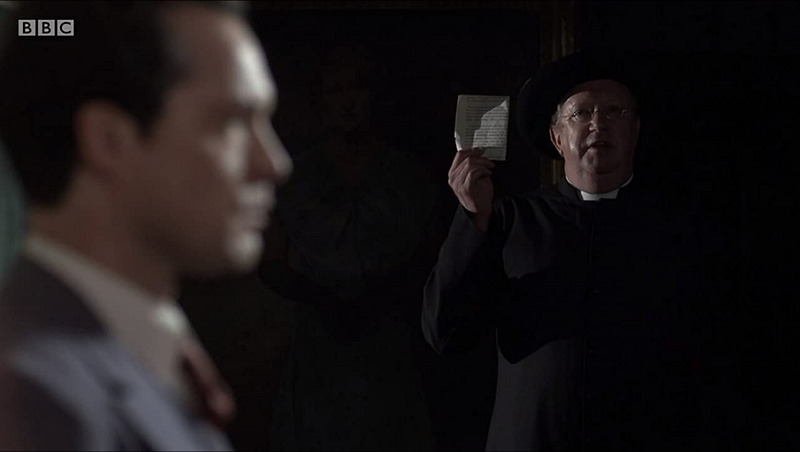
Monsieur Flambeau soon finds Miss Himelbaum with a loaded gun. Father Brown assures Miss Himelbaum that Mr Cadwaller will face justice for what he did during the war. The priest talks Monsieur Flambeau into using his skills to open the volt. Father Brown, remembering the year in the painting, tells Monsieur Flambeau to try 14 5 2 as the combination. It works. Mr Cadwaller is freed from the volt.
Father Brown confronts Mr Cadwaller for sending Miss Himelbaum’s family members to their deaths. The museum curator believes it was only business. Exposing Mr Cadwaller would also implicate the Catholic Church. The guilty, according to Father Brown, will answer for what they have done. Redemption is always there for those that truly seek it.
Later, in a brief conversation, Father Brown tells Monsieur Flambeau that he wants the painting returned. Monsieur Flambeau doesn’t believe that this is the time for a summon. The choices Monsieur Flambeau make are his and his alone. There is no going back. Father Brown gives to Monsieur Flambeau, because there is a chance of rain, his umbrella. Little does Monsieur Flambeau realise, long before Father Brown offered him the umbrella, the priest removed the painting from it. This, before leaving the museum with Lady Felicia, was where Monsieur Flambeau hid the painting.
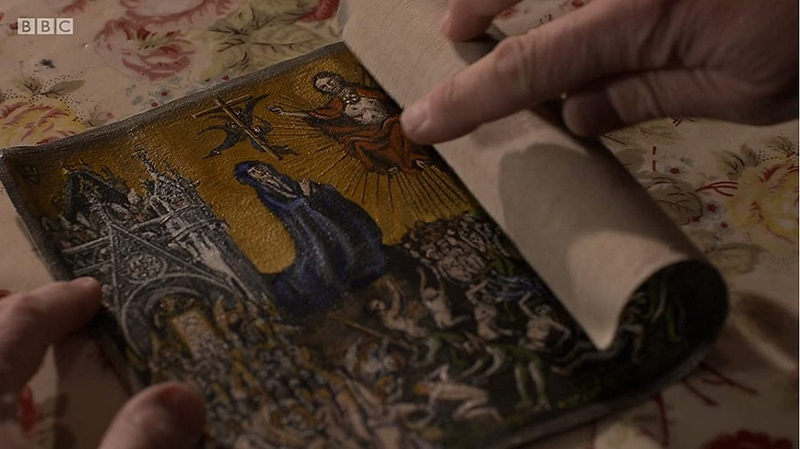
Mrs McCarthy is astonished Father Brown possesses the painting. The priest, having made a promise to Miss Himelbaum, doesn’t intend to return the painting to the Vatican as it was stolen artwork during the Second World War. Father Brown, recognising Monsieur Flambeau’s true nature, redemption is a long way off.


