
Exploring Leaflet for Interactive Map in React Apps
Leaflet is an open-source JavaScript library for mobile-friendly interactive maps
Web mapping or online mapping is the process of using maps, usually created through geographic information systems (GIS) on the Internet, more specifically in the World Wide Web.
Leaflet is the leading open-source JavaScript library for mobile-friendly interactive maps. It is designed with simplicity, performance, and usability in mind. It works efficiently across all major desktop and mobile platforms, and can be extended with lots of plugins.
As a JavaScript library, Leaflet works for all JavaScript applications. In this article, we are going to take a look at how to use it in React apps.
Set Up Leaflet in Create React App
We use Create React App as a base to explore Leaflet. The following command creates a React project:
% yarn create react-app react-map
% cd react-map
Set up leaflet:
% yarn add leafletIt becomes part of dependencies in package.json:
"dependencies": {
  "leaflet": "^1.9.3"
}
The working environment is ready.
Show a Map With React App
We are going to create an interactive map in a React app. The map is centered at San Francisco, whose coordinates, (37.774929, -122.419418), can be found at https://www.latlong.net/.
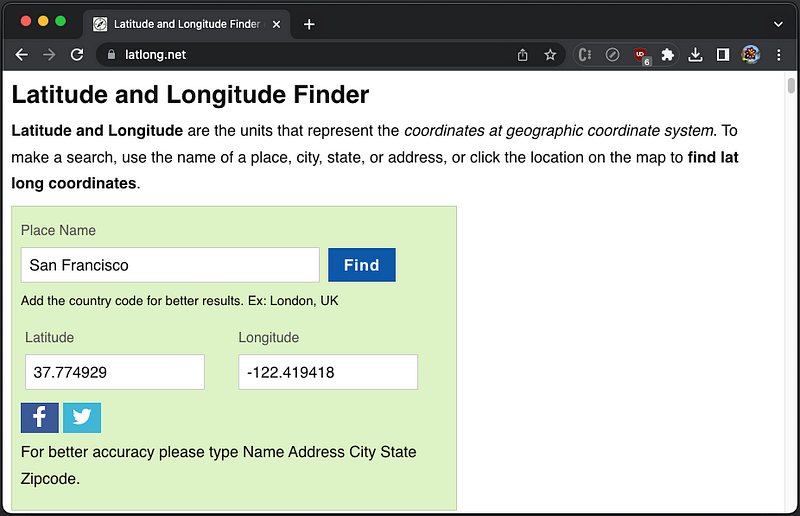
'leaflet' is imported as L, and a map centered at San Francisco with the initial zoom set to 8 can be created using the following code snippet:
const map = L.map(mapId, {
  center: [37.774929, -122.419418],
  zoom: 8,
});
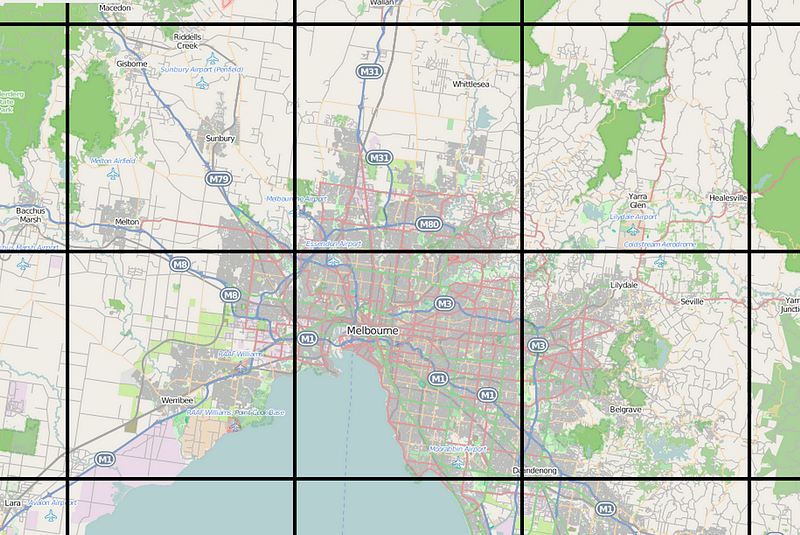
Web mapping loads map tiles from a tile server. A tiled web map is a map displayed in a web browser by seamlessly joining dozens of individually requested tiles in image or SVG formats.
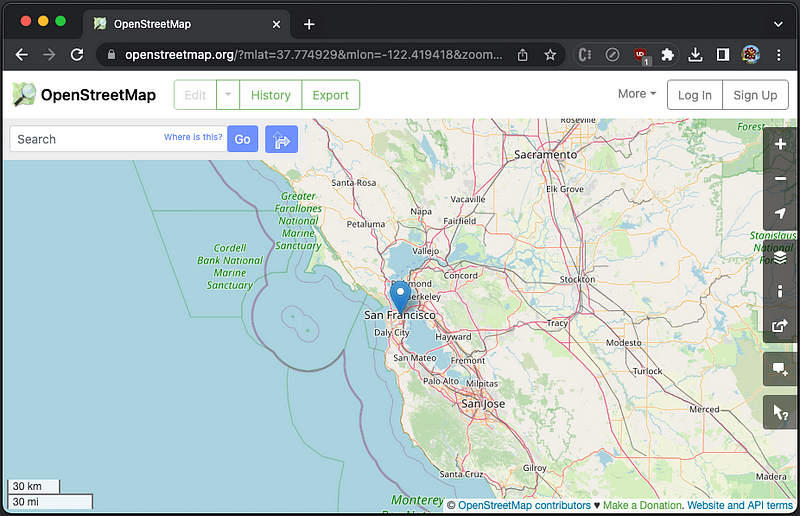
OpenStreetMap is a project that creates and distributes free geographic data for the world. The following URL shows a map with specified latitude, longitude, and zoom:
https://www.openstreetmap.org/?mlat={latitude}&mlon={longitude}&zoom={zoom}Go to the link, https://www.openstreetmap.org/?mlat=37.774929&mlon=-122.419418&zoom=8, and it will be redirected to an interactive map, centered at San Francisco (https://www.openstreetmap.org/?mlat=37.774929&mlon=-122.419418&zoom=8#map=8/37.775/-122.419).
Besides standard tiles, retina tiles come with a high dpi resolution for a crystal clear map experience on modern displays. The following image shows difference between standard tiles and retina tiles:
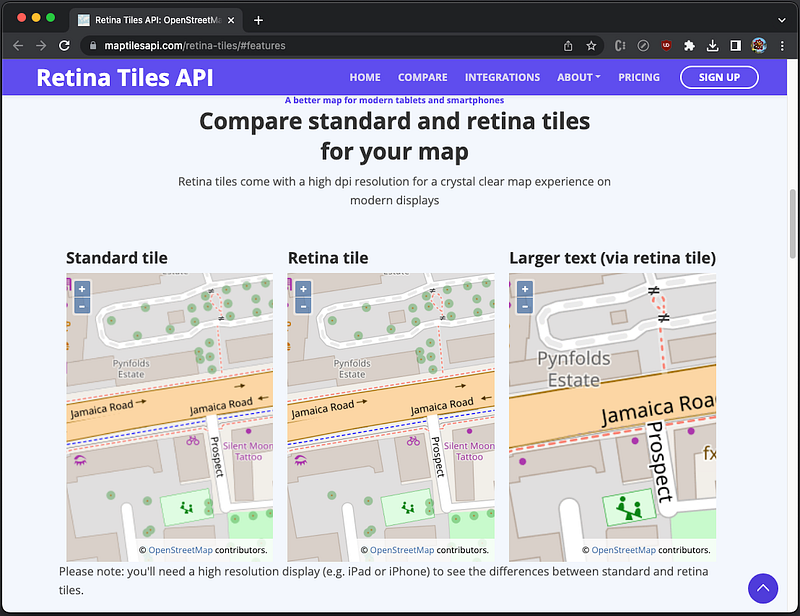
L.tilelayer(<String> urlTemplate, <TileLayer options> options?) loads and displays tile layers on the map. urlTemplate can be specified to OpenStreetMap as https://tile.openstreetmap.org/{z}/{x}/{y}{r}.png, where {z} is for zoom level, {x} and {y} are for tile coordinates, and the optional {r} adds @2x to the URL to load retina tiles.
The following L.tilelayer loads and displays tile layers from OpenStreetMap, with attribution to the map contributors.
L.tileLayer('https://tile.openstreetmap.org/{z}/{x}/{y}{r}.png', {
attribution:
'© <a href="http://www.openstreetmap.org/copyright">OpenStreetMap</a> contributors',
});Here is the modified src/App.js:
- At line 2,
'leaflet'is imported asL. - At line 3, Leaflet style is imported.
- At line 6,
mapIdis defined, as Leaflet requires adivelement with a certainidto put the map (line 21). - At lines 8–18,
useEffect()instantiates the map. – At lines 9–12, the map is created withmapId(line 9), center coordinates (line 10), and the initial zoom (line 11). – At lines 14–17,L.tileLayerloads and displays tile layers on the map.
Leaflet also requires some CSS changes, which are specified in src/index.css:
body {
  margin: 0;
}

#map {
  width: 100vw;
  height: 100vh;
}

.leaflet-container {
  width: 100%;
  height: 100%;
}
Execute yarn start, and we see the following error:
Map.js:1094 Uncaught Error: Map container is already initialized.
    at NewClass._initContainer (Map.js:1094:1)
    at NewClass.initialize (Map.js:136:1)
    at new NewClass (Class.js:24:1)
    at Object.createMap [as map] (Map.js:1750:1)
    at App.js:9:1
    at commitHookEffectListMount (react-dom.development.js:23150:1)
    at invokePassiveEffectMountInDEV (react-dom.development.js:25154:1)
    at invokeEffectsInDev (react-dom.development.js:27351:1)
    at commitDoubleInvokeEffectsInDEV (react-dom.development.js:27330:1)
    at flushPassiveEffectsImpl (react-dom.development.js:27056:1)
It is because useEffect() is called twice under StrictMode even if an empty array is used as a dependency.
Removing StrictMode in src/index.js fixes the issue.
root.render(
  <̶R̶e̶a̶c̶t̶.̶S̶t̶r̶i̶c̶t̶M̶o̶d̶e̶>̶
    <App />
  <̶/R̶e̶a̶c̶t̶.̶S̶t̶r̶i̶c̶t̶M̶o̶d̶e̶>̶
);
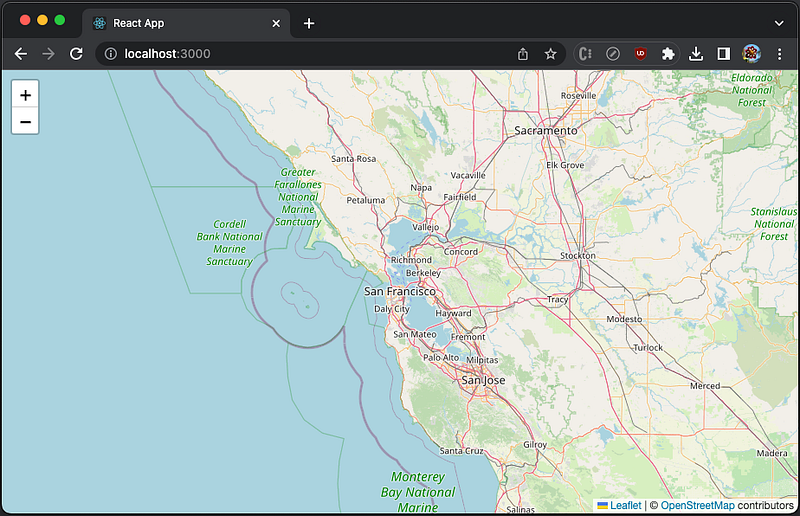
Execute yarn start, and we see an interactive map that is centered at San Francisco.
Alternatively, we can keep StrictMode in src/index.js, and clean up the map if it is already initialized.
Here is the modified src/App.js.
- At line 6,
savedMapis created to keep the map reference. - At lines 10–13, it cleans up
savedMapif it is already initialized. – At line 11, theoffmethod removes a previously added listener function. – At line 12, theremovemethod removes the layer from the map that it is currently active on. - At line 19,
savedMapis assigned to the newly createdmap.
Execute yarn start, and it works without error.
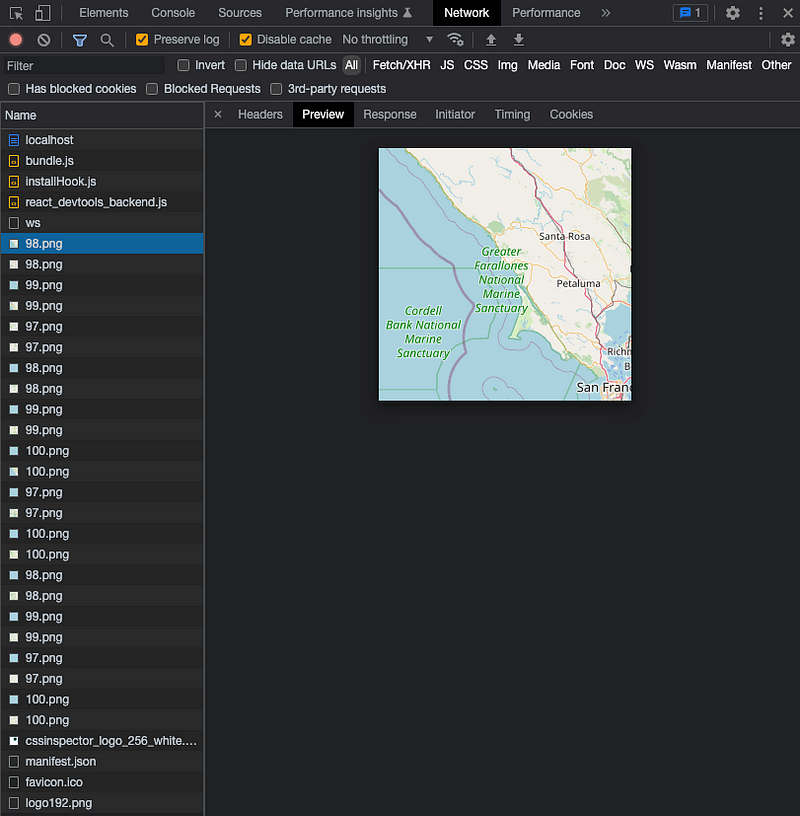
Open the inspect window, and we see map tiles that are loaded.
Create Markers and Popups on the Map
To mark a single location on the map, Leaflet provides markers. These markers use a standard symbol, or can be customized.
Marker is defined by L.marker(<LatLng> latlng, <Marker options> options?), where options is defined as the type of MarkerOptions:
export interface MarkerOptions extends InteractiveLayerOptions {
  /** Icon instance to use for rendering the marker */
  icon?: Icon | DivIcon | undefined;

  /** Whether the marker is draggable with mouse/touch or not. */
  draggable?: boolean | undefined;

  /**
   * Whether the marker can be tabbed to with a keyboard and clicked by
   * pressing enter.
   */
  keyboard?: boolean | undefined;

  /**
   * Text for the browser tooltip that appear on marker hover (no tooltip
   * by default).
   */
  title?: string | undefined;

  /**
   * Text for the `alt` attribute of the icon image (useful for
   * accessibility).
   */
  alt?: string | undefined;

  /** Option for putting the marker on top of all others (or below). */
  zIndexOffset?: number | undefined;

  /** The opacity of the marker. */
  opacity?: number | undefined;

  /**
   * If `true`, the marker will get on top of others when you hover the
   * mouse over it.
   */
  riseOnHover?: boolean | undefined;

  /** The z-index offset used for the `riseOnHover` feature. */
  riseOffset?: number | undefined;

  /** `Map pane` where the markers shadow will be added. */
  shadowPane?: string | undefined;

  /**
   * Whether to pan the map when dragging this marker near its edge or
   * not.
   */
  autoPan?: boolean | undefined;

  /**
   * Distance (in pixels to the left/right and to the top/bottom) of the
   * map edge to start panning the map.
   */
  autoPanPadding?: PointExpression | undefined;

  /** Number of pixels the map should pan by. */
  autoPanSpeed?: number | undefined;

  /** When true, the map will pan whenever the marker is focused. */
  autoPanOnFocus?: boolean | undefined;
}
Marker has an icon, which is a type of BaseIconOptions:
export interface BaseIconOptions extends LayerOptions {
  /**
   * (required) The URL to the icon image (absolute or relative to your
   * script path).
   */
  iconUrl?: string | undefined;

  /**
   * The URL to a retina sized version of the icon image (absolute or
   * relative to your script path). Used for Retina screen devices.
   */
  iconRetinaUrl?: string | undefined;

  /** Size of the icon image in pixels. */
  iconSize?: PointExpression | undefined;

  /**
   * The coordinates of the "tip" of the icon (relative to its top left
   * corner).
   * The icon will be aligned so that this point is at the marker's
   * geographical location. Centered by default if size is specified,
   * also can be set in CSS with negative margins.
   */
  iconAnchor?: PointExpression | undefined;

  /**
   * The coordinates of the point from which popups will "open",
   * relative to the icon anchor.
   */
  popupAnchor?: PointExpression | undefined;

  /**
   * The coordinates of the point from which tooltips will "open",
   * relative to the icon anchor.
   */
  tooltipAnchor?: PointExpression | undefined;

  /**
   * The URL to the icon shadow image. If not specified, no shadow image
   * will be created.
   */
  shadowUrl?: string | undefined;

  /** The URL to the retina icon shadow image. */
  shadowRetinaUrl?: string | undefined;

  /** Size of the shadow image in pixels. */
  shadowSize?: PointExpression | undefined;

  /**
   * The coordinates of the "tip" of the shadow (relative to its top left
   * corner) (the same as iconAnchor if not specified).
   */
  shadowAnchor?: PointExpression | undefined;

  /**
   * A custom class name to assign to both icon and shadow images. Empty
   * by default.
   */
  className?: string | undefined;
}
Let’s add a marker to label San Francisco in src/App.js:
- At line 4, Leaflet distributed marker icon,
leaflet/dist/images/marker-icon.png, is imported. - At line 5, Leaflet distributed marker shadow image,
leaflet/dist/images/marker-shadow.png, is imported. - At line 19,
mapsets the zoom to 12. - At lines 28–31,
customIconis created with Leaflet distributed marker icon and shadow image. - At lines 33–37, a marker is created using San Francisco coordinates. It uses
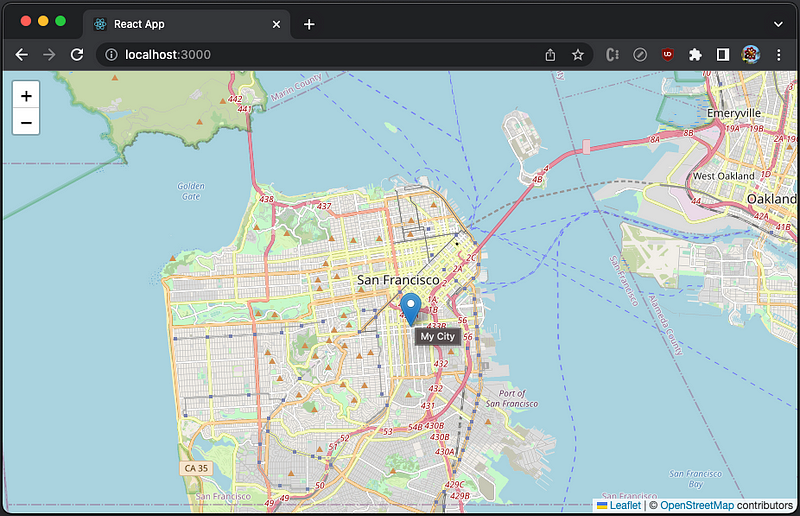
customIcon(line 34), and sets the title,'My City'(line 35). The marker is madedraggable(line 36).
Execute yarn start, and the map shows a shadowed and draggable marker at San Francisco coordinates.
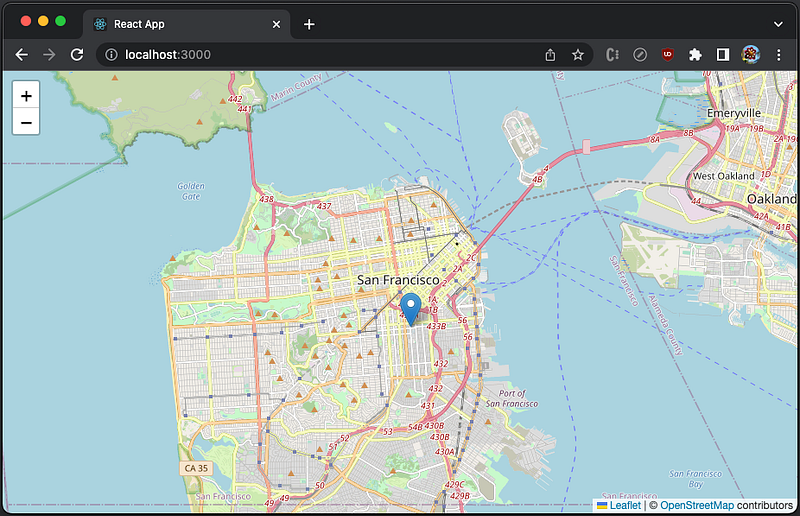
When the marker is hovered on, the title, My City, shows.
We can open popups in certain places of a map. A popup can be bound to the marker click, and in addition, it can be programmably opened:
marker.bindPopup(popupContent).openPopup();A popup can also be standalone.
L.popup(<Popup options> options?, <Layer> source?)
L.popup(<LatLng> latlng, <Popup options> options?)
options is defined as the type of PopupOptions that extends DivOverlayOptions:
export interface PopupOptions extends DivOverlayOptions {
  /** Max width of the popup in pixels. Default is 300. */
  maxWidth?: number | undefined;

  /** Min width of the popup in pixels. Default is 50. */
  minWidth?: number | undefined;

  /**
   * If set, creates a scrollable container of the given height inside a
   * popup if its content exceeds it.
   */
  maxHeight?: number | undefined;

  /**
   * Set it to true if you want to prevent users from panning the popup
   * off of the screen while it is open. Default is false.
   */
  keepInView?: boolean | undefined;

  /**
   * Controls the presence of a close button in the popup. Default is
   * true.
   */
  closeButton?: boolean | undefined;

  /**
   * Set it to false if you don't want the map to do panning animation to
   * fit the opened popup. Default is true.
   */
  autoPan?: boolean | undefined;

  /**
   * The margin between the popup and the top left corner of the map view
   * after autopanning was performed.
   */
  autoPanPaddingTopLeft?: PointExpression | undefined;

  /**
   * The margin between the popup and the bottom right corner of the map
   * view after autopanning was performed.
   */
  autoPanPaddingBottomRight?: PointExpression | undefined;

  /**
   * Equivalent of setting both top left and bottom right autopan padding
   * to the same value. Default is Point(5, 5).
   */
  autoPanPadding?: PointExpression | undefined;

  /**
   * Set it to false if you want to override the default behavior of the
   * popup closing when another popup is opened. Default is true.
   */
  autoClose?: boolean | undefined;

  /**
   * Set it if you want to override the default behavior of the popup
   * closing when user clicks on the map. Defaults to the map's
   * closePopupOnClick option.
   */
  closeOnClick?: boolean | undefined;

  /** Set it to false if you want to override the default behavior of the
   * ESC key for closing of the popup.
   */
  closeOnEscapeKey?: boolean | undefined;
}
DivOverlayOptions is defined as following:
export interface DivOverlayOptions {
  /** The offset of the popup position. Default is Point(0, 7). */
  offset?: PointExpression | undefined;

  /** A custom CSS class name to assign to the popup. */
  className?: string | undefined;

  /** Map pane where the popup will be added. Default is 'popupPane'. */
  pane?: string | undefined;

  /**
   * If true, the popup/tooltip will listen to the mouse events. Default
   * is false.
   */
  interactive?: boolean | undefined;

  /**
   * Sets the HTML content of the overlay while initializing. If a
   * function is passed the source layer will be passed to the function.
   * The function should return a String or HTMLElement to be used in
   * the overlay.
   */
  content?: string | HTMLElement | ((layer: Layer) => string) | ((layer: Layer) => HTMLElement);
}
The following code snippet binds a popup to the marker, and then opens it:
L.marker([37.774929, -122.419418], {
  icon: customIcon,
  title: 'My City',
  draggable: true,
  }).addTo(map)
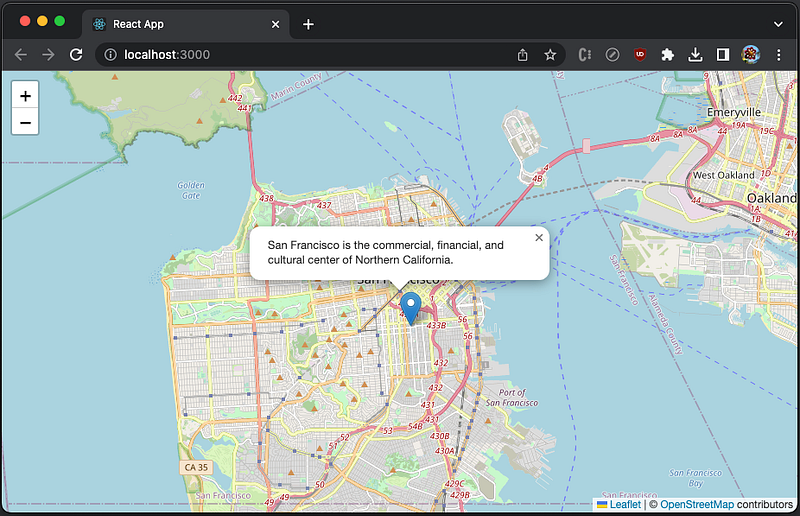
    .bindPopup('San Francisco is the commercial, financial, and cultural center of Northern California.')
    .openPopup();
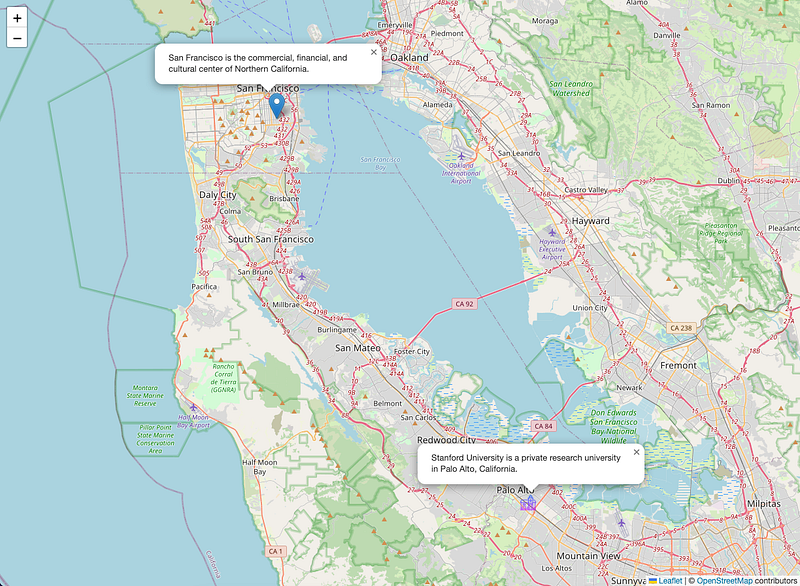
Execute yarn start, and the map has a popup that is bound to the marker.
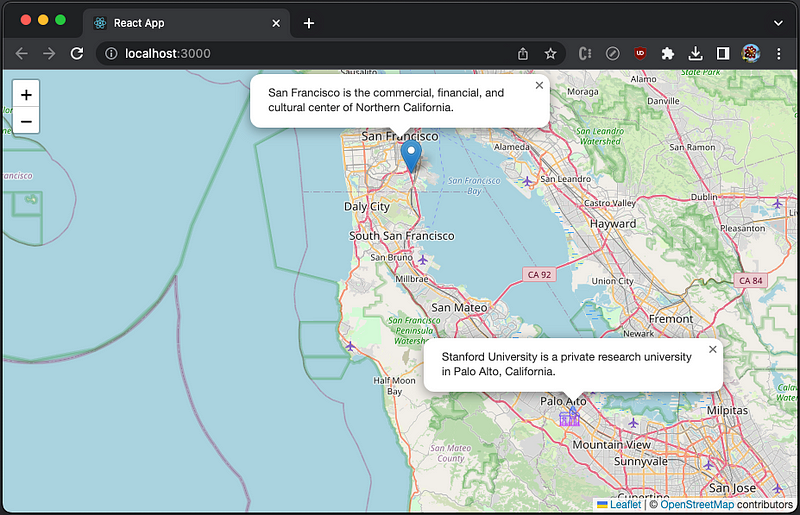
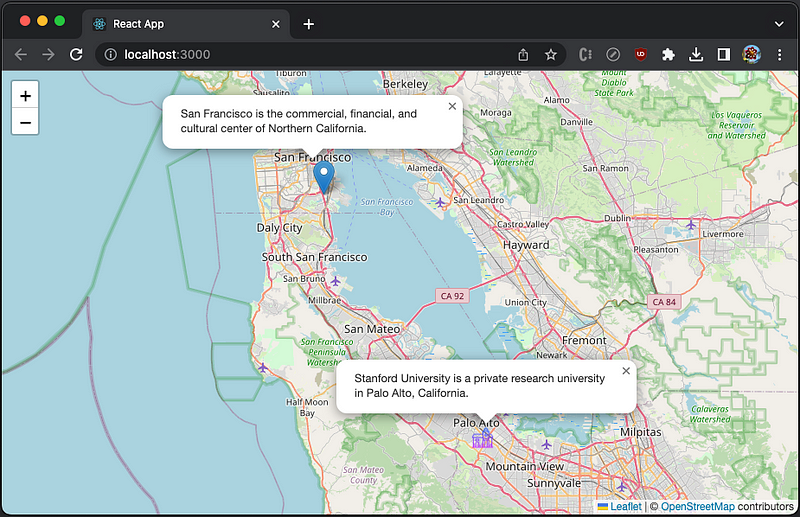
We have shown a marker and a popup. In addition to San Francisco, we are going to have a custom icon to indicate Stanford University at Palo Alto, California.
Here is the custom icon, src/icons8-university-64.png:

Here is the modified src/App.js:
- At line 6, the custom marker icon,
./icons8-university-64.png, is imported ascollegePng. - At line 19, the map coordinates are shifted a bit to show both San Francisco and Palo Alto.
- At line 20,
mapsetszoomto 10. - At lines 29–38, San Francisco marker is created with a popup, where
autoCloseis set to false (line 37). - At lines 40–50, Stanford University marker is created with a popup, where
autoCloseis set to false (line 49). The custom icon’s size (line 43) and anchor (line 44) are adjusted.
Execute yarn start, and the map has two markers and two popups.
Create Various Maps in Layers
Web Map Service (WMS) is a popular way of publishing maps by professional GIS software. This format is similar to map tiles, but more generic and not so well optimized for use in web maps. Therefore, the rendering might be a little slower.
WMS provides alternatives to OpenStreetMap, with different types of maps.
The following L.tilelayer loads and displays tile layers from WMS offered by Mundialis, with layers set to TOPO-WMS for showing world topography.
L.tileLayer.wms('http://ows.mundialis.de/services/service?', {
  layers: 'TOPO-WMS',
})
Usually it is a good idea to use software such as QGIS to see what layers are available in a WMS server in order to see what layers are available.
Here is the modified src/App.js:
- At lines 5–18, it creates
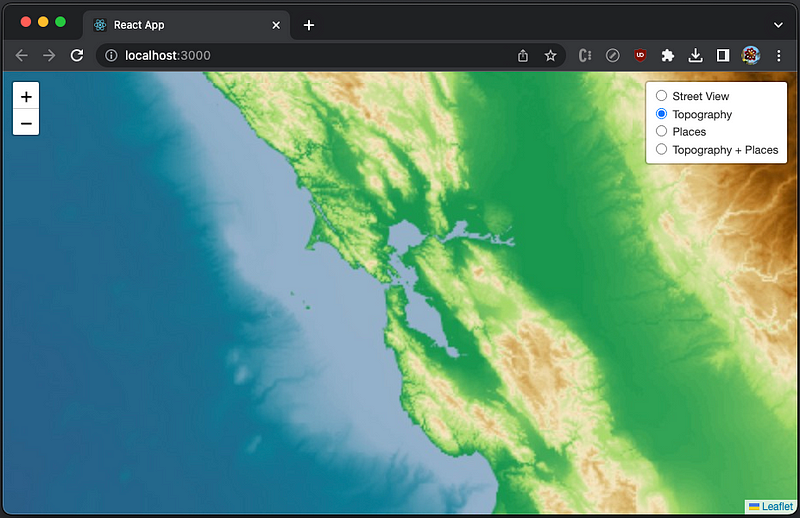
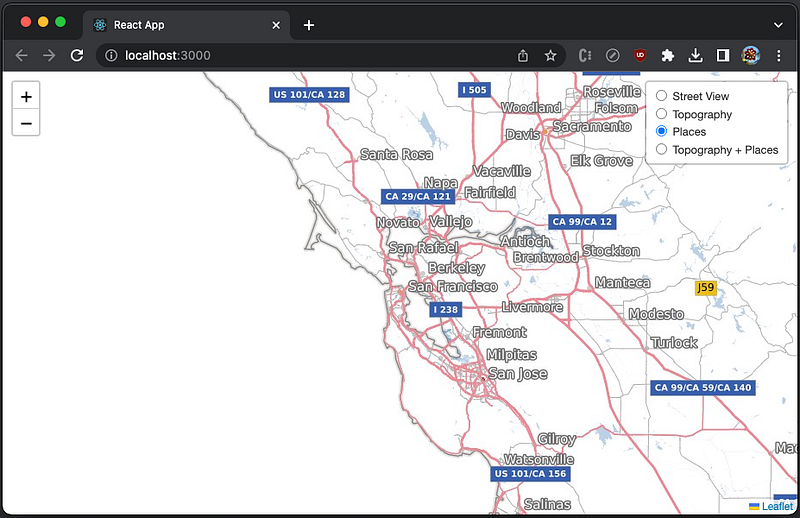
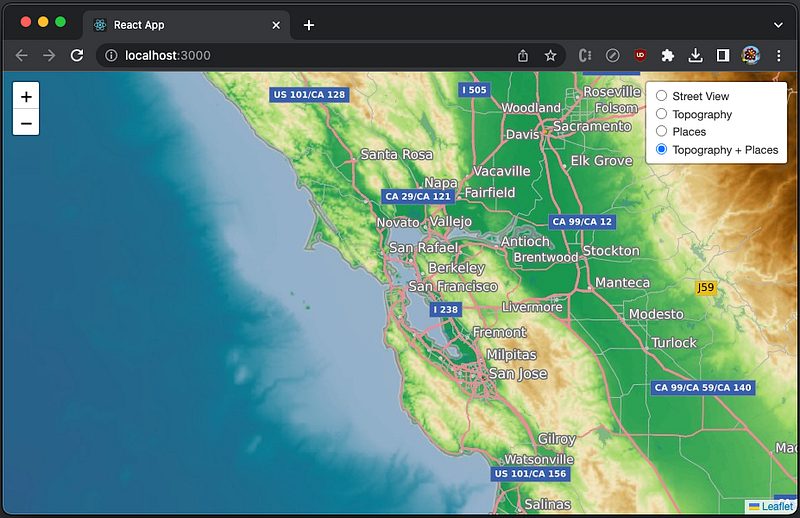
baseMapsthat is composed of 4 layers of maps. – At lines 6–8, the layer,Street View, is created from OpenStreetMap. – At lines 9–11, the layer,Topography, is created from WMS, with a layer of'TOPO-WMS', showing the world topography. – At lines 12–14, the layer,Places, is created from WMS, with a layer of'OSM-Overlay-WMS', showing the place names. – At lines 15–17, the combined layer,Topography + Places, is created from WMS, with two layers of'TOPO-WMS,OSM-Overlay-WMS', showing the world topography with the place names on top of it. - At line 36, it creates a layer control from
baseMaps. The overlay is set to null, and the control is open (collapsedis set to false). - At line 37, the layer,
Street View, is added to map as the default layer.
Execute yarn start, and we see the default layer, Street View.
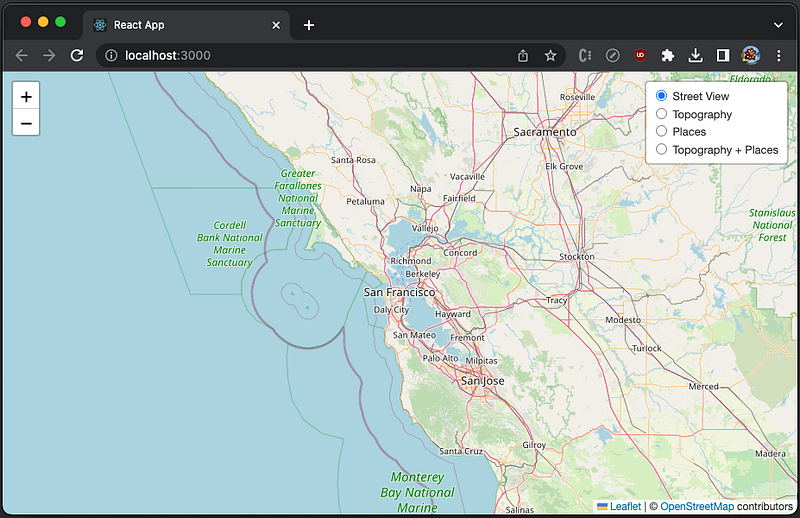
Click the radio button of Topography, and we see the layer, Topography ('TOPO-WMS').
Click the radio button of Places, and we see the layer, Places ('OSM-Overlay-WMS').
Click the radio button of Topography + Places, and we see the combined layer, Topography + Places (TOPO-WMS,OSM-Overlay-WMS, where the order matters).
Render GeoJSON Dynamically
GeoJSON is a format for encoding a variety of geographic data structures using JSON. A GeoJSON object supports the following types:
Feature: It is a spatially bounded entity, including a geometry object and additional properties. For example,the San Francisco area object.FeatureCollection: It is a list of Features, For example,[the San Francisco area object, the Palo Alto area object].- Geometry: It is a region of space, including
Point,LineString,Polygon,MultiPoint,MultiLineString,MultiPolygon, andGeometryCollection.
We write a GeoJSON file as public/example.geojson:
- At line 2, it specifies
typeasFeatureCollection. - At lines 4–13, it defines
Featureforthe San Francisco area object. – At lines 6–9, it defines aPointingeometrywith San Franciscocoordinates. – At lines 10–12, it defines apopupContentinproperties. - At lines 14–28, it defines
Featureforthe Palo Alto area object. – At lines 16–19, it defines aPointingeometrywith Palo Altocoordinates. – At lines 20–27, it defines apopupContentand aniconinproperties.
GeoJSON is rendered by L.geoJSON(<Object> geojson?, <GeoJSON options> options?), where options is defined as the type of GeoJSONOptions:
export interface GeoJSONOptions<P = any, G extends geojson.GeometryObject = geojson.GeometryObject> extends InteractiveLayerOptions {
  /**
   * A Function defining how GeoJSON points spawn Leaflet layers.
   * It is internally called when data is added, passing the GeoJSON point
   * feature and its LatLng.
   *
   * The default is to spawn a default Marker:
   *
   * ```
   * function(geoJsonPoint, latlng) {
   *   return L.marker(latlng);
   * }
   * ```
   */
  pointToLayer?(geoJsonPoint: geojson.Feature<geojson.Point, P>, latlng: LatLng): Layer; // should import GeoJSON typings

  /**
   * PathOptions or a Function defining the Path options for styling GeoJSON lines and polygons,
   * called internally when data is added.
   *
   * The default value is to not override any defaults:
   *
   * ```
   * function (geoJsonFeature) {
   *   return {}
   * }
   * ```
   */
  style?: PathOptions | StyleFunction<P> | undefined;

  /**
   * A Function that will be called once for each created Feature, after it
   * has been created and styled. Useful for attaching events and popups to features.
   *
   * The default is to do nothing with the newly created layers:
   *
   * ```
   * function (feature, layer) {}
   * ```
   */
  onEachFeature?(feature: geojson.Feature<G, P>, layer: Layer): void;

  /**
   * A Function that will be used to decide whether to show a feature or not.
   *
   * The default is to show all features:
   *
   * ```
   * function (geoJsonFeature) {
   *   return true;
   * }
   * ```
   */
  filter?(geoJsonFeature: geojson.Feature<G, P>): boolean;

  /**
   * A Function that will be used for converting GeoJSON coordinates to LatLngs.
   * The default is the coordsToLatLng static method.
   */
  coordsToLatLng?(coords: [number, number] | [number, number, number]): LatLng; // check if LatLng has an altitude property

  /** Whether default Markers for "Point" type Features inherit from group options. */
  markersInheritOptions?: boolean | undefined;
}
Here is the modified src/App.js:
- At line 8, the state,
jsonContent, is created to store the GeoJSON object. - At lines 12–17,
useEffect()fetchesexample.geojsonto initializejsonContent. - At lines 19–63,
useEffect()depends onjsonContent(line 63). IfjsonContentis set (line 33), the content is rendered. – At lines 35–48,pointToLayerdefines how points are displayed on layers. If a custom icon is defined, it is rendered (lines 36–40). Otherwise, the default icon is rendered (lines 42–47). – At lines 50–56,onEachFeatureis defined to show popups if they are defined by a feature. Each popup’sautoCloseis set to false (line 53). - At line 59, the map’s zoom is automatically adjusted.
- At line 61, each popup is opened.
Execute yarn start, and the map has two markers and two popups.
Conclusion
Leaflet is an open-source JavaScript library for mobile-friendly interactive maps. It is designed with simplicity, performance, and usability in mind. It works efficiently across all major desktop and mobile platforms, and can be extended with lots of plugins.
We have shown how to set up Leaflet in Create React App, and written code to display interactive maps using Leaflet APIs. 'leaflet' is imported as L. L.tileLayer loads and displays map tiles on the map, either from OpenStreetMap or other WMS. A map can be created by L.map with coordinates and zoom, with optional marker and popups. These objects can be hardcoded in the source, or dynamically loaded from GeoJSON files.
In the next article, we use react-leaflet components, a Leaflet wrapper, to implement maps. Both ways work for the same examples, and it depends on your preference.
Thanks for reading.
Thanks Ethan Brown for introducing Leaflet to me, and Sushmitha Aitha and S Sreeram for implementing Leaflet features in Domino products.
Want to Connect?

If you are interested, check out my directory of web development articles.
More content at PlainEnglish.io.
Sign up for our free weekly newsletter. Follow us on Twitter, LinkedIn, YouTube, and Discord.
Interested in scaling your software startup? Check out Circuit.


