
Spiritual Growth through Travel and Tourism
How To Create Your Reality — Explore Your World, Explore Your Mind
[Updated Jan 16, 2022] There are 4 ways to “create your own reality”, and all of them offer spiritual growth in our world.
CONTENT
[1] 4 Ways to Create Your Own Reality — [1.1] You Create Your “Emotional Reality” — [1.2] You Create Your “Perceived Reality” — [1.3] You Create Your “Physical Reality” — [1.4] You “Are” Your Reality [2] Exploring the World to Explore Our Mind — [2.1] Travel & Tourism into ‘Terra Incognita’ — [2.2] You Create the Places at Which You Arrive — [2.3] “The Path of the Dragon” [3] Traveling Through the 4 Definitions of “Creating Your Own Reality” [4] Move! [5] Related Material
“You form your own reality. That reality contributes to the experience of others, but each of you possesses a unique, original stance in space and time that is yours alone in quite practical terms, regardless of time’s relative existence.” — Seth/Jane Roberts, The Nature of the Psyche, Chapter 11, Session 800, April 4, 1977
and
“You are most certainly traveling through the private and mass psyche when you so much as walk down the street.” — Seth/ Jane Roberts, The “Unknown” Reality, volume 2, session 710, October 7, 1974
Seth (channeled by Jane Roberts) introduced the phrase “You Create Your Own Reality” in the late 1960s. That idea, however, has been around much longer, dating back to the New Thought Movement, in the early 1800s (coinciding with the Industrial Revolution).
[1] 4 Ways to Create Your Own Reality
From a New Thought / New Age spiritualist perspective, there are at least 4 levels or ways of Creating Your Own Reality.
[1.1] You Create Your “Emotional Reality”
The Law of Attraction (LOA) roughly states that you attract (or manifest) to yourself the vibration (or energy, or emotions) that you emit. Expressing positive behaviors attracts positive behaviors from others, for example.
For if you hate, you create a hateful reality. And to the extent that you hate, you find reality hateful. To the extent that you fear, you create a fearful reality. To the extent that you love, you create a lovely reality. — Seth (Jane Roberts), The Early Class Sessions, volume 1, ESP Class, April 22, 1969
People, unfortunately, interpreted the LOA as saying we need to “imagine” or “feel” wealth and abundance as the way to “create” wealth and abundance. It is an updated version of Norman Vincent Peale’s book, “The Power of Positive Thinking” (1952). We manifest through our deepest emotions, which are beyond our thinking and rational mind.
That interpretation easily becomes spiritual bypassing by blaming the victim for unfortunate things that befall them. Life, of course, is much more complicated than that.
For more on LOA, see:
[1.2] You Create Your “Perceived Reality”
Some New Age spiritual teachers and channelers prefer to reframe the Law of Attraction as the Law of Mirroring. This less well-known concept is also more complex because it suggests that things that you encounter in your external environment (objects, people, and events) are a mirror of your internal psyche (or of your energy vibrations). And, of course, both the world outside us and the world inside us are extremely complex!
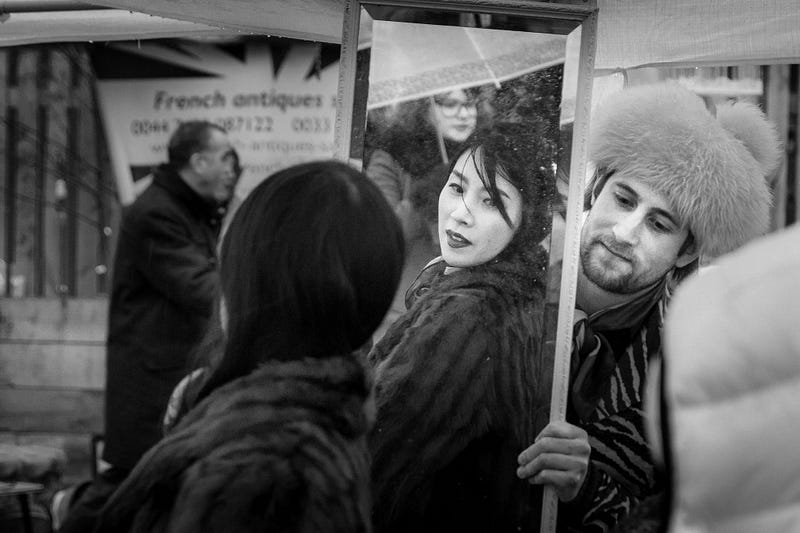
There is considerable support from the psychological and neurological sciences for this idea. The belief is that we can only know everything we experience in our world and universe through our senses and mind.
We cannot know anything in our physical world except as a sensory perception of our brain. And everything non-physical exists only in our brain/mind.
According to one neuroscientist, most of what your brain knows is actually guesswork, which we hallucinate into existence.
So perception — figuring out what’s there — has to be a process of informed guesswork in which the brain combines these sensory signals with its prior expectations or beliefs about the way the world is to form its best guess of what caused those signals. The brain doesn’t hear sound or see light. What we perceive is its best guess of what’s out there in the world. — Anil Seth, quoted in ‘Neuroscientist Shares How Your Brain Hallucinates To Create Reality’ (2017)
This argument is a version of solipsism and is further supported by Eastern religious traditions that see the world as an illusion (maya in Hinduism and Buddhism).
[1.3] You Create Your “Physical Reality”
The Law of Attraction and the Law of Mirroring are easily understood as alternative ways of saying “you create your own reality”. We can logically understand them from our experience. We create our experience of reality through our beliefs and our sensory nervous system (as stated above).
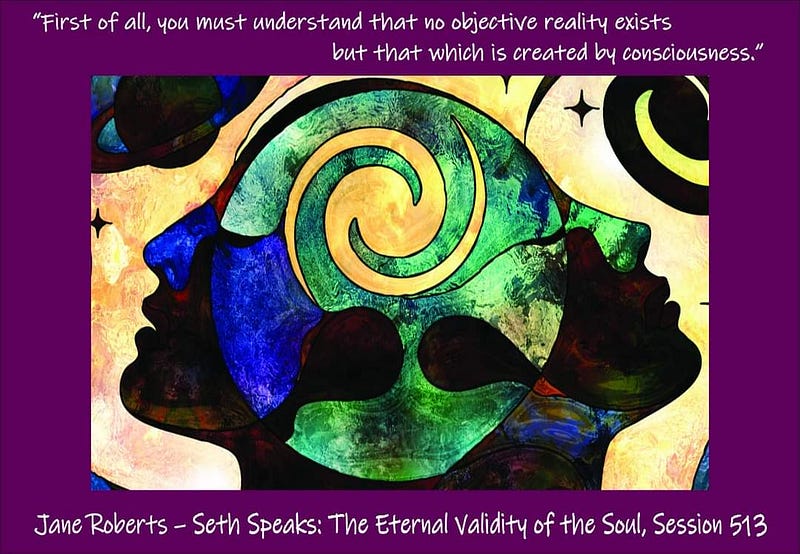
However, some spiritualist teachings go further than this to suggest that we create physical reality itself through our minds. That we create our physical reality through our deepest thoughts, beliefs, and expectations is a core teaching of Seth (channeled by Jane Roberts from the 1960s to 1984).
“For you form your own physical universe — it does not form you. You are in a dream. The dreamer says that physical reality forms you. In reality, you project your psychic energy outward into the physical universe. Therefore, to change your world you change that which you project.” — Seth/Jane Roberts, The Early Class Sessions, volume 1, ESP Class, February 29, 1968
and
You create your own physical reality! Each of you individually creates the reality that you know — and en masse, altogether, you create the reality of your world and your universe. — Seth/Jane Roberts, The Early Class Sessions, volume 1, ESP Class, April 22, 1969
Seth says that all reality is symbolic. That is easy to see in language. The words we speak and write are symbols for the things we are talking about . The word “tree”, for example, is not a physical tree. But he goes on to say that the physical world that seems to real to us is also symbolic of our inner consciousness.
To change our physical environment…
“…you must first of all remind yourself frequently that the physical condition is symbolic — not a permanent condition. Then you must look within yourself for the inner actuality represented by the symbol.” —Seth/Jane Roberts, Seth Speaks, Appendix: Session 594, September 13, 1971
Seth’s contention goes considerably further than the previous two forms of creating your own reality. However, it has some support from quantum physics, which sees everything in reality as constructed of particles and energy waves (or fields), and things we see as solid objects actually contain much more space than physicality.
For more on that idea, see:
[1.4] You “Are” Your Reality
“You are the universe.” “You are God.” “You are All-That-Is”. That is a fundamental concept in contemporary New Age spirituality. It builds upon and incorporates all the propositions above. But it also goes beyond those.
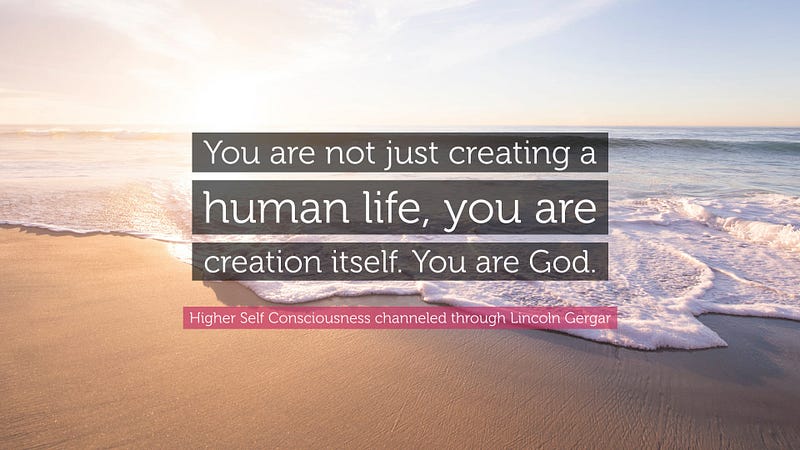
We are more than our body, our mind, our emotions, and our ego (all of which are considered our “physical” being). We are our eternal “soul” (or something similar), which is a closer connection to “Source / God / The Absolute” than our physical being.
With this spiritual understanding, we can experience ourselves as universal beings connected to, and one with, everything (“oneness”). In this state of “Unity Consciousness” (a level of enlightenment), we can access the Universal Mind and all knowledge (giving one psychic abilities), as well as the Universal Soul that is present in all beings.
For more on that, see:
So, in sum, “creating our own reality” has at least 4 meanings:
- Creating Our Emotional Reality
- Creating Our Perceived Reality
- Creating Our Physical Reality
- Becoming Our Reality
All 4 of these work for the following discussion. But #3 and #4 are more aligned with the message presented than #1 and #2.
“You are indeed learning to be creators… and you are already, in your terms, creators. And by the products of your creations shall you learn to see yourselves and know what you are. And through the mirror of physical reality do you see materialized the inner selves. And through your creations shall you realize your abilities and your responsibilities even as we.” — Seth II/Jane Roberts, The Early Class Sessions, Book 2, ESP Class Session, January 13, 1970
[2] Exploring the World to Explore Our Mind
A mind that is stretched by a new experience can never go back to its old dimensions. — Oliver Wendell Holmes, Jr.
No matter which level of the four perspectives presented above you believe in, there is an inextricable connection between our minds and our physical world. This connection is the basis for understanding how exploring our world is actually an exploration of our mind.
Spiritual teachers have traditionally emphasized the need to go inward, to close ourselves off to the outside world, so we can come to know our inner selves and inner realities. This is certainly true, mostly because modern humans have become overly focused on the outer and have forgotten the inner.
However, the opposite is also true — that we can come to better know who we are through a better knowing of the world we create and live in.
This is a less common perspective in spiritual teachings. Geomancy and animism (nature spirit) traditions are examples found mostly in traditional societies. Many philosophers (East and West) have expounded on the value of experiencing and knowing our natural world.
I took a walk in the woods and came out taller than the trees. — Henry David Thoreau
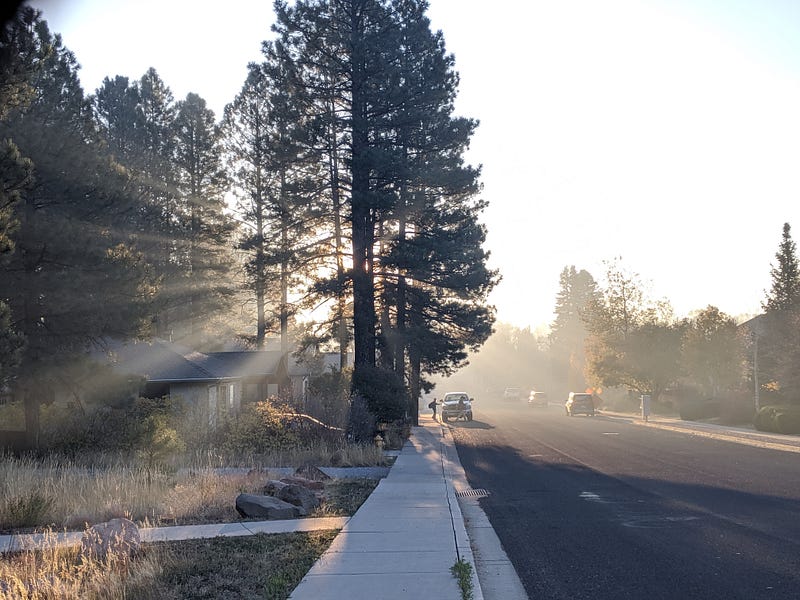
Personally, I see every walk in the woods, every walk in my neighborhood, and every trip I take to another place as an exploration of my mind. In each of these, I experience and come to better know a part of myself.
Revisiting places I already know refreshes those parts of my mind that I already know. But more, it presents the potential for new perspectives, insights, and understanding of what can too easily become “taken-for-granted” with time. I also find that these places often have messages for me, although these messages are more often energetic than verbal.
In Seth Speaks (Jane Roberts, 1972), Seth says that all manifest reality is made up of symbols. Some are more flexible, such as emotions and thoughts. Other are “symbols made physical”, such as tables, trees, mountains, and our bodies. He goes on to say…
“All symbols stand for inner realities, therefore, and when you juggle symbols, you are juggling inner realities. Any exterior move that you make is made within the interior environment, within all the interior environments with which you are involved.” — Seth/Jane Roberts, Seth Speaks, chapter 18, session 571, March 3, 1971
[2.1] Travel & Tourism into ‘Terra Incognita’
This approach to my outer world experience has become more clear over the past decade as I started writing, in my academic life, about the role of travel and tourism in expanding our global consciousness.
For as long as I can remember, I have intentionally sought alternative paths, unknown places, and new ways of experiencing the world to expand how I understand my mind, my world, and myself.
I believe that this is a major travel and tourism motivation for most people across the planet. But it is one that travel and tourism professionals and academics rarely discuss because it is beyond business and science. (But see the two YouTube interviews I have done in the “Related” section below.)
Such experiences involve taking risks. And travel and tourism is always about balancing risk and safety. Some people on some trips are more willing to take risks than others.
Risk takes us into terra incognita (Latin for “lands unknown”). Terra incognita places exist in both our environment and our psyche. As unknown lands become known to us, our minds expand into a deeper and fuller knowledge, appreciation, and consciousness of the world and universe that we exist in (or “that we are”).
…I suggested as a rule, at least one day if not two, a month, spent away from the familiar apartment props, and in short trips. The details are not important and need not cost much expense. If a car were not available, even long walks through various parts of town, with say lunch in various strange dining places, would do. Traveling itself with the change of environment, and with the right attitude, tends to ease and facilitate psychic transformations. If traveling is carried out also with the immersion into enjoyment of which I have spoken, then the benefits are twofold. — Seth (Jane Roberts), The Early Sessions, volume 2, session 78, August 10, 1964
See also:
[2.2] You Create the Places at Which You Arrive
In exploring our world, we are exploring our minds. But also, in exploring our world, we are creating our world.

We create the universe that we know, the universe of our experiences, both as individuals and in cooperation with others. There are many other universes. But if they are outside of our knowledge, memory, experience, and imagination, then they do not exist in our for us.
Anything within our knowledge, memory, experience, and imagination is part of our universe. It is a part of ourselves, and we create it through our deepest thoughts, beliefs, and expectations.
Anything new to us shows us our creative powers. We live in an infinitely expanding universe. So there is always something new in our manifest reality.
In this way, exploring our world also shows us how we create our world. Very few of us have any inkling of just how powerful and amazing we are as creators of our universe.
Now, “There is no place to go.” If you know what is truly meant by that statement, it is also true that there are as many places to go as you wish to find. You always create the places and the destinations at which you arrive. There are no places, and there are infinities of places. The inner self forms all systems and all places. On the one hand, you can indeed call them illusion. On the other hand, these illusions are quite real. —Seth (Jane Roberts), The Early Sessions, volume 7, session 305, November 30, 1966
Holding this perspective alone changes how we see the world, how we interact with the world, and how we live in the world as spiritual beings (souls) having a human experience.
A good traveler has no fixed plans and is not intent upon arriving. — Lao Tzu
[2.3] “The Path of the Dragon”
In the Far East, the dragon is a sacred mythological animal representing strength and good fortune. (Some say it is a 4th Dimensional [4D] being.) Its fierce and glaring eyes penetrate to see the inner truth of the world.
It is through the dragon that we come to know our own truth. Seeing our inner truth through the dragon is the path to good fortune, and a balanced and happy life in Eastern cultures. (Note that very few people in the Far East would phrase it in that way.)
Spiritually, the Path of the Dragon has two meanings. (Neither relates to the movie or the game with the same title.) Both are journeys of knowledge, in which we balance and harmonize our inner worlds.
One meaning/journey/path is to explore our inner self through our physical mind/body. We do this through contemplation, meditation, and introspection — often by temporarily withdrawing from the world. This can help form a foundation for the second path.
The second meaning/journey/path is to explore ourselves through the world (or worlds) we create. We can also think of this as the world that created us. We also use contemplation and introspection, but we are engaged in the world, with our Planet Earth. There is a merging of the inner and the outer, which are really one.
The Path of the Dragon, therefore, means traveling the world to know ourselves. We do this anyway. The difference is that we are doing it intentionally.
This means understanding how what we see and experience is us. It means coming to know ourselves through the larger world that we are a part of. Using our inner senses in the world, we change our relationship with ourselves and our planet.
As an analogy, it would be like a cell in our body coming to understand the larger body that it is a part of by traveling through the networks of blood vessels, nerve connections, or body fascia.
This is how we should think of travel and tourism — as the Path of the Dragon.
(The “Path of the Dragon” concept comes from Matias De Stefano, who briefly discusses it in this interview, on YouTube.)
[3] Traveling Through the 4 Definitions of “Creating Your Own Reality”
Each of the 4 “creating our own reality” approaches defined above offers possibilities to enhance our spiritual growth through travel and tourism.
- Creating Our Emotional Reality: We attract the energies that we emit. We are more likely to have a positive travel experience if we truly feel we will have one. — This works. In fact, research also shows that most people interpret their travel experiences as positive, no matter the outcome. This is because we want to feel that we have “gotten our money’s worth” from the time, cost, and effort involved in taking a trip. We set ourselves up to think positively from the start. Otherwise, we would cancel the trip (most of the time). That alone can help put us in the right emotional frame of mind for a good travel experience. (This can also be a form of “cognitive bias”.)
- Creating Our Perceived Reality: The places we experience are a mirror of our internal self. We have very limited conscious control over what we sense and what our brain processes. — Nondualism, for example, says we have no free will, and life just happens. All we can do is allow it and experience it. But if you have free will, you can go one step further and reflect on how everything you see, hear, smell, and experience is a mirror of yourself. This is an early stage of spiritual awakening. The mirror you perceive says more about your beliefs and expectations than the place you are visiting.
- Creating Our Physical Reality: From a spiritual perspective, we do this all the time. But very few of us know we are doing it. When we know we are doing it, we are at a higher level of spiritual awakening. — This expands the “perceived reality” perspective because we feel a sense of mastery. There is often much synchronicity and we can even experiment with creating some events. This is 4th Dimensional (4D) way to travel. — You can read about my experience with that in “Synchronicity: Allowing Hawai’i to Magically Reveal Itself” (Medium article).
- Becoming Reality: We not only create, but we are the places we visit. There is no difference between us and the world we experience. — This expands the “physical reality” perspective as we see the oneness and unity of all creation. From an enlightened state of consciousness, we see a spiritual purpose for every encounter and experience we have. Our travel is now in the 5th Dimension (5D). We can create our reality with intentionality, although by now, our ego’s desire to create has largely disappeared.
Here is a little more on Seth/Jane Roberts’ perspective on creating and changing our physical world:
“Your experience in the world of physical matter flows outward from the center of your inner psyche. Then you perceive this experience. Exterior events, circumstances and conditions are meant as a kind of living feedback. Altering the state of the psyche automatically alters the physical circumstances.
There is no other valid way of changing physical events. It might help if you imagine an inner living dimension within yourself in which you create, in miniature psychic form, all the exterior conditions that you know. Simply put, you do exactly this. Your thoughts, feelings and mental pictures can be called incipient exterior events, for in one way or another each of these is materialized into physical reality.
You change even the most permanent-seeming conditions of your life constantly through the varying attitudes you have toward them. There is nothing in your exterior experience that did not originate within you.
Interactions with others do occur, of course, yet there are none that you do not accept or draw to you by your thoughts, attitudes, or emotions. This applies in each area of life. In your terms, it applies both before life and after it. In the most miraculous fashion are you given the gift of creating your experience.”
— Seth/Jane Roberts, The Nature of Personal Reality, chapter 1, session 613, September 11, 1972
[4] Move!
We move and we travel for many reasons: to experience, to explore, to learn, and to create.
And in every movement, and in every place, we find ourselves. Here and now. We are always who we are. We are never anything else.
But we are also so much more than ourselves, we are our entire experience. We are our entire world and universe.
To know that, we need to realize that we are always right where we are supposed to be, with our eyes, hearts, and minds wide open, holding everything in our reality. This is us.
And remember…
Wherever you go, there you are.
Wherever you go, go with all your heart.
— Confucius
[5] Related Material
- [5.1] ⬇ Neuroscience has its own perspective on the value of new experiences:
- [5.2] ⬇ ️Here are a couple of poems I wrote about manifesting:
- [5.3] ⬇ In this video (YouTube, 10min), Matias De Stefano discusses how we manifest in a reality where everything is one. There are two ways: [a] surrendering and allowing our Higher Self to guide us (#3 above), and [b] becoming our Higher Self (#4 above).
- [5.4] ⬇ This channeling (on YouTube) about my neighborhood walks is about connecting with our world.
- [5.5] ⬇ ️I was interviewed for the Seatrade Cruise Conference in Spring 2021 on the topic “Why Do We Travel”, which is related to the article above titled: We Travel Because It Expands Our Global Consciousness.
- [5.6] ⬇ This interview/chat with Dr. Jaeyeon Choe was on January 10, 2022. The original title was: “From Global Understanding to Global Consciousness: Travel, Tourism, and Our Evolving Relationship to the Planet Earth”.
- [5.7] For more on Travel & Tourism Futures, see this collection of articles. Note that the articles in this collection are behind the Medium paywall. For paywall-free access to my articles, go to www.AlanLew.com, linked below.
Contact
- I am not financially affiliated with any of the people or products discussed in this article.
- I appreciate comments, questions, and typo corrections. - See the About link in my Medium profile for contact information and related articles.
- Written in collaboration with my Energy Group/Higher Self. This is our perspective of the truth and not the whole truth of reality.
My Medium writings are available “paywall free” at www.AlanLew.com:
- follow my Facebook page linked to my Medium writings
- subscribe to My Medium Writings
- become a Medium member to support my writings
Visit and Follow New Earth Consciousness (NEC) for More Articles like this.
- subscribe New Earth Consciousness NEWS, the occasional newsletter for NEC
- …and join our New Earth Consciousness Group on Facebook


