
Explanation Effect: Why You Should Always Teach What You Learn

I don’t know what I think until I write it down.
― Joan Didion
It is peculiar irony in life that the fastest and best way to learn something is to give it to others as soon as you learn it — not to hog it yourself.
Knowledge wants to be free. To rest in other people’s minds. To connect to other knowledge. It’s an innately social organism.
Therefore, teaching is knowledge’s oxygen.
In teaching what you learn as soon as you learn it, magical things happen before, during, and after:
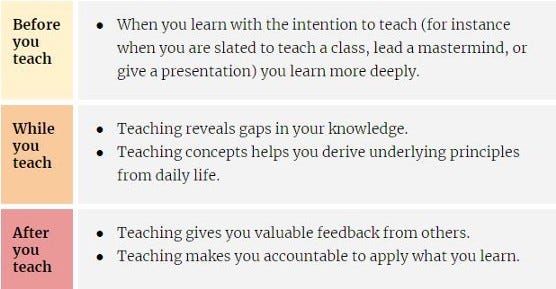
Not only do you learn faster when you teach others, you:
- Help others succeed.
- Build deeper relationships with others.
- Build a reputation as someone who is smart and who is a giver.
- Become a better teacher.
- Get paid (if you’re a teacher, coach, consultant, or writer).
How The Explanation Effect Helps You Learn Faster
“While we teach, we learn.” — Seneca
Learning is NOT just about taking in information. In my experience coaching hundreds of people on learning how to learn, almost no one has a system for processing information. It’s almost as if people just expect the learning to happen automatically after they read a book, listen to a podcast, watch a lecture, or have a life experience. Looking at text and expecting to learn is not far off from looking at food and expecting to get its nutrients. We need to digest our life experiences just like we digest our food.
Without some form of active processing, like teaching, almost everything we read is lost within weeks.
In my experience, teaching others what you learn is also more fun and easy to stick to
So what’s the simplest way to get started?
Starting A Daily Learning Journal Will Change Your Life
“No one learns as much about a subject as one who is forced to teach it.”
― Peter Drucker
In a Harvard study, “employees who spent the last 15 minutes of each day of their training period writing and reflecting on what they had learned did 23% better in the final training test than other employees.” Imagine spending 8 hours in a training, then spending 15 minutes reflecting on what you learned. Amazingly, those 15 minutes are only 1/33 of the total time but drive 20% of the learning gain.
Now, imagine what would happen if you spent 15 minutes per day every day reflecting on the lessons you’ve learned and sharing it with others?
I can tell you the answer…
Learning 20% more per day and having that compound over years is life-changing.
Because of the Explanation Effect, I started spending one hour per day reflecting on my learning in college, and I never stopped. I personally attribute this habit to peace of mind, faster learning, and helping me kickstart my career as a writer and teacher.
Reader note: The exact percentages in the learning pyramid at the top of this article are not officially backed by research. However, there is quite a bit of research on the power of teaching-to-learn. Furthermore, the percentages really ring true for me and many others, so I decided to include it. For an article where I go deep into the research, read Memory & Learning Breakthrough: It Turns Out That The Ancients Were Right.
If there’s a link to an Amazon book, it’s an affiliate link, which means I get a small amount of compensation when you buy the book. This compensation does not influence the specific books I recommend, as I only recommend books that I read and love.


