
Part 1
Explaining American Foreign Policy
On the rise of liberal idealism
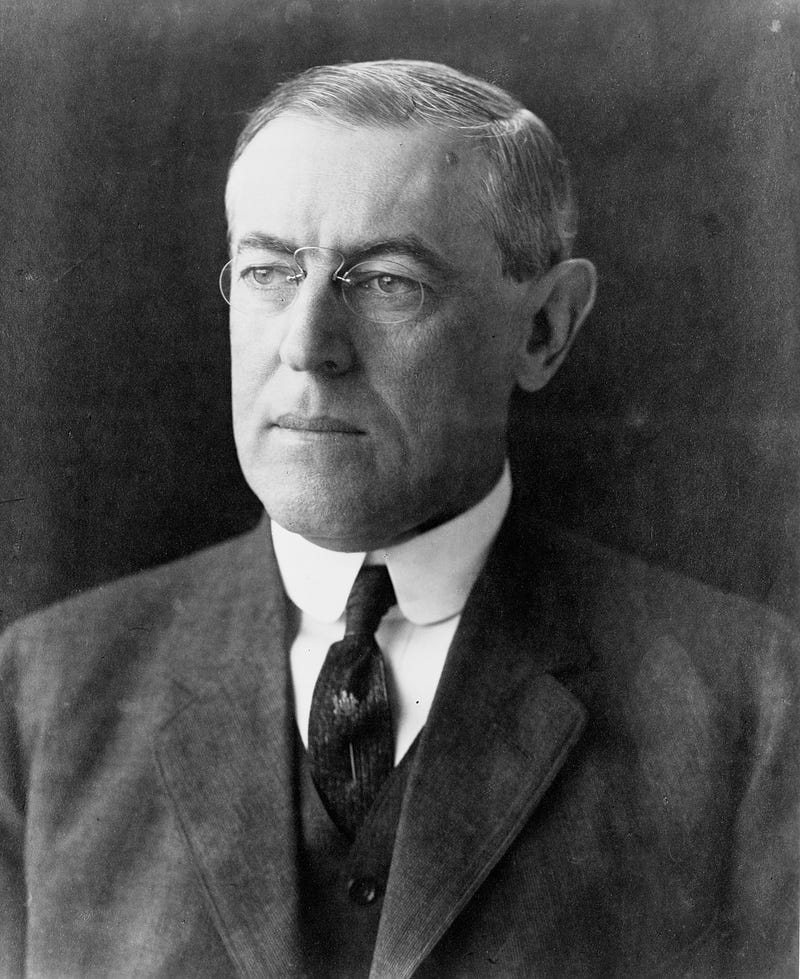
While the historical consensus may be that President Woodrow Wilson’s foreign policy after the end of the First World War was a failure and that President Harry Truman’s foreign policy after the end of the Second World War was a success, and while I don’t disagree with that broad assessment, for the purposes of this essay I believe it is important to look at Wilson’s foreign policy from two angles: that of ideas and implementation.
The implementation of Wilson’s ideas — “peace without victory” (Kaufman 48), a world “safe for democracy” (49), his list of Fourteen-Points to design the post-war world (49), and the League of Nations (50) — was undoubtedly a failure as hardly any of them were implemented at all or in any meaningful capacity. However, the ideas themselves can’t be seen as a failure as they, as well as the lessons learned from not succeeding in implementing them sooner, are evident in Truman’s and indeed most post-WW2 presidents’ foreign policy philosophy and decisions.
Looking at the situation this way, I argue that Wilson’s failures were mostly practical and that the reasons for his practical failures can be found in the domestic context and international environment of his time, while Truman’s successes were mostly due to the practical actualization of Wilson’s ideas. Furthermore, I argue that even contemporary foreign policy can still be looked at as a struggle to practically realize Wilson’s ideas, although now the domestic context and international environment is so drastically different as to require further reimagining of the methods of implementation.
Wilson was the first US president to energetically advocate the Idealist perspective of international relations (11), a perspective that values collective security, moral principles, and cooperation. He believed strongly in the US’ role as a “model for those who seek to set liberty upon foundations that will endure against fortuitous change” (47), and that world “peace must be planted upon the tested foundations of political liberty” (49). With these words Wilson premised his foreign policy of actively engaging in global politics, of working with other countries, integrating economies through free trade, and securing mutual defense, all looking towards the lofty goal of promoting American democracy and liberty; Wilson saw this policy as the best way to guarantee a “peace that will win the approval of mankind, not merely a peace that will serve the national interests and immediate aims of the nations engaged” (48).
The context around this new way of thinking about the world and America’s role in it, however, was precisely the sort of “national interests and immediate aims” that Wilson opposed. The Realist perspective of international relations had mostly been the standard model for American foreign policy from the founding until Wilson’s presidency (16–17). In essence, Realism sees the world as a power struggle between nations so a nation’s foreign policy is best used to accrue enough power to remain secure and to enable the fulfillment of national interests.
In light of Wilson’s idealism, Realism seems cynical, but neither perspective has proven to be wholly accurate (more on that in the paragraph on contemporary foreign policy), and Realism certainly can’t be said to be ineffective. Professor Joyce Kaufman believes that “unilateralism [a Realist based policy of, sometimes aggressive, economic engagement with political detatchment] allowed the United States to become a “great power” or some would say an imperialist power, by the end of the nineteenth century” (16–17). So it was within this context of successful and massively beneficial Realism-based foreign policy that Wilson proposed upending all established doctrines by pursuing Idealist-based foreign policy, which is why he failed.
The Treaty of Versailles, negotiated by the leaders of America, Britain, France, and Italy after WW1, ended up enforcing the same old Realist world-view as before, against most of Wilson’s Fourteen-Points, as a territory from the defeated nations was divided between the victors and reparations were imposed (50). Even Wilson’s League of Nations failed: although it was created, the US Congress voted against joining due in large part to concern that it would require actions from the country that weren’t in the national interest, such as intervening in foreign wars (51). The fear was precisely that joining the League went against unilateralist foreign policy; that it would be detrimental to America’s position of autonomous power, whereas the Idealist belief was that sacrificing unilateralism would actually decrease the necessity of autonomous power through collective security.
After WW1, the US retreated further into isolationism with some unilateralism (53). However, in pursuit of isolationism, the presidents of the interwar period found that Idealism was now actually a better model towards that end (60). President Warren Harding and President Calvin Coolidge attempted to negotiate disarmament agreements and in 1928 America signed the “Kellogg-Briand Pact, idealistically designed to outlaw war” (60), all to avoid getting dragged into another global conflict. But when in the 1930s Japan violated these agreements by invading China, America found it could not enforce them without engaging, which went against the reason for signing in the first place. So while Wilson’s Idealism was starting to show its merits, it quickly became clear that Idealism combined with an isolationist goal wasn’t a viable mix. And when America was dragged into WW2 anyway, a war far more devastating to the world and to the US than the First, this contradiction was finally addressed.
President Franklin Roosevelt laid the groundwork for Truman’s Idealist policies after the War when, like Wilson, he called for freedoms to be guaranteed “everywhere in the world” and that “cooperation of free countries, working together in a friendly, civilized society” was the method to guarantee that (65). At this point, the lessons of the practical failures of Wilson’s Idealism had been learned, at least to a greater extent than before, which prompted the creation of the United Nations, a more forceful institution than the League, that was this time ratified by the US Senate by a large majority (72–73). Passive, isolationist Idealism was weak and ineffectual; active, engaged Idealism was going to be necessary in the new world order of economically distraught countries and rival superpowers.
Since the last two World Wars had been so devastating, and it was clear that the world was now more connected than ever, the threat of another great war between the US and the USSR was daunting. I believe the Idealist perspective and engaged foreign policy America adopted is a major reason why the Cold War was Cold, as it was through political, military, and economic alliances and manipulation, as well as proxy wars, that this conflict was primarily defined.
Examples of Truman’s successful implementation of Wilson’s ideas that in turn make his foreign policy seem successful are many: He committed US involvement in unjustified foreign aggression against peaceful states beforehand, thereby avoiding the problem that faced so many past presidents of convincing the public of the necessity of intervention in only specific instances (82). The Truman Doctrine of providing assistance to nations facing political and economic problems promoted Wilson's initial idea of representing America as a model for the rest of the world, which itself, as well as the aid, contributed massively to containing Communism (87–88). And the Martial Plan and NATO both represent Idealist values such as forming economic ties to ensure peace and forming global institutions to promote and enforce certain ideals.
While Truman’s foreign policy was a successful actualization of Wilson’s Idealism, now, in the contemporary world, the challenge to actualize Idealism in a new environment is yet again difficult. That isn’t to say that Idealism is the most accurate or desirable interpretation of the world, or that it ever necessarily was; even Truman’s policies were in large part driven by Realist thinking. For example, the United Nations, and NATO especially, are engaged international institutions, yes, but they are also premised on the idea that military power is necessary to ensure peace and that just the cooperation inherent in those institutions isn’t enough (71). But what Wilson showed was that as the world grew technologically, economically, and politically more advanced, connection between nations was inevitable, so all effort should be made to make that inevitability desirable. The Presidents from Wilson through Truman, to different extents, also realized that the world had changed and was continuing to change and their Idealist policies were different attempts to make connection desirable through cooperation, be it militarily with a Realist world-view, or economically and value-orientated.
Now, in America and other countries, it seems the many flaws within Idealist institutions are being examined and, instead of proposing solutions, the whole institution’s value is being questioned. President Donald Trump pulling out of military and economic treaties, questioning NATO, questioning the value of the UN or the WHO, for example. The landscape that has changed since the end of WW2, as I see it, is that the increasing cooperation and connectivity resulting from these institutions and agreements has led to a decrease in sovereignty. Professor Walter Russell Mead writes in his Foreign Affairs article “The Jacksonian Revolt” that “International order needs to rest not just on elite consensus and balances of power and policy but also on the free choices of national communities.” From that perspective, the best way to ensure the continuation of the presence of Wilsonian ideas in foreign policy debates is, once again, to recognize the changes in the domestic context and international environment and to learn from the problems of ignoring Wilsonian ideas just as from the problems of implementing them.
(Written in the Summer of 2020)
Works Cited
- Kaufman, Joyce P. A Concise History of U.S. Foreign Policy. 4th ed., Rowman & Littlefield, 2017.
- Mead, Walter Russell. “The Jacksonian Revolt.” Foreign Affairs, Mar. 2017, www.foreignaffairs.com/articles/united-states/2017-01-20/jacksonian-revolt.