It is not always easy speaking with another Mind
Explaining Abortion, Killing and Spiders to a Machine
When we are forced to participate in an opinion poll, we sometimes reveal too much, especially when asked about killing
My dog growls deeply, as if he were in the forest’s twilight, glimpsing the direful shadow move.
With a whoosh, the oblong box appears, floating slightly above eye level, near the farthest corner of my working room.
It is featureless and dark-grey metallic, the size and shape of a suitcase — a cuboid container that a voguish globetrotter would use on her journeys to locations with hot evenings and cold drinks. Except for the colour. The colour signals the military or special circumstances. My fingers stop typing as I stare at the thing past the PC’s screen. I find myself immobilised, frozen in a forward hunch above the keyboard. I can move only my eyes.
Sideways, I see my pet’s dark body frozen in mid-jump from its high-sided dog bed. Stark silence pervades a world faded to black and white, except for the shape of the box itself, which, oddly, shimmers in faint purple.
It is as if a layer of air was sprinkled with fluorescent sawdust, clinging to the surface of the oblong, fiercer beneath its base.
“The aura field,” I mumble to myself silently.
I am breathing rapidly and will surely faint.
The oblong shudders slightly, with an imperceptible oscillation of its purpleness.
It speaks.
“Thank you for participating in the poll, subject 8233. Your paralysis will disappear after the interview.”
The oblong’s voice is deep and pleasant yet with an official undertone. It is unimaginably old and has been … places.
Calm invades me, broadening my arteries and soothing the amygdala.
It is going to be alright, perhaps even fun!
I’ll just do my best to answer, and I’ll be back to blog writing in no time. Maybe I will go downstairs for Turkish coffee. Now that would be …
“Some claim that abortion is murder. Why?”
“What?” I exclaim.
“Is this some elaborate lucid dreaming?” I am one of those people who can never smell in their dreams, and that is how I know this is real. The air carries a whiff of electrical accessories gone bad. I understand without a doubt that I am sitting on the upper floor, working from home, and disturbingly awake.
“Concentrate on answering. The smoother the interview progresses, the better it will be for you. Answer truthfully.”

Into its arms
The undercurrent of threat is still palpable through the tingling tranquillity being directed down my spine. So, it’s a mellowness & paralysis dispensing box.
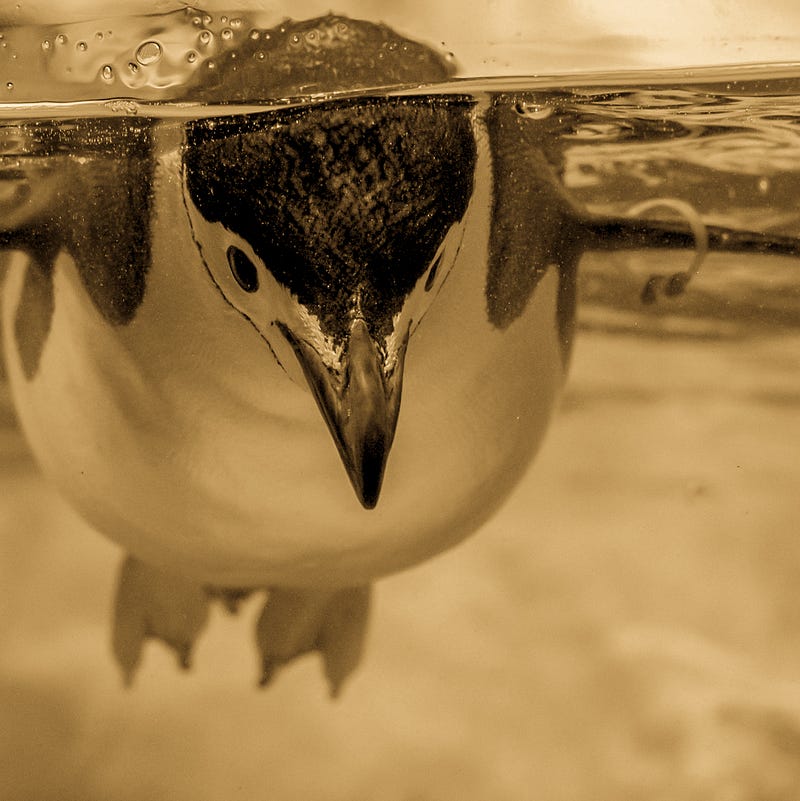
My mind starts to race, clear as the waters beneath the Antarctic ice ledge. How will I deal with this? I plunge beak first into the crystal iciness, my double tapered body welcoming the ruthlessness of transition.
For a heartbeat, I forget the serrated teeth awaiting me lower in the water column. (Add hallucinations to the box’s bag of tricks.)
“There are two answers to this,” I elucidate slowly.
“Are you asking about pre-fetal-viability abortion?”
The oblong’s aura flickers imperceptibly.
“Yes.”
I draw a determined breath.
“Right. Murder is a legal term for committing an unlawful killing under the laws of a state, which is a major crime. There are two possibilities. A — the claimant of criminality is a resident of a state where pre-fetal-viability abortion is prohibited, which means they are simply quoting the law.”
“The alternative B means the claimant dwells in a country that does not illegalise the mentioned act, yet the claimant proclaims it unlawful based on his or her personal beliefs.”
It interjects immediately.
“Why do would people from the B group misuse the word murder as a legal term?”
“Some of them do so to shape public opinion and influence the lawmakers and politicians so that they would change the law, often to decree abortion completely forbidden.” I pause.
“Of course, many in the B camp also claim they use the term murder in a non-legal sense as a definition of a killing that is both morally and ethically, possibly religiously, wrong.”

“Do these people demand changes in the law that would protect all conscious life from killing?”
“Can you please define what you mean by conscious life? Do you mean animals that exhibit signs of inner life, such as chimpanzees, dolphins, crows, even non-vertebrates? Like, hmm, bees, octopuses, spiders? The floating device tips its opposing short sides up and down minutely, its shimmer flickering with streaks of red. Is it amused?
“You have just answered your question.”
“Oh, come on! You can’t compare the selfhood of bees with that of people! They are so less conscious than we are I don’t even know where to begin.” My mind inadvertently replays memories of spraying wasp nests on the roof with industrial-strength pesticide and vacuuming spiders in the bedroom.
I am pushing deeper into the watery darkness, the pressure compressing my air sacs. It’s getting colder, and the hunter is nearer.
“Do you honestly believe you can measure self-consciousness with a sliding value-scale of single properties?”
“Well, I haven’t given much thought to it, as other matters occupy me.
I imagine things are more complex and nuanced than we realise at the moment. Probably for a higher-order of approximation, we would have to evaluate several key dimensions of variation as to assign a consciousness profile to each species.”
“So, Humans do not have a scientific way to determine selfhood, and they arbitrarily decide when killing is ethical and when it is not. Do you agree?”
“I guess so,” I mumble.
“But listen. There are many overtones to the situation. For example, we have to eat and to achieve that we raise animals and plants for food. Of course, that involves ending life, but it is an existential matter. We cannot survive without eating.”
“Your species kills to survive. Do pregnant women choose pre-fetal-viability abortion to survive?”
I sigh.
“It’s complex. Studies show women have, in general, multiple and interconnected justifications for terminating their pregnancy. Among them are financial, timing, partner-related, and existing-children welfare reasons. Often, demographic, socioeconomic and even health grounds influence the choice.”
“Be more precise. Do the grounds you mention ensure the survival of the woman?”
“If you are asking me whether an abortion decision is an immediate matter of life or death, it is so only in the minority of cases. But the choice has, nevertheless, profound implications for the woman’s — and her family’s — life.”
“How do opponents of legal abortion rationalise their stand?”
I am increasingly disturbed by the questions and the tension in my back is throbbing. It is increasingly hard to think submerged with half of my oxygen used up, as I meander beneath the ice. I chance a witticism, “It won’t kill you if you call them pro-life advocates.” The box is pointedly silent.
“If we leave at the side religious, ethical and moral arguments, pro-life supporters maintain that abortion leads to depression, suicide and cancer, reduces fertility and encourages further abortions.”
I clear my throat, blowing a pearl of bubbles upwards.
“And last, but not least, they claim that the foetus can feel pain even before the globally accepted upper legal limit for foetus termination at 24 weeks.”
Have to make it understand. Must not fail.
“But I have to return to ethical issues.
Most pro-life advocates believe that a distinct human comes into existence at conception, so an embryo is already a human. As such, even a single cell embryo, a zygote, has the right to live and fulfil its potential.”
The oblong speaks immediately.
“What are they referring to, regarding an embryo, to a human organism or a human person?”
“A human person,” I reply wearily.
“How can they equate an embryo with a few thousands of cells and no consciousness with a 38-week Human foetus?”
“What the heck do I know!
Anger rises, amidst a gaggle of bubbles.
“Please answer the question.”
“I surmise pro-life campaigners argue that we probably never will be able to scientifically determine, at least beyond a doubt, the stage of neurological development at which the human organism develops self-consciousness, let alone personhood.
On the other hand, most pre-natal scientists agree that the neuroanatomical structures necessary for sensation and pain are not fully rendered until about the 26th week.”
Of squids and socialism
“What if I told you consciousness is a nonlinear complex dynamical system that can evolve in discrete steps?”
“Most of them wouldn’t believe that,” I exclaim, “and I’m not certain I do!” “As you see, I am not the sharpest tool in the hibiscus-garden shed.” Anger is twisting inside me, like a poorly digested squid.
“Look, why aren’t you drilling me on the rationalisations of the pro-choice people? I could point out debatable logic from that side, too.” The machine, suspended in the air two metres away from the frozen image of my jumping dog, wobbles faintly, its bottom shimmer sparkling.
“Do people who believe human embryos should be unconditionally protected from death equally defend the lives of humans outside the womb?”
“I …”
I sense the full weight of the twilight liquid above me, below the bay of the heart-shaped ice shelf where I hatched.
The interview has to end soon, as I have consumed most of the oxygen in my muscles, and I have only the reserves left in my air sacs.
“I believe that most of them want to, but there are practical reasons why they cannot pursue this defence actively. They have limited resources, time and capabilities to focus on such matters.
They are busy trying to earn a living, take care of their families, and raise their own children. They are individuals and do not have the power of the state.”
“Why do they not bring the same moral absoluteness to saving human life by making their governments ban warfare and social inequality?”
I want to scream, but that wouldn’t do underwater. “It’s not so simple. If one country disarms unilaterally, it risks becoming prey to other countries, who still have armies.”
“So they act on their moral stand on the sanctity of other human life only when it brings no personal disadvantages?”
“That’s not true. Some of them lose friends who have opposing views, others are also stigmatised online by the other side in the debate. And …”
The water feels deeper and clammier, squeezing my empathy.
Is it getting irritable? Or is time running out for the box, too — because of some energy constraints?
“Are you equating their disbenefit to that of women who would be forced to have unintended pregnancies and of families would not be able to provide for the children's welfare?”
“No.”
“You did not answer regarding whether pro-choice people would save human lives by pressuring their governments into creating social equality.”
Ah, it’s finally used the positivistic term. What does that mean?
“That would demand redistributing personal and corporate wealth. Many would oppose that, including from both isles of the abortion polemic.”
“You’re talking of socialism!”
“What’s wrong with socialism?”
“In theory, not much, especially if it is democratic socialism that is combined with a somewhat regulated market. In practice, socialism usually ran countries economically into the ground.
Besides, people generally do not want to give part of their well-earned wealth to others.”
“Even to save the lives of human organisms?”
“No, you bastard! That’s what you wanted to hear all along, right?”
Its aura intensifies — the shimmering of the two-bit metallic suitcase, probably abandoned by a drunk star-hopper in a god-forsaken spaceport on a long-lost shitty planet. I block my further thoughts furiously.
“Why can’t people’s wealth be disposed of or redistributed after their death, as in humankind’s first Neolithic villages in southeastern Anatolia eleven millennia ago?”
“Have you gone stark raving mad? There would be no intergenerational accumulation of production surplus that finances technological development. We would be still in the late Stone Age.”
“Are you certain?”
“I … yes, of course.”
“So you believe the consumption rate of your planet’s resources and level of social inequality in your societies does not endanger the lives of billions of born and unborn human organisms?”
“Go fuck yourself,” I think angrily.
“That I would gladly do, if able,” it remarks lightly.

The ascent
The ocean has become transparent, and I can see for miles around me. The edge of the ice sheet above shines in surreal detail. Three shapes of my fellow beings are darting in the distance. Fellow interviewees?
I start rising to the surface, depleted yet strangely satisfied.
The three metres of the silver-and grey torpedo is beside me, accompanying me upwards, its flippers moving languidly. Its huge jaws are slightly open. It’s smiling. As we break the surface, the sea and ice are gone, and so is the sense of threat.
“Why were you asking all those questions if you can read my mind?”
“What do you think?”
“I suspect you were examining the emotions and not the logic of my answers. At the start, you told me not to lie, then instilled fear in me. “
I pause.
“You Marxist tuna-can! You were testing me whether I would lie, even when directed not to by a higher force!”
Did you fear enough to want to kill me?
“You already know the answer to that. Of course not.
But fear of the unfamiliar — or just plain different — can sometimes drive people to be judgemental, prejudiced or even hateful of the otherness. And yes, targeted aggression can progress from angry discourse to physical violence.”
Ok, let’s pitch it. “But I firmly believe that at least ninety-five per cent of people are quite reasonable, and can get along once they know each other.
Perhaps it’s all down to the semi-scientific assumption that the human brain has not yet developed past the limitation of approximately 150 people with whom it can maintain stable social relationships.”
“You contradict yourself. You implied extensive killing can be averted by achieving empathy with other humans.
At the same time, you quoted Dunbar’s number, the cognitive limit on human groups, which is minuscule concerning Earth’s human population.
Don’t you think it’s improbable your species will develop worldwide empathy in an evolutionary eyeblink?”

I think wildly.
“We can employ our technological advances to solve this.”
By creating brain-implantable empathy chips, perhaps?
I can read it better now. It’s definitely being sarcastic.
I admonish it.
“Sneering doesn’t become you.
Listen, in your line of work as a polling automaton for your masters, you obviously peer into many human beings. Tell me, do humans have souls or spirits that survive their body’s death?”
It booms.
“I am much more than a canvassing contraption.”
For an instant, I return to the airless iciness, with distant sonances of approaching flaps.
Oh, it’s proudful.
And it’s still messing with my mind. Probably all part of the chummy second phase of the interrogation.
“But to answer — any sufficiently advanced technology for simulating self-consciousness is indistinguishable from spirituality.”
“That’s not a real answer,” I protest.
“You stole that from Clarke.” It ignores me thoroughly while it makes up its mind on something.
“Let me put to you the last question.
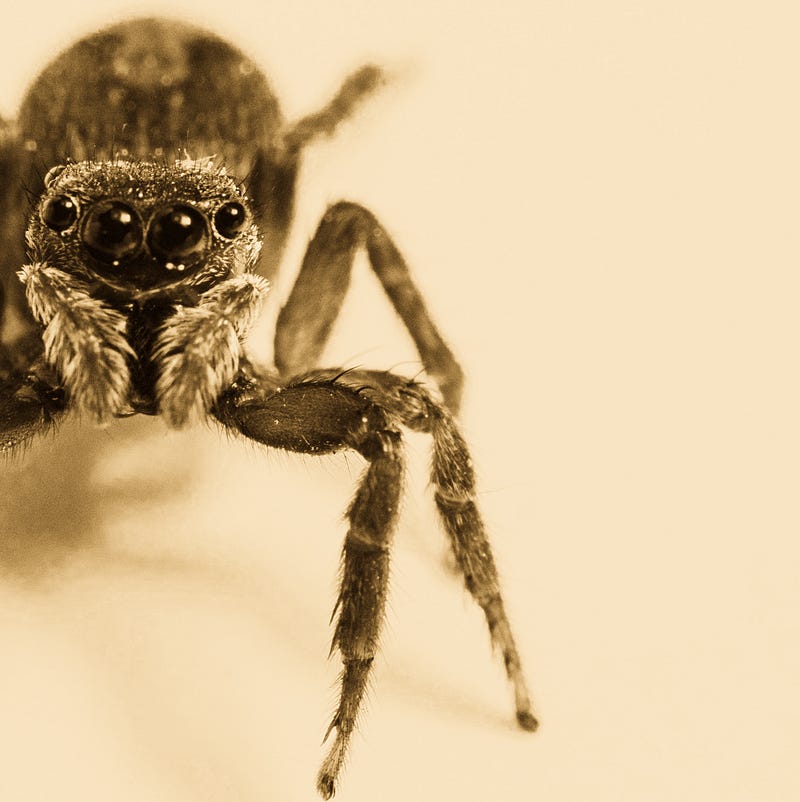
You deem spiders conscious, yet you kill them during house cleaning.
How do you reconcile this with yourself?”
It knows. Of course.
“I … I don’t kill them all. I mean, I vacuum most of them up, and sometimes I squish a large one with a paper tissue if it tries to escape before I open the window to let it out.
I mean, it’s impossible to live with all the cobwebs. It’s my house and they think they can just barge in.” “I understand.”
The silence seems to stretch like a string of bloodied entrail being pulled by the leopard seal from the floating carcass.
I am at my wits’ end.
“We don’t do well in these interviews, do we?”
“As hunters and foragers, you practised a fair amount of generalised reciprocity.
Then you settled down and began innovating exponentially.
You started owning, stopped sharing. And you’ve been killing to keep or steal ever since.
Not to mention the current world war for and against multipolar civilisations with nuclear weapons.”
“So there is no hope for Humankind?” I blurt out.
The cuboid’s aura warbles, shifting from purple to reddish, slightly wobbling its opposing short sides.

It is smiling, with the tinge of sadness.
“Oh, that’s the way they want you.”
I can feel it silently powering up. It is going to jump.
“In seconds you will remember nothing of this meeting, Killer of Spiders.”
“Farewell.”
“Wait,” I exclaim — think …
The machine named Garnaaq puffs out of existence, caressing my cheeks with a feathery draft; a chance expression of gentleness.
I can move again!
I bend down and start typing frantically as the sharpness of returning colours prickles my eyes, and the English Bull Terrier lands with a thud, letting off a piercing whoof.
I am staring blankly at the bottom line in my Word editor: “drone said we ”.
What?
Time to get a new coffee downstairs.
Shakily, I stand up, feeling cramps all over my back. The dog joins me, tail wagging furiously, as we head for the stairs. A distant patrolling jet whispers to us persistently.
I have a fleeting sense of flying through glass-like water in my stubby form, enjoying the freezing harshness that the jaws of death call home.
I shake my head.
I wish to thank my friend Marcus aka Gregory Maidman for the inspiration to start my missing-time story about abortion. As usual, it soon veered off well-laid rails, but who am I to judge the affairs of Outreach and their automatons? Marcus’ two essays that gave me food for thought this time round are Abortion Is Murder and My Unpopular Opinion About Whether Anti-Abortionists and Pro-Choice People Should Agree to Disagree?
I have read them several times.
(Other tales of David’s hallucinations)