
Abortion Is Murder
Yet I steadfastly believe the decision is a personal one that should not be criminalized before the point of fetal viability as there is no justification for human laws to ban it
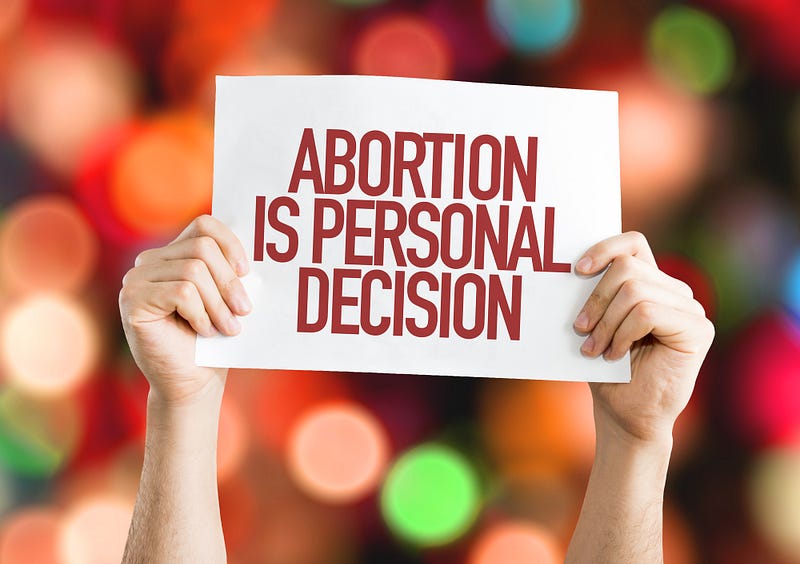
In anticipation of this article, I recently published my view on the hypocrisy of the constitutional philosophy of originalism. Nevertheless, I do not need to rely on modernism to support the notion that the government has no place in criminalizing pre-viability abortion. When one looks beyond the competing interests of protection for the unborn child and a mother’s right to make decisions about her body and life, even under an originalist view of the constitution, the holding of Roe v. Wade, while not the path the Court took to get there, withstands scrutiny.
As stated by the majority decision in Roe:
One’s philosophy, one’s experiences, one’s exposure to the raw edges of human existence, one’s religious training, one’s attitudes toward life and family and their values, and the moral standards one establishes and seeks to observe, are all likely to influence and to color one’s thinking and conclusions about abortion.
The whole debate turns on the belief of when life begins. Science cannot establish this. It is a matter of religious or spiritual beliefs, which are not necessarily the same.
Quoting the esteemed Justice Oliver Wendell Holmes in a since vindicated 1905 dissenting opinion, the majority in Roe v Wade stated:
“[The Constitution] is made for people of fundamentally differing views, and the accident of our finding certain opinions natural and familiar or novel and even shocking ought not to conclude our judgment upon the question whether statutes embodying them conflict with the Constitution of the United States.”
I could argue that this supports a philosophy of constitutional interpretation that views the document from the modernist, or living document view, but I need not go there. Rather, I simply need to point out that the constitution abhors the principle, that concerned the founders, of tyranny by the majority.
The Founders were determined to forestall the inherent dangers of what James Madison called “the tyranny of the majority.” So they constructed something more lasting: a republic. Something with checks and balances. A system of government carefully balanced to safeguard the rights of both the majority and the minority. — Source
According to poll results for the last 25 years, the country is primarily pro-choice. The demographic breakdown is striking. Yet, States with a conservative legislature are emboldened to pass laws that their constituents do not support, presumably because most people do not care enough about the issue and the representatives in our two-party system owe their seats to a vocal minority that has aligned themselves with one party. Thus we actually have tyranny by the majority not of citizens but of politicians who owe their political lives to the lobbyists of the minority.
Moreover, the anti-abortionist position is actually a religious position, one that I happen to spiritually align with because I know that souls incarnate at or about conception, and that is where the constitutional argument should end in favor of the unconstitutionality of the laws preventing or criminalizing pre-viability abortion. It is a religious view and thus all laws that run counter to Roe v. Wade violate the First Amendment’s prohibition on the establishment of religion.
Wherever you may fall on that spectrum, the government has no interest in legislating the availability of pre-fetal-viability abortion. I say this regardless of my belief that life begins at the moment of the first post-conception cell division, as that is when I believe, based upon my communications with the entities in the spirit realm, that souls incarnate a human life at the point of the first division of cells post-fertilization.
The soul of an unborn child that dies in utero, whether by miscarriage or abortion, agreed not to be born when it incarnated the zygote. Thus, it does not need the protection of human laws and its parents do not need the punishment/deterrence of human laws as they are not a danger to society — their decision will be reviewed and addressed in Heaven in their life review.
Discussing the debate of whether abortion or other morality issues, should or should be legislated by the government, has to start with the role of governments.
The most influential philosophers on this topic, at least as I recall learning in high school, are Thomas Hobbes and John Locke.
[Hobbes’s] main concern is the problem of social and political order: how human beings can live together in peace and avoid the danger and fear of civil conflict. — Source
In Locke’s view:
“Political power, then, I take to be a right of making laws with penalties of death, and consequently all less penalties, for the regulating and preserving of property, and of employing the force of the community, in the execution of such laws, and in the defence of the common-wealth from foreign injury; and all this only for the public good.”
Is there any public good in government regulating the availability of abortion? What is the public good in such regulation versus the individual good?
“The traditional approach to criminal law has been that a crime is an act that is morally wrong. The purpose of criminal sanctions was to make the offender give retribution for harm done and expiate his moral guilt; punishment was to be meted out in proportion to the guilt of the accused. In modern times more rationalistic and pragmatic views have predominated. Writers of the Enlightenment such as Cesare Beccaria in Italy, Montesquieu and Voltaire in France, Jeremy Bentham in Britain, and P.J.A. von Feuerbach in Germany considered the main purpose of criminal law to be the prevention of crime. With the development of the social sciences, there arose new concepts, such as those of the protection of the public and the reform of the offender. Such a purpose can be seen in the German criminal code of 1998, which admonished the courts that the ‘effects which the punishment will be expected to have on the perpetrator’s future life in society shall be considered.’ In the United States, a Model Penal Code proposed by the American Law Institute in 1962 states that an objective of criminal law should be ‘to give fair warning of the nature of the conduct declared to constitute an offense’ and ‘to promote the correction and rehabilitation of offenders.’ Since that time there has been renewed interest in the concept of general prevention, including both the deterrence of possible offenders and the stabilization and strengthening of social norms.” — Source
Laws preventing or unreasonably regulating the availability of abortion do not serve the societal benefits of government or criminal laws. An abortionist is not going to walk down the street and harm unsuspecting citizens. We all agree, regardless of religious and philosophical affiliation, that armed robbery and murder of a living and breathing human is an abomination and that citizens and their property require protection from such wanton acts.
The abortionist need not be so deterred. Laws that allow abortion do not subject a mother or its unborn child to forced abortion. These laws do not serve any societal benefit.
Leave mothers alone to make this all so painful decision on their own and discuss the reasons therefor with the jury of their peers in heaven. The soul of the aborted child entered the fetus knowing it would not take a human breath. The decision to abort may actually be decided to have been in the long-term benefit of the mother and the children she may bear later. That judgment is not within the limits of humans to make and there is no benefit to society to create nor determine this conflict.
In Rama I create, with soul-energy surging through my body, inspiring me and breathing wind into my sails,


