
Evil Scientist Who Tortured Monkeys For Notorious Fame
Uncovering the cruel insanity of Harry Harlow’s experiments.
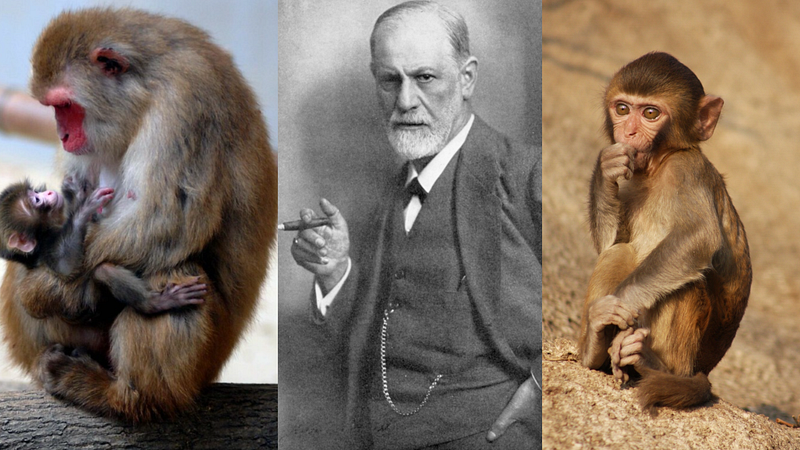
Harry Harlow’s academic history is in relative obscurity for more than 20 years at the University of Wisconsin. His claim to fame, or rather a claim to notorious fame is the experiment he conducted with rhesus monkeys.
The roots of this experiment were in questioning what most scientists believed about maternal love; that it was merely an attachment infants felt for someone who fed, clothed, and protected them.
The Process
First, Harlow raised monkeys in either partial or total isolation. In partial isolation, the monkeys were kept in wire cages where they could hear, smell and feel other monkeys.
Monkeys kept in partial isolation showed signs of emotional distress and agitation as they were recorded to circle their cage, or even indulge in self-mutilation. For the study, some monkeys were even kept in isolation for 15 years.
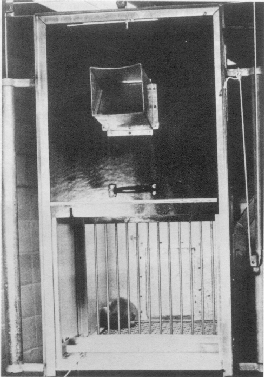
While partial isolation absolutely breaks our hearts, total isolation was even more brutal, and in some cases even fatal. This involved rearing monkeys in the ‘pit of despair,’ a chamber designed to keep baby monkeys alone in the dark, completely away from any social interaction.
Once released from here, monkeys were recorded to demonstrate signs of emotional shock characterized by autistic rocking and clutching. While in one case, a monkey even died and its autopsy report showed the cause of death to be emotional anorexia.
Misleading monkeys with fake surrogate mothers
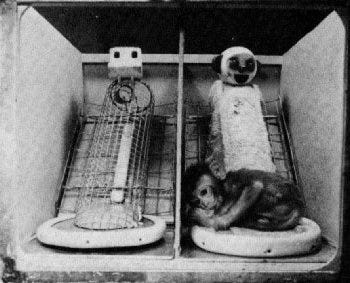
The monkeys in isolation were recorded to cling to their cloth diapers when nervous. This inspired the second part of Harlow’s experiment. He took baby monkeys and placed them with fake surrogate ‘mothers’ made from either wire or cloth. Each surrogate was alternately given a milk bottle as well.
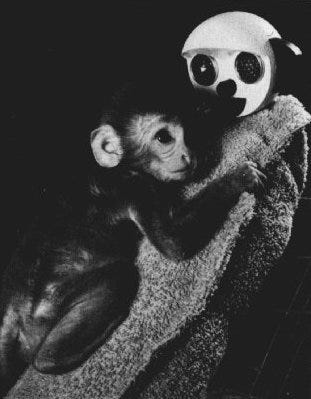
Surprisingly, the baby monkeys preferred the cloth mother more, even if it was without the milk bottle. Harlow tested this with a peer group as well.
This research established how mothers and peer groups help an individual to adapt to society and its norms, we cannot help but wonder how inhumane the experiment was. And the extent to which Harlow basically tortured the rhesus monkeys is condemnable.
Who’s Harlow? Understanding the man behind the science
Harry Harlow, originally named Harry Israel, was born and grew up in Fairfield, Iowa. He lived with his parents and three brothers. Deborah Blum in ‘Love at goon park: Harry Harlow and the science of affection’ writes that Harlow was a bright but bored child. His early years were lonely and partially eclipsed by his brother Delmer’s illness.

Later, in an unfinished autobiography, Harry Harlow would describe life to be particularly dreary under the ministrations of a mother who was both cold and indifferent towards him. This led him to experience bouts of depression throughout his life.

A seemingly capable student, Harlow was able to attend Stanford University after passing an aptitude test in 1924. He worked directly with Calvin Perry Stone, an animal behaviorist, and Walter Richard Miles, a vision expert.
He was supervised by Lewis Terman, upon whose urging, Harry changed his name from Harry Israel to Harry Harlow in 1930 after writing his doctoral dissertation and earning the title of Ph.D. in Psychology from Stanford University.
Later, after graduating from Stanford, Harry Harlow secured a faculty job at the University of Wisconsin, Madison. It was here he conducted his controversial yet renowned experiment with baby rhesus monkeys.
Why Chose Monkeys in Scientific Research?
After scientists, the scientific community owes its success to the countless non-human primates that aid the research process. Especially, the macaque and marmoset species of monkeys that are made to participate in lab experiments.
From Yamamoto et al using chimpanzees to demonstrate targeted helping behavior and general altruism among monkeys to Harry Harlow experimenting with rhesus monkeys to conduct research regarding maternal love. These creatures have been kept in labs and used as specimens to aid the scientific process.
Similarly, in most studies and experiments aimed at researching cognitive abilities or emotional capabilities, we see monkeys bearing the brunt of being chosen as participants of the study. Why monkeys? One might ask.
This is because monkeys are most similar to humans, physiologically, anatomically, and biologically. Hence, they serve as the best prototype for humans when the results of research need to be relevant to humans.
However, that still goes against various ethical guidelines of scientific research. For one, monkeys are unable to provide informed consent. Secondly, the research might distress the animal as well.
This makes us question the morality behind using monkeys in research. Nevertheless, this article is aimed not at the morality of animals being used in research, although it is a point to ponder. Rather, this article is aimed at Harry Harlow and his incredibly insensitive experiment surrounding monkeys and how they respond to maternal love.
Manufacturing Maternal Love in Labs
The extent to which Harry Harlow went to prove the necessity of mothers being available emotionally as well seems like a manifestation of his subconscious desire to be closer to his own mother.
To elaborate further, Harry Harlow once said
‘I have no memory of maternal separation but I have lost maternal affection.’
And in his unfinished autobiography, he describes his mother as ‘cold’ and ‘indifferent’. Moreover, one of Harlow’s inspirations was Sigmund Freud, a notable psychologist who researched mother-child relationships.
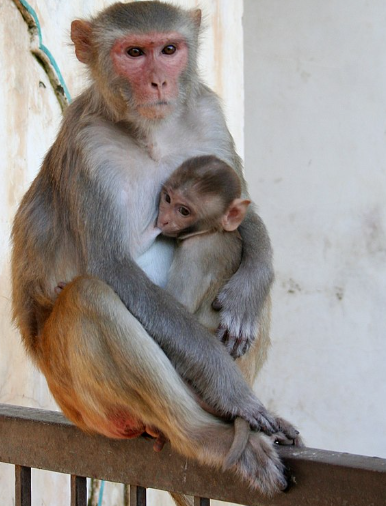
What does this all point to? There is a clear pattern emerging pointing to one question: Harry Harlow tries to prove aggression as a result of an absence of maternal affection, is the procedure of this experiment, starving and basically killing innocent monkeys a result of that same aggression?
The aggression he had suppressed, that resulted from the bouts of loneliness and depression he has been said to have faced! Regardless of the motives, in times like these such experiments in my opinion are highly immoral! Thoughts?
Want to follow up more from me and other amazing writers on Medium?
Hop on the chance to join:


