
Everything You Want to Know About Medium Curation in 2020
Discussing all the various aspects of curation on Medium

It seems that every month we need to relook at what’s working best on Medium for most authors out there. And by most, I mean those of us trying to get our articles seen without 71,713 followers to rely on.
One of the more common questions in the community is about the mystery and magic of curation. No one really knows how it works (outside of Medium itself), and there certainly is a lot of conjecture and opinions on the subject.
I tried to cut through the fluff with this article to help people better understand the function and how it works.
I hope it's useful, enjoy!
TLDR Table of Contents:
- What is curation?
- How are stories curated?
- Curation algorithm
- Human curators
- Basic requirements for curation
- Easy ways to not be curated
- Does Medium give feedback on curation?
- How do I know when I’m curated?
- What happens when I’m not curated?
- Why wasn’t I curated?
- Does curation really matter?
- Can I tell if another writer’s piece is curated?
- Lesser known facts about curation
- How do I get out of curation jail?
- J.J. Pryor theories on curation.
What Is Curation?
To keep this short and sweet, it’s best defined by Medium themselves:
“When they select a story, they then add it to topics, which makes those stories eligible for personalized distribution and promotion across Medium — on the homepage, on topic pages, in our app, in our Daily Digest newsletter, and in other emails.” — Medium FAQ
As of November 2019, there were 101 topics on Medium. They do add some from time to time so there might be slightly more by now.
That’s 101 potential topics for you to get your work curated in — and distributed across Medium in the places they pointed out above.
One key thing to remember is the word ‘topics’ up there. Topics are separate from tags, and so are the use cases for both. I discuss this more below.
How Are Stories Curated?
There are two aspects to curation. One is confirmed by Medium and the other is based on the community and general knowledge of tech platforms.
- The almighty Medium curation algorithm (non-confirmed).
- Medium human curators.
These two custodians of high-quality work are the only known methods that Medium uses to sift through the ocean of stories submitted every day.
Curation algorithm
The curation algorithm is the bane of many Medium writers on here. That’s why there’s the community slang of ‘curation jail.’
In its essence, the Medium algorithm has to sort through more than 10,000 articles published every single day.
This requires sorting methods, as they don’t want to curate and promote every piece of work that comes their way. The sorting method Medium currently uses appears to be placing a flag or marker on people’s accounts if they consistently produce work that is deemed non-curatable.
Once you get that flag on your account, you’re locked in ‘curation jail’ for a while.
Lot’s of people panic at this stage — don’t do that.
I’ll explain some simple methods to escape later on.
Human curators
Medium has a few posts discussing curation, which I’ll summarize below.
According to Medium, there are over 35 different curators that work there.
Who are they?
“Some come from writing and editing backgrounds, while others have specific expertise in fields that are popular on Medium.” — Medium FAQ
They state they’re based around the world as well. Another take on this is with two interviews they conducted with actual curators in early 2019.
Read those for some more insights into what their mission is.
Basic Requirements for Curation
The curation guidelines explain it best, but here’s a quick summary for those short of time.
- Proper headlines in title case and sentence case for subtitles.
- Proofread your stuff to avoid too many errors.
- At least one image and have it state the source (and that you have a right to use it).
- Citations — use them.
- Your profile should have a clear image, full name, and a bio with your credentials (I personally don’t think this is set in stone, just preferred).
- English only — for now.
Easy Ways to Not Be Curated
Once you’ve passed the minimum bar of what to do, you need to consider what not to do.
- Ads and brand marketing — tricky subject here.
- Requests for claps and donations.
- Violating copyright.
- Rules violations — the usual platform stuff, keep it civil.
- Prejudiced pieces — also a gray area sometimes.
- Undisclosed affiliate links.
- Fake news.
- Serial pieces — as in separate stories with two, three, or four parts.
- Content previously published on Medium.
- Stories about Medium itself —
.
Does Medium Give Feedback on Curation?
Generally speaking, no.
The FAQ guides linked to above are the only public statements about curation.
Privately, there was a period of time where people were emailing [email protected] to ask for stories to be reviewed again — and it worked.
However, as with all good things, this came to an end. Too many people probably started doing the same thing and flooded them.
It’s also not a direct line to curators — the email is meant for technical support. If you email them, you’ll likely get a response stating something along those lines.
But feel free to try anyway.
How Do I Know When I’m Curated?
You’ll get an email from Medium stating you’re curated if and when it happens. Make sure you allow ‘notifications on my stories’ in your settings page.
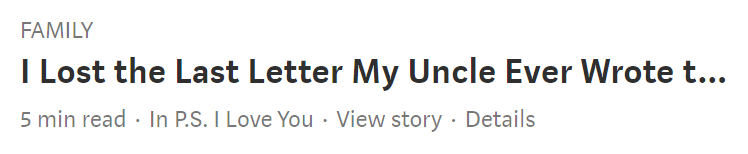
You can also see on the ‘stats’ page. A curated story will have the topics your piece was curated in listed in CAPITAL LETTERS above the title.
Like ‘FAMILY’ in the image below for one of my stories:
What Happens When I’m Not Curated?
Nothing. At least not at first.
You don’t get any notifications if your story isn’t curated. Medium doesn’t like to poke the angry bear-writer.
If you aren’t curated enough times in a row, you’ll eventually be placed in curation jail. You’ll know when you’re in curation jail when you see this dreaded phrase:
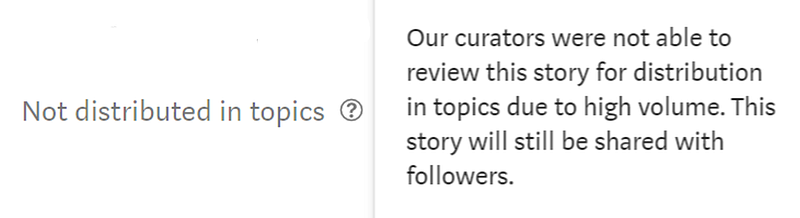
That’s curation jail, welcome to the party!
For now, there isn’t a confirmed number of times you can get rejected before jail time, but it’d be safe to assume it’s four to eight.
My guess is that a curator actually has to trigger the flag, so there may be no set number at all.
You’re not in curation jail if you instead see this phrase when rejected:
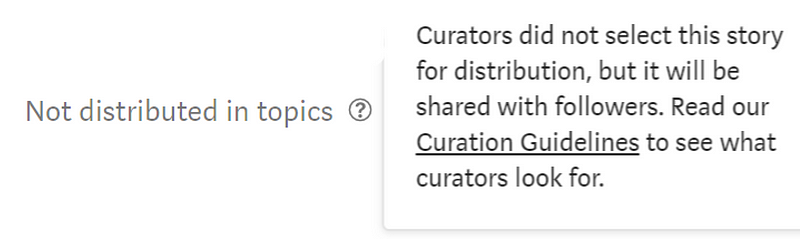
You may also see this message from time to time:

That just means they’re still evaluating your story. If it lasts longer than a few hours, you’re likely not in curation jail, and it’s awaiting a manual decision from a curator.
They officially state this can take up to two weeks if so.
Why Wasn’t I Curated?
If you aren’t in curation jail, and your article was actually reviewed by a human being, there are many possible answers.
Firstly, read those curation guidelines and disqualifiers. If those check out, then it might be due to the human nature of curation — it’s completely subjective.
Medium states they are “constantly working to improve” at being consistent in this area. As well as conducting “regular quality assessments of curators’ work.”
Bottom line — if your piece doesn’t stir the curator right in the cockles of the heart, they’ll reject your story.
Does Curation Really Matter?
Yes and no. If you remember that keyword from the very first question — topics — this is why curation does matter.
It’s the only known way to get added into a topic on Medium. Your story tags run in a separate system.
Topics are curated pieces that stay in those topics for a very long time. They’re likely only ranked lower in those topics as new curated pieces come into play and are shown first.
Essentially, curation matters over the long-term.
What it probably won’t help you with is the short-term. This is where a lot of the writers’ complaints come from. There are countless commentaries out there stating that curation doesn’t matter at all — and I’m sure many of them are because of the short-term time frame.
If you only look at results for a curated article over two weeks vs a non-curated article, you probably won’t see much of a difference. Do that same view over a period of two years instead, and the results should be vastly different.
There’s another benefit too — when your article is curated AND self-published, there’s a big chance the top publications will see your work. I’ve encountered many other writers that said this is how they got published in Medium’s own publications like Gen or Forge.
I haven’t encountered anyone stating that happened a single time without the piece being curated already.
Lastly, to support the negative side of the argument, being curated is just one more potential tool to get your work seen.
If nobody is interested in the topic, your headline isn’t interesting, or the story just isn’t ‘viralish’ — there won’t be any difference vs a non-curated story.
Can I Tell if Another Writer’s Piece Is Curated?
My favorite answer again — yes and no.
The only confirmed way to tell if another author’s piece has been curated is if it’s self-published.
And you can only see it after you click into the article. Here’s an example from our dear Tim Denning:
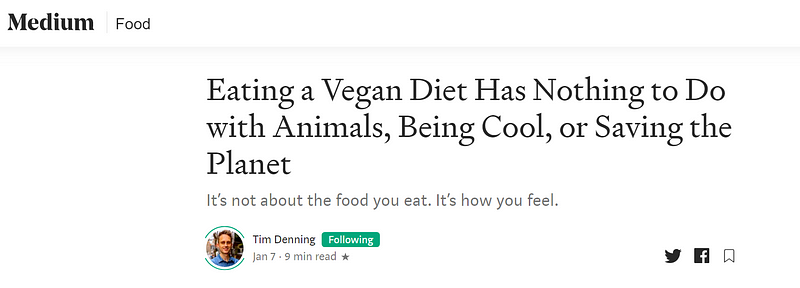
See that ‘Food’ beside the Medium logo in the top left? That’s the curated topic(s).
If this same piece was published, that wouldn’t appear anymore.
But here’s a beauty of a tip not many people know about:
Just go to the topic section of your choice, all articles in there have been curated!
Here’s a link to the topics page. Click on any one of them in there and you’ll see pure curation bliss.
Lesser Known Facts About Curation
- If you see another writer’s article that you really enjoy but isn’t curated, you can send an email to [email protected] — their inbound tip line.
- When you submit a piece and it’s being manually reviewed, the curators can’t see your tags — that’s why you sometimes see strange topics chosen for curated pieces.
- The recent changes to the front page algorithm have reduced the effects of curation — but this will probably change soon as they switch it up every month or two.
- There are a lot of tips and tricks you can use to improve your chances at being curated
How Do I Get Out of Curation Jail?
The curators at Medium hold the all-important keys to the cell, so the first answer is — through them.
There are a lot of opinions and advice out there about how to get out of curation jail, and that’s simply because no one knows for sure.
Well, except for the staff at Medium.
What does seem to work is the following. It’s unconfirmed, but I’ve had several writers tell me it happened to them (including myself):
- Several large publications have the power to curate, even if they aren’t Medium owned.
- Getting published with the above method won’t actually get you out of jail.
- BUT if you repeatedly get published by these publications in a short amount of time (ex. several times in one to two weeks) — you’ll get out.
The other credible theory out there is that there will be an automatic manual review every two to three months if people continue being active throughout the period.
Either way, find some bigger publications to get published in, work on your curation guidelines and publication style, and go write, write, write!
J.J. Pryor’s Theories on Curation
I also have my own theories about the hot topic of curation, but I can’t validate them. They’re based on my experience as the head of product for a large SaaS technology company — I have a knack for guestimating these things.
Theories:
- Curators can’t see author names.
- Curators are subjective and prefer certain styles — no matter the controls in place to keep it unbiased.
- You can have more than one curator at a time — and it does matter (I believe I have at least two looking at mine right now, based on which pieces are in ‘hang tight’ and which are rejected after reviewing).
- Curators are assigned based on their own expertise — a business expert curator gets all the stories sorted by the algorithm with words relating to business, etc. This would also support why my stories in one niche are in ‘hang tight’ but the other areas are quickly reviewed — it’s different people.
- Curators might have favorites — if curators are assigned work from people who post in the same niche repeatedly, and they’ve approved certain styles in the past, they’re likely to approve future iterations from the same author. Even if they can’t see the name, their work will still be in the style the curator enjoys.
- There might be other flags in the curation algorithm — for instance, writers that post regularly about Medium might have a tougher time being curated with their other work.
- Curators might not love J.J. Pryor, but I love them (especially the one that might be reading this!).
Thanks for reading! I hope I’ve covered all the bases and questions about curation. Let me know in the comments if you’d like to hear any other aspects of it.


