Everybody Wants Some — Nickel & Phosphates Demand Are Going To Explode With Volatile Commodities Markets in the Future
The Weekend Brief (TWB) is inspired by one of the ultimate American rock and roll bands to ever step into the history of music — the great Van Halen. The song “Everybody Wants Some” is my personal favorite rock song. Fresh off of the classic 1980 Women and Children First album — in my view, the greatest sounding rock and roll album to hear on vinyl, possibly only second to KISS Destoyer album — the intro and outro riffs by Eddie Van Halen are one of the emblematic features of the classic tune. Although there isn’t an official music video for the song, “Everybody Wants Some” was featured in a clip of the famous ’80s movie Better Off Dead starring John Kusack. Watch the full clip from Better Off Dead on Youtube.
Press Play: https://www.youtube.com/watch?v=YDsKGyu0F98

Question: Where Does Tesla Get the Battery Metals From?
Let’s begin TWB with none other than the man himself, Elon Musk, along with a question you probably haven’t thought about yet: Where does Tesla get their battery metals from?
On the news of Elon Musk’s Twitter fiasco, people are losing sight of what’s happening with Tesla in the Global Economy. Tesla’s market share of Electric Vehicles (EV) comes down to technological superiority and first-mover advantage.
Elon Musk hasn’t been shy about the raw materials needed for producing the batteries: nickel, copper, cobalt and lithium. He has been warning the world about global shortages of critical metals since May 2019.
According to Sarah Maryssael, a former Tesla supply manager and now Livent’s Chief Strategy Officer, Tesla would take necessary measures to ensure key supply of nickel and cut down on the use of cobalt for the company’s EV production — citing a “huge potential” to increase supply of nickel from Australia and United States.
Under the backdrop of underinvestment in the raw materials needed for an industry that depends on critical metals for the so-called electric revolution, the shortages were certainly exacerbated by the global outbreak of COVID-19. Back in 2019, however, Elon Musk already pointed out an essential truth for Tesla: “There’s not much point in adding product complexity if we don’t have enough batteries.”
https://www.youtube.com/watch?v=vpNZhKSfrKE
It’s well-known among industry insiders that Tesla has sought to produce its own vehicle components ever since rolling out EVs. But the supply of raw materials, such as nickel, must be procured from areas outside of Tesla’s geographic and market reach. The company simply does not have the capability to mine its own raw materials.
So, where will Tesla get these critical metals from?
In Janurary 2020, Tesla began negotiations with Switzerland-based Glencore plc to purchase long-term supplies of cobalt at its Shanghai Gigafactory.
One of Tesla’s most important lithium suppliers is a Chinese company, Contemporary Amperex Technology (CATL). The two companies partnered up on a deal for CATL to supply Tesla with lithium-ion batteries from 2022–2025. This is possibly the most important partnership in the EV sector, as far as raw materials procurement is concerned.
This was soon followed up by Elon Musk’s famous quote to global metal miners: “Any mining companies out there … wherever you are in the world, please mine more nickel…Tesla will give you a giant contract for a long period of time if you mine nickel efficiently and in an environmentally sensitive way.”
On July 21, 2021, BHP Group answered the call by signing a deal with Tesla to sustainably produce and supply battery metals from its Nickel West project in Western Australia. This was followed by another deal with USA-based Talon Metals to secure nickel supplies for a mine projected to begin production in 2026.
All of these developments in the critical metals space can’t be overstated for Tesla’s success as the world’s largest EV producer — the continuation of procuring raw materials will be the highest priority for the company going forward as new companies expand production and new partnerships emerge. It’s already been reported that automakers Ford and GM have secured lithium and coblat supplies to enhance EV production.
While other news surrounds product launches. Nissan and NASA teamed up to develop an all-solid-state battery that intends to replace lithium-ion batteries. And surprisingly, GM and Honda will jointly produce EVs based on a new global platform that will allow the companies to sell at a more affordable price in the American market.
The EV consumer market it projected to become a much more competitive sector. One of Tesla’s rivals, Rivian, announced on March 10, 2022, it would follow suit with the world’s biggest EV producer and seller by adopting lithium iron phosphate (LFP) batteries.
On the legislative front, California regulatory bodies proposed to ban the sale of new gasolne-fueled vehicles by 2035. I argue that, if this proposal is passed by relevant legal authorities, it would be a major boon for the rollout of EVs and clean energy products in USA.
With some analysts calling the this era “a gold rush to metals” the world is headed for a revolutionary expansion of renewable energy power and clean energy technologies that pass off on the fossil-fuels industry. That’s why metals are so critical to the world’s Net Zero ambitions. And to get there, Elon Musk is going to need more critical metals.

Question: What Happend on The London Metals Exchange (LME)?
Meanwhile, the story about battery metals is expanded further by a critical event in global commodities markets in March 2022, when there was a substantial crisis for China’s nickel trading giant — Tsingshan Holding Group — led by Chinese Wenzhounese billonaire Xiang Guangda who bet zealously on the growth of nickel production and supply this year at the London Metals Exchange (LME).
When the price of nickel surpassed $100,000 per tonne the LME had to stop nickel trading at an instant.
In response to the EV battery production shortages, Tsingshan Holding Group devised a strategy that would keep prices lower, and thus allow for cheaper production of battery ingredients, especially from areas of Southeast Asia like Indonesia. But unfortuantely the events in Ukraine have caused the markets to act in an extraordinary way — a way that was adverse to Tsingshan’s nickel production investment strategy.
Since March 8, 2022, international investors and bankers have been awaiting Tsingshan’s response. It wasn’t until March 15, 2022, that they finally announced an agreement with bank creditors, such as JP Morgan and CCBI Global Markets, to discuss a “standby secured liquidity facility” arrangement to solve the company’s problems. This agreement is being referred to by most sources as a standstill agreement for which it is expected that the haphazard nickel trading will once again stabilize.
The company released a statement, saying:
“As an integral feature of the agreement, there is provision for the existing hedge positions to be reduced by the Tsingshan group in a fair and orderly manner as abnormal market conditions subside.”
Any new rules will be applied by regulatory authorties in Great Britain: the Financial Conduct Authority (FCA) and the Bank of England.
This story about China’s Tsingshan Holdings Group sheds light on how critical the metals markets are becoming for global finance and investment banks.
With China’s capabilities to produce cheaply in Indonesia, and raise capital from the world’s largest international banks and financial institutions, I’d call this a recipe for stability and disaster offset by the production and supply of metals. This essential truth is even hidden within this story about the nickel industry: the whole point of the standstill agreement was to stabilize pricing and trading mechanisms to prevent a disaster in global markets.
Next, this story continues with a scheme implementation deed (SID) agreed to in December 2021 when Australia’s IGO Ltd sought to acquire another Australian metals miner outfit, Western Areas Ltd, to boost its nickel and lithium portfolio. By adding some of the highest-grade nickel and lithium mines that Western Australia has to offer, IGO would be able to significantly take on the metal production base that is crucial to Electric Vehicles (EV) and Clean Energy Technologies.
Originally valued at A$1.096 billion, IGO would takeover Western Areas Ltd assets with a 100% interest in the mines in Western Australia. IGO appeared to be on its way to a massive acquisition that would put it at the top of Western Australia’s nickel production capacity. Until recently when the nickel trading mechanisms on the London Metals Exchange (LME) got out of control, causing China’s Tsingshan Holdings Group to hedge production against a surging nickel price that hit a whopping $100,000 a tonne.
Due to the events on LME the company was expecting only a “relatively short delay” for the takeover deal at first. It was then reported on April 5, 2022, that IGO would completely back out of the deal to acquire Western Areas — citing only an independent expert report as the rationale for foregoing the acquisition.

Question: Why Was There An International Legal Dispute Over Exports of Phosphate Fertilizers on the American Markets?
In a move to possibly avert or manage disruption of the global fertilizer industry during the globl Covid-19 pandemic, an American fertilizer producer and exporter, The Mosaic Company initiated a petition in 2021 to have Russia’s and Morocco’s phosphate fertilizer subsidies investigated for Countervailing Duties (CVD).
The Mosaic Company argued that subsidies given to Morocco’s OCP and Russian exporters had unfairly harmed USA fertilizer industry producers, which was also judged based on factors that would substantially affect national security imperatives for food security and supply chain security.
When the United States International Trade Court (USITC) ruled in favor of The Mosaic Company, an association of farmers published their disapproval and objections to the final ruling. The farmers argued that these countervailaing duties imposed on Morocco’s OCP and Russian exporters would ultimately lead to higher tariffs on phosphate fertilizer imports to the USA from Morocco and Russia, which would in turn lead to higher costs for American farmers.
When assessing global fertilizer market factors, its’s probable that The Mosaic Company was utilizing strategic foresight capabilities, along with its predetermined judgements about domestic fertilizer supply in the USA, due, but not limited to, three factors at play in the global fertilizer market scenarios:
(1.) China would likely restrict its fertilizer exports due to domestic supply concerns during the government’s zero-Covid strategy to combat unexpected outbreaks of Covid-19 cases throughout China and ensure food security
(2.) Russia would likely restrict its fertilizer exports due to domestic supply concerns during the government’s reponse to unexpected outbreaks of Covid-19 cases throughout Russia, in addition to external geopolitical concerns, such as American and European sanctions on Russia in response to conflict escalation with Ukraine
(3.) Morocco would likely continue to increase its presence in the USA phosphate fertilizer market regardless of the USITC ruling because it is a critical market to Morocco’s global domestic product (GDP) and one of the key targets of Morocco’s largest company, OCP, to expand its operatons and supply chains to other areas of the world such as South America and Sub-Saharan Africa
All of these factors in the global fertilizer markets have added on to the global fertilizer shortage from 2020, and exacerbating a global food crisis around the world, giving new life to a concept called Fertilizer Diplomacy.
The impact on USA’s fertilizer exports and imports from the global fertilizer markets are closely correlated with and subjected to the demand for global energy and commodities, particularly oil, gas and petrochemicals.
On the one hand, USA has been determined to detach itself from oil and gas import dependence from the Middle East, Russia and other global producers and exporters over the years. On the other hand, USA’s emergence as an oil and gas producer is favorable to USA’s domestic fertilizer production industry, and in ways that have and will contribute to prefereable outcomes for The Mosaic Company and other American producers and exporters of commodities.
Since the availability of oil and gas in the USA have been improved and more easily distributed to domestic producers, this circumstance will allow American fertilizer producers to focus more on the domestic market, allowing for a bigger trend that has transformed how the USA fertilizer industry operates, for both domestic and international markets, which has led to more preferable outcomes for The Mosaic Company and other American domestic producers and exporters.
Evidence in both the fertilizer supply situation in USA, and geopolitical forces causing the Russia-Ukraine conflict to escalate on February 24, 2022, reveal that The Mosaic Company was likely to be acting on strategic foresight capabilities when considering the future of its imports and exports in the phosphate fertilizer market.
From a strategic foresight perspective, the uncertainties facing global fertilizer markets have been and will be susceptible to geopolitical forces outside of the USA going forward. These uncertainties from geopolitical risks are affecting both the short-term outlook and long-term dynamics of global fertilizer supply and demand, causing supply shocks and a global food crisis.
As this trend coincides with rising prices for food and fertilizer, there should be greater scruinty by government and industry regulators on how these companies take advantage of the lack of fertilizer imports into the USA market. Morocco’s OCP is fighting back against the tariffs, while Washington D.C.-based international law firm Covington & Burling is representing Morocco’s OCP in their trade dispute case (ostensibly to appeal the USITC ruling) filed against The Mosaic Company.
This case is still in the courts, but the outcome of this case should determine whether OCP still has any chance to succeed in the American market for their phosphate fertilizer exports in the future.
Mosaic Company claimed that OCP Group benefits from government subsidies which allow the company to sell phosphate fertilizer products for below their comparative value in the United States market. It’s a critical case not only for American fertilizer supplies, but also for how important the global fertilizer industry has become for food security and global commodites.
However, this is by far not the only crucial event taking place in the overall spectrum of the global fertilizer industry. Josh Linville of StoneX asserts that a series of Black Swan events since September 2021 have led to higher prices and tighter supplies in the fertilizer markets worldwide.

On 3 March 2022 The Fertilizer Institute (TFI) released a statement about the Russia-Ukraine conflict’s impact to global fertilizer supplies: “Because of Russia’s large fertilizer production and its role as a global fertilizer supplier, the removal of Russian product from the global marketplace will have an impact on supply.”
United States President Joe Biden has announced at least two separate actions, on 11 May 2022 and 17 June 2022, respectively, to reign in critical fertilizer supplies for farmers who cannot afford them, and to stave off a spike in energy prices that would exacerbate the price of fertiliers and the global food crisis.
Speaking at an event in Washington DC from October 10–16, 2022, Chairman & CEO of Morocco’s OCP Group Mostafa Terrab explained Africa’s role in alleviating food security around the globe:
“Putting things in context is very important. There is a visible crisis today; a shortfall of fertilizers today, but we should recognize that what’s visible today has been revealed by a crisis, but is based on a long-term situation that we have to address”
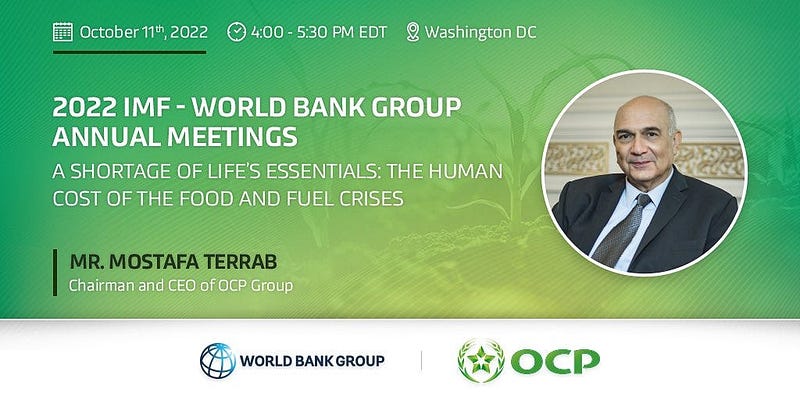
At the event, OCP Group announced that the company would send 4 million tonnes of fertilizers to farmers throughout Africa in 2023.
This initiative is being led by the subsidiary, OCP Africa. According to The North Africa Post, OCP Africa aims to develop a comprehensive farmer-centric approach for agriculture and food security on the African contient.
On Africa’s Green Revolution, OCP Group Chairman & CEO pointed out that it could not be similiar to the Green Revolution carried out by industrial farming practices in other parts of the world. The circumstances of land ownership and ag technology would need to priortized in the context of Africa’s Green Revolution. He compared the Green Revolution to how African countries realized the “telecom revolution” — instead of increasing landline density — which led to the first mobile payment by M-PESA Kenya.
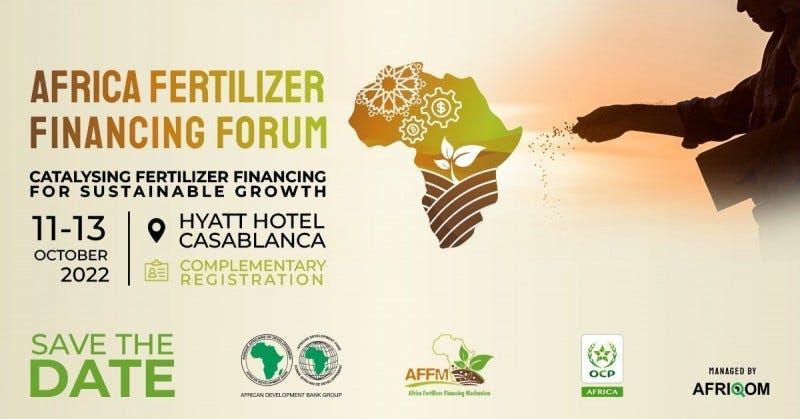
According to the in-depth analysis I’ve provided here about nickel and phosphates demand, here are three of the major concepts to know about the future trends:
- As the world is grappling with the global food crisis governments are hoping that needs that Brazil would produce more food, because it is already one of the world’s largest food-producing countries along with Ukraine. There should be more cooperation on food and energy in the future, look at some of the mutual problems and solutions shared at CES 2023 and Davos 2023. The current trend is highly unlikely to solve the global food crisis, as Brazil certainly cannot take the lead here, and Ukraine is forced to put all of its resources into the war effort. Thus, dealing with indigenous groups’ issues, where operations are located in vulnerable areas of political control, will be paramount to the future supply of raw materials and food production around the globe.
- The vitality of this new era for global mining projects depends on the sustainable production and effective marketplace mechanisms for future facing commodities, such as those for producing fertilizers and metals, which are both going to be energy-intensive — in a world that must trade-off energy consumption for climate change goals and food security. The goal of Net Zero 2050 is to produce these commodities with less energy intensity, not get rid of them completely, which is a key point that people seem to not take into consideration in these discussions about the Energy Transition.
- Cybersecurity is not only a symptom of these issues; it is a core problem to be dealt with in respect to industrial policies across the board. One way to take down bad actors in cyberspace is for countries to cooperate more throroughly on issues pertaining to maritime shipping and transportation. That’s why the maritime domain is crucial to our well-being in the future: food exports depend on shipping lanes and access to ports. On the other hand, geography matters more than people realize, both from an economic and mobility point of view. A future mega-trend is in electric mobility (e-mobility). The source of which is Electrification, which I’ve argued here changes the dynamics on global mining projects, such as lithium, copper, nickel, etc.

Curious About Culture, Intellectual About The World. Discover this publication’s content writers explaining scenarios/shifts related to geopolitics, future industrial policies and advanced technologies.
Sign up for The Weekend Brief (TWB) newsletter to stay on top of what’s happening with publicly-traded companies operating in global markets (including stock markets) at the nexus of tech, industrials and global commodities.


