
A Fake Christian “Counselor” Teaches the Religion to Hate Sex
Stephen Arterburn isn’t who he seems
He is the Christian psychologist who teaches young men how to think about sex—especially the evil of porn. That’s the religion’s take on Stephen Arterburn.
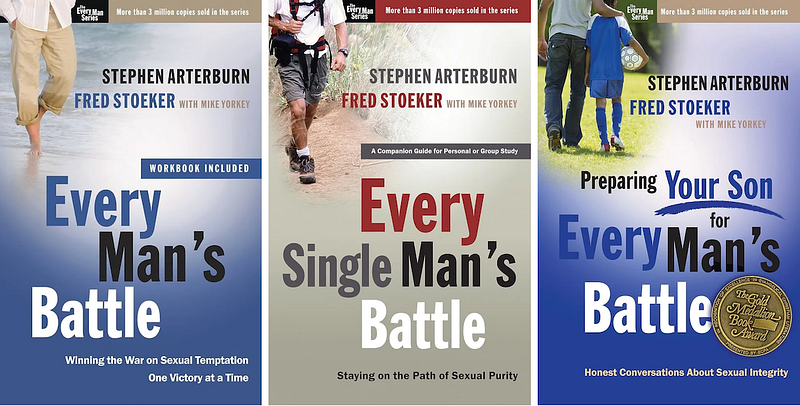
I’m looking into the life the man who wrote the ultra-bestselling Every Man’s Battle. He may be different than his readers imagine. He’s been married three times. He has no mental health training.
He isn’t trained in religion either. He makes it all up as he goes along.

A story he tells helpfully sets up his whole life.
At the beginning of Every Man’s Battle he recalls that one day in 1984 he was driving down a street in Malibu in his 1973 Mercedes 450SL. He spotted a woman jogger, and his eyes “locked on this goddesslike blonde.”
“Blam!” — he smashed into another car ahead of him.
The car crash seemed a divine event. He was married, and looking at another woman was “cheating Sandy out of my full devotion…”
The ‘lesson’ is clear: a Christian man has to be devoted to his wife—or disaster will strike.
But to look into his life, unexpected facts fill in.
His marriage to Sandy was his second marriage. It was completely non-sexual—and soon after, also ended in divorce.
A whole other reality begins to appear?—as it becomes unclear who he really is, other than a man who just doesn’t like sex.
He trains men to see themselves at war with women. Like the blonde jogger, they’re distractions from a man’s sacred focus.
They’re the enemy.
Stephen Arterburn was born in 1953 and raised by Southern Baptist parents in Ranger, Texas.
In Every Man’s Battle he presents himself as an ordinary young man whose life was profoundly altered by seeing World War II-era “nude pinups” in his paternal grandfather’s machine shop.
His life began to disintegrate into a hell of masturbation and sex.
That’s the story of his anti-porn writings. But Stephen Arterburn has written a library of books. He often tells personal stories. Yet in his non-porn writings, stories of his youth shift to his other grandfather.
His mother’s father killed himself in 1954— shooting himself in the mouth with a rifle. Stephen’s mother walked into the gruesome scene. He remembers “the deep sobbing sounds she made, as if her grief were so powerful that she could barely breathe.”
The suicide had great religious meaning.
Arterburn says their church read the act as suggesting his grandfather was not Christian. Then there was heavy suggestion mental illness ran in the Arterburn family. His mother sank into her own bout of it.
He writes about the suicide as a drama that blighted his youth: “I shared very little of what troubled me, and I lived feeling isolated and detached from nearly everyone around me.”
No talk of porn there, for some reason.
He was the youngest of three boys, and the other two were gay.
That’s another curious thing he leaves unmentioned in his anti-porn writings. Stephen Arterburn says he was actually the “gayest” one, with his artistic interests.
Two sons were closeted gays, and one had “gay” tendencies—and thinking about the naked women in his grandfather’s posters.
It seems a story with a lot of psychosexual dynamics?
But looking over local newspaper coverage of Arterburn’s early life, I keep being confused.
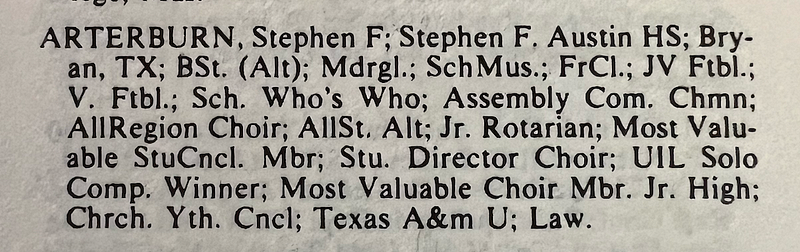
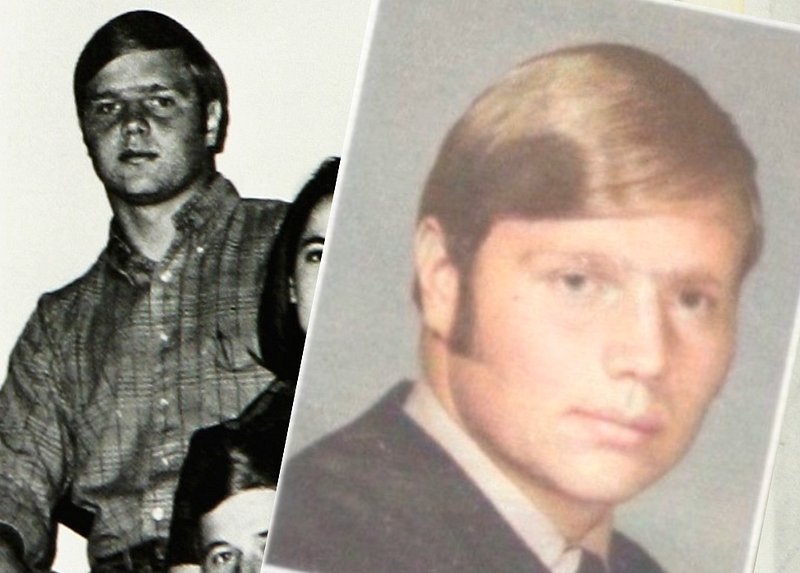
For all his apparent personal problems, he was an accomplished writer, a noted football player, and a member of high-achiever groups: the National Honor Society, the Fellowship of Christian Athletes.
He was named in Who’s Who Among American High School Students with a long list of accomplishments. This young man seems to be organized and focused—and intending to be a lawyer.
He often sang in church, where he had leadership roles.
I keep asking myself: was this really a young man agonized by porn and besieged by family drama?
Or maybe that was just another story he told.
In college he found a girlfriend he liked.
He didn’t like it when she got pregnant, and paid for her to have an abortion. In a 2012 profile there’s a curious moment when he says his ex-girlfriend had contacted him to remind him:
“…he had not merely paid for it, but had actually pressured and manipulated her to get it. In fact, he had made it clear to her that he would not be there for her and their child if she went through with the pregnancy.”
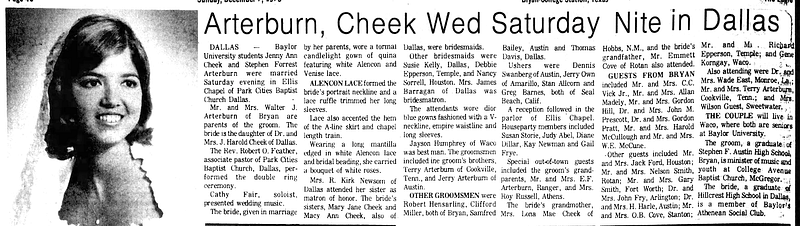
In 1975, he got married to a fellow student named Jenny Ann Cheek. Arterburn hides this marriage from his Christian audience.
He decided to be a Christian counselor.
In a 1976 newspaper clip he’s identified as a student at Southwestern Baptist Theological Seminary, studying ‘psychology and counseling’. The context here is “biblical counseling” done by clerics, not a mental health practice. Ordinary psychology would be read as “bad.”
He got started on his new career by writing an anti-gay newspaper op-ed, arguing that gays are pedophiles. He urges parents to “detect any unnatural behavior,” as kids must be “made to understand normal sexuality.”
He dropped out of seminary and enrolled in the University of North Texas, to get a master’s degree in elementary education. In Every Young Man’s Battle, he calls it “the easiest degree I could find, just to get out.”
He divorced, and moved to L.A.
In his later book, Every Man’s Marriage, he writes of meeting Sandy. He decided to hide his previous marriage. “I didn’t want to mess up this courtship,” he writes.
The draw to her seems mysterious, as he says she wasn’t interested in him at all. Even holding his hand, he writes, “kind of made her sick.”
After marrying, he adds, sex was a “painful experience for her” and she “wanted no part of it.” He writes in Every Single Man’s Battle that “since our wedding day, we both felt we had made a big mistake.”
I email Sandy Simonian, his ex-wife, who reverted to her maiden name. I ask for confirmation his stories about her were true. No reply.


He began writing books on “self-help” subjects.
He wrote books about dieting. He wrote about emotional healing. The impression I get is that he was watching Oprah every day and cranked out books on her themes, just packaged for Evangelical women.
He also helped his brother Jerry write a memoir. Jerry had gotten AIDS and in a panic tried to swear off homosexuality. The brothers co-wrote the 1988 book, How Will I Tell My Mother?: A True Story of One Man’s Battle With Homosexuality And AIDS.
Then Jerry died—as his book made Stephen a star. In the late 1980s and early 1990s he was booked on many talk shows, including Oprah. He recalls that experience to the Los Angeles Times:
“On the show, in the midst of all these people yelling at each other, I came on and said, ‘Look, whether you think homosexuality is right or wrong, you have to love your children.”
This is misleading. Stephen Arterburn is anti-gay to a startling degree, and a vocal advocate of reparative therapy. He also says that family members should continue to “love” each other.
He re-wrote himself into being a “counselor.”
He seems to have made false claims about having an M.A. in counseling. He had worked awhile as a health care administrator and misrepresented it as his own medical practice.

Then he wrote about men and porn—and hit it big.
There is no case from the Bible that a man must devote all his sexual interests to his wife. Many biblical figures have sex slaves and concubines!
But Arterburn based his case against porn on his own personal stories—like the blonde jogger. If it seemed to be a story about a husband needing to re-commit to his wife, we might re-read it in light of Sandy wanting nothing to do with him. She’d soon file for divorce.
He refers in another book to a car crash in college in which he wrecked his car “by running a stop sign.” Maybe he’s just a bad driver? And likes blaming women.
In the early 2000s he was Hollywood glamorous.
In 2006, a writer for GQ magazine interviews Arterburn for an essay on the Evangelical “purity” culture. He’s described:
“Arterburn is fully as good-looking as anyone in Hollywood, with a compact, lean physique, neat, close-cropped hair, and a symmetrical tanned face. Nice shoes as well, very glossy, black, and soft. Very American Giglio, actually.”
That’s a movie about a high-priced male escort. Others around him, likewise, saw a hustler in action. A woman who worked for him during the same time period recalls him as “absolutely arrogant” and openly talking about being in religion for the cash.
Aging out of his L.A. hustler look, he began his “Evangelical guru” era.
He married Misty. He seems to like this wife better than the first two. If he wants to give advice, it should’ve have been to keep divorcing until you get it right? The third time was the charm.

He and Misty re-settled in Indianapolis.
In 2012, he told Publisher’s Weekly he’s “a doctoral student at Newburg Seminary and Bible College.”
It’s an unaccredited degree mill. He dropped out.
He could be “Dr. Stephen Arterburn” all on his own.


Nobody would ever check on him.
The religion is theater, and they liked his show. He fed them what they wanted to hear—and the congregation said “Amen.” 🔶

cc. M.Arterburn