avatarJonathan Poletti

Free AI web copilot to create summaries, insights and extended knowledge, download it at here

3658

Abstract

arlier passages in his journals had displayed erotic interest in Ecuadorian women.</h1><p id="9e3a">The entry for May 23–25, 1952 has this impressionistic <a href="https://www.google.com/books/edition/The_Journals_of_Jim_Elliot/YzATEAAAQBAJ?hl=en&amp;gbpv=1&amp;dq=%22San+Miguel.+The+peasant+blouse,+the+thin+blue+dress,+and+the+plaid+blouse,+and%22&amp;pg=PT290&amp;printsec=frontcover">entry</a>:</p><blockquote id="0fce"><p>“San Miguel. The peasant blouse, the thin blue dress, and the plaid blouse, and jeans. <b>The shoulder, the leg, and the naked waist.</b></p></blockquote><p id="c74b">The boldfaced text is what appears in the published journal, but the space was cut out of the manuscript. So it’s not clear if that was Jim’s actual wording.</p><p id="96bb">He was including a lot of sex-talk in his journal—including noting that he wasn’t attracted to Betty. Some of the talk was evidently deemed so disruptive to the image of a “purity” hero that it had to be destroyed.</p><p id="e69b">Jim’s journal entry of July 5, 1953 had parts clipped from the pages. This occurs in the time frame that could have been describing the Ecuadorian girl with the black eye.</p><figure id="3400"><img src="https://cdn-images-1.readmedium.com/v2/resize:fit:800/1*6ss_rLHmVsqqCtAi0vkV9g.png"><figcaption>Jim Elliot, journal of July 5, 1953 (photos by author at Wheaton College; 2021)</figcaption></figure><h1 id="c9e8">For being so sex-starved, months went by and Jim was still very unwilling to marry.</h1><p id="01b9">They tied the knot, according to the recent biography by Ellen Vaughn, only to get a job that required a married couple. And the newly-revealed final journal entry reinforces that he had a severe sex problem, if ill-defined.</p><p id="850d">I’ve taken Jim to have mostly same-sex interest. As discussed in my viral posts “<a href="https://readmedium.com/the-purity-hoax-c9b1c4934325">The Purity Hoax</a>” and “<a href="https://readmedium.com/the-queer-evangelical-hero-46d933c9ab92">The Queer Evangelical Hero</a>”, Jim reads to me as a queer person. This new evidence about the heterosexual accusation complicates that portrait.</p><p id="8f81">But always with the Elliots, there’s text and subtext. To go back and re-read, odd details extrude. In the journal entry where he says he was “mad for a woman,” the passage in his journal has the semi-clothed workers described as “women and boys.”</p><h1 id="5c98">Surrounding passages of Jim’s journal are packed with bisexual and gay references.</h1><p id="b114">Try his March 29, 1953 <a href="https://www.google.com/books/edition/The_Journals_of_Jim_Elliot/YzATEAAAQBAJ?hl=en&amp;gbpv=1&amp;dq=%22I+hear+of+Maldonado+boasting+in+the+Plaza+of+Puerto+Napo+that+he+has+slept+with%22&amp;pg=PT287&amp;printsec=frontcover">entry</a> that discusses Ecuadorian men as bisexual:</p><blockquote id="2af5"><p>“I hear of Maldonado boasting in the Plaza of Puerto Napo that he has slept with Sevilla’s mother, his wife, all his daughters and now only lacks sleeping with Sevilla himself.”</p></blockquote><p id="e08c">And note the same journal entry where he’s “mad for a woman” pivots at the end to a dismissal of…gay marriage? Jim <a href="https://www.google.com/books/edition/The_Journals_of_Jim_Elliot/YzATEAAAQBAJ?hl=en&amp;gbpv=1&amp;dq=%E2%80%9CWhen+God+saw+that+it+was+not+good+for+man+to+be+alone,+He+saw%22&amp;pg=PT290&amp;printsec=frontcover">writes</a>:</p><blockquote id="2977"><p><i>“When God saw that it was not good for man to be alone, He saw something that is terribly obvious, and He did not meet the need by making a second man!”</i></p></blockquote><p id="7ee6">You could only wonder

Options

where <i>that</i> came from.</p><h1 id="d872">He talks up marriage as the divine goal—then sleeps with a woman?</h1><p id="5894">Elisabeth Elliot leaves no word about this. We flip through <i>Through Gates of Splendor, Shadow of the Almighty, </i>and<i> Passion and Purity</i> to find nothing about the story she confides to her mother.</p><p id="d919">Can the story be believed? The girl is described as “recently converted,” so Jim might’ve been involved in her accepting Christianity—and then puts the moves on her? He wouldn’t be the first Christian man in that situation.</p><p id="615c">Writing her mother, Betty doesn’t say she <i>disbelieved</i> the accusation. She also doesn’t say it was a lie. She simply tells her mother he was ‘accused’.</p><h1 id="01d1">Is there a psychosexual profile for a queerish Jim Elliot who sleeps with a girl?</h1><p id="da69">He was an American from a repressive religious community transplanted to a ‘pagan’ land, where both sexes might’ve seemed far more erotically available than any white Evangelical he’d ever met.</p><p id="3738">He was desperate to be married to achieve theological compliance with the Evangelical world. He may have felt that trying out his heterosexuality before the crunch time of a wedding night was a good idea.</p><p id="b4e1">He might’ve felt genuinely drawn to the woman. To look at the lives of well-known queer writers of the period, like Jack Kerouac and Bruce Chatwin, we do see them having episodes with women, especially women of color. Note Kerouac’s <i>Tristessa</i>, about a Mexican prostitute.</p><h1 id="ab39">He might’ve been trying to stage an ‘adultery’ drama to horrify Betty.</h1><p id="53c8">In allowing her to read his journals that are heavy with sex talk—and then to have sex with an Ecuadorian girl—could be strategies to alienate the Evangelical woman who was fixed on marrying him.</p><p id="5e6b">He’d learn that she wouldn’t be dissuaded so easily.</p><p id="f6b3">In having sex with a girl, Jim might’ve been trying to prove something to himself.</p><p id="d116">I’d note that in the <a href="https://www.facebook.com/media/set/?set=a.372567813170017&amp;type=3">Facebook archive</a> of Elliot photos, the only Ecuadorian person profiled—for reasons unknown—is a teenage boy.</p><figure id="4029"><img src="https://cdn-images-1.readmedium.com/v2/resize:fit:800/1*nP1_EdRTwkh0n_GLAwgLfg.png"><figcaption></figcaption></figure><figure id="a2b6"><img src="https://cdn-images-1.readmedium.com/v2/resize:fit:800/0*iCrJUFlqEpiCuLqM.jpg"><figcaption>unnamed male from <a href="https://www.facebook.com/photo/?fbid=572269389866524&amp;set=a.372567813170017">Elliot archive</a> (colorized); Passion & Purity paperback cover</figcaption></figure><h1 id="7ce1">Is the Ecuadorian girl with a black eye an Evangelical story?</h1><p id="e9c3">It feels so familiar. The purity culture Jim inspired did often feature the <i>female</i> being punished—as the man went off scot free.</p><p id="0ae3">The black eye is a curious detail. At first I’d read it to suggest the girl was punched as punishment for having sex with Jim. But in view of the <a href="https://readmedium.com/jim-elliots-last-journal-entry-ec8d40d36c5f">“angry” sex</a> in the final journal entry, Jim could’ve given it to her.</p><p id="cd33">Finally, all we know is how an Evangelical “purity icon” gets created.</p><p id="67e1">With scissors. And silences. 🔶</p><figure id="4ff1"><img src="https://cdn-images-1.readmedium.com/v2/resize:fit:800/1*xP5EVIv619q5lMqh3HotRA.png"><figcaption>August 20, 1953 letter from Elisabeth Elliot to her mother (photo by author)</figcaption></figure></article></body>

Evangelical “purity” icon Jim Elliot slept around?

New facts about a religious hero

Could the great Jim Elliot, the model of sexual “purity” in the Evangelical world, have slept around before getting married?

I recently visited Wheaton College and studied the archives of Jim and Elisabeth Elliot. There’s some things to report.

Jim Elliot, Wheaton yearbook photo (1945; colorized)

Jim Elliot, missionary and ‘martyr’, has been seen as the model Evangelical.

His sparkling morality is featured in the classic text Passion and Purity, which touched off the ‘purity culture’ of the 1990s to 2000s.

It turns out the Eliot archives have never been critically examined.

As in Jim’s newly-revealed final journal entry, the “hero” was a guy who’d been re-written by a religion after he died.
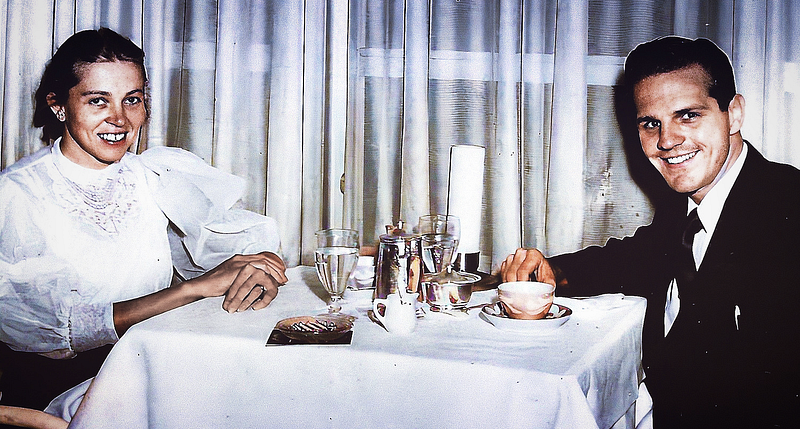

Elisabeth & Jim Elliot (1953; colorized); August 20, 1953 letter from Elisabeth Elliot to her mother (photo by author)

Take the August 20, 1953 letter from Elisabeth Elliot to her mother.

She’s telling her mom about reading her Christian boyfriend’s journal, noting he’d been fretting about his sexual temptations. She tells her mother:

“In one place he says how watching the Indian women at work with machetes on the airstrip almost drove him mad — they wear very tight short skirts, and loose blouses, which are as often off as on.”

She adds that their marriage better come soon, so Jim can have sex with her instead of ogling Ecuadorian women. She adds in a handwritten postscript at the bottom of the page:

“The Indians accused him of having intercourse with a girl recently converted — she got a black eye for it.”

The reference was to Jim’s entry of June 13, 1953.

On full view in the published version of the journals, this was a side of Jim Elliot not often remembered by his religion. He goes on about being “clean mad for a woman,” and writes:

“I want a woman — just one to hold and press against me, to feel and fondle with my lips and fingers. Disgustingly, it could be any woman, as I cannot seem to bring her fixedly to mind, and it is just the woman want that plagues me, the craving to feel one close to me. The Indians in the tight skirts and loose blouses bent over with machetes often bring me to this state, and I know of no escape from it except work.”

Elisabeth Elliot, called ‘Betty’, adds in the note to her mother: “He knew again that the Lord had seen his need, and given him me, to steady and purify and direct his desires.”

But Jim himself never says any of that.

Earlier passages in his journals had displayed erotic interest in Ecuadorian women.

The entry for May 23–25, 1952 has this impressionistic entry:

“San Miguel. The peasant blouse, the thin blue dress, and the plaid blouse, and jeans. The shoulder, the leg, and the naked waist.

The boldfaced text is what appears in the published journal, but the space was cut out of the manuscript. So it’s not clear if that was Jim’s actual wording.

He was including a lot of sex-talk in his journal—including noting that he wasn’t attracted to Betty. Some of the talk was evidently deemed so disruptive to the image of a “purity” hero that it had to be destroyed.

Jim’s journal entry of July 5, 1953 had parts clipped from the pages. This occurs in the time frame that could have been describing the Ecuadorian girl with the black eye.
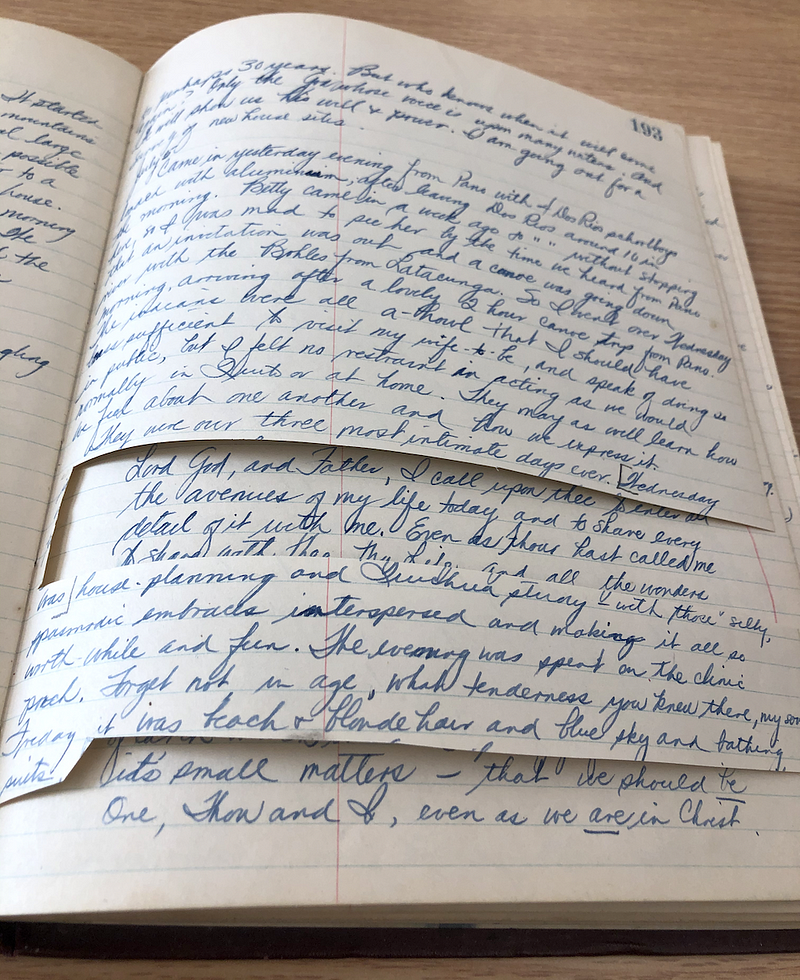
Jim Elliot, journal of July 5, 1953 (photos by author at Wheaton College; 2021)

For being so sex-starved, months went by and Jim was still very unwilling to marry.

They tied the knot, according to the recent biography by Ellen Vaughn, only to get a job that required a married couple. And the newly-revealed final journal entry reinforces that he had a severe sex problem, if ill-defined.

I’ve taken Jim to have mostly same-sex interest. As discussed in my viral posts “The Purity Hoax” and “The Queer Evangelical Hero”, Jim reads to me as a queer person. This new evidence about the heterosexual accusation complicates that portrait.

But always with the Elliots, there’s text and subtext. To go back and re-read, odd details extrude. In the journal entry where he says he was “mad for a woman,” the passage in his journal has the semi-clothed workers described as “women and boys.”

Surrounding passages of Jim’s journal are packed with bisexual and gay references.

Try his March 29, 1953 entry that discusses Ecuadorian men as bisexual:

“I hear of Maldonado boasting in the Plaza of Puerto Napo that he has slept with Sevilla’s mother, his wife, all his daughters and now only lacks sleeping with Sevilla himself.”

And note the same journal entry where he’s “mad for a woman” pivots at the end to a dismissal of…gay marriage? Jim writes:

“When God saw that it was not good for man to be alone, He saw something that is terribly obvious, and He did not meet the need by making a second man!”

You could only wonder where that came from.

He talks up marriage as the divine goal—then sleeps with a woman?

Elisabeth Elliot leaves no word about this. We flip through Through Gates of Splendor, Shadow of the Almighty, and Passion and Purity to find nothing about the story she confides to her mother.

Can the story be believed? The girl is described as “recently converted,” so Jim might’ve been involved in her accepting Christianity—and then puts the moves on her? He wouldn’t be the first Christian man in that situation.

Writing her mother, Betty doesn’t say she disbelieved the accusation. She also doesn’t say it was a lie. She simply tells her mother he was ‘accused’.

Is there a psychosexual profile for a queerish Jim Elliot who sleeps with a girl?

He was an American from a repressive religious community transplanted to a ‘pagan’ land, where both sexes might’ve seemed far more erotically available than any white Evangelical he’d ever met.

He was desperate to be married to achieve theological compliance with the Evangelical world. He may have felt that trying out his heterosexuality before the crunch time of a wedding night was a good idea.

He might’ve felt genuinely drawn to the woman. To look at the lives of well-known queer writers of the period, like Jack Kerouac and Bruce Chatwin, we do see them having episodes with women, especially women of color. Note Kerouac’s Tristessa, about a Mexican prostitute.

He might’ve been trying to stage an ‘adultery’ drama to horrify Betty.

In allowing her to read his journals that are heavy with sex talk—and then to have sex with an Ecuadorian girl—could be strategies to alienate the Evangelical woman who was fixed on marrying him.

He’d learn that she wouldn’t be dissuaded so easily.

In having sex with a girl, Jim might’ve been trying to prove something to himself.

I’d note that in the Facebook archive of Elliot photos, the only Ecuadorian person profiled—for reasons unknown—is a teenage boy.


unnamed male from Elliot archive (colorized); Passion & Purity paperback cover

Is the Ecuadorian girl with a black eye an Evangelical story?

It feels so familiar. The purity culture Jim inspired did often feature the female being punished—as the man went off scot free.

The black eye is a curious detail. At first I’d read it to suggest the girl was punched as punishment for having sex with Jim. But in view of the “angry” sex in the final journal entry, Jim could’ve given it to her.

Finally, all we know is how an Evangelical “purity icon” gets created.

With scissors. And silences. 🔶
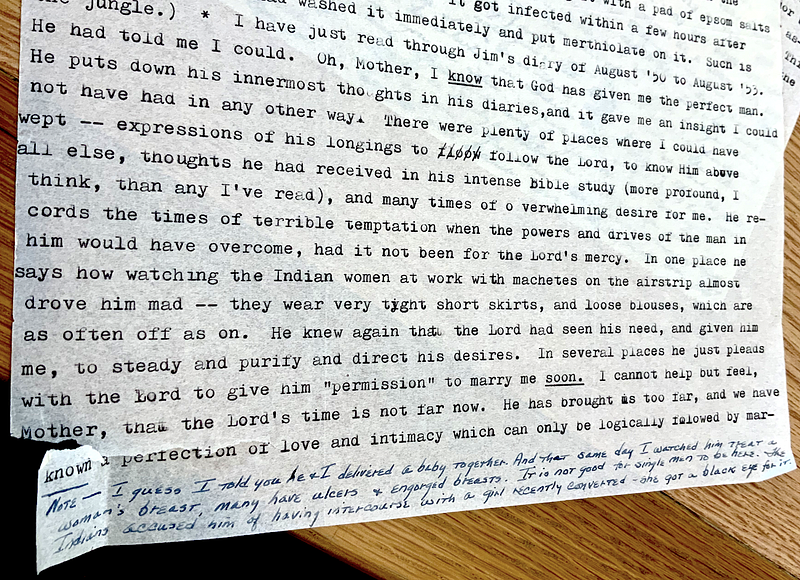
August 20, 1953 letter from Elisabeth Elliot to her mother (photo by author)
Religion
History
Evangelicalism
Sex
LGBTQ
Recommended from ReadMedium