
Tech
Aztec Network: An Ethereum Layer 2 I Actually Like
L2s typically disappoint me, but this one offers a feature we horribly need
Privacy is one of the ethe of crypto. However, in its progression, as it turns out the design of a public blockchain — a public ledger where every activity is visible — can feel too transparent sometimes.
This poses a threat in some cases. Such as when people can see your liquidation price and purposely rekt you. There are scenarios where you can’t keep your wallet address secret. Even if you plan to do nothing controversial, sometimes you just want to be left alone from prying eyes.
The blockchain industry lacks a good tool to protect one’s privacy. We got Tornado Cash, but its reputation — and asset pools — are too tainted due to its being the default destination for hackers.
Here’s where Aztec Network offers a solution.
A Rollup of Ethereum
Only last week launched on Ethereum mainnet, Aztec Network is a layer 2 network utilizing ZKrollup technology. Aztec inherit Ethereum security, taking advantage of the fact that Ethereum is the strongest and most decentralized L1 out there (Because what’s private if it isn’t secure?). Being a rollup, users also get benefited from cheap transaction fees. Even Aztec call themselves “Cheap privacy.”
This is generally what I like about L2s. Cheap, secure. But in execution, the existing L2s — i.e. Arbitrum, Optimism, often fall short. Perhaps, this time Aztec is worth the tradeoffs — or maybe there are none. Unlike general purpose layer 2s, Aztec works more like a specific-built middleware. No redundancy of purpose with the mainnet. Apps integrating with Aztec are promised no liquidity fragmentation, on top of easy implementation.
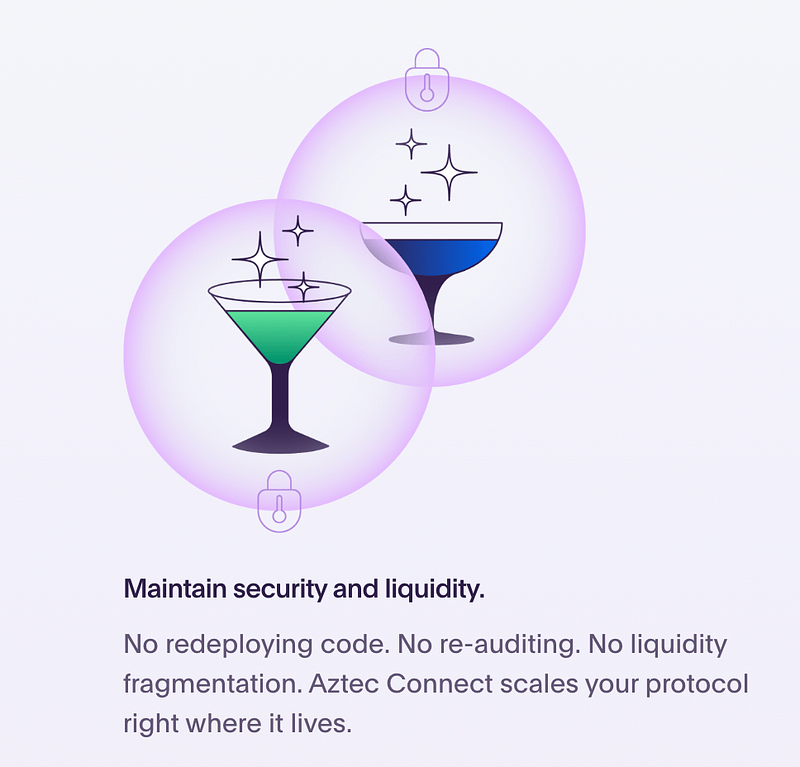
The basics of Zero Knowledge Proof: explained like you’re five
Aztec Network ensures privacy for users, but at the same time, also remains auditable. To understand this, you must understand how Zero Knowledge Proof (ZKP) works.
Picture two friends, Alice and Bob. Alice wants to make sure that Bob has money in his bag (perhaps they want to make a trade later.) But Bob doesn’t want anyone peeking inside his bag. So, they use ZKP mechanism. Something is sent to Bob’s bag, — imagine a robot —, the robot dips its finger into the bag, and confirms the money is there. In practice, the ‘robot’ is much more sophisticated. Not only that it confirms the existence of the money, but it can also ensure the amount. (Bob must not only have the money, but also the amount of money required to make a trade with Alice.) The verification is done through math, cryptography, and encryptions.
Shielding your assets
Smart contracts running on Aztec shield your asset from outsiders. They act like a shield. Once you deploy assets on Aztec smart contracts, what you do with your assets is no one’s business except yours.
A fully-functional protocol called zk.money, which runs on Aztec, is ready for use. You can deposit money over there and then withdraw it to another address. Basically, just like when you would use Tornado cash.
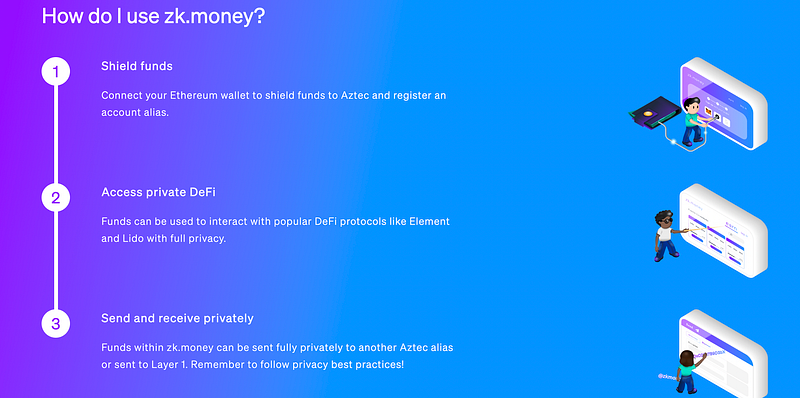
They have a migration guide, including best practices to further disguise your transaction trails.
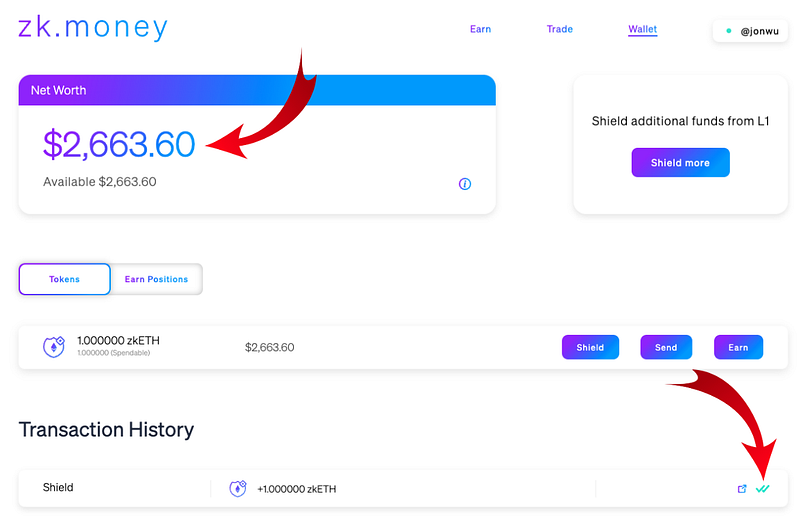
You can do a lot of things inside
This is the most promising and also my favorite feature. With Aztec Network, it’s not just about transferring funds privately. Users can actually do DeFi activities while funds are being shielded, such as yield farming, staking, and swapping tokens.
Currently, below is what’s available. More to come in the future.
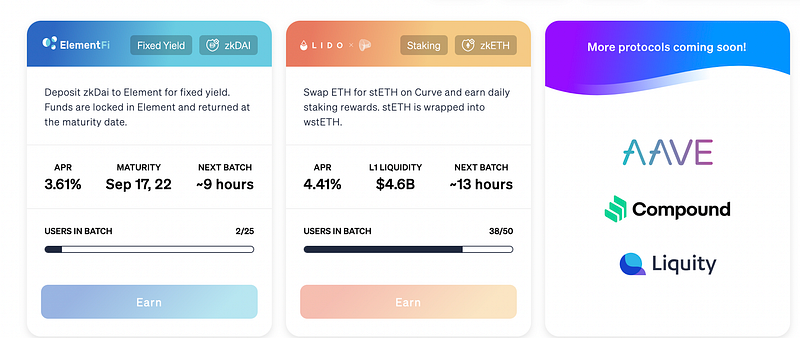
We can hope for more upcoming integration by famous names and DeFi favorites. Aztec team promises ‘only 200 lines of code’ required for integrations.
Minimum and maximum amount
Just like with other L2s, now let’s talk about some limitations. One of them is about the amount you can transact with zk.money.
Although you can deposit a minimum of ~$10 (or 0.01ETH,) the maximum amount you can deposit is capped at $10,000. This one, according to their FAQ, is a temporary move. Perhaps to discourage hackers to launder millions at once. They wouldn’t want to gain notoriety as Tornado Cash did, especially early in the development.
Decentralization on training wheels
Another tradeoff is the decentralization status of Aztec itself, which is a familiar problem among layer 2s. A rollup can be seen as a sidechain with its own block producers/sequencers/rollup providers(the ones who would collect transactions in batches before sending them to the mainnet to finally be added to the Ethereum blockchain ledger.) These providers are important for decentralization. Ideally, more is better. But currently Aztec is the only provider while offering more parties to become a rollup provider too.
Sounds not great indeed, but this is quite normal for an L2 project. ‘A training wheel’, they would argue. After all, they’re still new. Getting people to run a node and be a provider takes time. In the worst case when Aztec can’t do its duties being the provider — i.e. Aztec Network is offline — you can claim your assets back to mainnet using something called Emergency Withdraw. I guess that’s the tradeoff we can accept. (Insert ‘we’re still early’ meme.)
Possibly Aztec not only gonna be my favorite L2, but it’s going to be the layer 2 I use frequently. It’s promising what they offer, and pretty unique compared to competitors (if there are even any.) All this time I’m not convinced by L2, but Aztec changed my mind. Very interested in following their development.
Another alfafa (not financial advice, though): With currently it’s the trend that L2s airdrop their own tokens — such as the recently announced Starware aidrop — it won’t hurt to try around Aztec because one can hope they’re heading to airdrop path too. Who knows?