
Ephah
Americans think the metric system is tough? Try going biblical!

Today’s New York Times Spelling Bee letters:
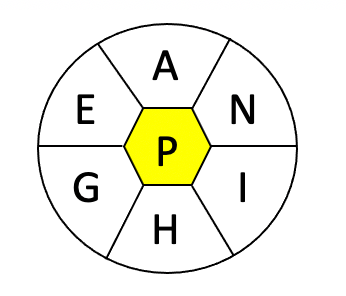
A, E, G, H, I, N, and center P (all words must include P).
Merriam-Webster says…
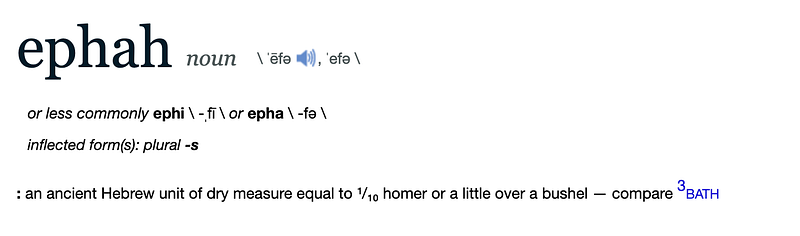
Silly little dictionary! Don’t you know ephah can’t possibly be a word if the New York Times says it ain’t?
Also, for further fascinating facts, check out the Spelling Bee Master.
What’s your favorite dord* from today’s puzzle?
My Two Cents
I am quite aware that people from all over the world read Medium and use it as a writing platform. Despite that fact, statistics do show readership (and writership — is that even a word?) skews American. That’s why I referred to them in the subtitle.
I know that for most of the world the metric system is not only a common thing, but also easy to understand. After all, it was designed to be a cinch to use. Almost every measuring unit is either a multiple of ten or a factor by ten of another unit. Prefixes like kilo- and milli- appear across measuring categories like length, mass, and liquid volume.
Just as Americans struggle with the metric system, many people can’t get a handle on the customary units used in the United States. Especially Fahrenheit. Who can make sense of a freezing point located at 32 degrees? (Scientific-minded Americans will quickly point out that Kelvin units of temperature make even less sense, but at least that base unit has a lovely thing called “absolute zero”.)
Now, onto the word, with two variations on its spelling.
CAPITAL E
Ephah with an uppercase E is a proper noun. As most words that start with a capital letter are. Duh! Please tell us something we already don’t know! Okay, then… did you know Ephah was a grandson of Abraham? The biblical one, not the Lincoln one whose views are currently being debated in the context of anti-racism.
When one thinks of Abraham the patriarch’s family, one probably remembers (1) Hagar, who bore him his first son (2) Ishmael, who Jewish and Islamic traditions consider the common ancestor of the Arabian people. Also the matriarch (3) Sarah, who gave birth to (4) Isaac, whose grandchildren formed the twelve tribes of Israel.
After Sarah died, however, an aging — yet feisty — Abraham married again. He and his second wife, Keturah, had six sons: Zimran, Jokshan, Medan, Midian, Ishbak, and Shuah.
Midian, unhappily fourth on the inheritance list, was the father of Ephah. He and his four brothers were the progenitors of the Midianites. One wonders how they achieved this, though, as apparently only men were being born at the time.
lowercase e
The word ephah in lowercase letters only is a unit of measurement for volume. According to the dictionary, the Hebrew איפה comes from the Egyptian ỉpt. What’s interesting is that the Israelite system for dry measures was exactly the same as the Babylonian one, not the Egyptian one. The Babylonian system used multiples of 6 and 10: 1, 12, 24, 60, 72 (60 plus 12), 120, and 720.
The ephah was typically used for capacity rather than weight, and was equivalent to 432 eggs. I swear I’m not making this up, nor did I arrive at the number randomly. Also, now you know why I photo of 432 eggs at the top of this article. Trust me, I counted, and there are indeed 432 eggs. Well, okay, 424, because I used eight to make a Spanish omelette for dinner.
Let’s start at the beginning, then, with a log. Not the piece of wood sitting in your fireplace, but the biblical measurement equivalent to six eggs. Why six eggs? Talmudic scholars probably know, but I’m still working on becoming one (a scholar, not an egg or a log). Four log — or lag– are one kab, six kab are one se’ah, and three se’ah form the magical ephah.
So… 6 x 4 x 6 x 3 = 432. The mysterious magic of the maths! Yay!
Now it gets trickier. There’s a unit called the omer, which is one-tenth of an ephah, or 42.2 eggs. How you get 0.2 eggs is beyond me, although I do know how to get 0.3 dollars. Hint: write a column about dictionary words on Medium for a week.
And here’s where it gets confusing. There’s also a unit called the homer. Yes, like omer but with an “h”. And the homer is not used to measure steroid use in baseball, despite what purists might claim. Clearly. The homer is actually ten ephah, or one hundred omer.
To be fair, though, homer and omer are quite different in Hebrew, because homer is spelled with a “hard h” sound (like the “j” in Spanish). English has traditionally used ch for that sound — think of challah or Chhannnuckahh (I never remember how the candle-lighting holiday is spelled). Frankly, I’ve always found that confusing, since ch also stands for the “ch” sound in child, children, and childbed.
Now, if you thought all that was a doozy, get a load of these measurements:
- 1 tefach (handbreadth)= 4 etzba’ot (fingers)
- 3 tefachim = 1 zeret (span)
- 2 zeret = 1 amah (the famous cubit), which is 6 handbreadths
The above are some of the length and distance units. We still have area, liquid measures, weight, coins… I can go on all day, but I won’t. Because you’ll stop reading and I won’t get another .03 dollars or even .02 eggs.
Anyway, I think we’ve convincingly established that Biblical units of measurement are harder to grasp than both the metric system and the customary units mixed together (for example, Fahren-sius).
But don’t lose an ounce (or 28.35 grams) of sleep over it. You won’t be able to use ephah to measure batches of eggs anytime soon. That’s because the editors of the Spelling Bee took one look at ephah and declared it a dord.*
Please check out my previous entry on another dord:
*What the heck is a dord, anyway? Here you go: