Machine Learning Art
Enter The World Of Diffusion Models
A Tutorial on Diffusion Models, DALL·E 2 ,Imagen and Co
Diffusion models have become a possible framework for generative modeling, which moves state of the art in picture and video creation problems forward. To get the best results, diffusion models use a guiding strategy to increase sample fidelity (in the case of photos and photorealism) at the cost of sample diversity.
- June 2022 — AI art tools update can be found ➡️ HERE ⬅️
You may be interested in the following tutorial on diffusion models (code +demos) and how they’ve been implemented. In this tutorial, the authors provide a brief introduction.
Project Page (scroll down)
What are Diffusion Models?
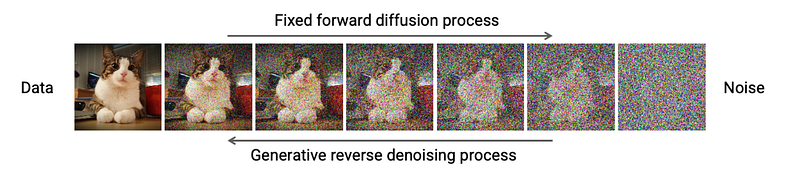
Diffusion Models are generative models, which means that they are used to make data that looks like the data they were trained on. Diffusion Models work by destroying training data by adding Gaussian noise to it over and over again, and then learning how to get the data back by reversing this process of adding noise.
high-quality images
Denoising diffusion models, also called score-based generative models, are a new type of generative models that are very powerful. They do amazing things when making high-quality images, sometimes even better than generative adversarial networks. They also offer substantial sample diversity and accurate mode coverage of the learned data distribution, which is very important. This means that denoising diffusion models are suitable for learning models with lots of different and complicated data. Denoising diffusion models represent a forward transformation that maps data to noise by slowly changing the input data. Data generation is done with a learned, parameterized reverse process that starts with random noise and cleanses it up one step at a time (see figure below).
text-driven image synthesis
Even though diffusion models aren’t that old, they’ve already been used in many successful ways. For example, they have been used in computer vision for image editing, controllable, semantic, and text-driven image synthesis, image-to-image translation, superresolution, image segmentation, 3D shape generation, and completion.
Denoising Diffusion Models
In this tutorial, the authors go over the basics of denoising diffusion models, such as how they work in discrete steps and how they are described using differential equations. They also discuss how denoising diffusion models can be used in practice and show how they connect to other generative models. This puts denoising diffusion models in a bigger picture. Also, they talk about recent technical improvements and advanced methods for accelerated sampling, conditional generation, and other things. The main problem with denoising diffusion models has been that the sample data is too slow. But many promising ways to deal with this problem have come to light. Denoising diffusion models have also made great strides in high-resolution conditional generation tasks, such as text-to-image generation, in recent years, and we talk about a few critical advanced techniques that have helped them do this. Finally, the authors also look at successful applications in computer vision to show how denoising diffusion models can be made to fit different vision use cases.
Computer Vision and AI art
Diffusion models will be used extensively in computer vision and graphics because of their unique strengths, including high-quality generation, mode coverage, and diversity. These strengths, along with recent work on fast sampling and conditional generation, make us think they will be used extensively in computer vision and graphics. Unfortunately, diffusion models are based on reasonably technical ideas. Because of this, their full potential has not yet been realized in many application domains because the community working on them is still small. The main goal of this tutorial is to give people interested in computer vision a short introduction to diffusion models. This tutorial will build on simple ideas about generative learning and teach researchers and practitioners what they need to know to start working in this exciting field.
How can we use diffusion models with different kinds of data?
Keywords: computer vision, Artificial Intelligence, datasets, Machine Learning, AI art, art, digital art, Diffusion models, finetuning, datasculpting, datasculptor, Dalle 2, Dall e alternatives
I invite you to explore the concept of “AI creativity” by reading and learning from the many articles found on 🔵 MLearning.ai 🟠
- Check out my instagram with new material every week
- If you enjoyed this, follow me on Medium for more
- Want to collaborate? Let’s connect on LinkedIn
- https://linktr.ee/datasculptor
- 3D Machine Learning generated model on sketchfab
Data Scientists must think like an artist when finding a solution when creating a piece of code. Artists enjoy working on interesting problems, even if there is no obvious answer.
All our writers (members) receive the opportunity to be promoted on our social media, which increases the popularity of articles published on MLearning.ai
- Linkedin (14.2K+ ML-professionals)
- Twitter (4.9K+ followers)
- Instagram (2.2K + followers )
- Sketchfab * — individual vRooML!
- Youtube
- Apple Podcasts
- Substack
Project Page (The tutorial slides):
Title: Denoising Diffusion-based Generative Modeling:
Foundations and Applications
The Authors : Karsten Kreis , Ruiqi Gao  , Arash Vahdat