
Enraged Anti-War Protesters Missed a Big Chance at Harvard This Week
Four strategies the protesters could have used — or used more smartly — to have a big impact.

Related
• Pressing Where It Hurts: How to Win Fights That Matter • The Samuel L. Jackson Approach to Dealing with Centrist Democrats • Six Behavioral Barriers That Prevent You from Changing the Status Quo — (Part 5) Smart Man’s Disease •• (Part 6) Blackballing
Recent
• How the Al Dente App Eliminates the MacBook Battery Life Problem • Why Are Chinese People Smarter About Mortgages than Americans? • Savvy MBA: Which of the 4 Apple iPhone 14 Models Is the Smart Buy? • The Social Contract Broke in the U.S. Years Later Than in Japan • The Ultimate Question for Starting a Conversation Between Two People
Potential to Change the Way You Think
• Life Expectancy vs. Healthcare Costs in the U.S. (and Japan, Germany, France, Spain, Portugal, etc.) • The Only 3 Differences That Matter Between Centrist Democrats and Republicans • Why Vote “Blue No Matter Who” If Centrist Dems Never Play to Win?

If you want to win . . . if you want to solve big, important problems . . .
then you have to think strategically . . .
be relentless and unyielding . . .
and have the fierce urgency of now.
Anything less than that, and the status quo forces you’re fighting to overturn will instead beat you.
Every time.
“How smart and savvy was the strategy of the anti-war protesters earlier this week at the Kennedy School?”
That was my starting point as I watched a group of anti-war protesters briefly take over a Harvard Kennedy School classroom earlier this week.
They were protesting the Kennedy School professor, a Raytheon executive named Meghan O’Sullivan. They were also protesting Raytheon. And they mentioned Harvard a few times.
“The protesters denounced O’Sullivan’s affiliation with Raytheon Technologies, a weapons manufacturing firm, and her role in the Bush administration during the wars in Iraq and Afghanistan” according to The Harvard Crimson.
While everyone else was watching the spectacle of a class at Harvard — Hahhvahd — get disrupted, I was thinking about this in terms of power and strategy.
What were the goals of the protesters?
Were they thinking strategically about what they wanted to accomplish?
If so, what strategies did they seem to be employing?
Were these strategies optimal and likely to be impactful?
When you watch the first few minutes of the above video and see the protesters calling Meghan O’Sullivan a war criminal to her face, you might think the protesters were hyperbolic and exaggerating what O’Sullivan was responsible for.
And . . . your thinking would be wrong.
Let’s connect two dots to make that clear.
Dot #1. According to O’Sullivan’s bio on the Raytheon website, “Dr. O’Sullivan served on the National Security Council as special assistant to President George W. Bush, and she was the deputy national security advisor for Iraq and Afghanistan.”
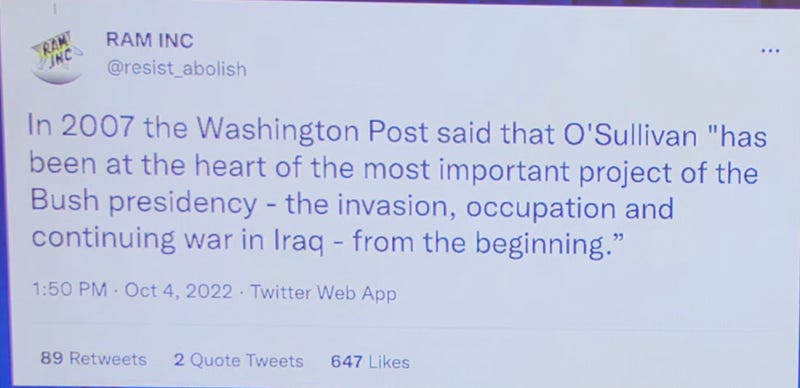
Dot #2. George W. Bush led the U.S. into an illegal, unprovoked war in Iraq that killed hundreds of thousands of Iraqis and thousands of American servicepeople and laid waste to so much of the country of Iraq. It’s correct to call that a war crime.
If you’re worried that this is too harsh or that I’m accusing Bush of something that he himself would dispute, well, listen to the first 90 seconds of this next video. Bush himself will put your worry to rest. He just blurts out his culpability . . . and then confirms it a second later in a sheepish kind of way.
Bush doesn’t just say the quiet part out loud, he says it with ironic clarity. And when he catches himself, he can’t resist a couple words of clear irony — “that, too” — only half under his breath which show he knows exactly what he did.
The entire 7-minute video is worth watching, but the most important part is contained within the first 60 seconds.
It’s genuinely stunning to hear an American president admit to a war crime that killed hundreds of thousands of people in such a matter-of-fact, folksy, sheepish tone.
It’s even more incredible that Bush said clearly — clearly — that he doesn’t really see a difference between (1) what he did 20 years ago by starting an unprovoked war against Iraq with no justification and (2) what Putin has done this year by invading Ukraine.
Ok, so O’Sullivan helped commit what an objective court would probably call “war crimes.”
Which means the protesters at Harvard weren’t being hyperbolic in calling O’Sullivan a war criminal.
So did the protesters accomplish anything of lasting value with their protest?
Let’s look at what their strategy appeared to be and then walk through 4 war strategies that the protesters could have used — actually, could still use — to get more done.
First, here’s what the protesters did
The protesters went after O’Sullivan and Raytheon and tried to cause public embarrassment and shame for both in that classroom. They also shouted “Shame on Harvard Kennedy” a few times, too.
- The first strategy the protesters used was to try to press where they thought it would hurt. They went after Meghan O’Sullivan and called her a war criminal over and over again in front of dozens of other people. The protesters wanted to shame and embarrass her.
- The second strategy the protesters used was to try to occupy the moral high ground. They questioned O’Sullivan’s and Raytheon’s motives to make them seem evil — saying they were ok with building bombs to kill people just so they could make money for the corporation.
On the surface, that makes sense, right?
But when you think more strategically about this, it makes less sense. There were opportunities that the protesters left on the table.
Here is a summary list of 4 “go to war” strategies that would be useful for the protesters.
More detail below.
Strategy #1. Press where it hurts. Find your opponent’s source of power and/or where they are weakest, and hit them there.
Strategy #2. Occupy the moral high ground. Make your opponents seem evil by contrast.
Strategy #3. Create uncertainty and a sense of panic by creating fear. Cause maximum chaos and keep your opponent off balance.
Strategy #4. Build up a reputation that you’re “a little crazy” and that fighting you is just not worth it. Create a threatening presence that makes it more likely that your opponent will want to avoid a fight with you in the first place. (Status quo forces use this strategy ALL the time — see Chevron’s unhinged and longtime persecution of activist attorney Steven Donziger as just one example.)
Strategy #1. Press where it hurts
This is a strategy that I discussed earlier this year.
Three key takeaways from the earlier article were:
Takeaway #1: You have to press where it hurts the other person / organization if you want to make progress and win.
Takeaway #2: It’s almost never just a “one-and-done” where you can deliver a single knockout punch to win the fight. Wars are usually made up of a series of battles. You have to be prepared to go the distance.
Takeaway #3: The status quo always fights back. If you’re up against a status quo that needs to be reformed or changed, you’re going to have to fight to get it done. They never give up willingly.
But while the protesters at Harvard were trying to “press” to cause pain, they weren’t pressing where it would hurt their opponents the most.
Did they press on the most visible and most easily targetable entity on the other side when they went after Ms. O’Sullivan? Yes, they probably did.
But did they press where it was going to cause the defense industry the most pain?
Definitely not.
Meghan O’Sullivan is a single person. She’s not the Raytheon CEO; she doesn’t even remotely have unilateral control over anything that Raytheon does. She is also not a well-known public figure.
In terms of the pain this classroom interruption caused her, it was an inconvenience and an annoyance. It cost her some time and threw her class schedule off by one session. Nothing significant.
Who were the other players/stakeholders where the protesters could potentially have “pressed” to cause some pain?
It wasn’t just Meghan O’Sullivan. I started making a list and quickly came up with more than 10 potential places/people to press to cause pain that would help move the ball down the field. Here are 7 from that list:
- the students in the classroom that day
- Harvard University and/or the Harvard Kennedy School
- Meghan O’Sullivan
- Raytheon
- companies that will hire the students in the classroom after graduation
- governments that will hire the students in the classroom after graduation (you will find Kennedy School alumni working in many governments around the world.)
- Harvard alumni in general who donate a LOT of money back to Harvard University.
Let’s go through a coupleof these to see why they would make sense for the protesters to focus in on.
To start with, I was thinking in terms of (1) how easy/hard it would be to press each of these entities; and (2) how impactful it would be the overall cause of the protesters if the entity were hit.
I laid it out in a 2 x 2 matrix:
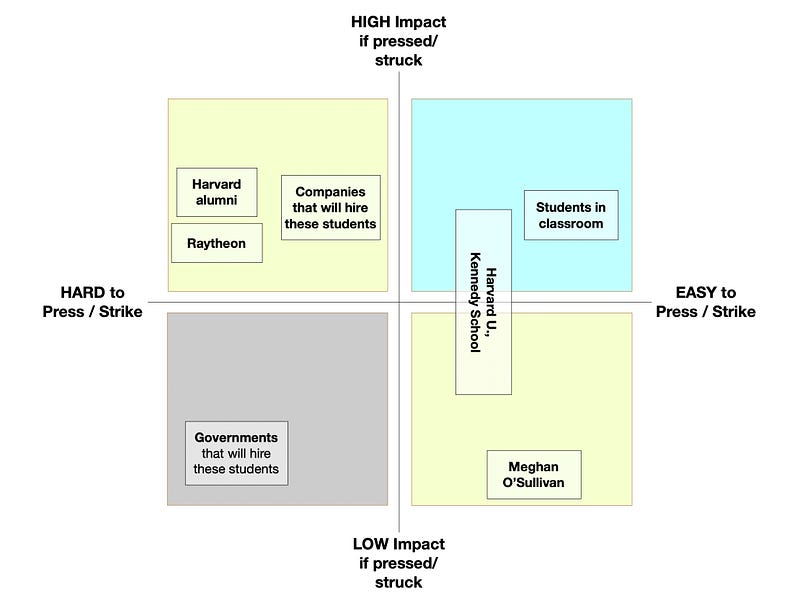
- The upper right-hand quadrant is the sweet spot. These are (1) people/entities who will be relatively EASY TO PRESS / put pressure on; and (2) people/entities where you will have a HIGH IMPACT if you can press them. For instance, the students in the classroom are easy to press — they’re right there in front of you, and they don’t have thick skins — and you can have some real impact if they are your target instead of Ms. O’Sullivan.
- The bottom left-hand quadrant is the worst place to be. These entities are hard to get to/hard to target, and you don’t really get much “bang for your buck” even if you do somehow manage to press them successfully.
It was easy to come up with a list like this with pros and cons for each entity and how best to “press them where it hurts.”
Pressing Where It Hurts #1. The students in the classroom.
The students are mostly in their 20s. They are much easier targets to go after than O’Sullivan, and they are literally right in front of you. They don’t yet have the decades worth of “battle-hardened” thick skin that O’Sullivan has. The grad students are also far more likely to react unpredictably to having direct, intensely uncomfortable, public pressure put on them. Can you imagine how uncomfortable it would instantly be for the students if they got called out by name right there and if they had protesters shouting things at them on camera like:
“Hey Martin Jones, you’re getting taught by a war criminal here. Are you planning to commit war crimes after you graduate? Should any companies that you interview with, Martin Jones, judge you for being taught by a war criminal? Are you here to learn how to commit war crimes? Why should companies take chances on hiring someone who learned from and was trained by a war criminal? This person up in front of the classroom has the blood of hundreds of thousands of Iraqi civilians — men, women, and children — on her hands. How about you…are you looking forward to having bloody hands also? Seems like you must be looking forward to getting your own hands bloody — I mean, you’re here paying Harvard big money to learn from this piece of trash who should be getting sentenced for war crimes at The Hague instead of enjoying a cushy, prestigious job at Harvard.”
There aren’t that many things that the Harvard University administration finds painful to have to deal with, but “unhappy, angry, panicky, frantic students” are on that short list.
When 20-somethings are angry and panicky, they are likely to start acting a little crazy, and Harvard, Raytheon, and O’Sullivan are going to be their first targets. The protesters can just sit back at that point and let the students do some of the work for them.
By getting the students up in arms, you create a problem that has much greater potential to press O’Sullivan, Raytheon, Harvard University, and the Kennedy School where it hurts.
Pressing Where It Hurts #2. Harvard University
Where is the most painful place to press if you want to put pressure on Harvard?
The professors? Not at all.
The administration? Not there either…or at least, not directly at them.
What does Harvard really care about? Money.
Alumni fundraising. The returns on — and growth of — the Harvard endowment.
If the protesters do something — anything — that puts this at any kind of risk, that’s likely to have some impact.
So if the protesters want to have some impact, maybe they start a public campaign: - directed at Harvard alumni
- asking them why they donate money to an institution like Harvard that hires war criminals to teach at Harvard Kennedy School;
- and reminding alumni that she worked for a confessed war criminal — George W. Bush — who graduated from Harvard Business School.
- Show them the video of Bush confessing what he did and then making a joke about it on a public stage — a joke that was really not funny.
- And while current Harvard U. President Lawrence Bacow surely wasn’t responsible for admitting a future war criminal like Bush to HBS back in 1973, he certainly owns some responsibility now for having O’Sullivan teaching at Harvard only 5 months after Bush —her former boss — owned his war crimes on the public stage.
- So maybe President Bacow isn’t fit to represent Harvard, either? (Put this on the table, too, because you shouldn’t just “press where it hurts — you should press *everywhere* it hurts!)
- Bottom line, Harvard alumni — why are you donating money to a university that hires war criminals to teach students?
- Or is it just that there’s maybe “a little war criminal” in all Harvard alumni…?

Strategy #2. Occupy the moral high ground.
The protesters did this. As noted in Strategy #1 above, it would be much more effective if the protesters were more strategic about WHO they are trying to occupy the moral high ground against.

Strategy #3. Create uncertainty and a sense of panic by creating fear. Cause maximum chaos and keep your opponent off-balance.
You can tell by how calmly O’Sullivan reacted during the protest and in the hallway afterward that — while she might have been inconvenienced by how her day turned out — she wasn’t at all fearful or off-balance.
What the protesters did that day was actually fairly “well-mannered” — nothing was said that would have created fear or caused panic in Ms. O’Sullivan.

Strategy #4. Build up a reputation that you’re “a little crazy” and that fighting you just isn’t worth it.
Create a threatening presence that makes it more likely that your opponent will want to avoid a fight with you in the first place.
As noted in the 3 takeaways above from my prior article, “wars” like this are rarely a “one-and-done” kind of thing. You’re going to have to keep going back and forth with the status quo until one of you loses.
Creating a reputation that shows (1) you can get “a little crazy” and (2) that there is risk for them in fighting you is an excellent deterrence strategy. It can make it easier for you to win — or maybe even avoid — future battles on your way to victory.
As I noted above, status quo forces use this strategy ALL the time. See Chevron’s unhinged and longtime persecution of activist attorney Steven Donziger as just one example.
If status quo forces (1) are not only going to use this strategy against change agents but (2) are also going to be brutal, brazen, inhuman, and ruthless about it the way that Chevron has over a period of years, change agents can’t afford not to leverage this strategy themselves.
Tactics like the one I suggested above where the students get confronted and addressed directly will feel to these students like a “crazy kind of thing” to have happen.
Harvard Kennedy students are not only risk-averse by nature, they are 100% used to people being civil in their speech and actions. This is the opposite of that. They will be way out of their comfort zones if they have to respond to it.
It won’t take very much “looking kind of crazy” behavior to make Kennedy School grad students decide that fighting you just isn’t worth it . . . and that they should put pressure on Harvard to do the right thing and get rid of Ms. O’Sullivan.
Planning your battles with the right strategies can have a massive impact on your road to victory.
Selecting the wrong strategies — or not even doing any strategic planning — can lose you the war before you’ve made your first move.
Related
• Pressing Where It Hurts: How to Win Fights That Matter • The Samuel L. Jackson Approach to Dealing with Centrist Democrats • Six Behavioral Barriers That Prevent You from Changing the Status Quo — (Part 5) Smart Man’s Disease •• (Part 6) Blackballing
Recent
• How the Al Dente App Eliminates the MacBook Battery Life Problem • Why Are Chinese People Smarter About Mortgages than Americans? • Savvy MBA: Which of the 4 Apple iPhone 14 Models Is the Smart Buy? • The Social Contract Broke in the U.S. Years Later Than in Japan • The Ultimate Question for Starting a Conversation Between Two People
Potential to Change the Way You Think
• Life Expectancy vs. Healthcare Costs in the U.S. (and Japan, Germany, France, Spain, Portugal, etc.) • The Only 3 Differences That Matter Between Centrist Democrats and Republicans • Why Vote “Blue No Matter Who” If Centrist Dems Never Play to Win?
Want unlimited access to all Medium articles? Become a member!
Would you like me to cover a topic? Please post suggestions in the comments, and I’ll use your input to help prioritize my writing and research.
If you appreciate my writing, please share it on social media.
Again, thank you for reading, subscribing, clapping, and sharing — your time and attention are deeply appreciated!