
Reading in English: E-books or Paper Books?
Reading in digital or printed from has an impact on your language learning
If you aren’t a member, you can read this article here.
The act of reading a book requires making various choices. Which type of book, genre, author and finally deciding on the right one.
There’s also the question of whether you should go for a physical printed book, or an electronic one.
If you’re an English learner who’d like to read a book in English, you might be unsure of whether a paper book or e-book would be more beneficial for the actual reading process, your comprehension and retention of the information.
Advantages of e-books
E-books have been around for a while and have many benefits, including:
- Taking up less space than physical books.
Instead of needing an entire bookcase to store all of your books, they can be stored compactly in digital form, on an e-reader.
- Not being as heavy or bulky to carry.
Some physical books can be big and heavy, like textbooks, and give you a bad back carrying them around. E-readers are compact and lightweight in comparison.
- Extra features, such as an inbuilt dictionary.
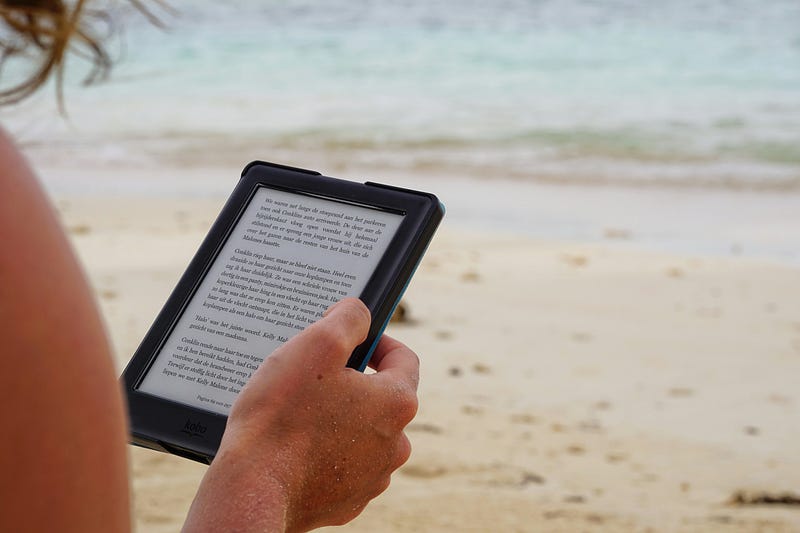
E-readers often come with an inbuilt dictionary, meaning you can instantly check the definition of any word you come across while reading.
Despite the above benefits, printed books remain very popular these days and in a large number of countries actually still outsell e-books, including Spain, France, the UK, Japan and the USA (Statista, 2024).
In fact, physical books have a number of advantages over e-books, especially for learning.
The benefits of reading printed books
Although we can read digital information faster than printed, we seem to process it more superficially. It’s okay for understanding the main points, but not the finer details (Singer Trakhman & Alexander, 2016).
Research suggests that reading comprehension is better with printed text than in digital form, particularly in younger children (Altamura et al. 2023).
A review of the research conducted in this area between 2000 and 2017 also had similar findings (Delgado et al. 2018), plus that the benefits of reading on paper have actually been rising since 2000.
Reading printed books is a multi-sensory experience. Holding the book in your hands, seeing and feeling the cover, turning the pages, the smell of the paper, etc. E-readers don’t offer quite the same experience.
Another study found that the more physical, sensory experience involved with printed books, such as turning the pages, meant that the chronological order of events was remembered better than on a Kindle e-reader device (Mangen et al. 2019).

How does this apply to your English learning and practice?
It doesn’t mean you have to choose one or the other. They both have their uses in different situations. E-books can be useful for reading on the go, for enjoyment, scanning information and getting the main idea.
However, if you want to take in information better and have a deeper understanding, paper books seem to be more effective.
As I mentioned before, e-readers have the added feature of an inbuilt dictionary, so you can check the meaning of the words you read.
While this is undoubtedly an advantage, you can get caught in the vocabulary trap, constantly looking up every single new word, so that you don’t make much progress with reading and it can end up being boring and you might give up.
You could set yourself a limit to the number of new words you check per page / chapter, to help overcome this hurdle.
Making the choice
Whether you read physical or electronic books might also depend on your personal circumstances. One might be more accessible to you than the other.
In some countries, books written in English can be difficult to get, due to limited stock, or high import prices. Buying electronic books in English can be much cheaper.
Despite the limitations of digital text mentioned earlier, steps can be taken to help with remembering the content — read slower and make notes by hand with the main ideas (Mangen et al. 2013).
You can apply these methods when you read in electronic form in English.
Environmental considerations
Although we often think of e-readers and books as being the most eco-friendly option, we mustn’t forget the environmental implications of the production and disposal of e-readers.
In addition, when a paper book is made, no other energy usage is required afterwards, whereas with e-readers, we have to keep using electricity to charge them.
Paper books can also be shared easily with other people, so that when one person finishes reading, they can be passed on and enjoyed by another.
Read whichever way
Ultimately, the act of reading is beneficial in itself, so it’s better to read in some form than not at all.
In my case, I usually read paper books. Although I have a Kindle, I always forget to charge it and I like taking a break from looking at a screen.
Do / would you prefer to read physical or electronic books in English?
I’m Mary, a British online English tutor for adult learners. I post about English learning, vocabulary and grammar, to help you to expand your knowledge and improve your communication skills in English.
If you enjoy reading my posts, or find them useful, please clap, comment, or highlight, as this helps me to keep on writing more. Thanks! :)


