Energy Headlines Reveal Onslaught Of Geopolitical Complexities To Come…
Here’s why international oil companies are making the headlines right now
International oil companies are not known for being the most likeable entities these days, but they are definitely making the headlines right now.
Energy production investments are being spread out across the world, irrespective of energy transition strategies. From the perspective of most oil and gas executives in the United States, oil is still a key part of the world’s transition away from fossil fuels, of which the Permian Basin has a big part to play in the future.
To know more about how North America is driving activity in global energy markets, read a full story in Areas & Producers about the future of US shale production.
One of the premier companies operating in the Permian Basin is Devon Energy. A spokesperson for the company touted that “the next Permian Basin” will not be changing by area, but through other production aspects, such as investments in advanced technologies and enhanced oil recovery.
The big player in the US Permian, however, is Chevron, whose Chairman and CEO Mike Wirth spoke to Bloomberg reports in a lengthy interview about the company’s US shale production strategy in the Permian Basin.
Wirth touched on many aspects of the global energy markets and energy transition during the interview. He also echoed some of the statements made by Devon Energy about investments in recovery methods:
“If we can improve recoveries, that changes the entire economic equation in a very profound way. We’re working hard on that.”
As for global energy markets, there’s some even bigger developments happening in other parts of the world. Since there’s too much to unpack about energy production investments this week, I have compiled the top stories of the month so far. Check out the energy news stories in the link.
It should be noted that the link above includes information about all of the key international oil companies: BP, ADNOC, SLB, Eni and TotalEnergies.
That’s why it is such a big time for energy news stories right now. But to understand the full picture, it’s important to understand the geopolitical trends happening simultaneously.
New Kazakhstan Gas Pipeline Expects To Boost Russian Energy Supplies To Global Markets
Kazakhstan became a member of OPEC+ which was a big boost to OPEC’s overall control over the production and supply of oil to global markets. It is therefore a significant producer of oil and gas supplies, but also a crucial point of volatility to oil and gas markets in the near- and long-term.
Kazakhstan’s inauguration of the second line of the country’s massive gas pipeline system in Mangistau province, known as the Beyneu-Zhanaozen gas pipeline, illustrates how closely the world should be watching Russia’s latest push into the global markets.
This latest gas pipeline extension will reportedly allow the country to boost its gas capacity from 3 billion cubic meters (bcm) to 9 bcm per year. Not only that, but the pipeline is supposed to be taking in Russian gas supplies.
Anyone who is following the Russia-Ukraine war understands what Russia’s oil and gas supplies mean for the geopolitics of this war. Kazakhstan, though, is generally overlooked due to the competing interests among Russia, China and the United States in the country’s volatile domestic politics.
For example, Chevron already has a presence in Kazakhstan’s Mangistau province at the Tengiz oilfield, which is the main export pipeline for the Caspian Pipeline Consortium (CPC). The CPC was a flashpoint during the initial period of Russia’s invasion of Ukraine.
Chevron Purchases Hess Oil In A Move To Compete With Exxon’s Top Position
News about mega-deals in global energy markets just keeps on coming. It was just announced on 23 October 2023 that two of the biggest US oil and gas producers, Chevron and Hess, will merge in a deal reportedly worth $53 billion.
You can watch a full CNBC interview about the merger deal with CEOs of Chevron and Hess. Interestingly, Hess CEO John Hess opens up the discussion by sharing a personal story about his father driving a truck delivering fuel oil during the Great Depression in the United States; but he swiftly shifts the discussion to the company’s shareholders:
“We’ve always been guided by making the right long-term decisions for our shareholders. This is the right long-term decision for our shareholders…I think what’s important to understand is that Hess brings growth to Chevron, growth to resource, growth to production, growth in cash flow, and Chevron brings us financial strength.”
Another intersting note is that right when Hess was starting to mention the company’s position on the energy transition, the CNBC analyst/interviewer basically cut him off to ask more about the company’s strategy.
This speaks to how investors and reporters are viewing oil and gas company’s thoughts on energy transition these days. There’s not a lot of talk about that right now, especially in the context of US oil and gas producers.
See all of the details about the acquisition from CNBC below:
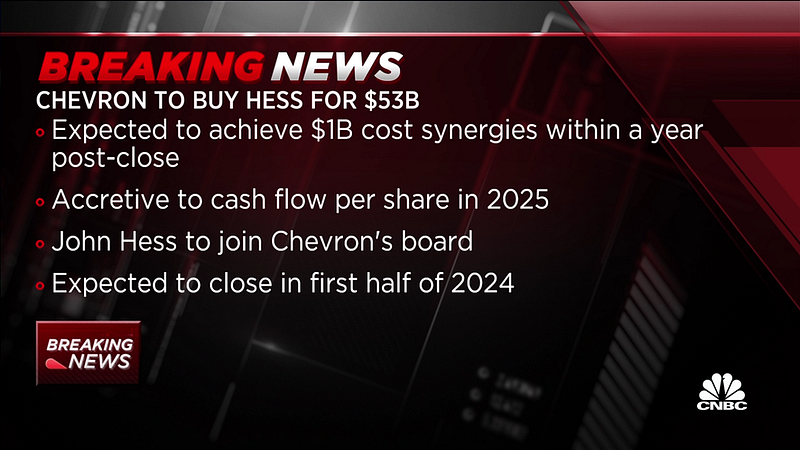
The outcome of this merger deal comes in less than the competitor’s latest mega-merger deal — Exxon Mobil acquired Pioneer Natural Resources in a $60 billion deal to make it the top producer in the Permian Basin.
It’s a big deal for global energy markets, nevertheless, since this deal obviously signals to the markets that there is a lot of competition for investments in the oil and gas markets, both globally and in the United States. Just look at Shell’s 27-year LNG supply deal with Qatar to understand more about the global market trends.
Shell Signs 27-Year LNG Supply Deal With Qatar
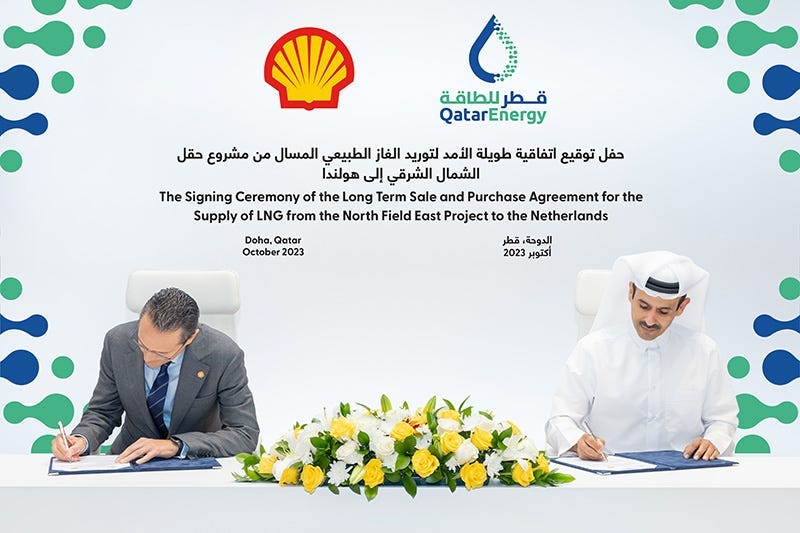
On 18 October it was announced that Shell signed a new liquified natural gas (LNG) supply deal with Qatari government leaders, such as the Minister of State for Energy Affairs and President and CEO of QatarEnergy, Saad Sherida Al-Kaabi.
Shell CEO Wael Sawan, who is seen in the link above with his Qatari counterpart, was eager to sign the long-term contract for Qatar’s LNG supplies, because he is still coming under pressure about the company’s energy transition strategy.
According to the terms of this LNG deal, QatarEnergy will deliver approximately 3.5 million tons of LNG per year to an import terminal in The Netherlands at Rotterdam Gate. It is the second deal reached between a European supermajor and QatarEnergy, as the LNG giant also reached a previous long-term contract with France’s Total Energies.
Saad Sherida Al-Kaabi is the most significant leader in Qatar’s global LNG strategy, since he is both the energy minister and CEO of the country’s largest LNG supplier, QatarEnergy. Here’s what he said about the LNG supply deal with Shell:
“These agreements reaffirm Qatar’s commitment to help meeting Europe’s energy demands and bolstering its energy security with a source known for its superior economic and environmental qualities. We look forward to work closely with our partner, Shell, in delivering on this shared endeavor.”
The 2023/2024 winter season is coming, which means these LNG supply deals also have a political dimension for the European Union’s energy security in the near-term. Not to mention the long-term strategy to disrupt Russia’s massive energy supplies to European markets.
Chevron Is Forced To Shut Down Offshore Gas Operations In Israel
Offshore energy projects in the Eastern Mediterranean are getting into some trouble lately. The latest news about Chevron’s offshore natural gas operations in Israel’s Tamar offshore production field is a case in point.
Due to Hamas’ strikes on Israel, the Israeli government forced Chevron to stop all operations in the Tamar offshore area. The company’s operations in the Levanthian field remained on schedule, nevertheless.
The Eastern Mediterranean offshore gas deposits form a key part of the geopolitical shifts in this martime region, which is why Chevron was allowed to continue operations at the Levanthian field; it’s too important to the region’s energy supplies.
Cyprus already rejected Chevron’s latest proposal to develop the Aphrodite natural gas field — a gas field in the Eastern Mediterranean controlled by a consortium of international oil companies such as Chevron, Shell and NewMed Energy.
Cyprus’s Aphrodite natural gas field is crucial to the country’s energy security in the near-term. That’s why it must use all of its power and influence to negotiate the best deal for the country’s national interests. This offshore development project will undoubtedly cause international issues, since Israel and Egypt are two of the main beneficiaries of the gas export scenarios.
Turkey also has its own interests in a nearby offshore gas field in the Eastern Mediterranean. Since sanctions on Russian energy exports are causing countries to rethink industrial policies, this will be another issue of leverage between Russia and Turkey in the future.