avatarDark Energy Articles

Free AI web copilot to create summaries, insights and extended knowledge, download it at here

2007

Abstract

ever even look for any signs of life there before. Any way you look at it, Saturn and its moons lie really far from the so-called ecosphere of the Sun. At such a distance, liquid water will not be found on the surface of any globe.</p> <figure id="2259"> <div> <div> <img class="ratio" src="http://placehold.it/16x9"> <iframe class="" src="https://cdn.embedly.com/widgets/media.html?src=https%3A%2F%2Fwww.youtube.com%2Fembed%2Fs6xl9abYL2k%3Ffeature%3Doembed&amp;display_name=YouTube&amp;url=https%3A%2F%2Fwww.youtube.com%2Fwatch%3Fv%3Ds6xl9abYL2k&amp;image=https%3A%2F%2Fi.ytimg.com%2Fvi%2Fs6xl9abYL2k%2Fhqdefault.jpg&amp;key=a19fcc184b9711e1b4764040d3dc5c07&amp;type=text%2Fhtml&amp;schema=youtube" allowfullscreen="" frameborder="0" height="480" width="854"> </div> </div> </figure></iframe></div></div></figure><p id="a2a3">The problem is that the surface is one thing, and the interior of the moon is another. The gravitational interactions taking place between the planet, the moon, and the other moons of the system relentlessly affect the interior of such a globe, <b>then compressing it, then stretching it</b>. These stresses alone are able to keep the interior of the globe at temperatures high enough to keep the salt water filling it in a liquid state. Data from the Cassini probe indicate that there is a lot of water inside Enceladus, and it hides under the ice. The ice crust is thicker in some areas, thinner in others. The thinnest, however, is near the south pole, at the so-called Tiger Belt. It is from there that gushing geysers of steam can be observed, the source of which is most likely the subsurface ocean.</p> <figure id="83cb"> <div> <div> <img class="ratio" src="http://placehold.it/16x9"> <iframe class="" src="https://cdn.embedly.com/widgets/media.html?src=https%3A%2F%2Fwww.youtube.com%2Fembed%2FQuAgTEunHFA%3

Options

Ffeature%3Doembed&display_name=YouTube&url=https%3A%2F%2Fwww.youtube.com%2Fwatch%3Fv%3DQuAgTEunHFA&image=https%3A%2F%2Fi.ytimg.com%2Fvi%2FQuAgTEunHFA%2Fhqdefault.jpg&key=a19fcc184b9711e1b4764040d3dc5c07&type=text%2Fhtml&schema=youtube" allowfullscreen="" frameborder="0" height="480" width="854"> </div> </div> </figure></iframe></div></div></figure><p id="cb00">Scientists point out that Saturn’s surroundings may not be <b>the ideal place to search for life,</b> due at least to the gas giant’s enormous magnetic field. On the other hand, however, the thick layer of ice separating this environment from the ocean inside Enceladus may effectively protect whatever could be formed inside. Not surprisingly, then, like Europa orbiting Jupiter, Enceladus has received a patch as one of the most interesting places for scientists searching for extraterrestrial life in the Solar System.</p><div id="8ec8" class="link-block"> <a href="https://readmedium.com/deep-sea-fish-are-the-strangest-creatures-that-exist-on-earth-their-appearance-is-awe-inspiring-33a034a610b5"> <div> <div> <h2>Deep-sea fish are the strangest creatures that exist on Earth. Their appearance is awe-inspiring</h2> <div><h3>Sea monsters appear in many myths and legends. However, you don’t necessarily have to look for them on the pages of…</h3></div> <div><p>medium.com</p></div> </div> <div> <div style="background-image: url(https://miro.readmedium.com/v2/resize:fit:320/1*VKCu0yytad0GW_x-H07UEg.jpeg)"></div> </div> </div> </a> </div><p id="fd71"><b>Cool that you made it to the end of this article. I will be very pleased if you appreciate the effort of creating it and leave some claps here, or maybe even start following me. It would be nice if you also left a tip! Thank you!</b></p></article></body>

The Snowy Wonder: Exploring the Frozen Landscape of Enceladus

Enceladus, a small icy moon of Saturn, is one of the most interesting places in the Solar System. This inconspicuous globe with a diameter of only a few hundred kilometers, orbiting the magnificent Saturn most likely hides an ocean of liquid water in its interior. One would like to finally send a lander to it. Before anyone undertakes this, however, it would be helpful to know what that lander would eventually land on.
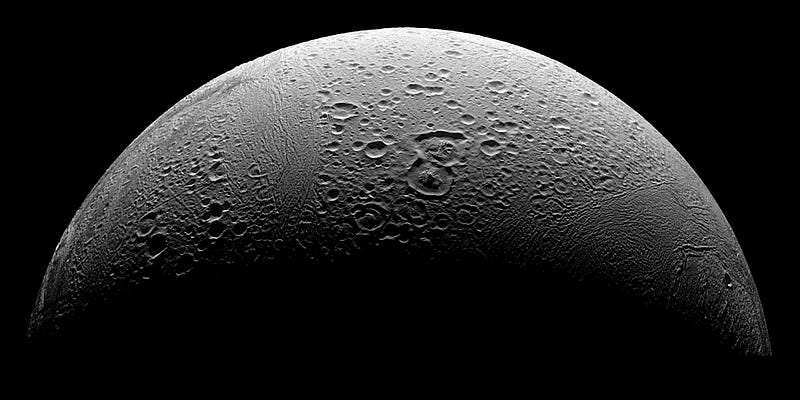
Photo: [NASA/JPL/Space Science Institute, Public domain, via Wikimedia Commons]

Were it not for the Cassini probe, which orbited Saturn for more than a decade and repeatedly had the opportunity to look at the unusual Enceladus, probably no one would have paid exaggerated attention to this small globe. Precise observations of its motion and sightings of geysers gushing from its surface made scientists momentarily interested in it.

Saturn is located on average 1.5 billion kilometers from the Sun. No one would ever even look for any signs of life there before. Any way you look at it, Saturn and its moons lie really far from the so-called ecosphere of the Sun. At such a distance, liquid water will not be found on the surface of any globe.

The problem is that the surface is one thing, and the interior of the moon is another. The gravitational interactions taking place between the planet, the moon, and the other moons of the system relentlessly affect the interior of such a globe, then compressing it, then stretching it. These stresses alone are able to keep the interior of the globe at temperatures high enough to keep the salt water filling it in a liquid state. Data from the Cassini probe indicate that there is a lot of water inside Enceladus, and it hides under the ice. The ice crust is thicker in some areas, thinner in others. The thinnest, however, is near the south pole, at the so-called Tiger Belt. It is from there that gushing geysers of steam can be observed, the source of which is most likely the subsurface ocean.

Scientists point out that Saturn’s surroundings may not be the ideal place to search for life, due at least to the gas giant’s enormous magnetic field. On the other hand, however, the thick layer of ice separating this environment from the ocean inside Enceladus may effectively protect whatever could be formed inside. Not surprisingly, then, like Europa orbiting Jupiter, Enceladus has received a patch as one of the most interesting places for scientists searching for extraterrestrial life in the Solar System.

Cool that you made it to the end of this article. I will be very pleased if you appreciate the effort of creating it and leave some claps here, or maybe even start following me. It would be nice if you also left a tip! Thank you!

Space
Science
Technology
Life
Life Lessons
Recommended from ReadMedium