avatarDark Energy Articles

Free AI web copilot to create summaries, insights and extended knowledge, download it at here

4351

Abstract

ing the temperature of the eyeballs, which significantly improves the ability to see, and thus the effectiveness of hunting.</p><figure id="01e1"><img src="https://cdn-images-1.readmedium.com/v2/resize:fit:800/1*U3qU5pvC_2lrYO965MYdFw.jpeg"><figcaption>Xiphias gladius — [Photo; Naturalis Biodiversity Center, CC0, via <a href="https://commons.wikimedia.org/wiki/File:Xiphias_gladius_Linnaeus,_1758_2599925021.jpg">Wikimedia Commons</a>]</figcaption></figure><h1 id="8c6b">Other species of deep-sea fish</h1><p id="2386">Many deep-sea fish have an uncanny appearance. Some can directly resemble monsters. For example, fish from the family <b>Eurypharynx pelecanoides</b> are quite impressive. These fish have huge jaws and a huge throat that looks like a skin sack in pelicans. The rest of their body is reduced, making swallows look like floating heads propelled by a thin tail.</p><figure id="fef6"><img src="https://cdn-images-1.readmedium.com/v2/resize:fit:800/1*ud9JHfnJm5zZ_wHgLVWJZg.jpeg"><figcaption>Eurypharynx pelecanoides — [Photo: Emőke Dénes, <a href="https://creativecommons.org/licenses/by-sa/4.0">CC BY-SA 4.0</a>, via <a href="https://commons.wikimedia.org/wiki/File:Hal_-_Eurypharynx_pelecanoides_-_1.jpg">Wikimedia Commons</a>]</figcaption></figure><p id="fd27">The fish of the <b>Melanocetus johnsonii </b>species also have a huge sack under their throat. They live at a depth of one and a half to two kilometers, where sunlight no longer reaches. So these fish attract prey using bioluminescence. They have such an extensible stomach that they are able to swallow prey weighing more than themselves.</p><figure id="7d9f"><img src="https://cdn-images-1.readmedium.com/v2/resize:fit:800/1*gphYcPn2ksJHs3iV_e2P8Q.jpeg"><figcaption>Melanocetus johnsonii — [Photo: Ryan Somma, <a href="https://creativecommons.org/licenses/by/2.0">CC BY 2.0</a>, via <a href="https://commons.wikimedia.org/wiki/File:Melanocetus_johnsonii1.jpg">Wikimedia Commons</a>]</figcaption></figure><p id="704e"><b>Chauliodus sloani </b>can also be frightened. It has a very long body ending in a large head with huge teeth. Thanks to a light organ, this fish lures prey into its wide-open mouth, which it then closes like a trap.</p><figure id="9568"><img src="https://cdn-images-1.readmedium.com/v2/resize:fit:800/1*Ysx827pr_sgVOEpfqOoMOg.jpeg"><figcaption>Chauliodus sloani — [Photo; This file is licensed under the <a href="https://en.wikipedia.org/wiki/en:Creative_Commons">Creative Commons</a> <a href="https://creativecommons.org/licenses/by-sa/3.0/deed.en">Attribution-Share Alike 3.0 Unported</a> license, via <a href="https://commons.wikimedia.org/wiki/File:Messina_Straits_Chauliodus_sloani.jpg">Wikimedia Commons</a>]</figcaption></figure><h1 id="b227">The strangest fish of the deep</h1><p id="2468">One of the most famous deep-sea fish is <b>Psychrolutes marcidus</b>. This name is unlikely to tell anyone anything, but already the English blobfish — perhaps so. The blob fish lives at a depth of about one kilometer. However, when it is brought to the surface, its gelatinous body swells and spills, giving it a strange appearance. To people who easily succumb to pareidolia — that is, seeing familiar things in different shapes — the blob fish begins to resemble a swollen, sagging face.</p><figure id="bd39"><img src="https://cdn-images-1.readmedium.com/v2/resize:fit:800/1*K_r7lvlXmBfiXeOyLOawtA.jpeg"><figcaption>[Photo: Rachel Caauwe, <a href="https://creativecommons.org/licenses/by-sa/3.0">CC BY-SA 3.0</a>, via <a href="https://commons.wikimedia.org/wiki/File:Two_Psychrolutes_marcidus.jpg">Wikimedia Commons</a>]</figcaption></figure><p id="1517">On the other hand, <b>Albatrossia pectoralis</b>, one of the most common deep-sea fish, consists of an ominous-looking head with a large snout and a long fleshy tail. It is found at depths ranging from several hundred to 3.5 kilometers. It can be up to two meters in length. It is estimated that these fish make up as much as 15 percent of the entire population of deep-sea fish.</p><figure id="d5e8"><img src="https://cdn-images-1.readmedium.com/v2/resize:fit:800/1*CZkdlTzE9ZEzJqko1nZ-lA.jpeg"><figcaption>Albatrossia pectoralis — [Photo: This image is in the <a href="https://en.wikipedia.org/wiki/public_domain"><b><i>public domain</i></b></a> because it contains materials that originally

Options

came from the U.S. <a href="https://en.wikipedia.org/wiki/National_Oceanic_and_Atmospheric_Administration"><i>National Oceanic and Atmospheric Administration</i></a>]</figcaption></figure><p id="b22d">Iconic deep-sea fish are also representatives of the genus <b>Anoplogaster</b>. We know of two species of these undersized fish that have been found as far as five kilometers below the surface. They have disproportionately large teeth and twisted mouths, which gives them an unpleasant, off-putting appearance. However, they are completely harmless to humans.</p><figure id="c582"><img src="https://cdn-images-1.readmedium.com/v2/resize:fit:800/1*3jhug9QJHRsUF607psz-xA.jpeg"><figcaption>[Photo: Sandra Raredon/Smithsonian Institution, Public domain, via <a href="https://commons.wikimedia.org/wiki/File:Anoplogaster_cornuta_SI.jpg">Wikimedia Commons</a>]</figcaption></figure><p id="ffb7">The same can be said of the extremely rare shark <b>Mitsukurina owstoni</b>. This shark, although it looks ominous, feeds on cephalopods, crustaceans and fish. It has protruding jaws (so this shark may have inspired the authors of “Alien”) and a distinctive long beak. The fish feeds at several hundred meters — the deepest place from which it was fished was 1,300 meters below the surface.</p><figure id="b1b2"><img src="https://cdn-images-1.readmedium.com/v2/resize:fit:800/1*E6e98aYPSmdJzPAuzc6W8g.jpeg"><figcaption>Mitsukurina owstoni — [Photo; This file is licensed under the <a href="https://en.wikipedia.org/wiki/en:Creative_Commons">Creative Commons</a> Attribution-Share Alike <a href="https://creativecommons.org/licenses/by-sa/2.5/deed.en">2.5 Generic</a>, <a href="https://creativecommons.org/licenses/by-sa/2.0/deed.en">2.0 Generic</a> and <a href="https://creativecommons.org/licenses/by-sa/1.0/deed.en">1.0 Generic</a> license, via <a href="https://commons.wikimedia.org/wiki/File:Mitsukurina_owstoni,_Pengo.jpg">Wikimedia Commons</a>]</figcaption></figure><h1 id="4d8f">What lives at the bottom of the ocean?</h1><p id="922f">What fish live at the greatest depth? Just last month, scientists picked out a new record holder. This was achieved by a Japanese-Australian scientific expedition studying the Izu-Ogasawara Trench, which is up to 10 km deep.</p><p id="c100">At a depth of 8336 m below the surface, a fish belonging to <b>Pseudoliparis</b>, a genus of demersal fish living in the greatest depths of the Pacific Ocean, was recorded.</p><figure id="dac4"><img src="https://cdn-images-1.readmedium.com/v2/resize:fit:800/1*qXSeXJVdy9ADQr-C2xFg-w.jpeg"><figcaption>Pseudoliparis — [Photo: Gerringer, M.E., Linley, T.D., Jamieson, A.J., Goetze, E. & Drazen, J.C. 2017. Pseudoliparis swirei sp. nov.: A newly-discovered hadal snailfish (Scorpaeniformes: Liparidae) from the Mariana Trench. Zootaxa 4358(1): 161–177, <a href="https://creativecommons.org/licenses/by/3.0">CC BY 3.0</a>, via <a href="https://commons.wikimedia.org/wiki/File:Pseudoliparis_swirei_(10.11646-zootaxa.4358.1.7)_Figure_8.jpg">Wikimedia Commons</a>]</figcaption></figure><blockquote id="55ff"><p>According to the researchers, “there is a certain limit below which no fish could live anymore. It amounts to about 8400 meters. Below it, cellular biochemical processes that protect deep-sea fish cells from high pressure cease to function”.</p></blockquote><div id="7020" class="link-block"> <a href="https://readmedium.com/archaeologists-have-discovered-hidden-symbols-on-the-stone-of-destiny-12c8c9db97eb"> <div> <div> <h2>Archaeologists have discovered hidden symbols on the Stone of Destiny.</h2> <div><h3>The latest analysis of the Stone of Scone, also known as the Stone of Destiny, has revealed that there are previously…</h3></div> <div><p>medium.com</p></div> </div> <div> <div style="background-image: url(https://miro.readmedium.com/v2/resize:fit:320/1*hE1FvLw24V55FQ0W1GlNEA.jpeg)"></div> </div> </div> </a> </div><p id="345f"><b>Cool that you made it to the end of this article. I will be very pleased if you appreciate the effort of creating it and leave some claps here, or maybe even start following me. It would be nice if you also left a tip! Thank you!</b></p></article></body>

Deep-sea fish are the strangest creatures that exist on Earth. Their appearance is awe-inspiring

Sea monsters appear in many myths and legends. However, you don’t necessarily have to look for them on the pages of books. Deep below the surface of the water live deep-sea fish. They are creatures that are directly difficult to imagine.
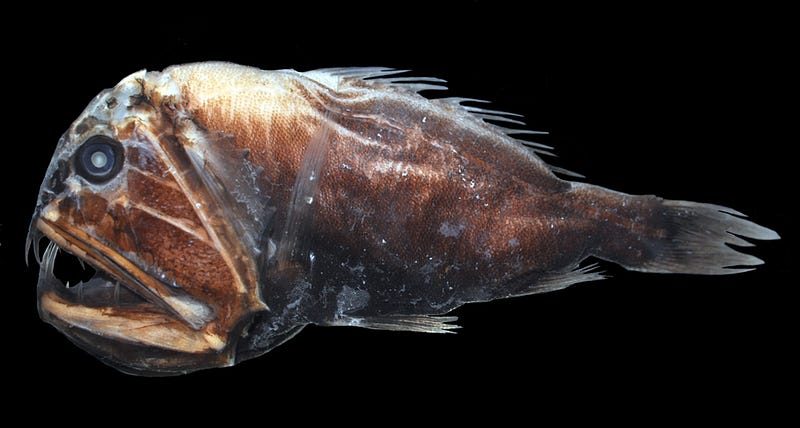
Anoplogaster cornuta — [Photo: © CitronCitron / CC BY-SA 3.0, vis Wikimedia Commons]

Deep-sea fish inhabit the darkest regions of the seas. They are found in parts of the oceans where sunlight no longer reaches. The zones where they are primarily found are called batial and abysal. The first of these, the batial or batial zone, covers waters from 1,000 to 4,000 meters below the surface. The abysal (or abyssal zone) is the depths from four to six kilometers below the water table.

At such great depths, conditions for life are very difficult. In addition to the lack of light, all marine animals must also cope with low temperatures, small amounts of oxygen and very high pressure. Pressure increases with depth by one atmosphere for every 10 meters. This means that five kilometers below the surface of the ocean, the organisms living there must withstand pressures 500 times greater than at the surface.

How have deep-sea fish adapted to living where the pressure is so high? One adaptation is the absence of a swim bladder — that is, a chamber (sometimes consisting of several parts) filled with gases. The swim bladder makes it easier for fish to submerge and surface, but it has secondarily disappeared in deep-sea fish.

Many changes have also occurred in their bodies at the molecular level. For example, they have chemical compounds in their cells that protect them from deformation under high pressure.

What do fish from the ocean floor feed on?

Kilometers below the surface of the water there is not only light, but also no plants. The fish living there have two choices when it comes to getting food. The first is to catch the remains of plants and animals, falling from higher layers of water. The second is predation.

Both ways require good orientation in the area. Therefore, many deep-sea fish have developed various types of light organs (or photophores). These help attract and then capture prey. For example, matron fish, which live at a depth of four kilometers, have a luminous antenna (illicium) on their head that looks like a fishing rod. In fact, these are specially transformed dorsal fins. At depth, they act as a decoy.
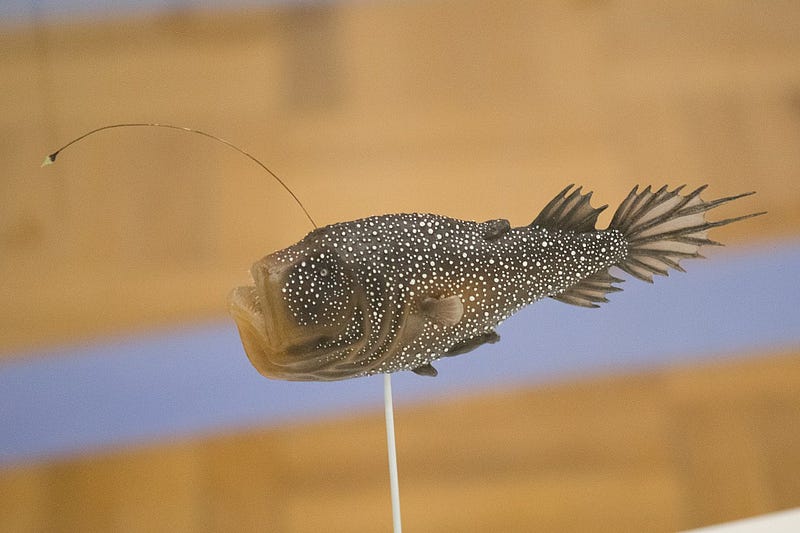
[Photo: Thomas Quine, CC BY 2.0, via Wikimedia Commons]

Many organisms living in the deep have the ability to bioluminescence — that is, to glow. Catching even the faintest source of light can be crucial for a fish. That’s why some species of deep-sea fish often have huge eyes. They allow them to perceive even the faintest light stimuli.
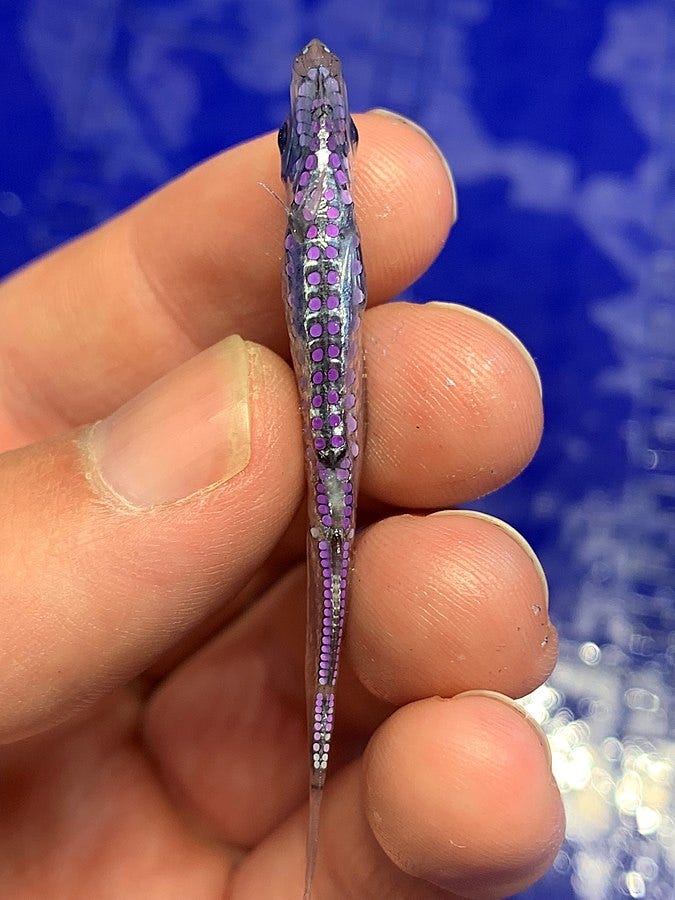
[Photo: HulloThere, CC BY-SA 4.0, via Wikimedia Commons]

Some of the largest eyes are those of Xiphias gladius, which lives at the edge of deep water, that is, 900–1000 m below the surface. The diameter of the eyes of this fish is 9 cm, which is about 3 percent of the body length (3 m). Interestingly, swordfish have special organs for raising the temperature of the eyeballs, which significantly improves the ability to see, and thus the effectiveness of hunting.
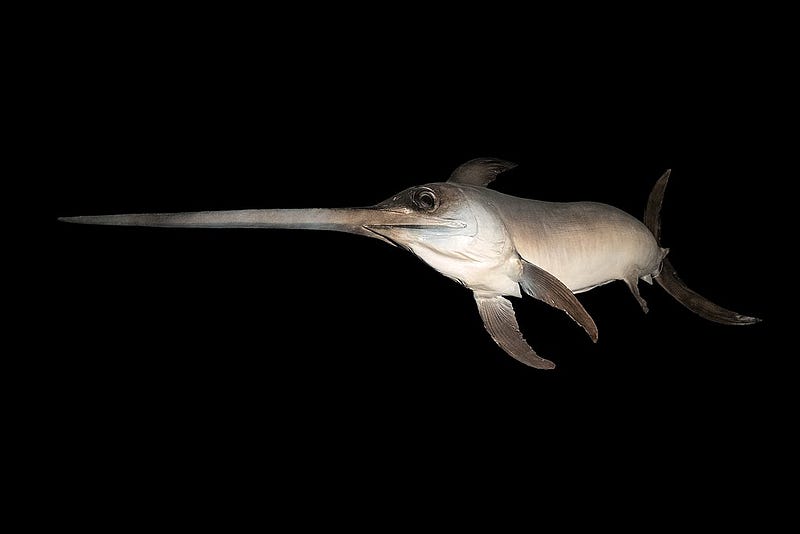
Xiphias gladius — [Photo; Naturalis Biodiversity Center, CC0, via Wikimedia Commons]

Other species of deep-sea fish

Many deep-sea fish have an uncanny appearance. Some can directly resemble monsters. For example, fish from the family Eurypharynx pelecanoides are quite impressive. These fish have huge jaws and a huge throat that looks like a skin sack in pelicans. The rest of their body is reduced, making swallows look like floating heads propelled by a thin tail.
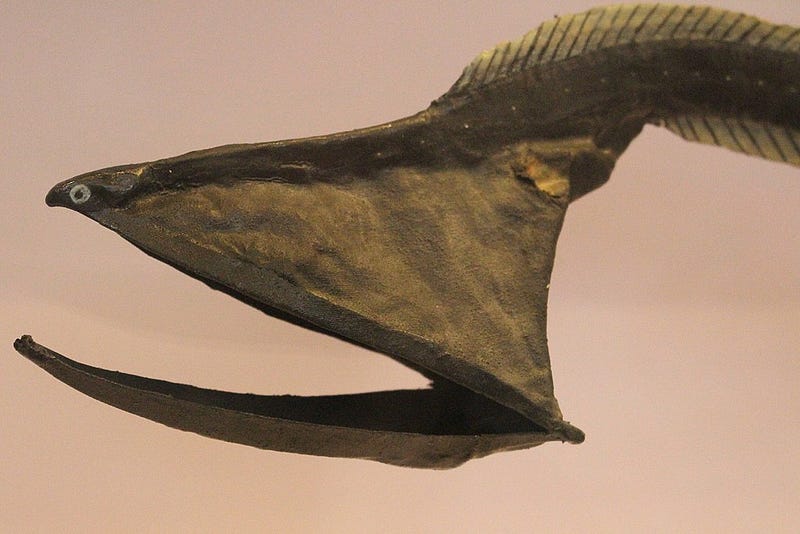
Eurypharynx pelecanoides — [Photo: Emőke Dénes, CC BY-SA 4.0, via Wikimedia Commons]

The fish of the Melanocetus johnsonii species also have a huge sack under their throat. They live at a depth of one and a half to two kilometers, where sunlight no longer reaches. So these fish attract prey using bioluminescence. They have such an extensible stomach that they are able to swallow prey weighing more than themselves.
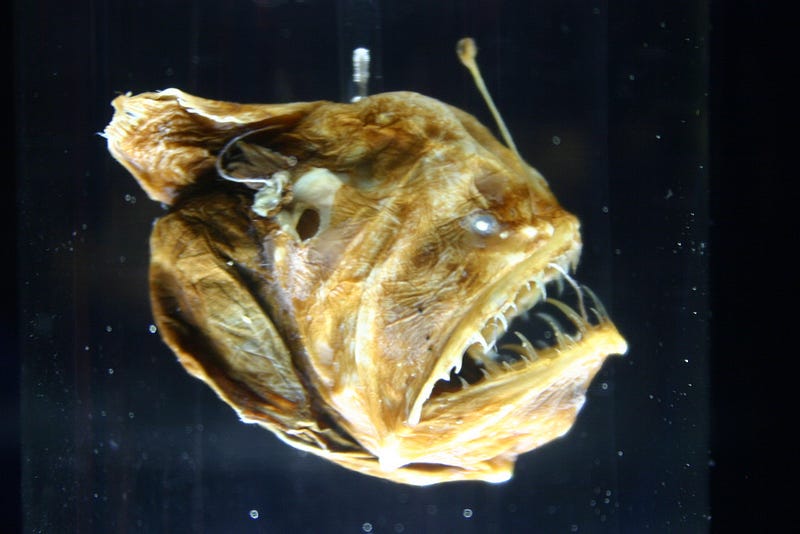
Melanocetus johnsonii — [Photo: Ryan Somma, CC BY 2.0, via Wikimedia Commons]

Chauliodus sloani can also be frightened. It has a very long body ending in a large head with huge teeth. Thanks to a light organ, this fish lures prey into its wide-open mouth, which it then closes like a trap.
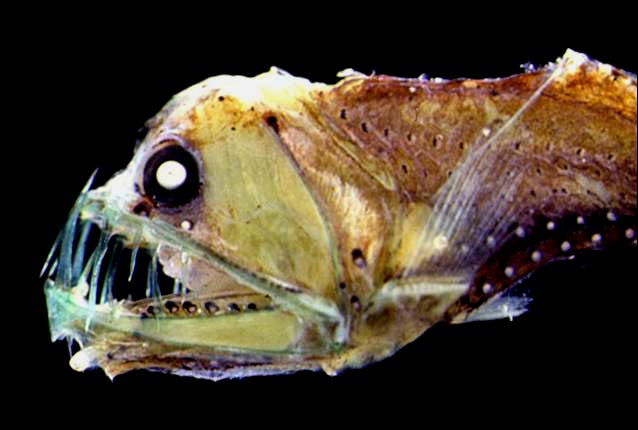
Chauliodus sloani — [Photo; This file is licensed under the Creative Commons Attribution-Share Alike 3.0 Unported license, via Wikimedia Commons]

The strangest fish of the deep

One of the most famous deep-sea fish is Psychrolutes marcidus. This name is unlikely to tell anyone anything, but already the English blobfish — perhaps so. The blob fish lives at a depth of about one kilometer. However, when it is brought to the surface, its gelatinous body swells and spills, giving it a strange appearance. To people who easily succumb to pareidolia — that is, seeing familiar things in different shapes — the blob fish begins to resemble a swollen, sagging face.
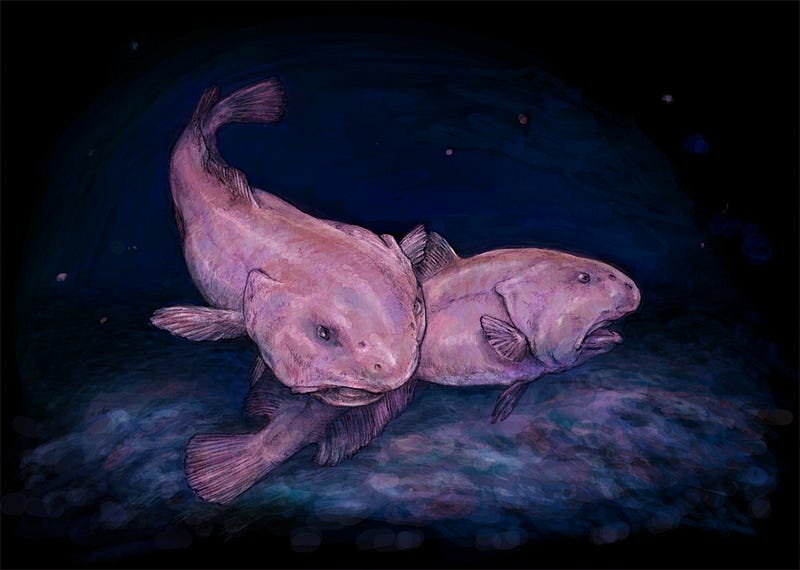
[Photo: Rachel Caauwe, CC BY-SA 3.0, via Wikimedia Commons]

On the other hand, Albatrossia pectoralis, one of the most common deep-sea fish, consists of an ominous-looking head with a large snout and a long fleshy tail. It is found at depths ranging from several hundred to 3.5 kilometers. It can be up to two meters in length. It is estimated that these fish make up as much as 15 percent of the entire population of deep-sea fish.
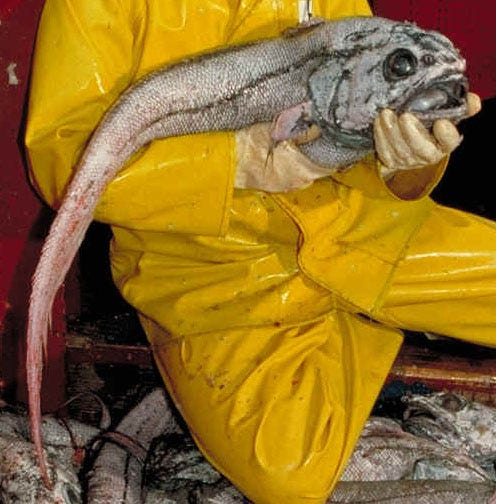
Albatrossia pectoralis — [Photo: This image is in the public domain because it contains materials that originally came from the U.S. National Oceanic and Atmospheric Administration]

Iconic deep-sea fish are also representatives of the genus Anoplogaster. We know of two species of these undersized fish that have been found as far as five kilometers below the surface. They have disproportionately large teeth and twisted mouths, which gives them an unpleasant, off-putting appearance. However, they are completely harmless to humans.
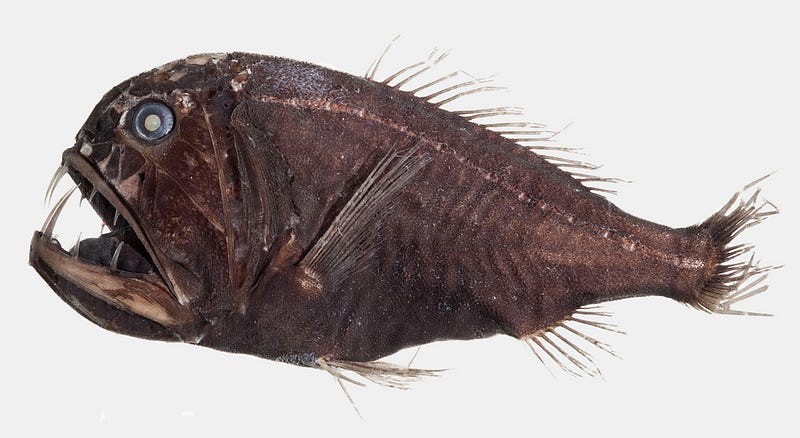
[Photo: Sandra Raredon/Smithsonian Institution, Public domain, via Wikimedia Commons]

The same can be said of the extremely rare shark Mitsukurina owstoni. This shark, although it looks ominous, feeds on cephalopods, crustaceans and fish. It has protruding jaws (so this shark may have inspired the authors of “Alien”) and a distinctive long beak. The fish feeds at several hundred meters — the deepest place from which it was fished was 1,300 meters below the surface.
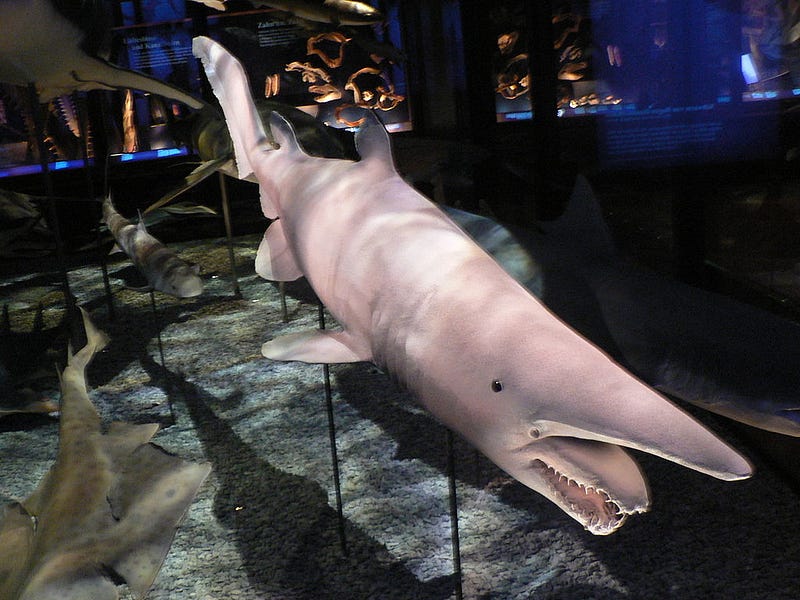
Mitsukurina owstoni — [Photo; This file is licensed under the Creative Commons Attribution-Share Alike 2.5 Generic, 2.0 Generic and 1.0 Generic license, via Wikimedia Commons]

What lives at the bottom of the ocean?

What fish live at the greatest depth? Just last month, scientists picked out a new record holder. This was achieved by a Japanese-Australian scientific expedition studying the Izu-Ogasawara Trench, which is up to 10 km deep.

At a depth of 8336 m below the surface, a fish belonging to Pseudoliparis, a genus of demersal fish living in the greatest depths of the Pacific Ocean, was recorded.
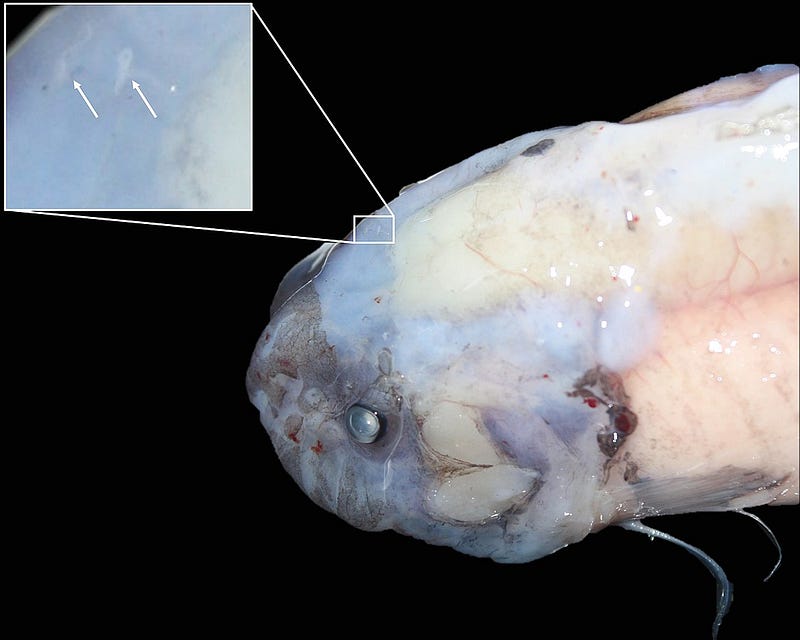
Pseudoliparis — [Photo: Gerringer, M.E., Linley, T.D., Jamieson, A.J., Goetze, E. & Drazen, J.C. 2017. Pseudoliparis swirei sp. nov.: A newly-discovered hadal snailfish (Scorpaeniformes: Liparidae) from the Mariana Trench. Zootaxa 4358(1): 161–177, CC BY 3.0, via Wikimedia Commons]

According to the researchers, “there is a certain limit below which no fish could live anymore. It amounts to about 8400 meters. Below it, cellular biochemical processes that protect deep-sea fish cells from high pressure cease to function”.

Cool that you made it to the end of this article. I will be very pleased if you appreciate the effort of creating it and leave some claps here, or maybe even start following me. It would be nice if you also left a tip! Thank you!

Science
Nature
Animals
Life
Sea
Recommended from ReadMedium