
Empathy: The Secret Weapon for Creating a Thriving Brand
People love to talk about the power of empathy and list all the reasons this skill is a powerful asset to cultivate. First, however, you must be given concrete steps to practice empathy and unlock its incredible power.
Today, we are teaching you a simple way to practice empathy within your organization—no more abstract concepts. Let’s talk about how you can make empathy your brand’s secret weapon to thrive.
An Empathy Map helps you create a shared understanding of needs by discussing what you know to be true about the experience.
Envisioning user perspectives and behaviours in an empathy map allows your team to align on an in-depth understanding of end users and make informed decisions about enhancing their experience with your brand. This interactive, collaborative group activity will help reveal gaps in your knowledge and align on finding the answers.
“We all carry our experiences, understanding, and expertise with us. Your assumptions may be misconceptions and stereotypes and can restrict the amount of real empathy you can build.”- Scott Doorley, Sarah Holcomb, Perry Klebahn, Kathryn Segovia and Jermey Utley
Practical Benefits of Empathy
Establishing empathy with users is the design thinking framework’s first and arguably most crucial stage. An Empathy Map is the perfect place to start, especially if you are new to design. An empathy map is a visual tool that helps teams identify and reflect on a user’s behaviours and attitudes.
By thinking about your users as real people with goals, needs, and desires, you can:
- Identify improvement opportunities for your product or service.
- Access user experience enhancements.
- Create new features to meet user needs.
The Risk of Skipping Empathy: A Personal Design Story
When I worked at one of the leading telecommunications providers in Canada — we were redesigning the “renew your phone contract” experience. We assumed the most important part of the journey was when a customer got their renewal offer — a heavily discounted flashy new phone (in exchange for signing up for another two years). We poured our time, money, resources, etc., into designing a cutting-edge recommendation engine (using predictive analytics when it was still a newer concept) and a beautifully updated version of the email they would receive with the offer.
After spending time with our customers, we soon realized the offer letter was not the “magic moment”; getting their new phone in their hand was the most satisfying part of the journey — and unfortunately, we overlooked the part of the process. This insight allowed us to pivot quickly, but an empathy map and some team alignment would have helped us move faster and likely get it right the first time.
Leverage Empathy Mapping to Design Better Solutions.
Since a designer and end-user have different perspectives, it is hard to answer such pressing questions as:
- What is missing from a product or service experience?
- How do you feel about our offerings compared to the competition?
- Where are their pain points throughout their journey?
These questions do not have quick answers — a project team alone should not assume the responses. Furthermore, without an empathy map, you risk bias.
“By challenging our biases & assumptions, we discover solutions that are not initially obvious.” - Andrew Edwards, designACE
Empathy Framework
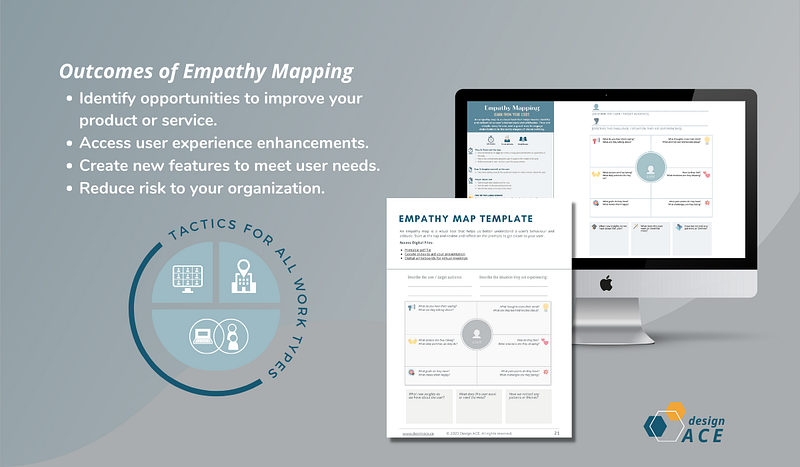
The Empathy Mapping framework is simple and easy to facilitate. It focuses on 4 key quadrants that help design teams walk a mile in their user’s shoes. A couple of ways to use an Empathy Map
- Team alignment tool.
- Interview guide.
- Document your research observations.
- Framework for organizing insight.
- Analyze a user’s experiences.
Follow us on Instagram for simple tips on applying empathy to improve your teams, products, and services.
Empathy Map 4X4 Quadrants Explained
The Empathy Map Template is a tool to uncover user needs and understand what motivates people to act or behave a certain way. Below are explanations of questions you can use when completing an Empathy Map.
What does the user hear or say?
For example:
The customer sees the products advertised in stores.
The user told their friend the product was too expensive.
What does the user think?
For example:
The user is excited about the new feature.
The customer is worried about how long the wait time is.
What are they doing?
For example:
The user looks online to compare prices.
The user stopped using the product because it was too difficult to use.
How does the user feel during the experience?
For example:
They feel anxious about all the choices.
The user is proud of their purchase.
Want to facilitate an Empathy Workshop like a pro?
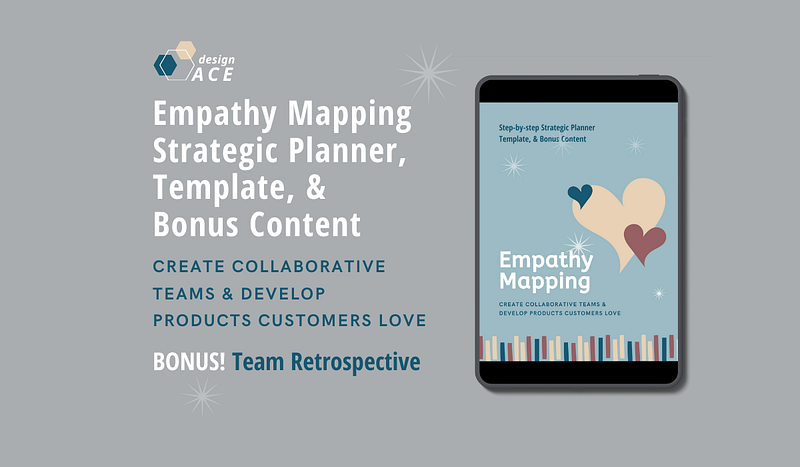
Are you a busy professional trying to develop products and services customers love? We have you covered! This Empathy Mapping Strategic Planner guide has everything you need to take a more thoughtful approach to understanding user behaviour, creating collaborative teams, and developing experiences customers love.
Innovation is all about solving problems for people — understanding their needs and designing something that makes it easy to accomplish their goals. When we can experience users’ struggles firsthand, feel their frustration, and hear their words, we can’t help but empathize.
When we empathize, we can better envision the future, strengthen user interactions, and prioritize the right features to support the vision.
This guide is your “meeting in a box” so you can facilitate like a pro:
✔️ Workshop Outline & Scripts ✔️ Warm-up Activity Templates ✔️ Agendas & Meeting Invites ✔️ Step-by-step facilitation instructions ✔️ High-quality, printable templates ✔️ Engaging slides ✔️ Ready to use, digital whiteboards ✔️ Pro facilitation tips and tricks ✔️ Provoking thought starter and discussion questions
Get your copy of our Empathy Mapping Strategic Guide from our Etsy Store
Are you on Pinterest and want to collaborate on our productivity board? Connect on Pinterest #NewWaysOfWorking
If you like the article and would like to support us, make sure to:
- 👏 Clap for the story (50 claps) if you’d like to help this to be featured
- 🔔 Follow us on Medium
- 📖 Subscribe to our newsletter for our latest posts: Subscribe now
- 🔗 Become a medium member
- 📰 View more content on my Medium
- 🔔 Follow us on LinkedIn | Instagram | YouTube | Pinterest
- 🛒 our shops Etsy | Amazon
Originally published at https://www.designace.ca on September 19, 2023.
This article has affiliate links for Canva, a daily product Andrew & Christine use.


