
Emic
How do you see the elephant in the room?

Today’s New York Times Spelling Bee letters:
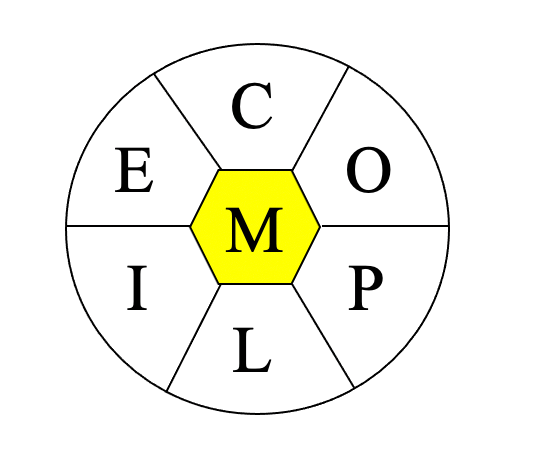
C, E, I, L, P, O, and center M (all words must include M)
Merriam-Webster says…
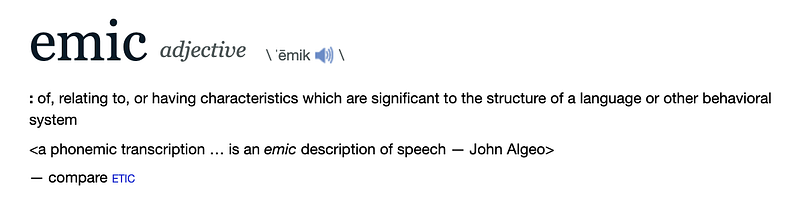
Silly little dictionary! Don’t you know emic can’t possibly be a word if the New York Times says it ain’t?
For further fascinating facts, check out the Spelling Bee Master.
What’s your favorite dord* from today’s puzzle?
My Two Cents
One of the things I enjoy most about writing this column (which I try to do on a daily basis, September–December 2021 notwithstanding) is that I learn something new every time. And relearn a lot of stuff, too. There are times when the two situations combine to create a perfect storm of education: I learn something new about something I already knew.
Today is a great example of that. Have you heard about the story of the four blind men and the elephant? Perhaps you know it as the quartet of visually- impaired people and the pachyderm. In any case, did you know that fable is very much meta? And by meta I mean “showing or suggesting an explicit awareness of itself, or cleverly self-referential”.
Me, myself, and I
Our friends at Merriam-Webster explain that the term emic comes from the suffix of the word phonemic, and suggest we compare it to the word etic. So I’ll oblige and click:
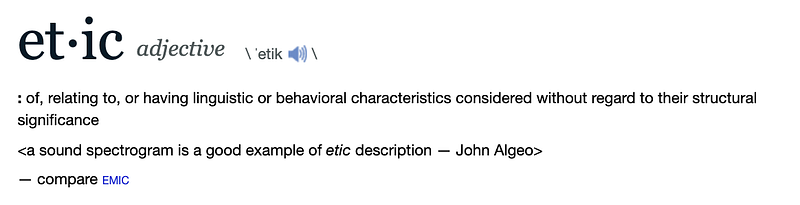
If you click fast enough between the two words, they mix together to form the word emetic, which means “an agent that induces vomiting”, like the action of clicking incessantly back and forth between two dictionary entries.
Turns out etic also originated from a suffix: phonetic.
Unsurprising conclusion: emic and etic are intimately related to each other and to linguistics. Phonemic speech is what you and I picture when we think of the sounds, or phonemes we make while speaking. This is what children are taught in school when learning which letters represent sounds.
Phonetic transcription directly specifies to how words of a certain language are pronounced to those people who do not speak the language. In many languages ––and English is one of them–– ordinary spelling of words doesn’t reliably reflect the actual pronunciation of said words. Because of that, a system known as the The International Phonetic Alphabet (IPA) was developed, as a standardized representation of speech sounds in written form. Here is the very intimidating chart created for that purpose:
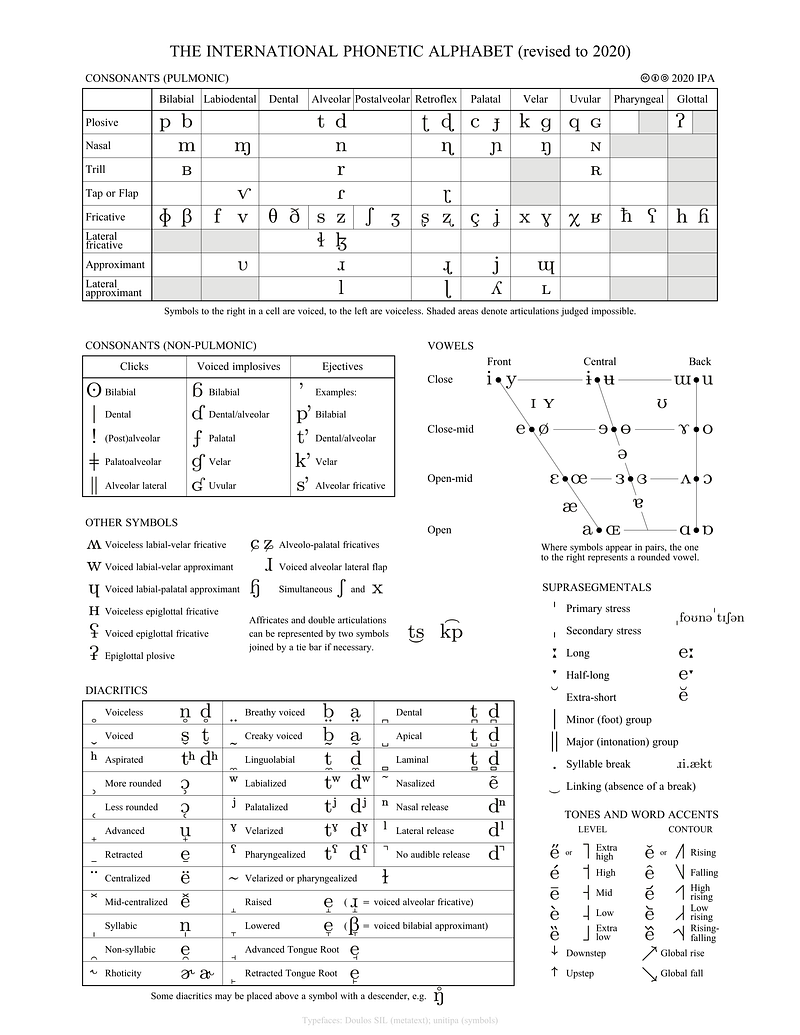
As an example, here is a phonemic transcription followed by a phonetic one of the word establishment:
/e/ /s/ /t/ /a/ /b/ /l/ /i/ /sh/ /m/ /e/ /n/ /t/
ɪˈstæblɪʃmənt
Quite the difference, huh?
The first known use of the linguistically-derived terms emic and etic was recorded in 1954, when coined by Kenneth Pike. Pike was an American linguist and anthropologist who invented a language ––Kalaba X–– for the sole purpose of helping with translation techniques. Pike died on December 31st, 2000, leaving us with the eternal debate about whether or not he lived in the 21st century.
According to Pike:
“Emic” (as in “phonemics”) refers to the role of cultural and linguistic categories as understood from within the cultural or linguistic system that they are a part of, while “etic” (as in phonetics”) refers to the analytical study of those sounds grounded outside of the system itself.
Pike’s main thesis was that only native speakers could naturally determine emic descriptions, thus playing a key role in providing data for linguistic research. Meanwhile, the researchers themselves (from outside the linguistic group) applied scientific methods in the analysis of language, producing etic descriptions that could be verified and reproduced.
Pike became known for his his “monolingual demonstrations”. He would appear before an audience, along with several chalkboards. A speaker of a language unknown to Pike would be brought up. Using gestures and objects, and not asking questions in a language that the person might know, Pike would analyze the language right there before the audience.
I couldn’t find a video of Pike himself doing it, but I did find one from the Linguistic Society of America featuring Daniel Everett. It’s rather long, but check it out.
An elephant walks into a bar…
The story of the blind men and an elephant originated in the ancient Indian subcontinent centuries ago. It is now a well-known parable still taught in elementary schools across the world. The original plot involved a group of blind men who come across an elephant, which until that moment was an unknown animal to them. As each blind man feels a different part of the elephant’s body, such as the leg or the tusk, they describe the creature based on that limited experience. Of course, their descriptions of the elephant vary greatly amongst them. The moral of this story is that humans have a tendency to claim absolute truth based on their limited, subjective experience while ignoring other people’s limited, subjective experiences… which may be equally true.
Following is a condensed version of the tale; you can read more complete one here.
A group of blind men heard that a strange animal, called an elephant, had been brought to the town, but none of them were aware of its shape and form. Out of curiosity, they said: “We must inspect and know it by touch, of which we are capable”. So, they sought it out, and when they found it they groped about it. The first person, whose hand landed on the trunk, said, “This being is like a thick snake”. For another one whose hand reached its ear, it seemed like a kind of fan. As for another person, whose hand was upon its leg, said, the elephant is a pillar like a tree-trunk. The blind man who placed his hand upon its side said the elephant, “is a wall”. Another who felt its tail, described it as a rope. The last felt its tusk, stating the elephant is that which is hard, smooth and like a spear.
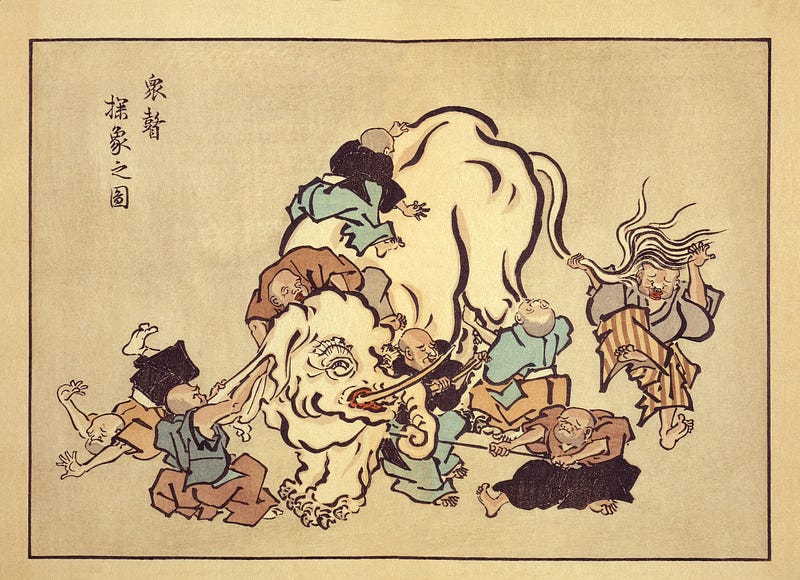
This story is seen as a metaphor in many disciplines. In quantum mechanics, it’s served as an analogy for the wave–particle duality. In biology, the way the blind men hold onto different parts of the elephant has been seen as a good analogy for the polyclonal B cell response.
Here’s where things get interesting, though. The fable can also cast light on the response of listeners or readers to the plot itself. In other words, just like the blind men’s multiple interpretations of the elephant, readers will also see different things reflected in the moral of this story.
Meta. “The blind men and the elephant” is meta!
Indian author and Sufi teacher Idries Shah has commented on this element of self-reference in the many interpretations of the tale, and its function as a teaching story:
…people address themselves to this story in one or more […] interpretations. They then accept or reject them. Now they can feel happy; they have arrived at an opinion about the matter. According to their conditioning they produce the answer. Now look at their answers. Some will say that this is a fascinating and touching allegory of the presence of God. Others will say that it is showing people how stupid mankind can be. Some say it is anti-scholastic. Others that it is just a tale copied by Rumi from Sanai — and so on.
What’s your take on this ancient fable? What conclusions or meaning do you derive from it, my dear readers?
After reading today’s column, one could not be faulted for thinking emic is a word. Yet, in a move we can describe only as etic, the editors of the Spelling Bee decided that emic is a dord*.
You can check out my previous entry on another dord* here:
*What the heck is a dord, you ask? Here’s the answer: