
Elvis Presley’s seriously underrated rhythm guitar chops
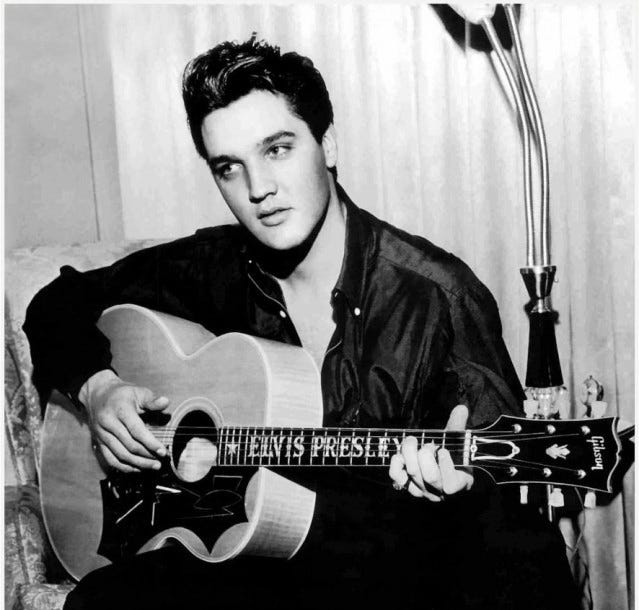
Did you know that Elvis Presley possessed genuine rhythm guitar chops? According to contemporary Johnny Cash’s 1997 autobiography entitled Cash, the “I Walk the Line” balladeer concurred, considering Presley’s skills as a rhythm guitarist to be significantly underrated. Having first encountered Presley on Sept. 9, 1954 playing an acoustic Martin guitar during the special grand opening of Katz’s Drug Store in Memphis, Cash next caught him wowing the spectators at the intimate Eagle’s Nest nightclub.
“The thing I really noticed that night, though, was his guitar playing,” recalled Cash. “Elvis was a fabulous rhythm player. He’d start into ‘That’s All Right, Mama’ with his own guitar alone, and you didn’t want to hear anything else. I didn’t anyway. I was disappointed when Scotty Moore and Bill Black jumped in and covered him up. Not that Scotty and Bill weren’t perfect for him — the way he sounded with them that night was what I think of as seminal Presley, the sound I missed through all the years after he became so popular and made records full of orchestration and overproduction. I loved that clean, simple combination of Scotty, Bill, and Elvis with his acoustic guitar. You know, I’ve never heard or read anyone else praising Elvis as a rhythm guitar player, and after the Sun days I never heard his own guitar on his records.”
Don’t believe the Man in Black? Then check out Presley’s historic early recordings with producer Sam Phillips at Sun Records in Memphis like “That’s All Right,” “Mystery Train,” and “Baby Let’s Play House”, the 1960 sessions at RCA Studio B in Nashville that firmly re-established the artist as a contemporary force after his Army sojourn [e.g. “Reconsider Baby,” “I Will Be Home Again”], or the ’68 Comeback Special NBC television broadcast.
On the 1954–1955 Sun recordings, it’s just Presley on vocals and rhythm acoustic guitar, Moore on lead electric guitar, and Black on doghouse bass. There was no drummer present for ninety percent of the recordings, so Presley’s acoustic guitar was crucial in anchoring the rhythm section. Anytime you are trying to pick Presley out in the mix, listen for the tell tale strumming in E on the low bass strings and sneaky accentuated licks that permeate cuts like “One Night,” “Just Call Me Lonesome,” and “Funny How Time Slips Away.” Thanks to FECC’s “ElvisAliSellers” for the sharp analysis of Presley’s fretboard attributes.
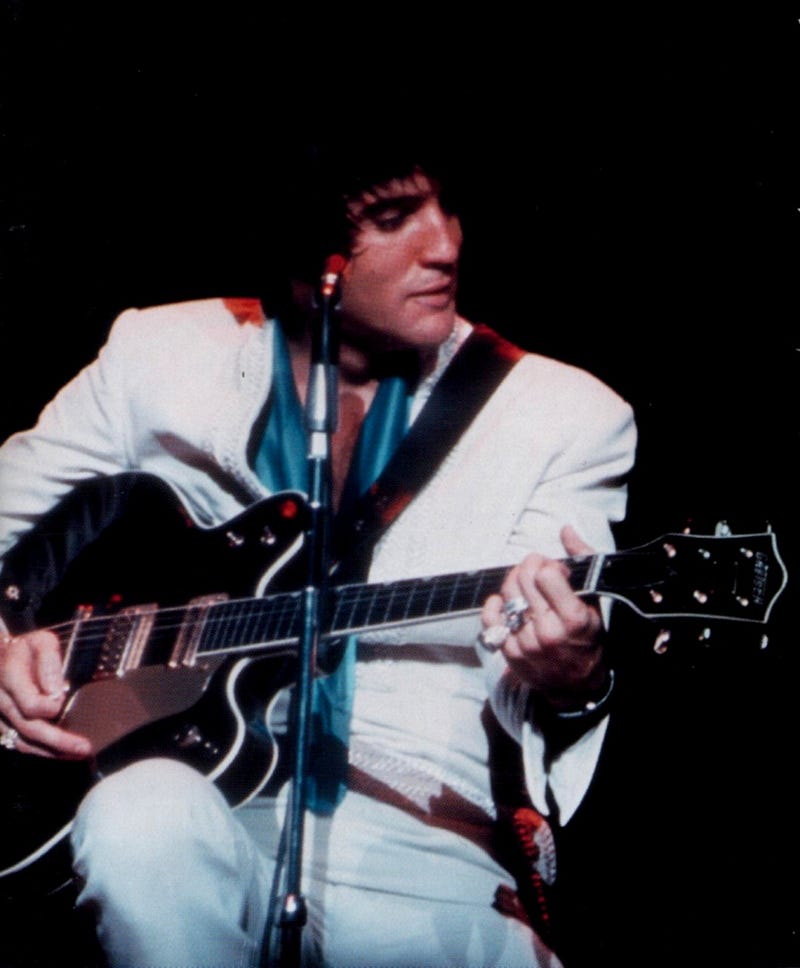
On the cover of the terrific Suspicious Minds: The Memphis 1969 Anthology, Presley can be seen sitting onstage during his celebrated August 1969 return to live performing at the Las Vegas International, renamed the Hilton several years later. The former box office champ is playing his Gretsch Country Gentleman electric guitar — he played it repeatedly during the That’s the Way It Is documentary — which continued to pop up during short unplugged segments usually comprised of the singer’s early hits through 1971. Three songs recorded during the Memphis sessions with plenty of Presley’s rhythm guitar are “Stranger in My Hometown,” “If I’m a Fool for Loving You,” and “True Love Travels on a Gravel Road.”
Don’t waste your time analyzing the overwhelming majority of the ’60s movie travelogues or later ’70s concerts like Aloha from Hawaii which obfuscate Presley’s musical abilities and lend credence to the widely held belief that his guitar served as an unnecessary prop. The superstar didn’t help matters when he occasionally ad-libbed to his loyal audiences, “I only know three chords.”
In the unplugged video segment accompanying this article, Presley sits in the boxing ring and takes over Moore’s 1963 Gibson Super 400 guitar on the spur of the moment. If you wanna see the King of Rock ’n’ Roll attack an electric guitar with unmitigated passion, the ’68 Comeback Special is the ultimate way to go.
© Jeremy Roberts, 2015, 2016. All rights reserved. To touch base, email [email protected] and mention which story led you my way. I appreciate it sincerely.