
Eleven Members of a Family Commit Suicide For Apparently No Reason, But Why?
The reason is beyond your imagination

July 1, 2018, 7:30 AM. Gurcharan Singh, a resident of the Burari colony in New Delhi, the capital of India, was on his regular morning walk. His walking partner, Lalit Chundawat from the neighborhood, was not giving him company today.
Lalit, usually prompt, rarely missed his morning walk. And Lalit’s shop, which commenced business before 6 AM, was still not open.
Concerned, Gurcharan walked into Lalit’s residence. Little did he know that he was about to get the shock of his life.
The door of Lalit’s house was open. Gurcharan walked in. Inside, he found all 11 members of Lalit’s family hanging from the ceiling! Lalit’s mother, 80-year-old Narayani Devi, the only person not hanging, was dead on the floor.
Gurcharan ran away in disbelief, informed the police, and India soon woke up to a shocking incident: The Burari deaths.
Three generations under one roof
The Chundawat family was a typical Indian joint family. Three generations were living in one double-storied house.
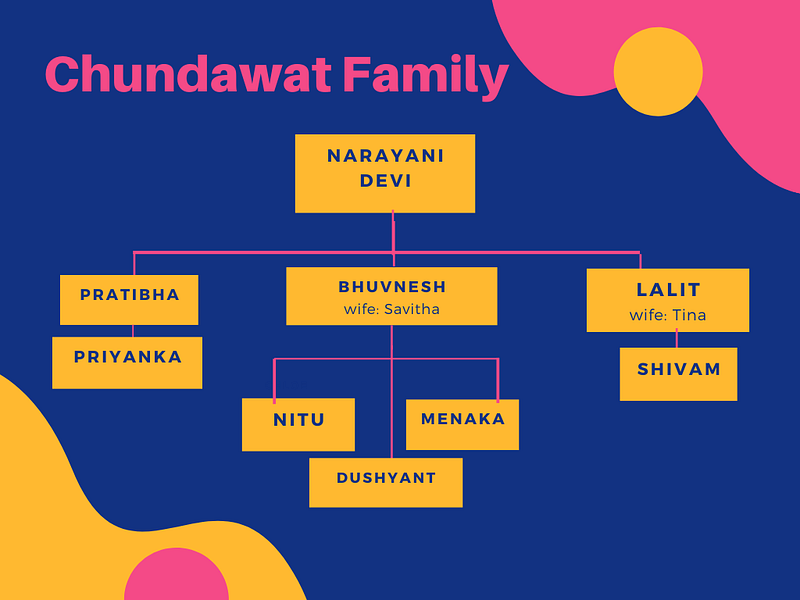
Narayani Devi, the 80-year-old woman, solely represented the first generation in the Chundawat family.
The two sons and one widowed daughter of Narayani Devi were the second generation, and yes, the wives of those sons too. So, this was Bhuvnesh(50), the elder son, Lalit(45), the younger son, and Pratibha Bhatia(57), the widowed daughter.
Bhuvnesh was married to Savita(48), and Lalit’s wife’s name was Tina(42).
Bhuvnesh had three children: two daughters- Nitu(25) and Menaka(23), along with a son, Dushyant(15)(aka Dhruv). Pratibha’s daughter was Priyanka(33).
Lalit had a son named Shivam(15).
On July 1, 2018, Gurcharan Singh couldn’t find a single one of them alive. From the 15-year-old Shivam to the 80-year-old Narayani Devi, everyone had perished.
The banyan tree deaths
It is not unheard of to have an entire family commit suicide. Very often, such mishaps spring out of financial crunch in third-world countries. But the Chundawat family was reasonably affluent.
A few weeks before, they had thrown an expensive party to celebrate the engagement of Priyanka, Pratibha’s daughter. The neighbors recollect that Chundawat was a friendly, cheerful, and religious group of people.
Why would they hang themselves? But wait, what if this was a murder?
And there was a strong reason to believe so since most of the deceased had their eyes blindfolded, hands tied using wires, mouths taped, and cotton plugging their ears.
All ten bodies were hanging from a mesh in their ceiling. A police officer, one among the first respondents to the news of this death, recollects that the bodies were hanging like roots of a banyan tree.
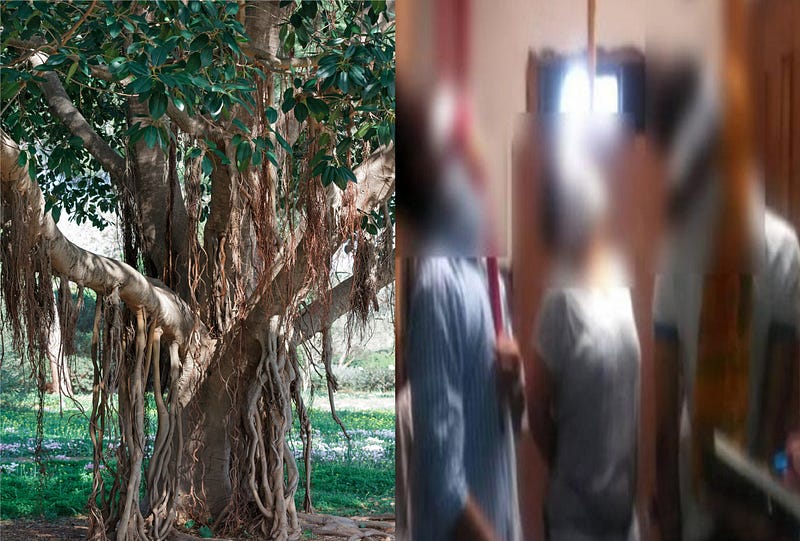
The only one person not hanging from the ceiling, Narayani Devi, had strangled marks on her neck.
So could this be murder?
The CCTV revelation
The investigative officers started working towards this case, keeping an angle of murder wide open. The CCTV visuals near their residence were checked to see if it showed the entry of a 12th person into their house.
Every frame of the CCTV visual was scrutinized, and they found a breakthrough. There was no intruder, but the visuals clearly showed the family members carrying new stools into the house, days before their death.

The police had recovered the same stools from the crime scene, 5 of them, probably shared by the ten dead people to pull off their act. Dhruv, and Shivam, were also found carrying wires- the same wires used to tie the hands of the dead ones.
This was definitely a planned act. The family, at least some of them, knew what they were going to do. But the question remains, why?
How can a family, dancing and joking a few weeks before, on the occasion of Priyanka’s engagement, descend into madness in the space of a few days?
The diaries
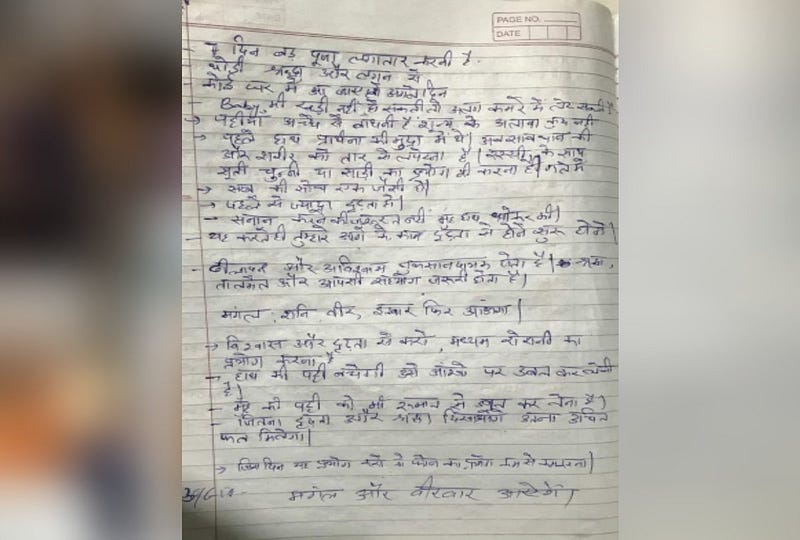
The investigative officers recovered multiple diaries from home. Diary notes started from as early as 2007, going all the way up to a day before the death. And these notes started narrating a tale.
Many of those diary entries were in the form of diktats as if an all-seeing eye was guiding the family on how they should behave. There were corrections, revisions, and suggestions meant for each family member. The members were supposed to abide by those instructions.
And most of the notes were written by Lalit, Narayani Devi’s youngest son. A handwriting analyst confirmed this.
Neighbors and relatives also recollect that Lalit was calling the shots in the family set up. Every other member of that family looked up to Lalit for instructions and guidance.
Children waited in line for Lalit’s approval to play with crackers. Lalit headed the party, and Lalit’s word was final and unchallenged.
The Chundawat family was a little Lalit cult.
Why would an entire family listen to the youngest of Narayani’s children?
Sure, Indian families are organized and the eldest member of the family commands respect from everyone else. The family looks up to the wise, the eldest person for guidance and leadership.
In that case, the 80-year-old Narayani Devi should have been the spiritual leader of this family, not Lalit, the 45-year-old.
Then, why?
Lalit- the eldest
Bhopal Das was the husband of Narayani Devi. He was the leader of the Chundawat family until he passed away in 2007.
After his death, the family started believing that Bhopal’s spirit possessed Lalit. People trusted that everything Lalit said was the late Bhopal’s words.
So, Lalit was not considered as the youngest son of Narayani; he was, in fact, Bhopal Das for the family members. Lalit’s diary entries were Bhopal’s instructions for the family.
Strange? One might wonder how an educated family with young people could believe this weirdness.
If you want to be a cult leader, there is invariably the need for a magic trick you need to perform and impress your followers.
What did Lalit do to gain the trust of his family members?
Lalit’s magic
It turns out Lalit had a few enemies in the past. Some of them, in an altercation, locked Lalit in a room and set it on fire. Lalit managed to save himself after struggling for several minutes. He made the grand escape but lost his voice in the process.
Or did he? Was the loss of voice a psychological effect of the trauma he underwent in the locked room?
It was about when Lalit started writing diary entries, and one of the entries recommended that the family members chant hymns for Lalit. This was supposed to heal Lalit’s condition. The family obliged.
After a year, one fine day, during the recital of hymns, Lalit was singing along with them. The diary entry had worked. Bhopal Singh’s advice through Lalit restored his voice.
This was the beginning of Lalit growing in stature.
Whether it was Lalit’s fancy or prudence, most of his advice started working for the family. They obeyed every word written in the diary, and there was economic prosperity for the family.
Lalit had now become the undeniable leader. And it continued till they were all dead.
The ritual
The last few entries of the diary show us what Lalit was up to. Lalit had planned an elaborate ritual, which was supposed to cleanse them of their sins and help attain salvation.
The crime scene was an exact replication of the last few diary entries. “Keep a bowl of water outside the room. When the color of the water changes, I shall appear,” said an entry, that promised Bhopal Das’ intervention.
The family members clearly did not expect themselves to die!
The ritual included hanging themselves blindfolded, trusting the powers of Bhopal Das. The spirit of Bhopal Das was supposed to come and save them!
So, this was never really a case of attempted suicide, but a case of shared delusion. None of them thought they would die, as it was written: “after the ritual, the members should help each other untie”.
No Bhopal Das came, and nobody was left to untie.
Were the educated members of the family, especially children, naive enough to believe this tale? Well, they believed and kept Lalit’s delusions as a secret for long, but hanging themselves to death? It is hard to imagine.
Perhaps that explains why the hands of the children were tied tight using wires. Maybe their resistance was overthrown. In a way, this was possibly a murder.
The diary entries had some leeway for Narayani Devi, who cannot climb on a stool. She was allowed to do it from the hook of her wardrobe.
Lalit and his wife Tina seemed to be the ones who did the ritual in the end, as they were not quite tied up.
The unending array of questions
Despite the overwhelming presence of diary notes, the ritual was a hard pill for many, especially the relatives. They knew the family was religious, not superstitious.
A day after the death, the media found 11 pipes on the walls of their residence. And they started making connections- some wondered if the pipes were meant for the 11 souls to escape.
Interestingly, 7 of those pipes were kept straight, while four were kept towards the downward direction. The Chundawat family had seven females and four males!
The relatives, friends, and neighbors are still in shock and say they had no clue whatsoever. Could a family have concealed the secret so well? Weren’t the children going to talk about it to some of their friends?
Why did Lalit’s diary notes-beneficial and non-harming for so long, suddenly take a fatal turn? Neighbors and friends recollect that Lalit had grown a little serious post-Priyanka’s engagement party.
Was he worried about one of their family members leaving the cult? Speculations would continue to arise, and this is a puzzle that can never be completely solved.
There are a few certainties here. Lalit’s diary notes exist. The ritual was planned. And many family members believed they were not going to die. The kitchen had items for the next day’s breakfast, as probably the women folk expected their life to go on as normal.
If you want more information on the incident, you can always google Burari deaths. But I’ve got to warn you, do not look at the face of those young children. It will haunt you.
They were ambitious, intelligent, and brimming with possibilities when Lalit made them walk into death.
Here are a few more interesting stories from India. Do check it out.


