
Elegit
Bad old-fashioned law
Today’s New York Times Spelling Bee letters:
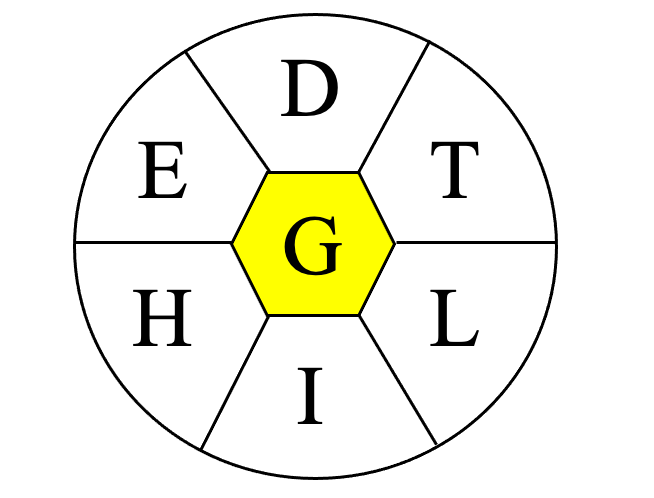
D, E, H, I, L, T, and center G (all words must include G)
Merriam-Webster says…
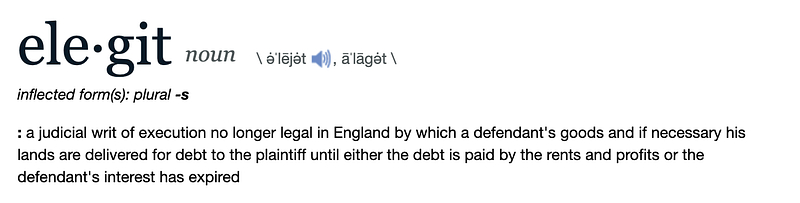
Silly little dictionary! Don’t you know that elegit can’t possibly be a word if The New York Times says it ain’t?
For a complete list of rejected words, check out the Spelling Bee Master.
What’s your favorite dord* from today’s puzzle?
My Two Cents
When I hear or read the words “England” and “sheriff”, two things always come to mind. The first is Disney’s eternally beloved 1973 animated version of the Robin Hood folk tale. The second is Alan Rickman’s memorable portrayal of the Sheriff of Nottingham in Robin Hood: Prince of Thieves, the eternally hated 1991 film also starring Kevin Costner, Morgan Freeman, and Mastrantonio. Rickman may have been the best thing the movie had to offer, and was accordingly given a well-deserved BAFTA (British Academy Film Awards) mask as Best Actor in a Supporting Role. He should have won the Oscar in the same category, but, criminally, he was not even nominated. (Jack Palance won for Cityslickers and proceeded to do a set of one-armed push-ups on stage.)
In 2015 an article in The Times, Rickman admitted he secretly requested that his lines as Sheriff of Nottingham be rewritten. A couple of scriptwriter friends, Ruby Wax and Peter Barnes, punched up the script when Rickman told them “Will you have a look at this script because it’s terrible, and I need some good lines.” Director Kevin Reynolds ended up including them in the film, to the delight of all the Hans Gruber and Professor Snape fans.
Disney’s Robin Hood remains my favorite Mickey Mouse studio movie to this day. It probably has a lot to do with the fact that I strongly identified with the portrayal of Robin as a small, skinny guy who relied on smarts and humor to outwit the baddies and endear himself to the ladies (or in this specific case, the Lady Marian)… much like I did for a good chunk of my life.
What does all this have to do with our daily word? Well, read on to find out.
Law & Order
Our friends at Merriam-Webster tell us that elegit comes from the Latin word meaning “he has chosen”, which is the perfect indicative singular of eligere (“to choose”). And the reason this judicial writ of execution was called that is because the plaintiff had chosen this way of settling the lawsuit.
There was not a lot of available information about elegits, but I did manage to find an article by Thomas Coleman in a 1929 issue of the West Virginia Law Review. In it, he explains this:
At common law it was not permissible to take the lands of a debtor for his debts, except to satisfy judgments due the King. The goods and chattels of the debtor and the annual profits of his lands as they arose were the only funds available for the payment of his debts. This continued to be the law until the statute of Westminster 2, 13 Edward I, Chapter 18, (A. D. 1285) which was in substance embodied in the 1 Revised Code of Virginia, Chapter 134, (1819). This important act provided a new form of execution known as the writ of elegit, by which a moiety of the lands of the judgment debtor, and all his goods and chattels, saving his oxen and beasts of the plow, might be taken by the sheriff and delivered to the creditor, and thereby the creditor became the absolute owner of the personal property, and was entitled to hold the moiety of the lands as his freehold until he should have levied thereof his debts and damages.
A few takeaways from the above explanation:
- First of all, it’s good to be the King.
- I had no idea what moiety meant, so I looked it up: “one of two equal portions” or “one of the portions into which something is divided”.
- A statute established in 13th-century England was not only adopted by the American Colonies, but was still around in at least one state (Virginia) four decades after the independence was declared in 1776.
I have no idea when elegits stopped being enforced in the United States, but according to Wikipedia, in Britain they were abolished on January 1, 1957, by the Administration of Justice Act 1956. There is no reference provided, however, so take that information with a grain of salt.
Now, I know many of my five regular readers may not find all this legalese interesting, so here is something tangentially related to our dord*, but perhaps more entertaining.
Music & Lyrics
Gaspar Fernandes was a Portuguese-Mexican composer and organist in the late 16th and early 17th centuries. He spent time in what was back then Santiago de Guatemala (present-day Antigua) and Puebla de los Ángeles, New Spain (present-day Puebla, Mexico). It was not unusual for composers to sail across the pond in employment of the cathedrals in the cities or towns under Spain and Portugal’s control.
According to an online piece by Bernard Gordillo, Fernandes “motet Elegit eum Dominus (The Lord Chose Him) is the earliest known work in Latin written by a Spanish colonial composer.” A motet, it turns out, is “a polyphonic choral musical composition of a kind originated in the 13th century, based on a sacred Latin text, designed for church performance, and usually sung unaccompanied.”
Here is one version of Elegit eum Dominus for you to enjoy. And if you understand Spanish, you’ll get some extra information about the composition.
This piece was one of six composed by Fernandes for the arrival of the Don Diego Fernández de Córdoba to the City of Puebla. Fernández de Córdoba (no relation to Gaspar) was Viceroy of Mexico between 1612 and 1621, and Viceroy of Peru from 1622 to January of 1629.
Although Gaspar Fernandes composed most of his works on Spanish, he also wrote some in Portuguese and even in Nahuatl, an indigenous language of what is now Central Mexico.
Now you know. If you’re ever in serious debt that can’t be forgiven by presidential decree, you could negotiate with your creditor and ask them if they’d accept a writ of elegit as a payment. Don’t be surprise if they laugh in your face, however. Not because this legal instrument is no longer valid… but because the editors of the Spelling Bee decided that elegit is a dord*.
You can check out my previous entry on another dord* here:
*What the heck is a dord, you ask? Here’s the answer: