
Electric Vehicles Have Almost 80% More Problems than Gas-Powered Ones, a New Report Says — CBS
Navigating the Electric Vehicle Reliability Challenge — Insights from Consumer Reports
How to Get Rich with Investing (without Getting Lucky)
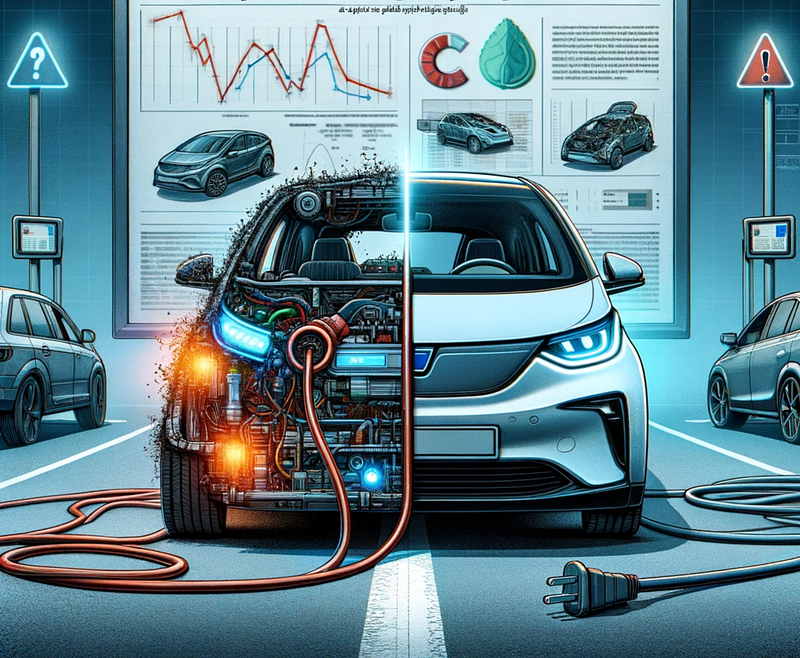
A recent report from Consumer Reports reveals a significant disparity in the reliability of electric vehicles (EVs) compared to their gasoline-powered counterparts.
The findings indicate that electric vehicles experience nearly 80% more problems, with plug-in hybrid electric vehicles (PHEVs) faring even worse, encountering almost 150% more issues than traditional cars.
This revelation comes amidst increased consumer incentives for EV adoption, such as federal tax credits.
The Electric Vehicle Reliability Gap
The Consumer Reports survey, which encompassed data on more than 330,000 vehicles from 2000 to 2023, including some 2024 models, reveals a significant reliability gap between EVs and traditional gasoline vehicles.
EV owners primarily reported issues with battery systems and charging mechanisms, alongside inconsistencies in body panel and interior part fittings.
Also, to read:
Plug-in hybrid electric vehicles (PHEVs) fare even worse, with almost 150% more problems reported.
This higher incidence of issues in PHEVs can be attributed to their dual-engine system, which combines traditional combustion engines with electric drives, adding layers of complexity and potential for faults.
Offering a glimmer of hope, standard hybrid vehicles are noted to have around 25% fewer problems than their gas-powered equivalents, marking them as a more reliable bridge technology in the transition to full electrification.
Fuelling Adoption Hesitancy
Despite attractive incentives like a federal tax credit of up to $7,500 for purchasing an EV, consumers have been slow to adapt, primarily due to concerns over maintenance costs and the need for additional equipment like home electric charging ports.
The report’s findings on reliability are likely to add to the apprehension, joining other concerns such as the scarcity of charging stations and prolonged charging times.
Jake Fisher, Senior Director of Auto Testing at Consumer Reports, interprets these challenges as part of the evolutionary journey of any new technology.
He suggests that the industry is in the phase of ironing out the technical kinks that come with novel advancements.
Bright Spots Amidst Challenges
Despite the general trend, some PHEVs like the Toyota RAV4 Prime and Kia Sportage have shown resilience, scoring above average in reliability. The BMW X5, Hyundai Tucson, and Ford Escape PHEVs also achieved commendable average reliability scores.
The report identifies compact cars as the most reliable market segment, followed by sportscars, small pickups, and midsize to large cars. Toyota’s 4Runner stands out as the top-ranked model for reliability.
Top Ten for Reliability: Lexus leads the pack, followed closely by Toyota and Mini. The list also includes Acura, Honda, Subaru, Mazda, Porsche, BMW, and Kia.
Brands Facing Reliability Issues: At the lower end of the spectrum are Jeep, Volkswagen, Rivian, Mercedes-Benz, and Chrysler, pointing towards areas for potential improvement.
Conclusion
The Consumer Reports study serves as a critical benchmark in assessing the current state of EV and PHEV reliability.
As the automotive industry continues its inexorable shift towards electrification, these insights offer both consumers and manufacturers a valuable perspective on the challenges and opportunities that lie ahead.
The path towards a fully electric future is complex, but continued innovation and refinement in design and technology holds the promise of a more sustainable and efficient future in transportation.
Sincerely,
The Pareto Investor
My Book Free to Read: The Little Principle That Beats the Market