avatarYury Erofeev

Summary

In 2023, Germany's electricity production from renewable energy sources (RES) reached a record high, accounting for nearly 60% of the country's net generation, with wind and solar alone contributing about 44%.

Abstract

The German Institute for Solar Energy Systems (Fraunhofer ISE) reported that in 2023, Germany's electricity production from renewable sources set a new record, with RES accounting for 59.6% of the net electricity generation. This significant shift towards renewables was driven by a substantial increase in wind and solar power, which together made up approximately 44% of the net generation. The data, which excludes the consumption of solar energy by prosumers, underscores the viability of a reliable energy supply from variable renewable energy sources in large energy systems. Coal-fired electricity generation fell to levels not seen since the late 1950s and early 1960s, despite the closure of nuclear power plants. Although gas power plant output remained stable compared to 2022, Germany became a net importer of electricity for the first time since 2002, largely due to lower electricity prices in neighboring countries during the summer. The average wholesale electricity price in 2023 was 92.2 euros per megawatt-hour, a significant decrease from the previous year.

Opinions

  • The report from Fraunhofer ISE suggests that a high share of variable renewable energy sources can ensure a reliable energy supply in large energy systems.
  • The decrease in coal-fired electricity generation, despite the closure of nuclear power plants, indicates a successful transition towards renewable energy sources in Germany.
  • Germany's status as a net importer of electricity in 2023, after being an exporter for many years, reflects the changing dynamics of the European energy market.
  • The lower average wholesale electricity price in 2023 compared to 2022 is seen as a positive development for the economy and consumers, potentially indicating a stabilization of energy markets after the volatility of the previous year.

Electric power industry in Germany: results for 2023

Photo by Leon Seibert on Unsplash

The German Institute for Solar Energy Systems (Fraunhofer ISE) traditionally publishes detailed information at the beginning of the year on Germany’s electricity production in the past year. Access the full report here.
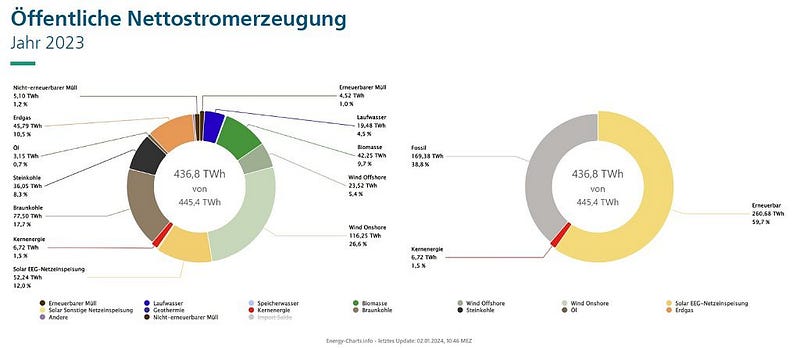
According to preliminary data from 01/03/2024, in 2023, about 261 TWh were generated from renewable energy sources (RES), and their share in net generation reached a record 59.6%.

[According to Fraunhofer ISE, “net output” is the electricity produced in a country that goes into the grid; The electricity consumption of the power plants themselves, as well as the generation of industrial enterprises consumed by these enterprises, is not taken into account].

The share of wind and solar generation in net generation was approximately 44% (and this does not take into account the consumption of solar energy by prosumers). This fact once again confirms that in large energy systems, a reliable energy supply can be ensured even with a high share of variable RES.

Since 2019, renewable energy sources have produced more electricity in Germany than fossil fuel-based power plants.

Gross coal-fired electricity generation in 2023 fell to 1959 levels of approximately 126 TWh. And coal-based electricity production fell to 1955 levels.
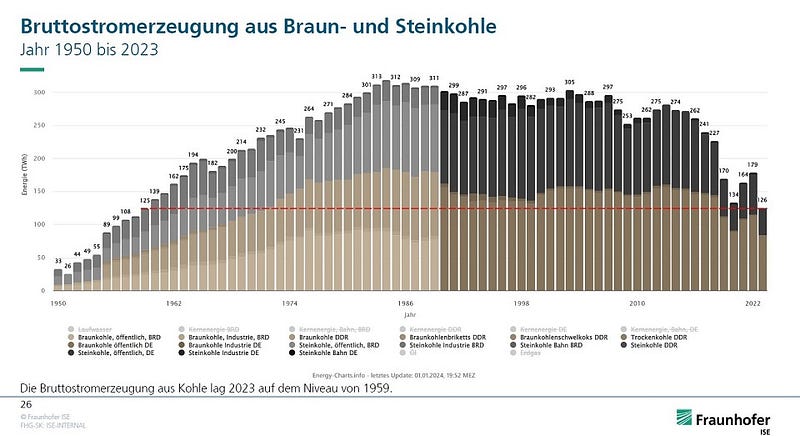
By comparison, wind farms produced about 140 TWh.

It should also be noted that the drop in output from coal-fired power plants was recorded against the backdrop of the closure of nuclear power plants in Germany.

The output of gas power plants remained virtually unchanged compared to 2022.

In 2023, for the first time since 2002, Germany became a net importer of electricity (annual imports exceeded annual exports by 11.7 TWh). This is mainly due to lower electricity prices in neighboring countries during the summer. The main volumes of imported electricity came to Germany from Denmark, followed by Norway and Sweden.

In 2023, the average wholesale electricity price for the day ahead was 92.2 euros per megawatt-hour, which is significantly lower than in 2022 (239.5 euros/MWh), and also less than in 2021 (93.5 3 euros/MWh).

Read more about the Energy & Climate Change news updates in the publication Areas & Producers.

Germany
Energy
Climate Change
Renewable Energy
Sustainability
Recommended from ReadMedium