
Einstein’s Thought Experiments and How to Apply Them to Your Life
Improve your life by running Thought experiments occasionally
The Man Who Saw the Unseen
Hey, ever heard of Albert Einstein? Silly question, right? The dude was like a rock star for science.
Sure, he gave us E=mc² and the theory of relativity, but he also mastered the art of “thought experiments.”
Not experiments in a lab but, like, in his brain! Could his way of thinking help us figure out real-life stuff, too?
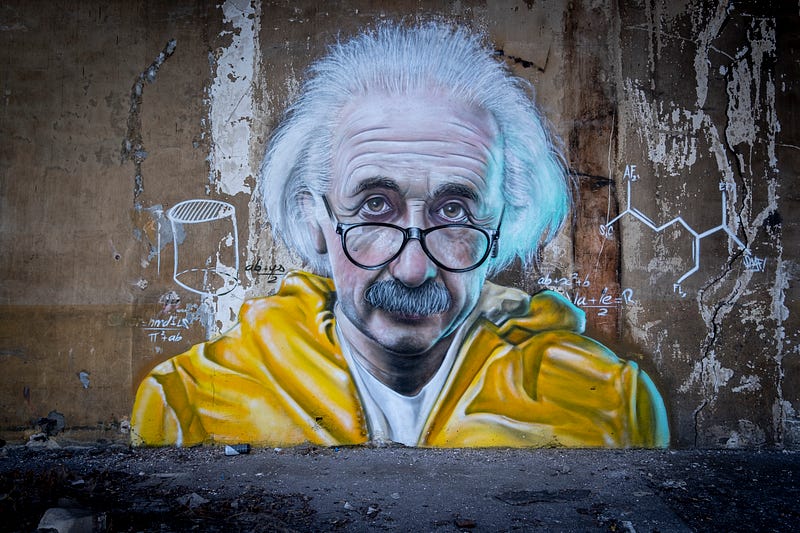
“Imagination is more important than knowledge. For knowledge is limited, whereas imagination embraces the entire world.” — Albert Einstein
The Train Ride: Making Choices That Don’t Suck
We’ve all heard of Einstein’s theory of relativity, but how did he arrive at such a mind-bending concept?
One of his thought experiments involved imagining chasing after a beam of light while sitting in a moving train.
For Einstein, this intellectual exercise helped redefine our understanding of time and space.
Don’t want to get into details of the experiment.
But let’s bring it down to our world — life choices.
Ever had to pick between two things and didn’t know what to do? Einstein felt you. His train thought experiment made him rethink time and space.
Now, imagine you’re on a train, and you’ve got two paths ahead. One’s a quick thrill but ends fast. The other is a long ride but leads to something awesome. Kinda like choosing between binge-watching Netflix and studying for exams, right?

Elevator Ups and Downs: Changing Your Viewpoint
Einstein once envisioned standing inside an accelerating elevator and pondered how it could be indistinguishable from the gravitational pull. It’s all about frame of reference.
In simpler terms, if you’re inside an elevator that’s speeding up, you’d feel heavier, just like you do due to Earth’s gravity. Einstein’s point? Whether you’re being pulled down by gravity or pushed up by an accelerating elevator, the experience can feel the same.
It’s all about how you look at a situation — your frame of reference — that can totally change your understanding of it.
What’s the life lesson here?
Perspective matters, folks! Losing a job might feel like the end of the world, but maybe it’s a new beginning, depending on how you look at it.
“A question that sometimes drives me hazy: am I or are the others crazy?” — Albert Einstein

The Twin Paradox: Your Time, Your Rules
Another riveting concept from Einstein involves the Twin Paradox, concerning two identical twins. Suppose one twin travels to space at the speed of light and returns to find the Earth-bound twin aged more.
Einstein had this wild idea about two twins and time travel.
The takeaway? Time feels different depending on what you’re doing.
An hour at a job you hate drags on, but when you’re with friends, time flies.
Learn how to manage your time better, so you make the most of it.
“Time is an illusion.” — Albert Einstein

Thought Experiments and Personal Growth
The coolest thing about thought experiments? They let you break free from the usual stuff and think about “what if” scenarios. You get to stretch your mind and see where you can improve in your own life.
“Don’t let your brain interfere with your heart.” — Albert Einstein
Thought experiments aren’t just for brainiacs. They’re for anyone willing to shake things up a bit.
Einstein used these mind games to unlock the universe’s secrets, and you can use them to unlock yours. Sound like a plan?
“Strive not to be a success, but rather to be of value.” — Albert Einstein
Conduct thought experiments and be the Einstein of your personal universe.

Cheers !


