
Eco-Friendly Gel Batteries: Are They the Future?
This water-based battery is a safe and cost-effective alternative to the Li-ion technology.
Reliable rechargeable batteries are crucial to accelerating the all-around adoption of renewable energy. Multivalent ion batteries (MIBs) are a cost-effective alternative to their Li-ion counterparts, as multivalent metals (such as Ca, Mg, and Al) are more naturally abundant than Li. Furthermore, a multivalent cation has the capacity to release more than one electron, which can increase the energy stored in the battery. However, current MIBs charge slowly, do not support many charging cycles, and become unsafe over time due to spiky microstructures that form on the anode and which can short-circuit the system.
In a multi-institutional study published on May 17, 2021, in the prestigious journal Nature Communications, scientists have come up with a universal design for aqueous MIBs that are long-life, eco-friendly, and stable and can store sufficient amounts of energy. The model developed by the researchers is made of a sulfur/carbon positive electrode, a layered Ca₀.₄MnO₂ negative electrode, and a water-based gel electrolyte, which provides the medium for the charge to flow through the battery.
An issue that can arise in MIBs is the formation of a layer on the surface of the anode that is difficult for the charges in the battery to cross. To tackle this disadvantage, the strategy used in this novel battery was to integrate sulfur in the anode. Among its many other contributions, sulfur impedes the formation in time of irregular microstructures called dendrites, which can ultimately short-circuit the cell. In fact, this anode material contributes to the creation of a very useful layer on the anode, called the solid electrolyte interphase (SEI) layer, which protects the electrode and ensures the long life, high capacity, and safety of batteries in general.
The experimental and theoretical investigations in this study have shed some light on the mechanisms that lead to the outstanding properties of this gel-based battery. As a rule, when calcium and sulfur come into contact, calcium polysulfide forms and dissolves in the water present in the electrolyte, which in turn reduces the capacity of the battery. However, the gel electrolyte contains polyvinyl alcohol, which works in synergy with a highly concentrated Ca₀.₄(NO₃)₂ solution to suppress this process.
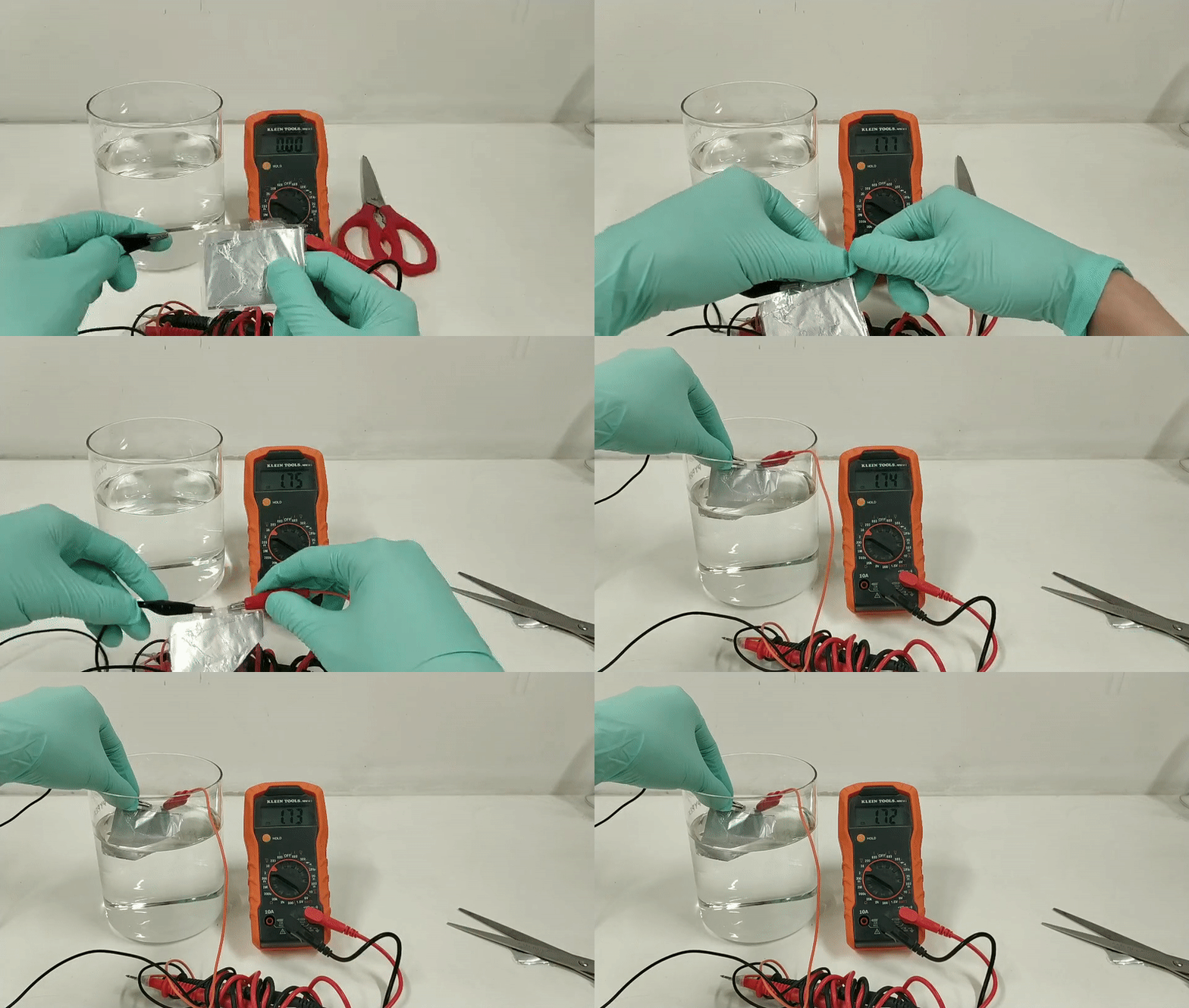
Safety has been an important concern of existing Li-ion batteries, which have been known to catch on fire. In this context, the researchers performed an experiment using a pouch version of this novel battery, to which inflicting damage as serious as cutting a corner of the cell (as seen in the animation above) does not lead to spontaneous ignition — rather surprisingly, the battery is not only stable but also maintains its voltage.
“[Their] intrinsic safety could endow [aqueous calcium-ion sulfur batteries] promising (sic!) for the applications in extreme conditions, e.g., aerospace, deepsea submarine, and other military devices,” the authors state in the original paper.
Despite its outstanding properties, the proposed battery design has its shortcomings: even higher specific energies could be harvested by using cathode materials with higher capacities, while the complex reactions happening at the electrolyte-electrode interface limit the efficiency of aqueous electrolyte batteries in general. Improvements in the compatibility of the electrolyte with the anode material could mitigate this drawback.
Although we might have to wait a while for these batteries to become mainstream, in the words of the authors, these “key findings make a revolutionary step-forward towards the development of aqueous multivalent-ion batteries for low-cost energy storage.”
Source: “A universal strategy towards high–energy aqueous multivalent–ion batteries,” by X. Tang, D. Zhou, B. Zhang, S. Wang, P. Li, H. Liu, X. Guo, P. Jaumaux, X. Gao, Y. Fu, C. Wang, C. Wang, & G. Wang, Nature Communications (2021). The article can be accessed at https://doi.org/10.1063/1.5145201.
© Gianina Buda, PhD 2021
Thank you for reading! If you wish to support me, please clap, comment, or share this article. And if you are interested in becoming a Medium member, you can use my link (I will receive a portion of your membership at no extra cost for you).
More of my work you might like:


